Paying for SEO buys work you can inspect, such as audits, fixes, pages and reports, and never a ranking. Pay for deliveries you can check, keep ownership of your own accounts, and the money has something to show for it.
This guide covers what a payment can and can’t buy, the 4 bills inside one invoice, how to compare quotes, the payment terms to write down and the monthly check that shows whether the work happened.
Is paying for SEO worth it?
Sometimes, for the parts you can’t do yourself. Google says it costs nothing to appear in its organic results, so the money goes to someone’s time and skill, not to Google.
Google’s guidance on hiring an SEO, last updated 2026-06-05, adds that a small local business can probably do much of the work itself, starting with the SEO starter guide. Paying for SEO then makes sense in 3 cases:
- You lack the hours, and the work would stall.
- The fixes are technical, such as redirects or JavaScript rendering, and need a developer’s eye.
- You are about to redesign or launch a site, when Google says hiring early gives the best result.
If none of those apply, learn the basics first, which takes a few hours. It also tells you when an agency proposes something odd. For the dollar side, the SEO price guide covers ranges, and Google SEO cost covers the time cost of doing it yourself. Here we stay with the question of what a payment buys, because paying for SEO without a clear picture of the deliverables is how most of the regret starts. A useful test is simple: after 1 month of paying for SEO, you should be able to point at something that exists now and didn’t before.
Can you pay for SEO rankings?
No. Google says it never accepts money to include or rank sites in its search results, and that advertising with Google has no effect on your site’s presence in organic results. That is 0 payments accepted for ranking.
The same page of Google’s advice warns that no one can promise a #1 ranking, and that anyone claiming a “special relationship” with Google or a “priority submit” should be avoided. A promise like that is a reason to look elsewhere. An honest seller sells effort and expertise, and says so. When you pay for SEO, the invoice is for that effort, and the result depends on the site, the competition and Google’s systems.
Two payments that look like buying rankings are worse than useless:
- Paying for links. Google’s spam policies, updated 2026-08-28, list buying or selling links for ranking purposes as link spam, including exchanging money for links. Google’s hiring advice also says you should never have to link to an SEO.
- Paying for a tool’s “approval”. Google’s page on third-party tools says these tools don’t have access to Google’s internal ranking data and can’t promise performance.
If an SEO has FTP access to your server, Google says they should be willing to explain every change they make. You are responsible for what a company you hire does, so a payment never moves the risk to them.
What are you actually paying for in SEO?
Four bills, usually folded into one invoice: labour, tools and data, content, and site build work. Splitting them shows what a quote contains and what it leaves out.
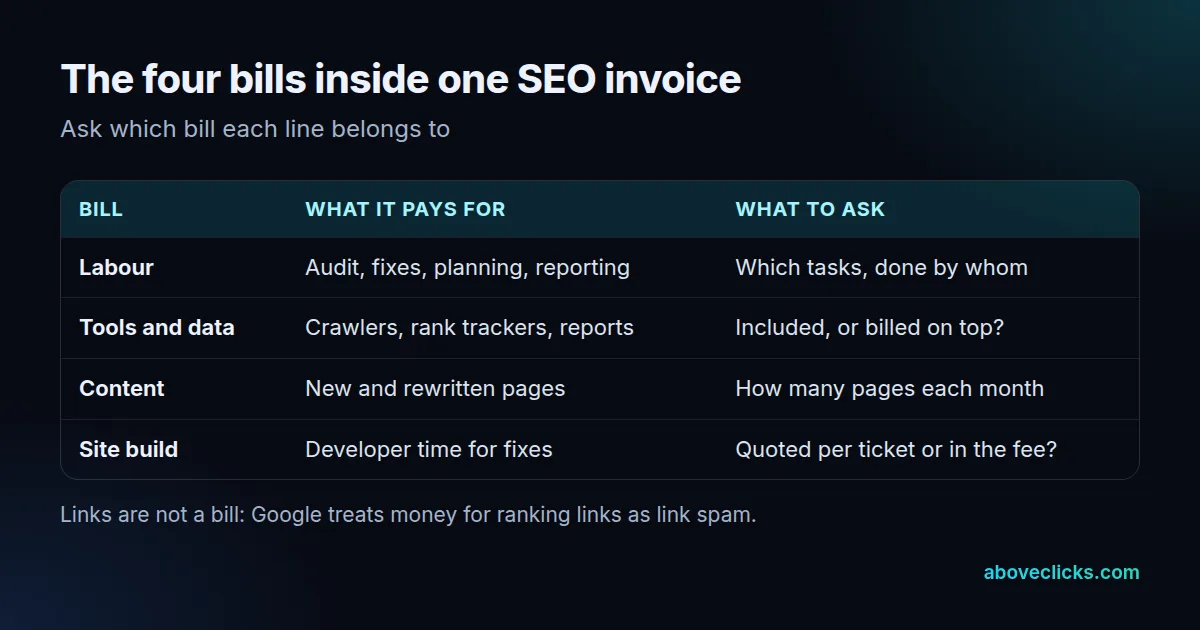
Most disputes about paying for SEO come from rows 2 and 4. A fee can include the tools but not the developer time to fix what they find, so the fixes sit in a queue for 3 weeks while the invoices keep arriving. Ask for each of the 4 in writing, even if the answer is “not included”.
The first row is where you judge the agency. Look for named tasks, not “ongoing optimization”. Our own ecommerce SEO work is laid out the same way: an audit, a fix plan, page work, then a monthly report. Whoever you hire, paying for SEO should come with that level of detail, and for the hours or the items behind each line, such as 4 pages rewritten or 2 new guides.
How should you pay for SEO?
By what you can check. A project suits a defined list of fixes, a monthly fee suits ongoing work, and a fee for results suits only outcomes you can see in your own analytics.
The marketing agency pricing models guide explains the standard billing models. Whichever you choose, compare quotes with one number:
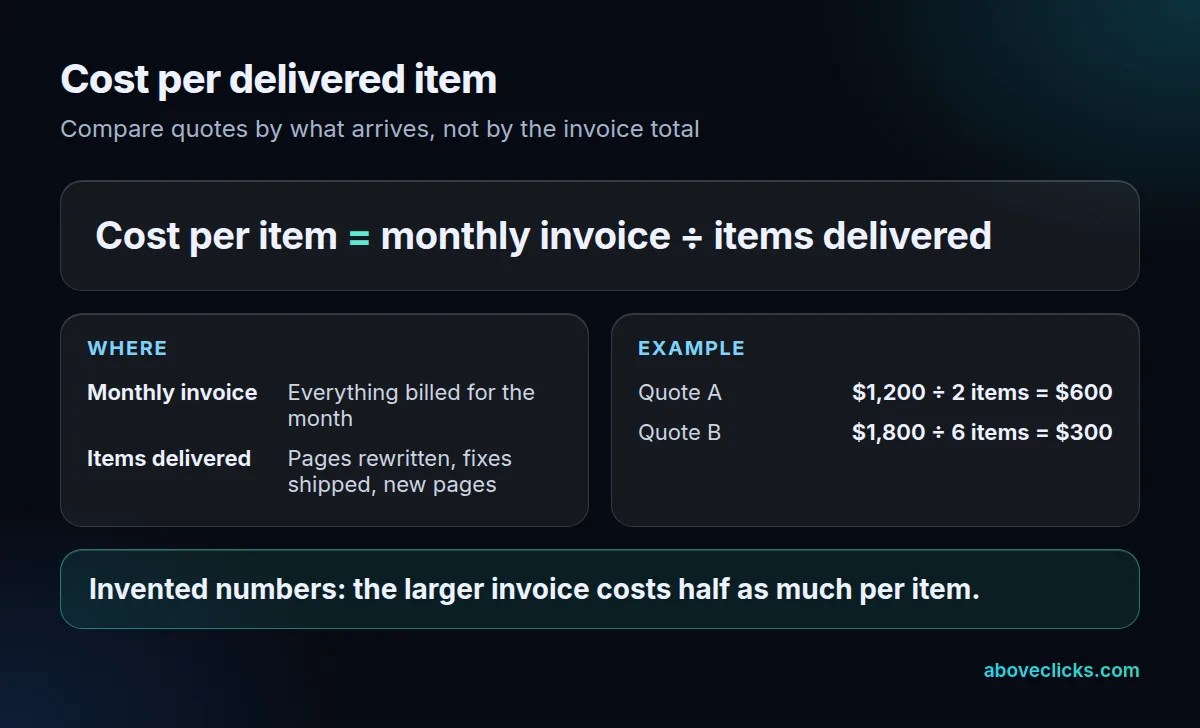
In that invented example, the larger invoice buys 6 items instead of 2, so it costs 50% less per item. Ask each seller to list the items behind the fee, divide, and compare. Paying for SEO by the item also makes it easy to say yes to a smaller scope in a slow month.
Be careful with pay for performance SEO. If the performance is a ranking, Google’s advice above says no one controls it. If it is orders or leads, the agency needs to see your analytics, and you need to agree how a sale is counted. Write both down before the first payment, because “results” is the term most often disputed.
When you pay for SEO as a one-off, such as an audit, paying upfront for a written scope is fair. For ongoing work, a notice period of 30 days or less protects you better than a long prepayment. The monthly SEO package guide covers retainers in more detail.
How long should you keep paying for SEO?
Long enough to see the work land, which Google puts at a few hours for some changes and several months for others, and not past the point where deliveries stop.
Google’s SEO starter guide, last updated 2025-12-10, says some changes take effect within a few hours, while others could take several months. So judge deliveries monthly and results in quarters when you are paying for SEO:
- Month 1: an audit and a fix list should exist, with dates.
- Months 2 to 3: the fixes on that list should be done and logged.
- Month 6: rewritten pages should show impressions and clicks against the same months a year earlier.
If month 6 arrives while you are still paying for SEO and the list, the log or the pages are missing, stop paying and ask for a written reason first. If deliveries are there but results lag, keep the fixes and ask what the next test is. For help choosing who to pay, the guide to choosing an SEO company covers the checks.
What belongs in the payment terms?
Six terms: an itemised invoice, a written scope, a notice period, ownership, access and a report. They decide what stopping costs and whether you can check the work.
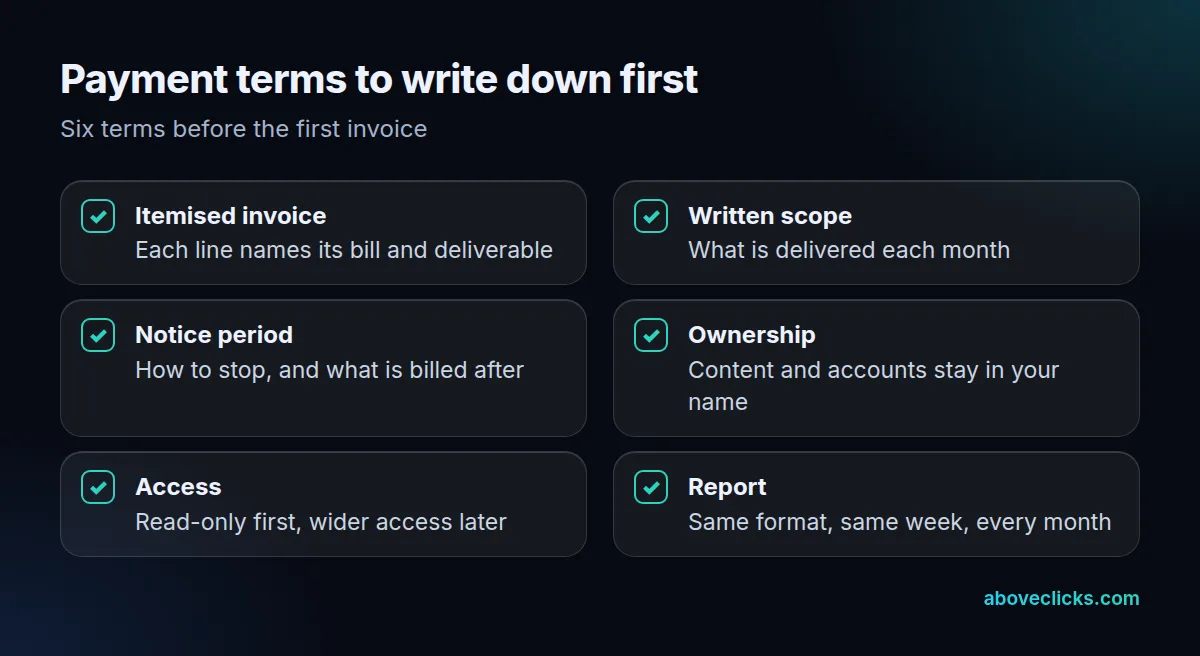
Access deserves a closer look. Google advises that if an SEO offers an audit, you grant read access to Search Console only at that stage, not write access. Keep the owner role in your own name and add the agency as a user. That way, ending the arrangement means removing 1 user, not recovering a site.
Content belongs on the list too. State that pages, briefs and images written for you are yours, even if you leave in month 2. Ask for the same for the fix log, so the next person can see what changed. Paying for SEO is easiest to stop, or to scale up, when the terms are plain. Put the 6 terms in the contract or the order form, not in an email thread that nobody can find in month 9.
How do you check what you paid for?
In your own Search Console, once a month, against the report you were sent. Google suggests checking the tool about once a month, and the account must be yours to do it.
Google’s Search Console guide starts with verifying ownership. A property must keep at least 1 verified owner, and delegated owners and users are added or removed in user management. So verify the site yourself, then give the agency access.
A monthly check takes about 15 minutes:
- Compare the clicks and impressions in the agency’s report with the Performance report.
- Open 3 pages from the fix log and confirm each change is live.
- Match each invoice line to a delivered item.
- Note anything that waited on you, such as an approval.
If the check shows that nothing in the log is live after 2 months, ask for a written explanation before the next invoice. If you believe a seller deceived you, Google’s advice points US readers to the Federal Trade Commission, which handles complaints about deceptive or unfair business practices. Keep the invoices, the scope and the fix log, because they are your evidence. Paying for SEO with a paper trail turns a vague disagreement into a list of items that were or weren’t delivered.
An example of a report built this way is our sample report. If you would rather have a second opinion before you pay anyone, our free audit reads your Search Console with read-only access. More guides are in buying guides.