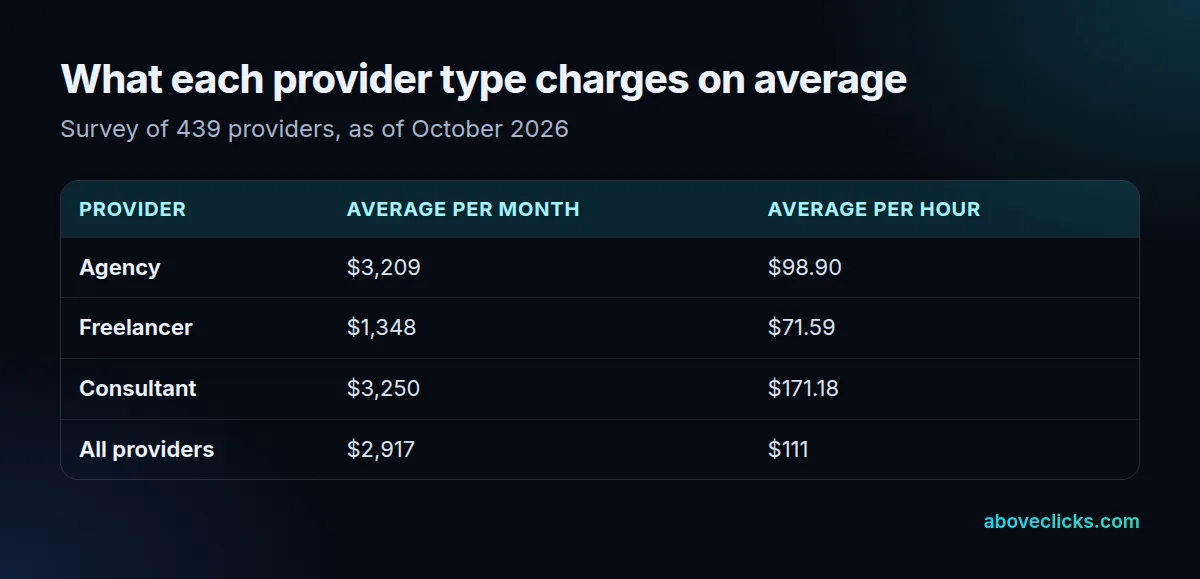
The average seo price is $2,917 a month, according to a survey of 439 providers, as of October 2026, reported in the Ahrefs survey. That average hides the number that matters: the hours of work your retainer actually buys each month. This guide to seo price turns every monthly number into hours, so you can compare quotes fairly.
A seo price only makes sense with its scope attached, and this seo price guide keeps every figure tied to its source. A $1,000 retainer from one provider and a $1,000 retainer from another can mean 6 hours of senior advice or 14 hours of freelance execution. The tables below use the survey’s own averages, as of October 2026, from the Ahrefs survey, so the arithmetic is checkable rather than a sales claim.
What is the average seo price in 2026?
The average seo price is $2,917 a month overall, with 63% of businesses spending $500 to $5,000, according to the Ahrefs survey as of October 2026. That range, not the single average, is the useful planning number.
Most businesses land in the middle of that range because the most common retainer band in the survey is $501 to $1,000 a month, and 78.2% of providers charge by monthly retainer, as of October 2026, according to the Ahrefs survey. The average sits higher than the most common band because a minority of large campaigns pull it up.
Treat the $2,917 figure as a market midpoint, not a quote for your site, as of October 2026, according to the Ahrefs survey. Use that range as your seo price planning band, not the single average. Your seo price depends on your market, your site’s state, and how much content and link work the job needs. A contained local site and a national ecommerce catalog are not the same job, even when both are called “SEO.”
How much does an SEO agency charge versus a freelancer?
Agencies average $3,209 a month and freelancers average $1,348, while consultants average $3,250, according to the Ahrefs survey as of October 2026. The gap is about team size, not just hourly rate.
An agency price buys parallel work, and that is the seo price gap between a team and a single pair of hands: technical fixes, content, and links can move in the same month because different people handle each stream. A freelancer price buys one person’s time, which suits a narrow scope with a clear brief and a single decision maker.
Consultants sit at the top of the monthly averages because they usually advise rather than execute. If your team will do the work and needs direction, a consultant’s seo price can be good value. If nobody in-house will do the work, an agency or freelancer who executes is the honest comparison.
What does a monthly SEO retainer actually buy?
A $1,000 retainer buys about 10 agency hours, 14 freelancer hours, or 6 consultant hours at survey rates, according to the Ahrefs survey as of October 2026. That hours figure is the real scope.
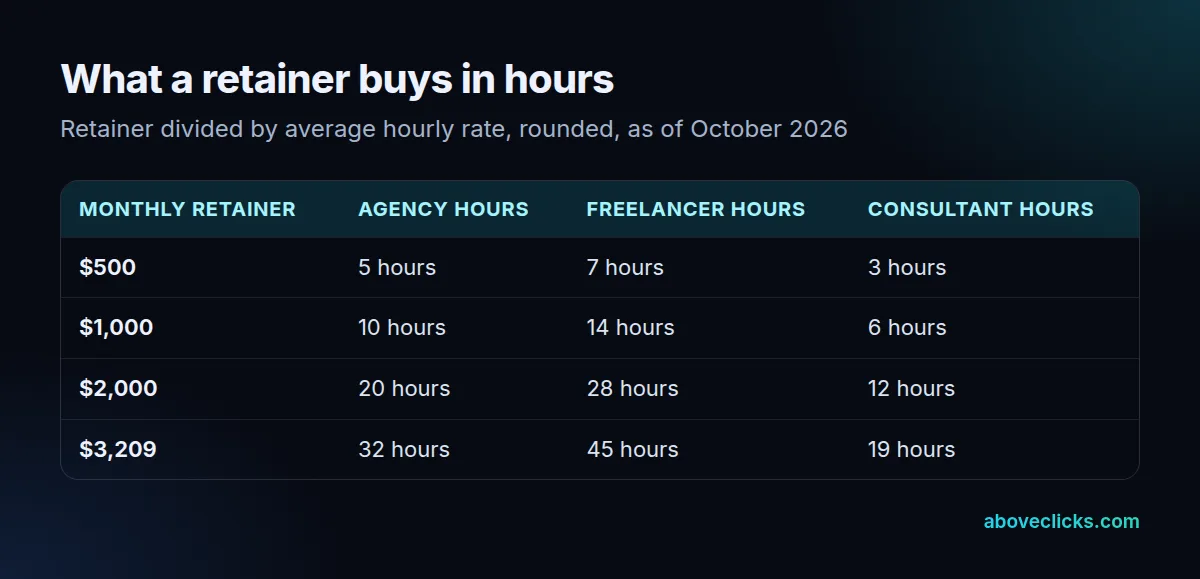
Work through the arithmetic before you sign. That hours figure is the seo price in its most honest form: Divide the monthly fee by the provider’s hourly rate, then ask what fits in those hours: a technical fix, a content piece, and a link push rarely fit together in 5 hours. A $500 retainer buys about 5 agency hours, which is why very cheap retainers usually cover reporting and little else, as of October 2026, according to the Ahrefs survey.
The hours table also explains why seo charges rise with competition. Harder keywords need more content and more authority work, and both consume hours. Doubling the budget does not halve the timeline, but it does let technical, content, and link work advance together instead of in sequence.
Is hourly, project, or retainer pricing cheaper?
No model is cheapest in general: retainers suit ongoing growth, hourly suits advice, and projects suit defined jobs, according to the Ahrefs survey as of October 2026. The cheapest model is the one that matches the job.
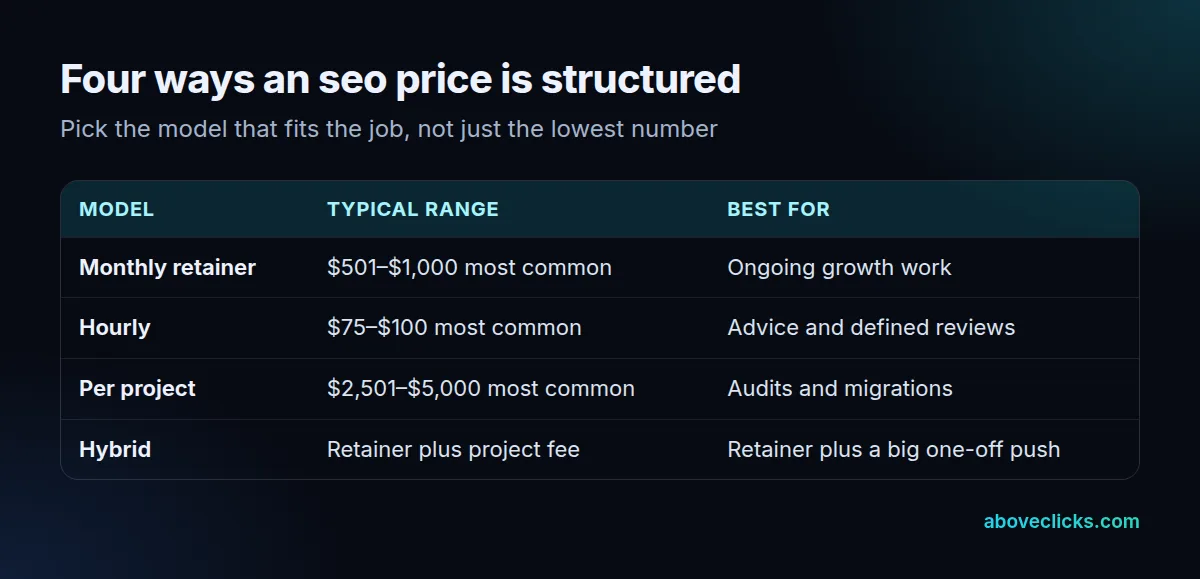
Hourly pricing averages $111 across providers, with $75 to $100 the most common band, as of October 2026, according to the Ahrefs survey. Hourly fits a second opinion, an audit review, or coaching for an in-house team. It fits ongoing work poorly, because every call becomes a billing decision.
Project pricing fits work with a finish line: a full audit, a migration, or a penalty cleanup. The most common project fee is $2,501 to $5,000, while agencies average $9,507 per project, as of October 2026, according to the Ahrefs survey. Projects work badly when you expect rankings to keep climbing after the work stops, because they do.
Why do SEO quotes for the same site differ so much?
Quotes differ because they are rarely for the same work: one includes four content pieces and active link building and another includes neither, according to the PixelChefs guide as of October 2026. Compare deliverables, not totals.
Four things move a seo price most, and published guides put the typical small-business seo price at $300 to $3,500 a month, with simple local work at the low end, as of October 2026, according to iWhale: competition in your market, the state of your site, the number of pages and locations, and the content volume. A site needing two months of remedial technical work costs more at the start than a clean site, whatever the monthly headline says.
Speed is the fifth factor, and the most misunderstood. Google’s starter guide says changes take weeks to months to show, so a quote promising fast rankings is selling something the search engine itself does not offer. Ask any provider quoting speed what extra hours, not what extra promises, the faster plan buys.
Scope checks that use official documentation catch gaps a headline total hides. Google’s Business Profile help center explains how ownership, manager access, and verification work, so a quote that lists profile work can be checked line by line against what the platform actually allows a manager to do. Search Console help covers how a site is verified and how coverage and performance reports are read, which turns vague reporting promises into named reports you can ask to see. When a provider lists structured data work, the official type definitions show exactly which fields a local business listing can carry, and that definition, not a sales description, is the scope to agree in writing.
Technical scope benefits from the same check. The search starter guide sets out how crawlable pages, descriptive titles, and clear internal links help search engines understand a site, and the web documentation for page markup explains how headings and links are structured in the underlying document.
The structured data introduction explains how eligible content is marked up, so a line item for markup work can be matched to a named content type. A quote that names those jobs specifically, rather than promising visibility in general, is easier to compare with another quote that names the same jobs. Ask each provider to map every technical line item to a page, a template, or a report, and leave any line item that cannot be mapped out of the comparison until it is explained.
What extra costs sit outside the seo price?
Tool subscriptions, content production, and one-off setup work often sit outside the retainer, and they change the real monthly total, according to the WebFX pricing page as of October 2026. Ask for each one by name.
Content is usually the largest extra. WebFX’s published content plans run $1,800, $3,600, and $6,000+ a month for 3, 6, and 10 assets, with single blog posts at $150 to $600, as of October 2026, according to its pricing page. If your retainer excludes content, that is a second budget line, not a saving.
Some costs are free and should never appear on an invoice. Creating a Business Profile and listing your business on Google is free, as of October 2026, according to Google’s Business Profile page.
Local tooling is the middle case: BrightLocal’s Track plan is $41 a month for one location, as of October 2026, according to its help page, and it scales per location. List every extra before you compare two seo plans side by side. Those extras explain why a quoted seo price and a real monthly seo price can differ by hundreds of dollars.
Reporting and advertising scope also need separate lines. Analytics help documents how accounts, properties, and access are organised, so reporting access can be agreed before work starts rather than discovered at the first report. Advertising help separates paid campaign management from organic work, which matters when a quote bundles both, because paid spend and organic effort are measured in different systems. For a store built on a hosted platform, the platform help center documents how store settings, redirects, and page structure are managed, so ecommerce technical work can be scoped without guessing which settings the provider can actually change.
How do you compare two SEO quotes fairly?
Use the same five checks on every quote: deliverables per month, hours behind the fee, exclusions, timeline, and exit terms, and cross-check the timeline point against Google’s starter guide as of October 2026.
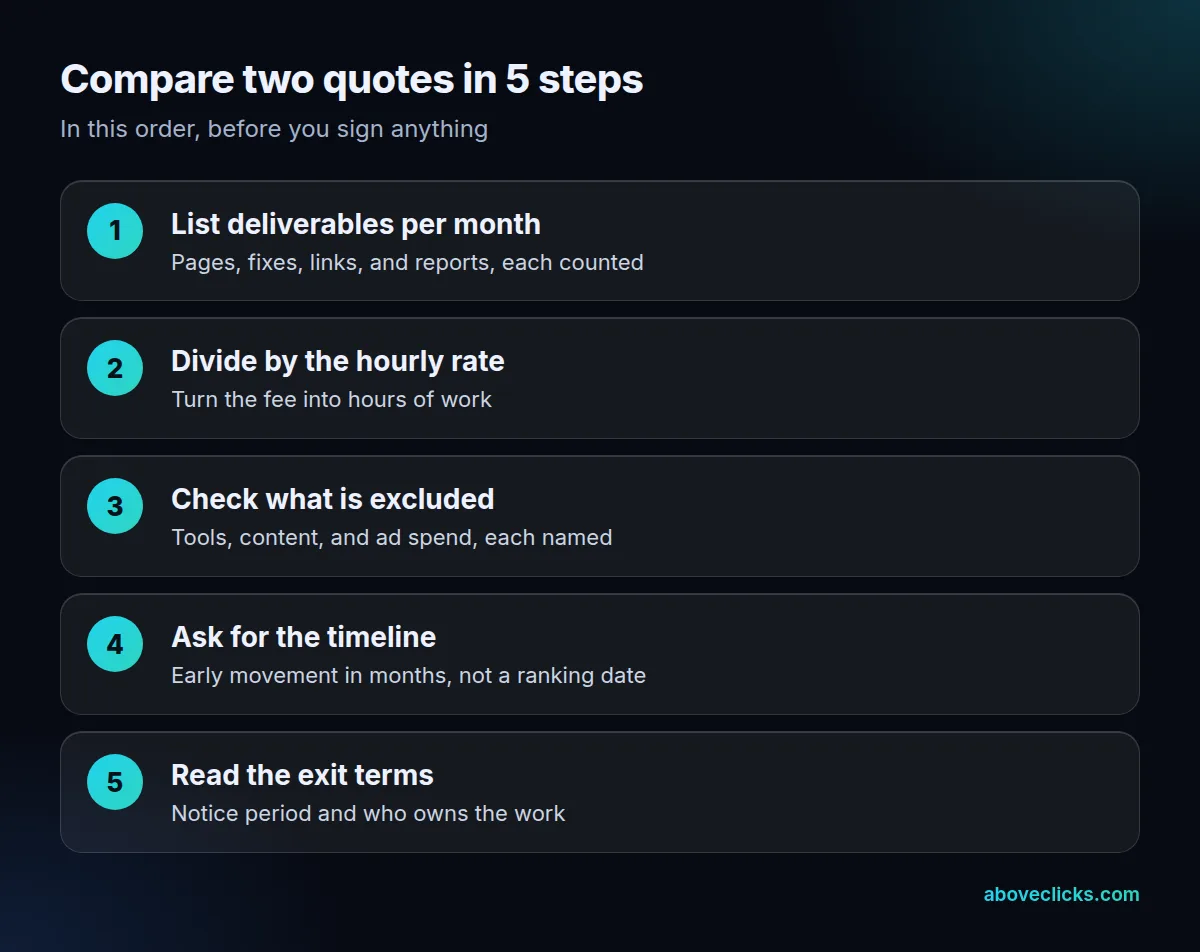
- List deliverables per month, each counted: pages, fixes, links, and reports.
- Divide the fee by the hourly rate to get hours of work.
- Check what is excluded: tools, content, and ad spend, each named.
- Ask for the timeline in months, not a ranking date.
- Read the exit terms: notice period and who owns the work.
Cross-checking scope across search engines avoids a single-platform blind spot. Bing Webmaster documentation covers site verification and sitemap submission for that search engine, so a provider who only reports one search engine can be asked what the other one shows. Business help for the major social platforms documents how business accounts and advertising accounts are structured, which helps separate account setup work from ongoing content work in a quote.
Google’s Business Profile product page is a useful cross-check here, because it confirms the listing itself is free, so any line item that charges for the listing alone stands out at once. Those checks do not change the survey averages above; they change whether a quote’s line items can be verified at all.
Use this seo price checklist on every quote you receive. Before we price any engagement, we scope it first: site size, category count, technical state, and content need, in that order. That scoping step is how a seo price stops being a guess and becomes a plan with hours attached. To see how that scoping would read for your site, start with the ecommerce SEO service page, or ask for a free audit of the setup you have today. More guides are in general.