A real estate listing marketing plan is a dated checklist for selling one property: what to prepare, publish and advertise each week, what it costs and what to check before changing anything. Judge it by those checks, not by how many channels it lists.
This guide gives a six-week plan for a single listing, a budget sized to one property, the advertising rules that apply to housing and a weekly review you can run in ten minutes. It is built for one house, not for your whole year.
What is a real estate listing marketing plan?
A plan for one property, from the week before launch to the day the seller decides what happens next. It is narrower than a yearly agent plan, which sets income goals and lead sources for the whole business.
If you need the yearly version first, read our guide to a real estate marketing plan and the filled-in sample real estate marketing plan. Those cover goals, channels and budgets across a year. A real estate listing marketing plan sits underneath them and answers a smaller question: what do we do for this house, this week? The plan here runs 6 weeks, with 2 reviews, at day 14 and day 28.
Every listing differs, so the plan has to be short enough to repeat. A real estate property marketing plan that takes a day to rewrite for each home will be skipped on the busy weeks.
What goes in a real estate listing marketing plan template?
Six blocks: the property facts, the target buyer, the assets, the channels, the budget cap and the review dates. Anything beyond that tends to be copied from a template and never used.
A real estate listing marketing plan template needs only these fields:
- Property facts: address, asking amount, three real selling points, and anything a buyer will ask about (age of the roof, parking, school zone).
- Target buyer: one sentence, such as “a family moving for a job who searches online in the evening”. Say who the home is for, and write the listing for that person.
- Assets: photos, a floor plan, a short walkthrough video and a listing page with one phone number and one form.
- Channels: the portal listing, your own page, email to your list, a few ads and the sign.
- Budget cap: one number for the whole listing, and who approves spending above it.
- Review dates: day 14, day 28 and the final seller report.
Keep the real estate listing marketing plan template to one page. The point is that someone else could run the listing from it if you were out for a week.
How do you market a house for sale, week by week?
Prepare in week 0, launch everywhere in week 1, review views against requests at day 14, change one thing and review at day 28, then report to the seller in week 6.
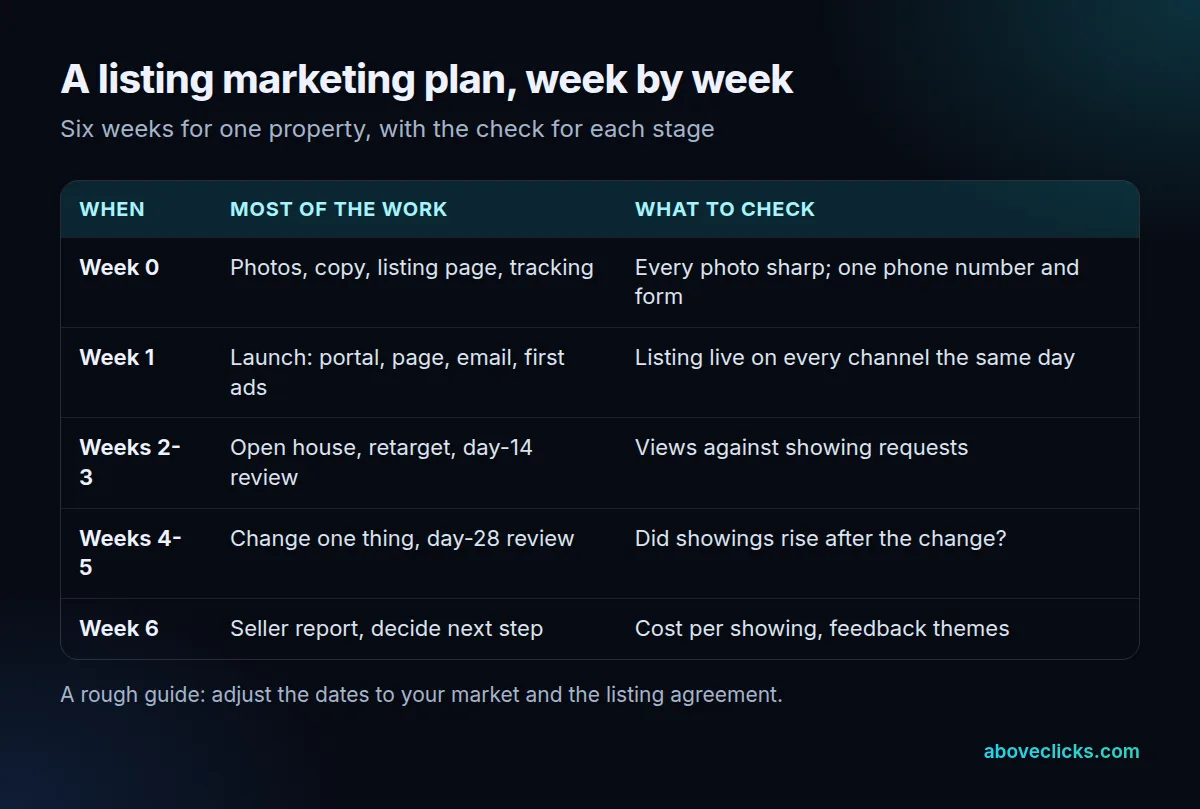
The value of this order is that a real estate listing marketing plan stops being a list of ideas and becomes a sequence with decisions in it. That is how to market a house for sale without guessing.
Week 0: build the assets before anything goes live. Photos are the base of the plan, because the portal, the ads and the emails all show the same pictures. Google says that high-quality photos appeal to users more than blurry ones, and recommends descriptive filenames and alt text, so name each file for the room it shows. Set up the listing page and test the phone number and the form yourself.
Week 1: launch on one day. Publish the portal listing, the page and the first email together, and start the ads the same day. A listing that appears in three places across a week looks stale in two of them.
Weeks 2 and 3: run the open house and review at day 14. Compare listing views with showing requests. In this real estate listing marketing plan, many views and few requests point to the photos or the asking amount; few views point to reach.
Weeks 4 and 5: change one thing. Change the photos, the headline, the asking amount or the audience, but only one, so you can see what moved the numbers. Review again at day 28.
Week 6: report and decide. A real estate property marketing plan ends with a decision, not a pause. Send the seller the numbers, the repeated feedback from showings and a recommendation: continue, adjust or relaunch.
How do you advertise a property for sale online?
With a listing page, a portal listing, a small set of ads and a follow-up email, while following the special rules that apply to housing ads on Meta and Google.
Housing is a restricted category. On Meta, ads about housing must be placed in a Special Ad Category, and for advertisers in the United States and Canada several audience options are limited or unavailable: age, gender, ZIP or postal code, exclusion targeting, lookalike audiences and saved audiences. Audiences based on a city or a dropped pin also get an expanded radius.
Google applies similar limits. Under its personalized advertising policy, age, gender, marital status and parental status cannot be used to target Housing ads in the United States and Canada, and ZIP code location targeting cannot be used. Check both policies again before each launch, because they change.
In practice, a real estate listing marketing plan should lean on what is still allowed:
- Location radius around the property, keeping in mind that Meta widens it for housing ads.
- Creative that does the targeting: a photo of the kitchen, a headline naming the neighborhood.
- Search ads on the property’s area and type for people already looking. Our guides to Facebook ads for realtors and Google ads for realtors go into the set-up.
- A listing page that is easy to read, with the date shown. Schema.org’s RealEstateListing type has a datePosted property for the publication date of an online listing, so ask your web team to use it.
For the follow-up email after an open house, the FTC’s CAN-SPAM guide requires a valid physical postal address and a clear way to opt out, and says you must honor opt-out requests within 10 business days.
How much does it cost to market one listing?
It depends on the property and your market, so set a cap per listing and divide it. Photos usually take the largest share, because everything else reuses them.
The budget is the part of any real estate listing marketing plan that owners ask about first. We don’t publish market ranges here; they move too fast to stay true. Instead, here is how a cap can be split. This is a worked example with an invented listing and a $1,200 budget, not a rate.
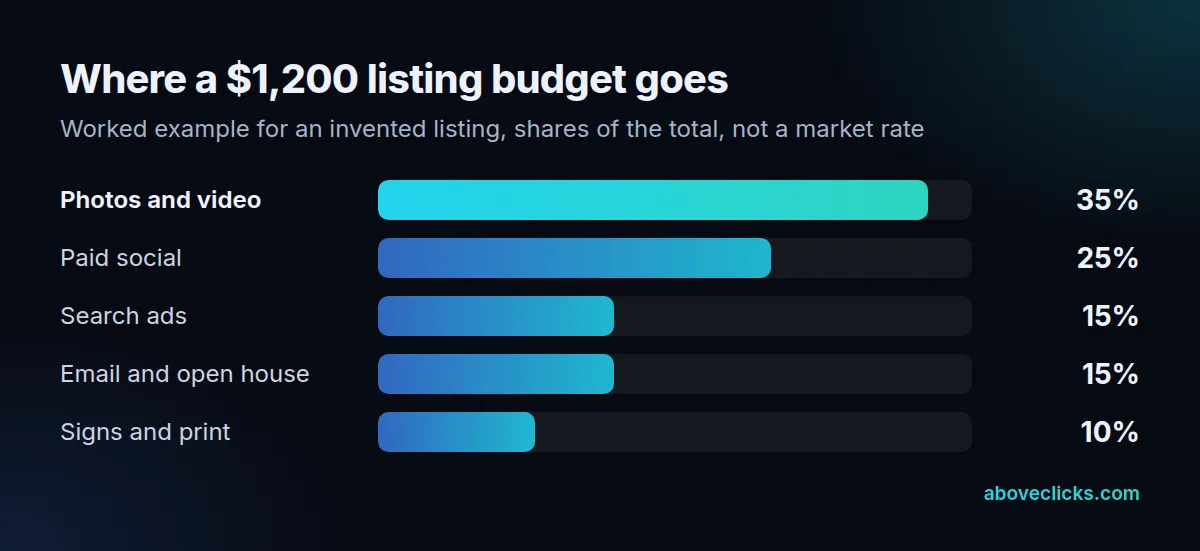
In the example, $420 goes to photos and video, $300 to paid social, $180 to search ads, $180 to email and the open house, and $120 to signs and print. The paid ads total $480 over four weeks.
The number to watch is cost per showing:
Cost per showing = paid spend ÷ showings booked from the ads
Example: the ads bring 12 leads, and 4 of them book a showing. $480 ÷ 4 = $120 per showing. If the same ads brought only 1 showing, the cost per showing would be $480, which is the signal to change the creative or the page, not to raise the budget.
If you hire help, our real estate marketing service starts with a one-off setup from $400 and monthly management from $450 plus ad spend, as of November 2026. It includes a weekly report with leads, qualified leads, site visits and cost per site visit. The industry page shows how that works across developers, brokers and rentals.
How do you know if the listing plan is working?
By checking the same few numbers every week: views, showing requests, reply time, repeated feedback and spend against the cap. A rise in views with no rise in requests means the problem is the offer, not the reach.
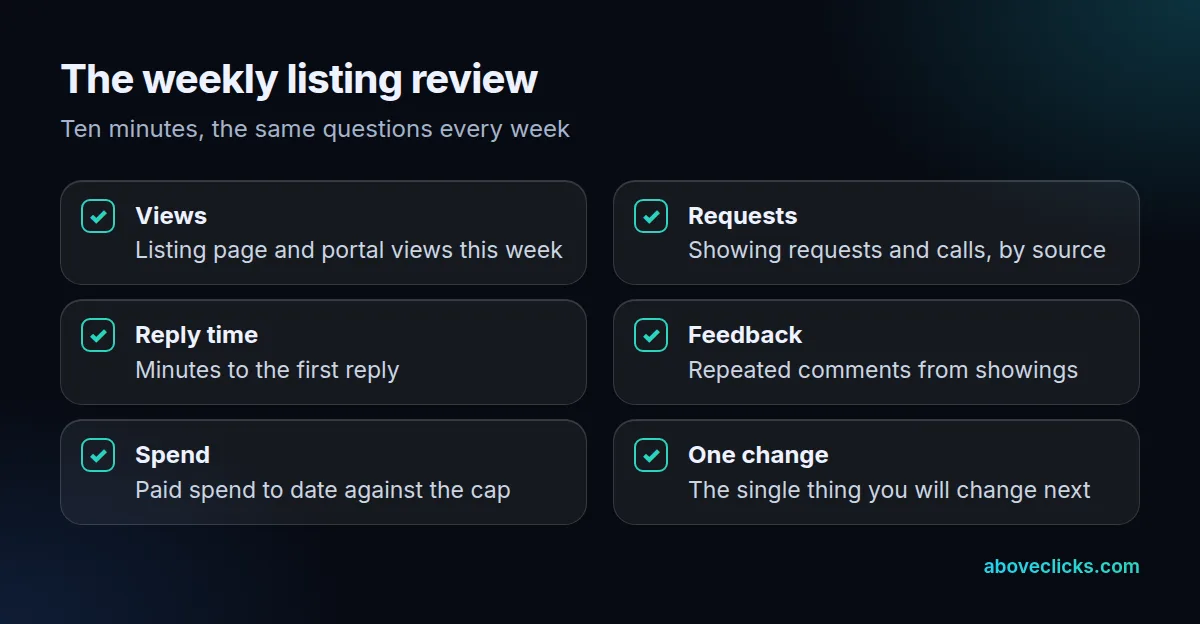
Use two simple rules at the reviews:
- Day 14: if views are healthy but showing requests are few, change the photos or the headline first. If views themselves are low, widen the radius or add a second ad.
- Day 28: if showings happened but offers did not, look at the repeated feedback. When three buyers raise the same point, such as the asking amount or the condition of a room, talk to the seller about it before spending anything more.
Reply time deserves its own line. In any real estate listing marketing plan, a request that waits a day for an answer often goes to the next listing, and no ad budget fixes that. Track the minutes to your first reply, and ask for a free marketing audit if you want a second pair of eyes on the numbers.
What should the seller see in the plan?
A one-page real estate property marketing plan: the dates, the budget cap, what you will do each week and the numbers you will report. Sellers want to know what is happening and why, not to read your whole template.
Share the plan before launch and the report each Friday or at least at day 14 and day 28. Show views, showing requests, feedback themes and spend, and always end with the single change you will make next. That makes a real estate listing marketing plan something the seller can hold you to, and it makes the talk about the asking amount at day 28 easier because the evidence is already on the table.
Keep the seller’s own limits in the real estate listing marketing plan too. Some sellers don’t want a sign, an open house or ads that show the street. Write those choices down at the start so the plan reflects them. More guides for this field are in industries.