Triple Whale pricing depends on your brand’s annual gross merchandise value (GMV) and the package you pick, and its pricing page shows no dollar figures. So the first job is to understand how the price is built, then test whether the data justifies a long term.
This guide covers how Triple Whale pricing works as of October 2026 (source: the vendor’s pricing page), what the free plan and the three paid plans include, and a short cost check to run before you sign. Our other Triple Whale guides compare it with Hyros and with alternatives; this one stays on cost. For the wider picture, see our measurement guides.
How much does Triple Whale cost?
How much Triple Whale costs depends on your annual GMV and the plan, and the vendor does not publish a price. According to Triple Whale’s pricing page, as of October 2026, all prices are based on a combination of your brand’s annual GMV and the package you choose.
That means Triple Whale pricing differs by store: two stores on the same plan can pay different amounts. The page also says every paid plan includes unlimited users and connects as many stores as you need, so adding a colleague or a second store does not raise the price by itself.
Two other rules shape Triple Whale pricing over a year:
- Term: Foundation, Automate and Enterprise are 12-month subscriptions. You pick monthly billing, or annual billing with two months free.
- Growth: as your revenue grows, you move to the plan for your new revenue tier. If you prepay for a year, you lock in your tier for that year.
Because Triple Whale pricing has no list price, any dollar figure you see on a review site is a snapshot that may be stale. Get the quote in writing and ask which GMV band it is based on. Our guide to Triple Whale vs Hyros shows how a quoted price compares with a published one, and the alternatives guide covers what else to price.
Is Triple Whale free?
Partly. The free end of Triple Whale pricing is 1 plan with no commitment, and it covers the single business view, first and last click attribution and the Triple Pixel for tracking, according to the pricing page as of October 2026.
The free plan is enough to see whether the pixel’s order numbers match your store. Connect it, let it collect for 2 weeks, then compare the order count and revenue with your Shopify orders for the same 14 days.
That costs nothing and tells you more than a demo does. It stops short of multi-touch attribution, which starts at Foundation.
Treat it as a trial of the data, not of the whole product, because the dashboards, the SQL editor and customer segments sit in the paid plans. The vendor says most brands are set up in 15 minutes with no engineer, so there is little reason to commit to a paid term before you have run this test.
Write down the result in two lines: the order count the tool reported, and the count Shopify reported for the same dates. A gap of a few orders can come from refunds or timing; a gap of dozens points to a tracking problem that no plan will fix, and it is better to find it while the cost of Triple Whale pricing is still zero.
What do the Triple Whale plans include?
Four packages make up the Triple Whale plans: Free, Foundation, Automate and Enterprise, each adding to the one before. The table below shows what each plan adds, based on the vendor’s own list.
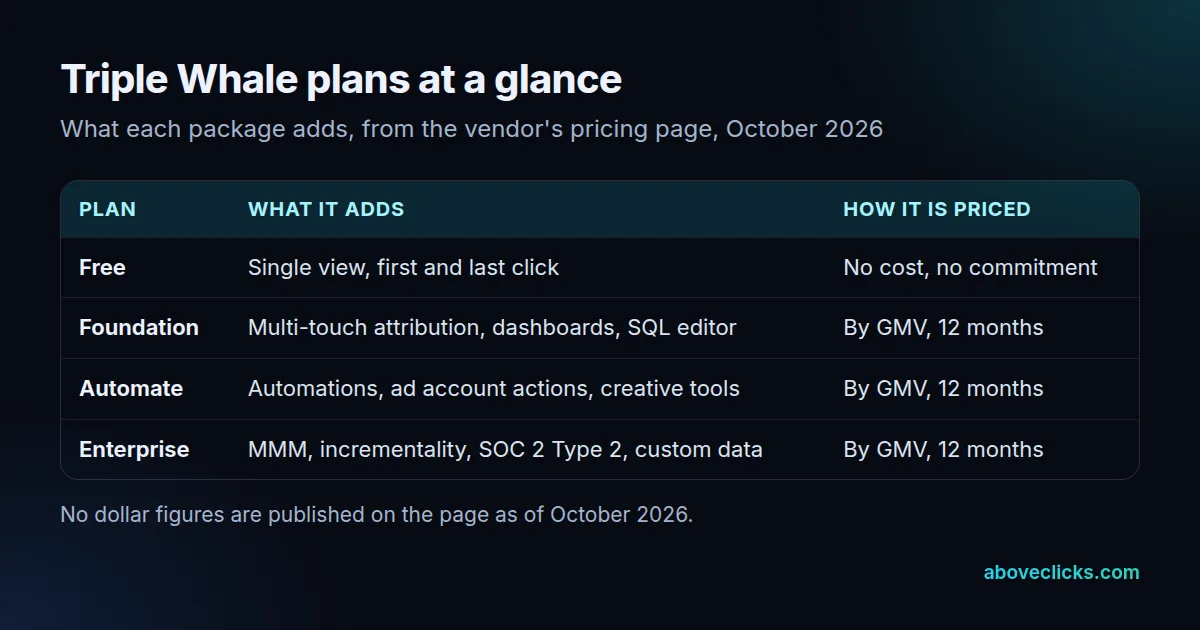
Foundation is the first paid step in Triple Whale pricing. It adds multi-touch attribution, no-code dashboards, customer segments, a SQL editor and the AI assistant Moby. Automate adds scheduled automations, actions in your ad accounts and creative tools. Enterprise adds marketing mix modelling, incrementality tests, SOC 2 Type 2 and custom data connections.
The page also lists add-ons that change Triple Whale pricing, such as Retention, Conversion, Compass and Data Warehouse Sync. Some are included on Automate or Enterprise and some are quoted separately, so ask which of them your plan already covers. A dedicated customer success manager is listed for brands with GMV of $10M or more, so smaller stores should ask what support they get instead.
Is Triple Whale worth it?
It is worth it if you will act on the extra data every week and the numbers match your orders. The paid plans run for 12 months according to the pricing page as of October 2026, so a tool nobody opens is paid for 12 times.
Start with what you already have for free, because Triple Whale pricing only makes sense against it. Shopify’s marketing reports offer 4 attribution models: last non-direct click, first click, any click and linear. Any click credits every channel in full, so it can report more credit than orders. If a free model already answers your questions, paying for another is hard to justify.
Triple Whale pricing is easiest to justify when you run several ad channels and need one view of orders, spend and customers, and when you will use features like dashboards and segments. Our ecommerce attribution work starts from that question, not from a tool.
Three costly mistakes show up most often:
- Buying on a demo without matching the numbers to your own orders.
- Ignoring the 12-month term, then paying for months nobody opens the dashboard.
- Forgetting that your GMV band, and so your Triple Whale pricing, moves as you grow.
A fourth mistake is comparing plans by feature count alone. Triple Whale pricing rises with your revenue, so a feature you use rarely costs more each year as the store grows. List the three reports your team would open every week, then check which plan carries them. If a cheaper plan holds all three, the extra features are a nice-to-have, not a reason to move up.
Is Triple Whale better than Google Analytics?
Neither is better in general; they answer different questions, and the right one depends on how many channels you run. Google Analytics 4 is free and offers 3 attribution models in its Attribution reports: data-driven attribution, paid and organic last click, and Google paid channels last click.
Google also defines touchpoints as the steps along a user’s path that credit can be assigned to, and it excludes direct visits from credit unless the whole path was direct.
Compare that with the 4 Shopify models and you already have 7 model definitions to reconcile before a paid tool adds its own. Triple Whale adds its own pixel, which is what its pricing pays for, a store-wide view of ads, email and orders, and the AI assistant. Run GA4 and the tool side by side for 14 days and compare their order counts. GA4 is the better first step if your tracking is not yet reliable, because a paid tool built on broken events inherits the same gaps. A GA4 audit finds those gaps first.
Server-side events matter here too. Meta’s Conversions API sends events from your server to Meta, and Meta’s deduplication guide explains how to avoid counting the same event twice when the browser Pixel also sends it. Whichever tool you choose, and whatever its pricing, ask how it handles duplicates, because they inflate reported results.
How do you check the real cost before you sign?
Work through the five steps below. As of October 2026 the pricing page lists no price, so these steps turn a quote into a 12-month figure you can compare against the value.
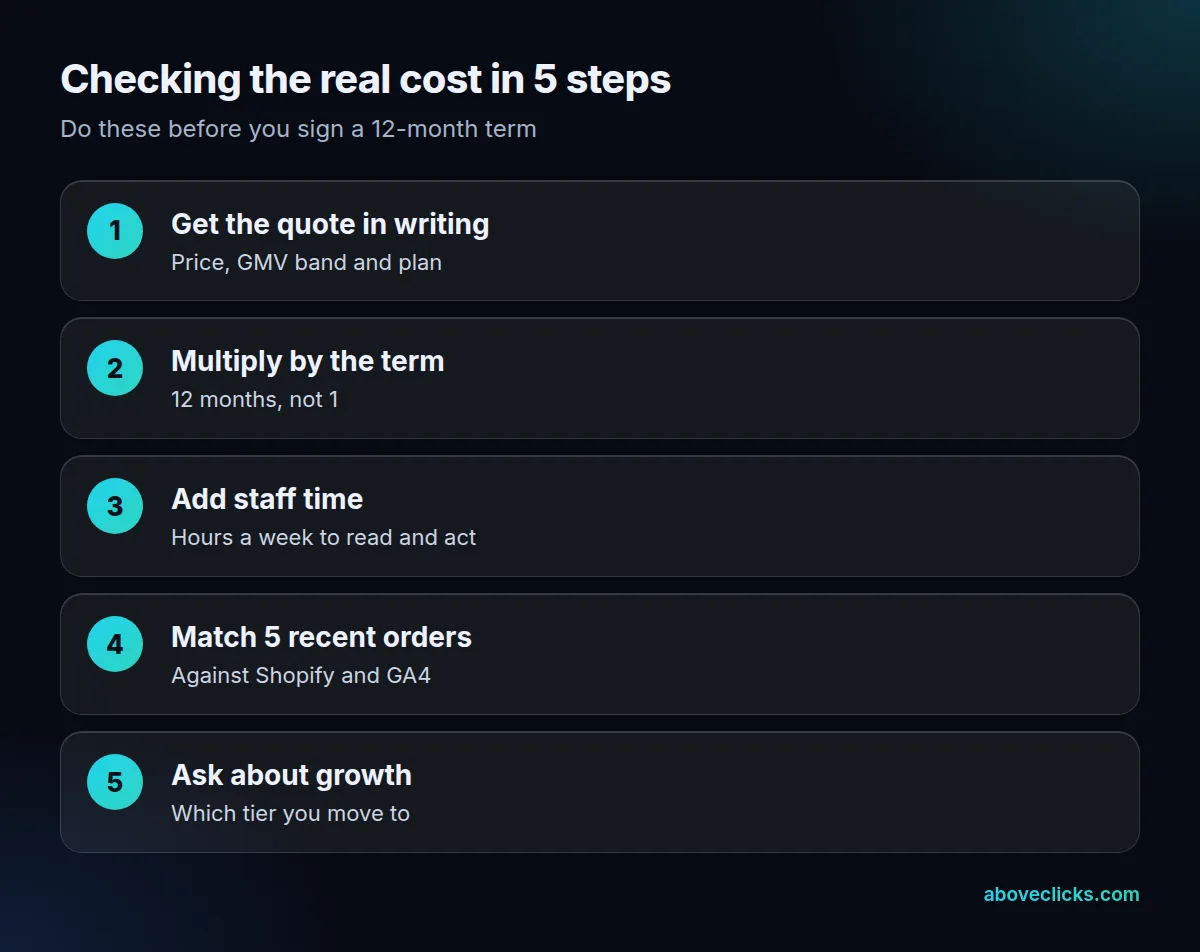
The order test is the one most people skip. Pick 5 recent orders and look each one up in Shopify, in GA4 and in the tool.
Take a worked example: a customer clicks a Meta ad, then a Google ad, then an email, then buys a $120 product.
Shopify’s last non-direct click gives the email the full $120. First click gives it to the Meta ad. Linear gives each click $40.
A tool that credits the order three different ways is not wrong; it uses a different rule. You need to know which rule it uses and whether your team agrees with it.
If the tool’s total revenue matches Shopify and the channel split looks reasonable, the data passes. If its order count is far from the store’s, ask why before you pay for 12 months.
Log the 5 orders in a small sheet with one row per order and one column each for Shopify, GA4 and the tool; 5 rows are enough to spot a rule difference, and 20 rows show how often it happens.
Now add the cost. Take an invented example of how to price the Triple Whale plans: a quote of $X a month, a 12-month term and 3 hours a week of staff time at $Y an hour. The year costs 12 times $X, plus 156 hours times $Y.
Put your own numbers in and compare the total with the ad spend the tool helps you manage; if the total is a large share of what you can realistically save, the tool is expensive for you, whatever the plan is called. Also ask whether the quote changes at renewal, because a price set for this year’s revenue band may not hold once the store is larger.
What belongs in a Triple Whale pricing quote?
Then put the key terms of the Triple Whale pricing quote in writing, using the list below.
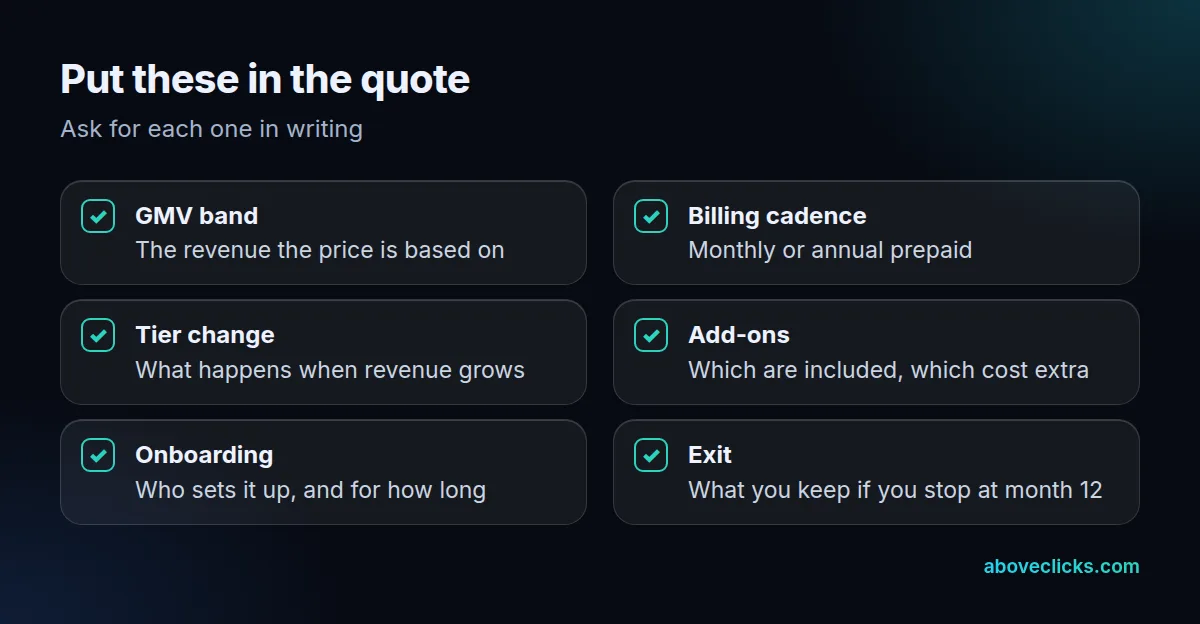
For staff time, count the hours a week you will spend reading and acting on reports. A paid plan you open once a month gives little back, whatever Triple Whale pricing you negotiate. If your tracking has gaps, our tracking and analytics team can audit the setup first, and the free audit is a no-cost first look.