SEO vs paid ads is a choice between earning clicks slowly and buying them quickly. Decide it search term by search term, using four tests, rather than picking one channel for the whole business.
This guide explains how SEO vs paid ads differ, how long each takes, what 18 months of both can look like in a worked example, and how to read both in one report. It treats paid ads as paid search ads, where a store pays for a click on a search result. For the Google Ads mechanics, such as the auction and budgets, see our guide to SEO vs AdWords.
What is the difference in SEO vs paid ads?
Who gets paid, and when visits start. With SEO you improve pages so they can show in the free results; with paid ads you pay for each visit, and the visits end when the budget does.
Google says in its guide to how Search works, as of November 2026, that it doesn’t accept payment to crawl a site more often or rank it higher. Its help article on paid and organic results adds that investment in paid search has no impact on organic ranking.
Two things follow. You can’t buy your way up the free results, so SEO costs work rather than clicks. And you can test a search term with ads without changing how your pages rank. That article also notes that its combined report counts text ads only, so Shopping ads sit outside it.
In practice, SEO vs paid ads is a question about where your next 40 product pages or your next $1,000 of budget should go. Take a store with 40 product pages. It might buy clicks on 8 of those pages’ search terms to test demand, and earn the other 32 with page work. Whether to pick SEO or paid ads for a given term is what the four tests below settle.
How long does SEO take compared with paid ads?
On timing, SEO vs paid ads is a gap of weeks to months: ads can start as soon as a campaign is live, while SEO takes longer. Google’s SEO starter guide says some changes take effect in a few hours and others several months, and suggests waiting a few weeks before judging a change.
The slow part is partly Google’s side. After you change or add a page, crawling can take anywhere from a few days to a few weeks, and the page still has to earn a position.
Ads skip that wait, because the first clicks don’t depend on crawling or ranking. That is why ads suit a launch, a sale or a test, and why SEO suits terms you will want for years. It also means the two are judged on different clocks: a week of ads is a fair test, while a week of SEO is not.
Here is the timing in a simple case. A store has a sale in 6 weeks. A new guide published today may take a few weeks just to be crawled, and it still has to rank, so most of the sale could pass before it earns a visit. Ads for the same term can show on day 1. In SEO vs paid ads decisions with a deadline, the deadline decides.
How do SEO vs paid ads costs compare over 18 months?
Ads win the first months, SEO can win the long run, and the crossover depends on your numbers. A worked example shows the shape of SEO vs paid ads over a year and a half. Every figure below is invented, not a market benchmark.
Take a store with an $80 average order and a 40% margin. Each order earns $32, so break-even ROAS is 1 ÷ 0.4 = 2.5. Suppose each side costs $1,500 each month, including the work, so each spends $27,000 over 18 months.
- Ads: the $1,500 buys 60 orders at $25 each, from month 1. That’s a ROAS of 80 ÷ 25 = 3.2, above break-even.
- SEO: 0 orders in months 1 to 3, then 20 each month in months 4 to 6, 50 in months 7 to 9, 80 in months 10 to 12, and 110 from month 13.

By month 12 ads have brought 720 orders and SEO 450. SEO catches up in month 18, with 1,110 orders against 1,080, and an order costing $24 against $25. If the example’s SEO pages keep their traffic after month 18 while ad orders stop when the budget stops, the gap widens.
The lesson from the table is about shape, not the numbers. In SEO vs paid ads, the first 6 months favor ads: 360 orders against 60. A store that judges both channels at month 3 will always back ads, and a store that judges at month 18 may back SEO. Pick the date you will judge on before you start, and write it down.
Real accounts differ in both directions. Ad costs usually rise as you add budget, and SEO may never reach 110 orders. So rebuild the table with your own margin and order value, and use our guides to PPC pricing and SEO pricing for how fees are structured.
Is SEO better than paid ads?
Neither wins in general; each wins on some search terms. Run four tests on every term before you choose between SEO or paid ads.
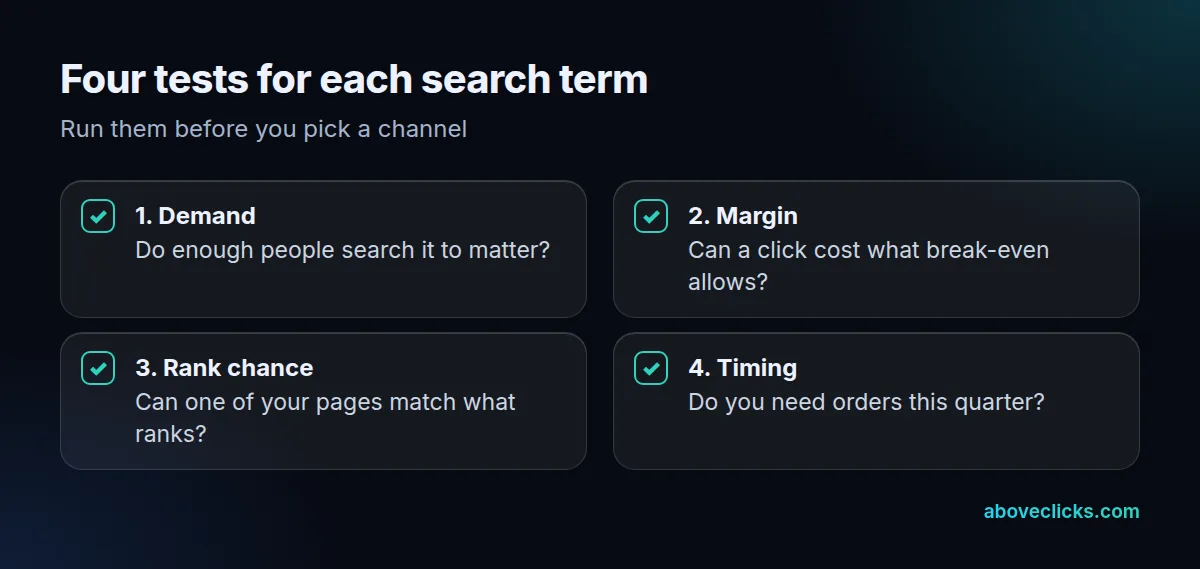
- Demand: do enough people search it? Check the volume in a keyword tool, and in Search Console for terms you already show for. A term with 10 searches a month is a poor ads test and a poor SEO target.
- Margin: can a click cost what break-even allows? At a 40% margin and a 2.5 break-even ROAS, an $80 order can afford about $32 of ad spend. If clicks for the term cost more than that per order, SEO or a different term fits better.
- Rank chance: can one of your pages match what already ranks for the term? Search it and read the first 5 results. If they are all guides and you sell products, you need a guide.
- Timing: do you need orders this quarter? If yes, buy them. If the term matters for the next 2 years, start earning it now.
A term that passes all four tests, such as a product you sell well with steady demand, belongs in both channels. A term that fails test 2 but passes test 3 is an SEO term. A term that fails test 3 but passes test 2 is an ads term.
Which should you start with: SEO or paid ads?
Start with the channel that fits your situation, then test it. The table is our rule of thumb for four common cases of SEO or paid ads.
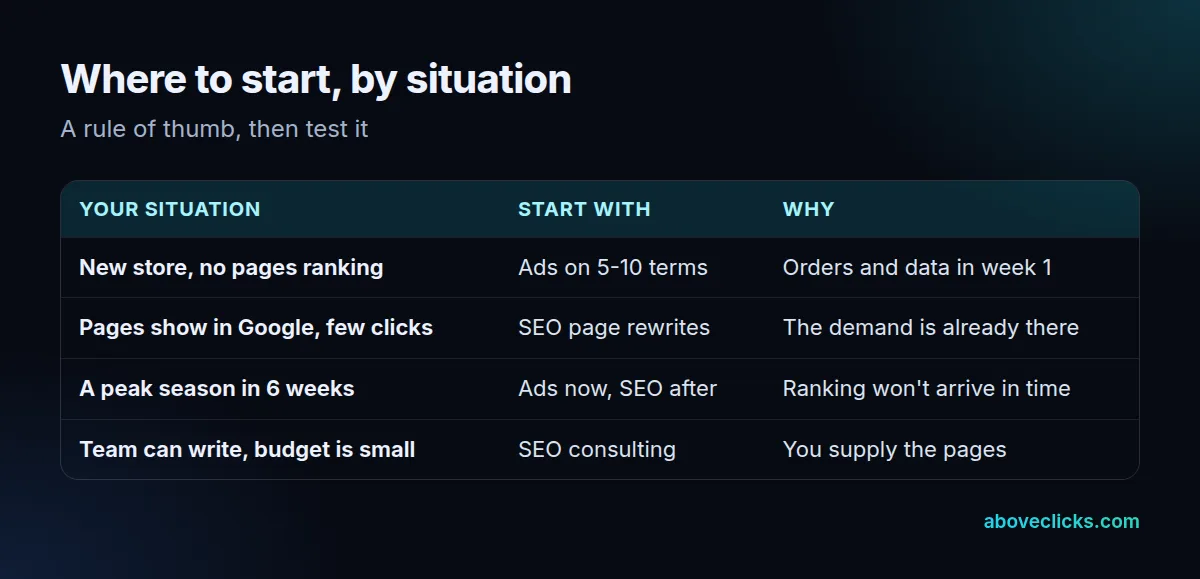
In this SEO vs paid ads choice, a new store has no pages ranking, so ads give orders and search-term data in the first week. A store whose pages already appear in Google but get few clicks should rewrite those pages first, because the demand is already there.
A peak season 6 weeks away is too close for SEO, given the weeks-to-months timing above, so buy the peak and start SEO for the next one. If your team can write but the budget is small, SEO consulting puts the plan and review with a specialist while your team supplies the pages.
Don’t wait for one channel to finish before starting the other. Review the split every quarter: move a term from ads to SEO once a page of yours ranks for it and converts, and keep buying the terms where no page can win. Most stores end up funding both, in different proportions by season. Asking SEO or paid ads for every term, rather than once for the whole business, is what keeps the split honest. For the account structure of the paid side, read ecommerce paid search.
How do you measure SEO and paid ads together?
In one report, over the same dates, which is the only fair way to compare SEO vs paid ads. Google’s paid and organic report shows organic results from Search Console beside the performance of your text ads, for the same search terms. You need to link the two accounts first.
The goal is one view of orders by search term, so each term can be moved between channels on evidence. Three habits keep the comparison honest:
- Use the same window. The Performance report opens on the past 3 months by default. Google’s traffic-drop guide says to set it to the last 16 months, so seasons show up.
- Count orders, not clicks. Both channels should report the same conversion, such as a purchase, from your own tracking.
- Mind the data gaps. The paid and organic report holds organic data only from the day you linked the accounts, and doesn’t include Shopping ads.
If the numbers disagree, the cause is usually the window or the definition of an order, not the channel. Keep the SEO vs paid ads comparison in one sheet with the same 16 months, the same order count and one row per search term, and review it each month. For a second opinion on your current setup, our free audit reads your accounts with read-only access. More guides are in buying guides.