PPC pricing has two parts, and most quotes only show one of them clearly. You pay the platform for clicks, and you pay a manager for running the account. This guide to ppc pricing prices both parts separately, then adds them into one monthly total you can compare.
The confusion around ppc pricing comes from mixing those two parts together. A quote that says “$2,000 a month” may mean $2,000 of ad spend with management on top, or $2,000 all-in with only a small amount left for clicks. Before you compare any two quotes on ppc pricing, ask each one the same question: how much of this goes to the platform, and how much goes to you? Google Ads itself frames the platform side as an average daily budget with a monthly charging limit, as of October 2026, according to its average daily budgets guide.
The rest of this guide answers that question for ppc pricing in full, from the price of a click to the fee for managing it.
What is PPC pricing made of?
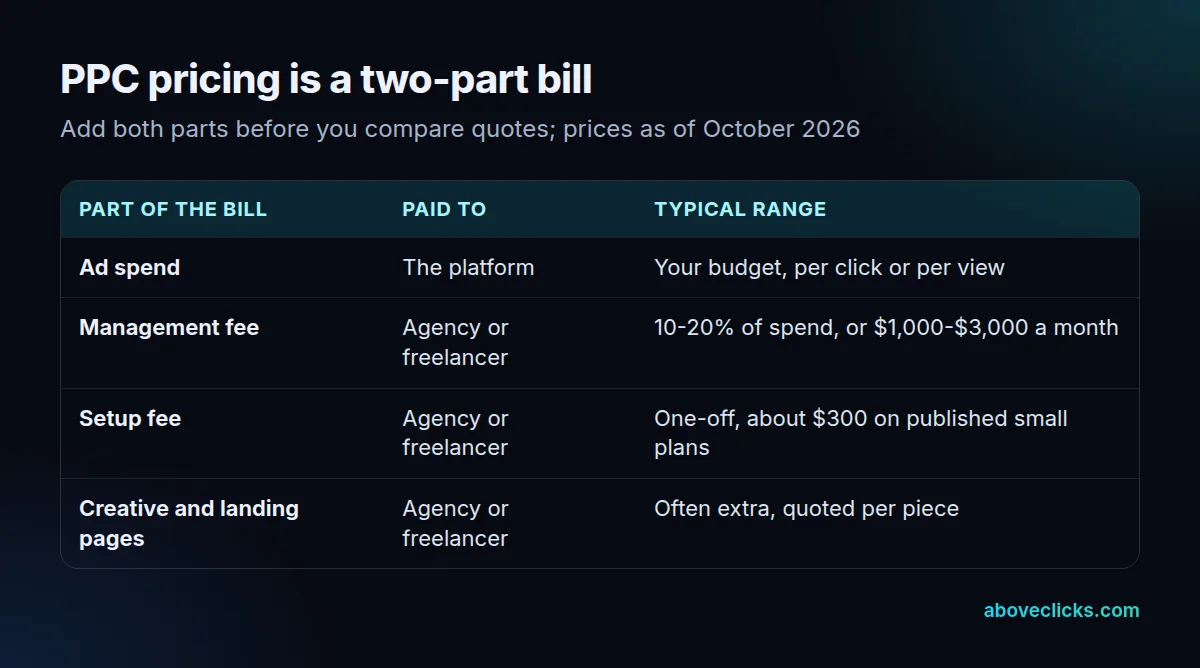
PPC pricing is made of ad spend plus a management fee, with setup and extras charged separately in most quotes, according to published 2026 agency pricing guides. (Source)
Ad spend is the money that goes to the platform. On search campaigns you pay per click: each time someone clicks your ad, the platform charges you the clearing price for that auction. On display campaigns you may pay per thousand views instead. Google’s own help defines this view-based model plainly: with CPM bidding you pay per one thousand views, and with viewable CPM you pay only when the ad can be seen, as explained in its CPM definition. That is the first part of ppc pricing, and it is the part that buys traffic.
The management fee is the second part of ppc pricing. It pays for keyword research, ad writing, bid changes, negative keywords, landing page checks and reporting. Without it, ad spend runs without anyone watching it, and the usual result is clicks that never convert. With it, someone is accountable for the cost per lead, not just the cost per click. Setup is often a third, one-off charge: building the account, writing the first ads and installing conversion tracking. Creative work, such as new landing pages or video ads, is commonly quoted per piece on top of both.
When you read a quote, split it into those four lines: ad spend, management fee, setup, and extras. If a quote will not split them, treat that as a warning sign. A clear split is the single most useful test in all of ppc pricing, because it stops the commonest trick: a low management fee hiding a high ad spend, or a low total hiding almost no ad spend at all.
How much does a click cost in 2026?
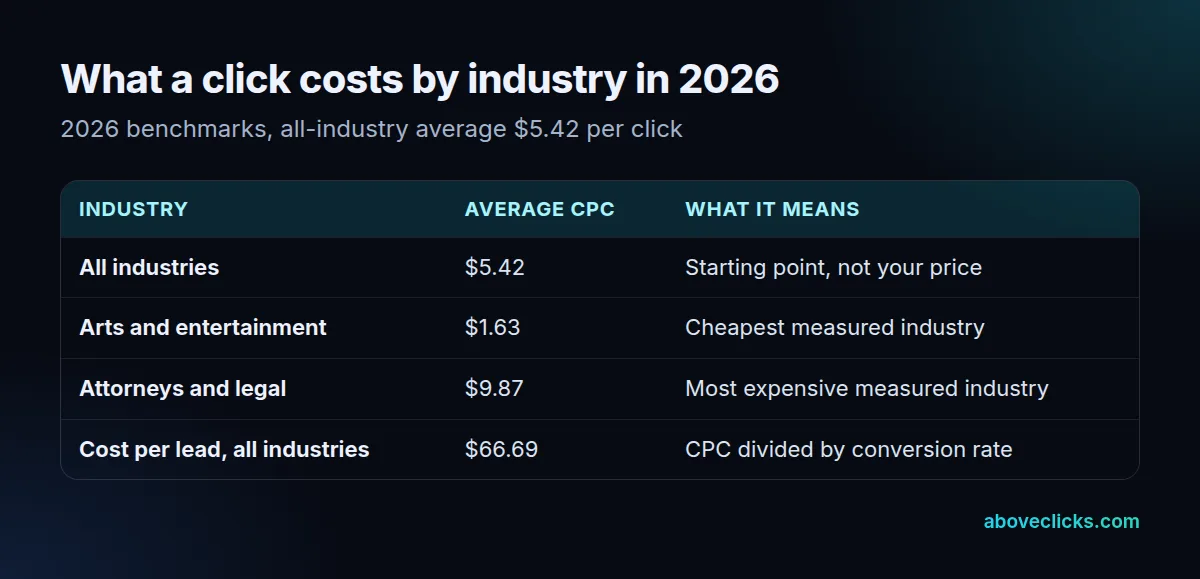
A click cost $5.42 on average across industries in 2026, but your industry moves that average more than any other factor, as of October 2026. (Benchmarks)
That $5.42 figure comes from a 2026 benchmark study of more than 13,000 search campaigns across 23 industries, measured between April 2025 and March 2026, as of October 2026, according to the benchmark summary. The same study puts the average cost per lead at $66.69, the average click-through rate at 6.64 percent, and the average conversion rate at 8.18 percent. Those four numbers are the starting point for ppc pricing in any industry, not the price you will pay.
The range is what matters for ppc pricing. Arts and entertainment averaged $1.63 per click, while attorneys and legal services averaged $9.87, as of October 2026, according to the same benchmark summary. That is a six-fold gap on the same platform. A business in a low-cost industry can buy six times as many clicks as a law firm for the same ad spend, which is why generic ppc pricing advice that quotes one average misleads both of them.
Why clicks cost different amounts comes down to the auction. Google’s help explains that keywords match your ads to searches, and that each keyword carries a Quality Score based on expected click-through rate, ad relevance and landing page experience, with higher quality leading to lower costs and better positions, as set out in its keywords guide. In practice, that means ppc pricing rewards relevance: a tight ad group, an ad that matches the search, and a landing page that answers the search will usually pay less per click than a broad, mismatched campaign bidding the same amount.
Search engine marketing cost also varies by campaign type. Search clicks cost more than display clicks because the searcher has stated intent, while display and video formats price attention rather than intent. Shopping clicks sit lower than search text clicks for many retailers. When you budget ppc pricing, price each campaign type separately instead of applying one average click price to the whole account.
What do PPC management fees look like?
PPC management fees usually run as a percentage of ad spend or a flat monthly retainer, with the percentage falling as spend rises, as of October 2026. (Models)
The percentage model is the commonest in ppc pricing. Published 2026 agency pricing guides put the standard range at 10 to 20 percent of ad spend, with 15 percent the most common rate, as of October 2026, according to the agency pricing models.
The rate slides with spend, as of October 2026, according to the same agency pricing models: under $5,000 a month of ad spend, the rate is typically 20 to 25 percent; from $5,000 to $25,000 it is 15 to 20 percent; from $25,000 to $100,000 it is 10 to 15 percent; and above $100,000 it is 7 to 12 percent and usually negotiated. That slide exists because managing $100,000 of spend does not take twenty times the work of managing $5,000.
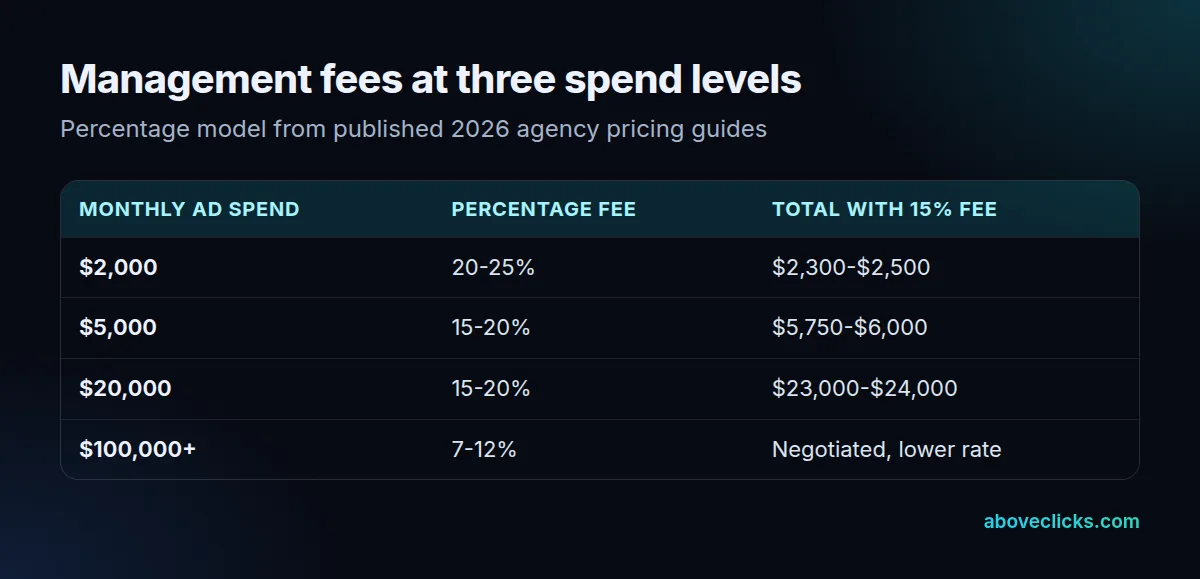
Worked totals make the model concrete for ppc pricing. At $2,000 of ad spend with a 20 percent fee, the monthly total is $2,400. At $5,000 of ad spend with a 15 percent fee, the total is $5,750. At $20,000 of ad spend with a 15 percent fee, the total is $23,000. Those totals come from applying the published percentage bands, as of October 2026, from the same agency pricing models. Notice what happens at the low end: a 20 percent fee on a small budget buys little management time, which is why many agencies set a minimum monthly fee even on the percentage model.
The flat retainer model fixes the fee regardless of spend. It suits small, steady accounts where the work is stable month to month, and it makes the total easy to forecast. Its risk is scope: keyword research, bid changes and monthly reporting are usually included, while campaign builds, tracking setup and creative work may bill separately. Before you pick a model for ppc pricing, ask what the fee includes in writing, and what bills extra. A flat fee that excludes landing page work can cost more than a percentage fee that includes it.
A hybrid model is also common in ppc pricing: a base retainer plus a smaller percentage above a spend threshold. It protects the manager’s time on small accounts while sharing the upside of growth. Whatever model you choose, the test is the same: divide the fee by the hours and deliverables it buys, and compare that with the cost per lead the account must produce. A fee is cheap only if the leads it produces are affordable.
How much should a small business budget for PPC?
A small business should budget from the click price backwards, starting with the clicks it needs and the cost per lead it can afford, as of October 2026. (Benchmarks)
Start with the arithmetic for ppc pricing. At the $5.42 average click, $1,000 of ad spend buys about 184 clicks. If one in twelve of those clicks becomes a lead, that is about 15 leads at roughly $67 each, which matches the benchmark cost per lead of $66.69, as of October 2026, from the benchmark summary. If your landing page converts better, the same spend buys cheaper leads; if it converts worse, the leads cost more. That is why landing page quality is a pricing lever, not just a design topic, in search engine marketing costs.
For a first budget, aim for at least 100 to 200 clicks a month. Below 100 clicks, the account produces too little data to judge: a single good or bad week swings the averages, and bid changes are guesses.
At 150 clicks and a $5.42 average, ad spend is about $813, and a 20 percent management fee adds about $163, for a total near $976 before setup. That is a realistic starting total for ppc pricing in an average-cost industry, and it is the figure to scale up or down by your own industry’s click price. Treat that total as a planning figure, as of October 2026, built on the benchmark click price above and on Google Ads’ average daily budget model, explained in its average daily budgets guide.
Pay per click packages that quote one all-in monthly price should be read against this arithmetic. If a package promises 500 clicks a month for $500 all-in, the implied click price is $1 or less before any management fee, which only fits the cheapest industries. If a package promises leads without stating clicks, click price or conversion rate, ask for those three numbers. Any ppc pricing quote that cannot show its arithmetic is a quote you cannot compare. The same clicks-times-price arithmetic is how Microsoft Advertising frames budgets, as of October 2026, in its budget options guide.
What extras sit outside the management fee?
Extras outside the management fee are usually setup, creative work, landing pages and reporting tools, and they are quoted separately in most ppc pricing, as of October 2026. (Models)
Setup is the first extra to pin down in ppc pricing. It covers account structure, keyword research, first ad drafts, negative keyword lists, conversion tracking and the first landing page review. Some managers include a basic setup in the first month’s fee; others charge it once, on top. Either way, ask for a list of what is built and a date it will be live. Setup that drags on for a month while ad spend runs is money spent before the account is ready to convert.
Creative and landing page work is the second extra. New ad variations, display banners, video ads and landing page builds each take hours that a standard management fee rarely covers. If your account needs a new landing page every month, that work can exceed the management fee itself. Price it per piece, and judge it by conversion rate: a landing page that lifts conversion from 5 percent to 8 percent cuts your cost per lead by more than a third without touching bids.
Bidding tools and reporting dashboards are the third extra in search engine marketing cost. Automated bidding is built into the platform: Target CPA, for example, sets bids to reach a desired average cost per conversion, with some conversions costing more and some less, as Google’s Target CPA guide explains. Third-party bid tools, call tracking and dashboard software are separate subscriptions.
Note that Enhanced CPC, an older manual-bidding aid, was retired for Search and Display campaigns in 2025, according to Google’s ECPC guide, so do not pay for it as a current feature. Ask which tools are included, which are billed through, and whether you keep the data if you leave. Data ownership matters more than tool choice in ppc pricing, because your click and conversion history is what makes the next manager effective.
How do you build a PPC budget from scratch?
You build a PPC budget from scratch by working backwards from the value of a lead, not forwards from a round monthly number, as of October 2026. (Benchmarks)
Here is the method we use when scoping ppc pricing before quoting: first, the industry click-price range; second, the clicks needed for a readable test; third, a conversion tracking check; fourth, a landing page check. That order matters. Quoting a budget before checking tracking and the landing page is like pricing fuel before checking whether the car runs. The tracking check confirms that a lead is counted once, and the landing page check confirms that the page answers the search that brought the click.
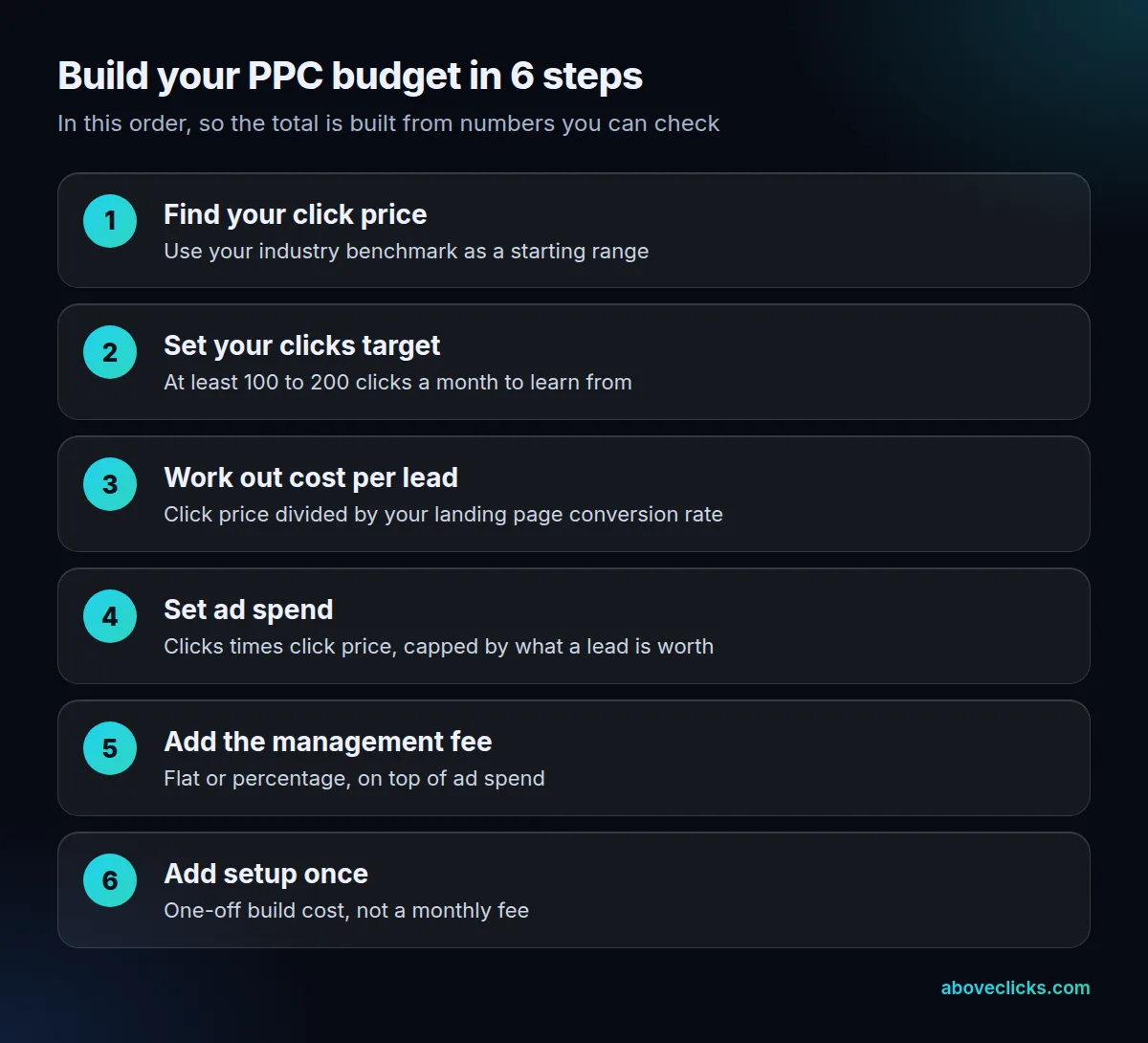
- Find your click price from your industry benchmark range, not the all-industry average.
- Set your clicks target at 100 to 200 a month for a first test.
- Work out your cost per lead: click price divided by your landing page conversion rate.
- Set ad spend: clicks times click price, capped by what a lead is worth to you.
- Add the management fee: flat or percentage, on top of ad spend.
- Add setup once: the one-off build cost, not a monthly fee.
Then run the budget for a full test period before judging it. Two weeks is too short: weekly patterns, weekends and auction swings distort small samples. A month of data at 100 to 200 clicks gives a cost per lead you can trust, and a second month shows whether bid and landing page changes moved it. If the cost per lead after two months is above what a lead is worth, the answer is usually the landing page or the keyword match, not a bigger budget. Spending more on clicks that do not convert only buys expensive proof of the same problem.
Seven budget rules sum up this guide to ppc pricing: split every quote into spend and fee; price your industry, not the average; buy at least 100 clicks to learn; judge fees by cost per lead; get setup in writing; price creative separately; and keep your data. To see how those rules apply to a full agency rate card, read the pricing models page, or ask for a free audit of the account or budget you have today. More guides are in general.