SEO vs AdWords is a choice between earning clicks and buying them. SEO works on your pages so Google ranks them in the free results; AdWords, now called Google Ads, puts paid ads above and below those results and charges you per click.
This guide compares the two from Google’s own pages, works through what a click and a month of ads can cost, and ends with a plan for running both without paying twice for the same customer.
What is the difference between SEO and AdWords?
Who you pay and how the order is decided. In the free results, Google’s ranking systems decide and no one pays Google; in the ads, an auction decides who shows and every click is billed.
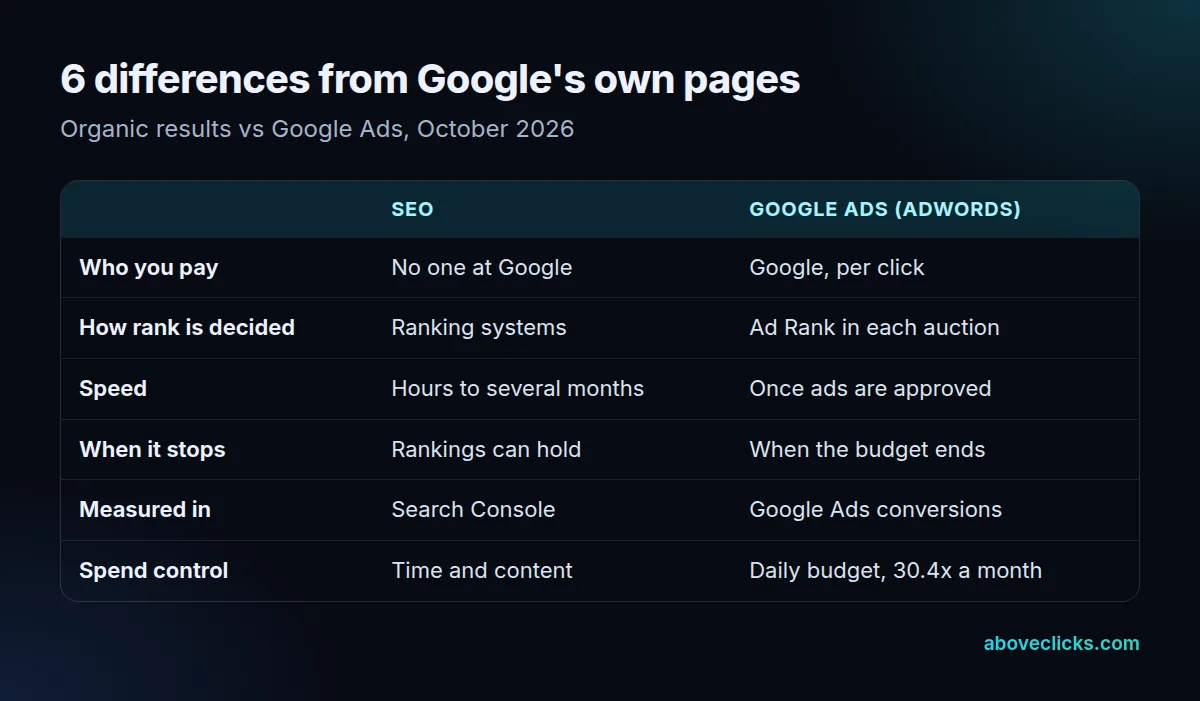
Google is blunt about the first half. Its guide to how Search works says, as of October 2026, that Google doesn’t accept payment to crawl a site more often or rank it higher, and that ranking is done programmatically. So SEO costs you time, content and technical work, but never a payment to Google.
The ads side is an auction that runs again for every search. In Google’s own actual CPC example, 5 advertisers compete for 4 ad positions above the results, and only the ones whose Ad Rank clears a minimum get there. That’s the core of SEO vs AdWords: one is a ranking you earn over time, the other is a seat you win, search by search.
Is AdWords now Google Ads?
Yes. Google renamed AdWords to Google Ads in 2018, so most “AdWords” advice online now refers to Google Ads, and the paid search ads work the same way under the new name.
Google announced the change on The Keyword on Jun 27, 2018, under the heading “Google AdWords is becoming Google Ads”, noting that AdWords had launched nearly 18 years earlier. The post explains the new name reflects ads that reach people on Search, YouTube, Google Maps, Google Play and partner sites, not only search results.
The old name lives on in searches like “AdWords vs SEO”, which is why both terms show up in this guide. When an agency proposal says AdWords, read it as Google Ads, and ask which campaign types it means: Search, Shopping and Performance Max behave differently for a store.
How much does Google Ads cost compared with SEO?
Google Ads costs whatever clicks win in the auction, within the budget you set; SEO costs the work on your site, with no charge for the clicks. One bills per visit, the other per hour of work.
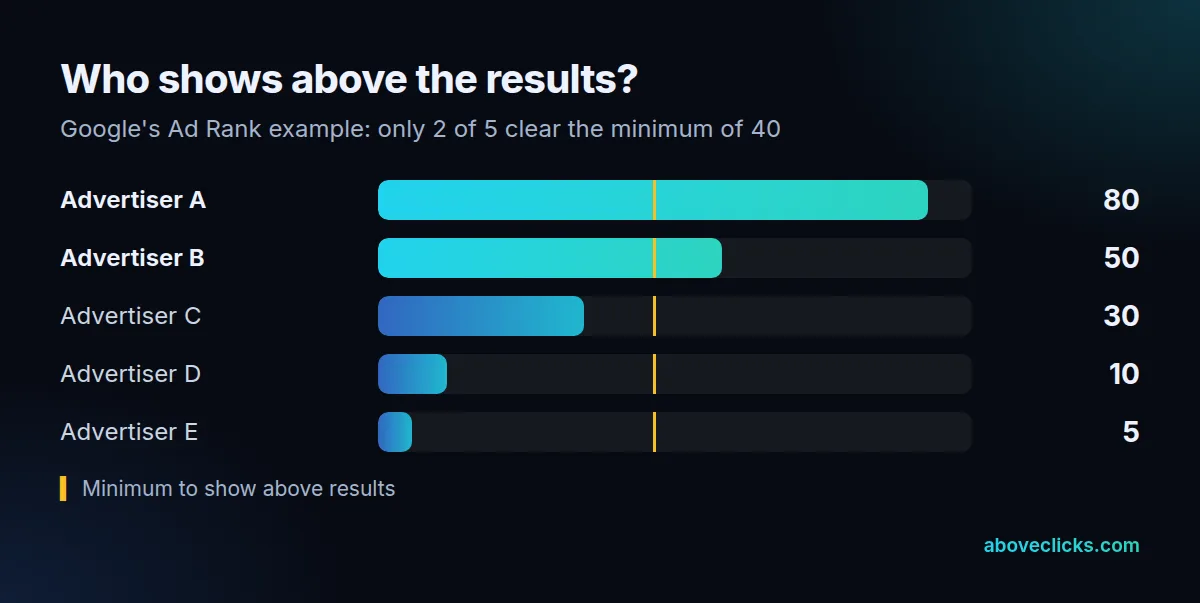
The auction rules decide what a click costs. Google’s Ad Rank article explains, as of October 2026, that Ad Rank uses your bid, the quality of your ad and landing page, the thresholds an ad must clear, and the context of the search, such as location and device. Its actual CPC guide adds that you usually pay less than your maximum bid: just enough to clear the threshold and beat the advertiser directly below you, rounded up to the nearest billable unit, which in the US is $0.01. In the chart’s example, the 2 advertisers above 40 show above the results.
That’s why ad quality matters as much as the bid; our quality score entry covers the signals. For what agencies charge to manage the ads, see our guide to PPC pricing, and for the other side, what SEO costs.
SEO vs AdWords: a worked budget example
Budgets in Google Ads are a monthly ceiling, not a fixed daily spend. Take an invented store that sets an average daily budget of $30.
Google’s budget article says, as of October 2026, that a campaign might spend up to twice its average daily budget on a given day, and no more than 30.4 times it in a month. For this store, that’s up to $60 on a busy day and at most $30 × 30.4 = $912 a month. Plan the month at $912, not at $30 times the days you expect to run, and you won’t be surprised by a $60 Tuesday.
The second costly mistake in SEO vs AdWords budgeting is comparing a month of ads with a month of SEO work as if they bought the same thing. A month of Google Ads buys that month’s clicks, and they end when the budget does. A month of SEO buys pages and fixes that keep working, if they rank, long after the work is paid for. Compare the two over the same 12 months instead: total ad spend for the keywords you’d buy, against the SEO work needed to rank for them and the clicks those pages bring once they do.
How long does SEO take to work?
Longer than ads, and less predictably. Google’s own starter guide says some changes take effect in a few hours and others could take several months, so plan in months rather than weeks.
The SEO starter guide adds, as of October 2026, that you should generally wait a few weeks before judging whether a change worked. For a new page that has to be crawled, indexed and then earn its place, several months is the normal case, not the slow one.
That delay is where the SEO or AdWords decision gets real money attached. As a worked example, if the pages you need take 6 months to rank and you buy the same traffic with the $30-a-day campaign above in the meantime, the ads can cost up to 6 × $912 = $5,472 over that stretch. Neither number is wrong; it’s the price of time. Our ecommerce SEO work reports progress from Search Console and store revenue for that reason, so you can see whether the months are paying off.
Does Google Ads help SEO?
Not in the rankings. Google says advertising with it has no effect on your site’s presence in the search results. Ads help SEO only through the data they give you about what people search and buy.
On its page about hiring an SEO, Google states, as of October 2026, that advertising with Google won’t have any effect on your site’s presence in its search results, that it never accepts money to include or rank sites, and that appearing in the organic results costs nothing.
The data is a different story. A search terms report shows the exact searches that triggered your ads and which of them led to sales, so you learn which phrases buyers use before you write a page for them. Keyword Planner adds search volume and forecasts, and its filters can show, for example, keyword ideas where bids under $1 may be enough to reach the top of the page, as of October 2026. Both are keyword research you’d otherwise guess at.
Is SEO better than Google Ads?
Neither is better in general. Google Ads is better when you need sales soon or want to test keywords; SEO is better when clicks cost more than they earn and you can wait for pages to rank.
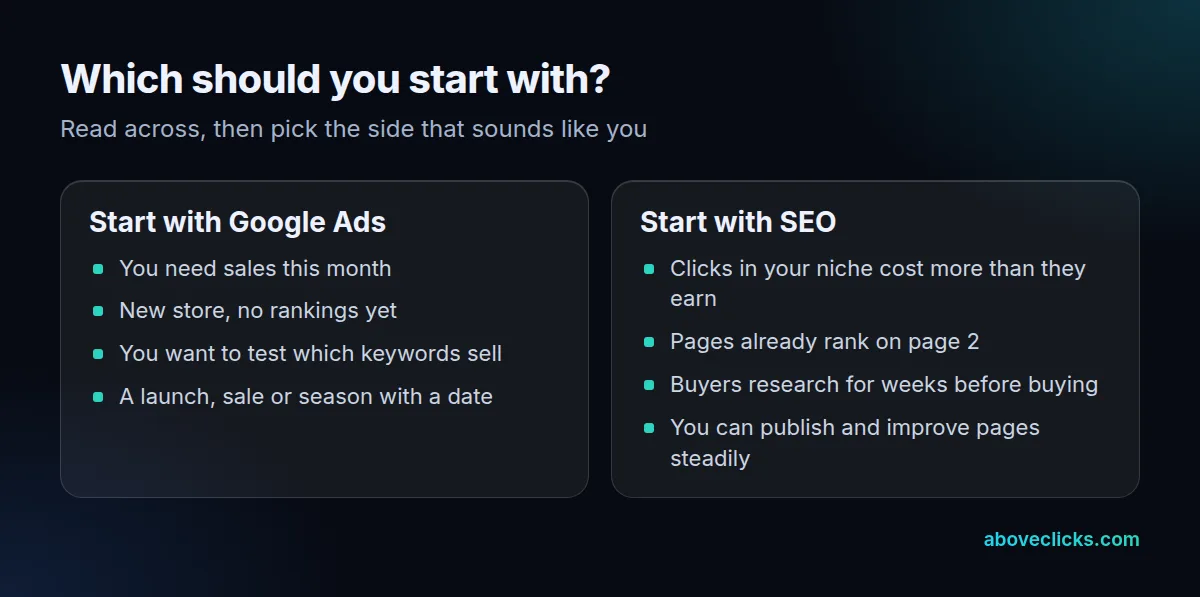
A quick test settles most cases. Take an invented product that earns $40 of margin per order, on a site where 2% of visitors buy: each click is worth at most $40 × 2% = $0.80. If the clicks you need cost more than that in the auction, ads lose money on every sale and SEO is the better long-term bet for those keywords. If they cost less, ads can pay for themselves while SEO catches up.
The answer often differs keyword by keyword. Brand and product searches with a clear buyer can be cheap and profitable to advertise; broad research searches usually aren’t, and they’re where good guides and category pages earn free clicks. So for most stores, SEO vs Google Ads is a split per keyword, not one decision for the whole site.
Should you run SEO and AdWords together?
Usually, yes, in a set order: ads first to learn which searches sell, SEO next to earn those clicks for free, then less ad spend where your pages rank well.
A practical plan runs in 4 steps:
- Run Search and Shopping ads on the keywords you think matter, with purchase tracking working first.
- After a few weeks, read the search terms report and mark the searches that led to sales.
- Build or improve the category pages and guides for those searches, and track them in Search Console’s Performance report, which shows clicks, impressions, average CTR and average position.
- As a page holds a top position, test lower bids on that keyword and move budget to searches you don’t rank for yet.
The mistake to avoid is cutting ads the moment SEO starts. Until a page actually ranks, the ads are the only traffic you get for that search. If you’re weighing SEO or AdWords for a new store with no rankings at all, the same order works: ads bring sales and data in the first weeks, and the pages built from that data take over later.
Our Google Ads work starts the same way. The free audit is a written review of your ads, Merchant Center, tracking and SEO, with the top 5 fixes ranked by impact; then we set targets from your break-even ROAS on real margins, fix the feed and tracking before rebuilding campaigns, and send the first monthly report after 30 days. More on running paid search for a store is in our Google Ads guides, wherever you land on SEO vs AdWords.