An SEO price quotation is a written offer that names the SEO work, the fee, the term and what is left out. Judge one by its deliverables and terms, not by the total at the bottom.
This guide shows the 9 lines a good SEO price quotation contains, how to ask for one, what an SEO quotation template looks like, how to compare two quotes fairly and which lines should make you stop.
What is an SEO price quotation?
A written document in which an agency or freelancer says what SEO work it will do for your site and what it will charge. It sits between a first call and a signed contract.
Google lists 8 kinds of service that SEOs commonly offer: content or structure review, technical advice, content development, campaign management, keyword research, training, market expertise and optimizing for generative AI. A quote that says only “SEO services” could cover anywhere from 1 to 8 of them.
That is why the document matters more than the total. A quote is a promise about work, so a vague SEO price quotation is a vague promise. For market averages by provider type, read our SEO price guide; for how those averages are built, see average price of SEO. This page is about reading the quote in your hand.
What should an SEO quotation include?
Nine lines: scope, deliverables, timing, fee, term, access, reporting, ownership and exclusions. If any line is missing from an SEO price quotation, treat the gap as a question for the provider.
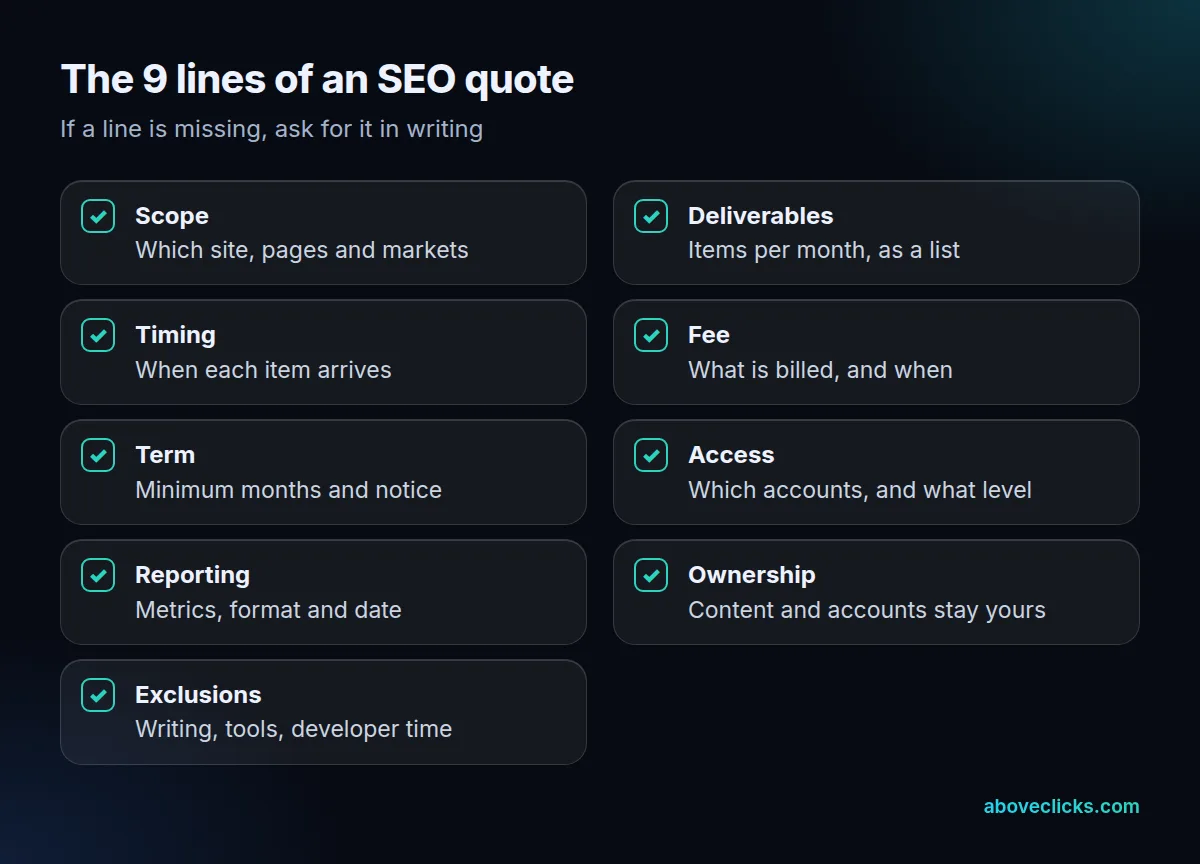
Here is what to look for on each line of the SEO quotation:
- Scope: the exact site, the number of pages or products and any extra markets or languages. A quote written for 40 pages doesn’t cover 4,000.
- Deliverables: items per month, such as pages rewritten, fixes shipped or guides written. “Ongoing optimization” is not a deliverable.
- Timing: when the audit, the first fixes and the first report arrive.
- Fee: the amount, what it covers, when it is billed and whether the first month differs from the rest.
- Term: the minimum number of months, the notice period and whether the fee changes at renewal.
- Access: which accounts the provider needs and at what level.
- Reporting: which metrics, in what format and by which day each month.
- Ownership: who owns the content written and the accounts created.
- Exclusions: what the fee does not cover, such as writing, tools or developer time.
Lines 5 and 8 are the ones owners skip. Our guide to a monthly SEO package goes deeper on the contract side.
How do you ask for an SEO quote?
Send each provider the same short brief, so the quotes describe the same job. Six items are enough: your site address, the number of pages, your platform, your goal, what you can do yourself and who approves changes.
Sending the same brief to 3 providers makes the replies comparable. Without it, one provider quotes for a clean 40-page site and another for a 4,000-page catalog, and the totals mean nothing next to each other.
Keep the wording plain, for example: “Our store has about 400 product pages on Shopify. We want more organic orders from category pages. Please send a written quote that lists what you will deliver each month, when, and what is not included.” That one paragraph gives a provider enough to quote the same job as everyone else.
Add two questions to the brief. Ask which items are included each month, and what the provider needs from you to start. Our guide to choosing an SEO company has the interview side.
Be careful with access at this stage. If a provider offers an audit first, Google’s hiring advice is to grant read access to Search Console only, not write access. The same page says an audit should give you realistic estimates of improvement and of the work involved.
For our own ecommerce SEO work, the audit comes first and uses read-only access, as described on the ecommerce SEO page.
What does an SEO quotation template look like?
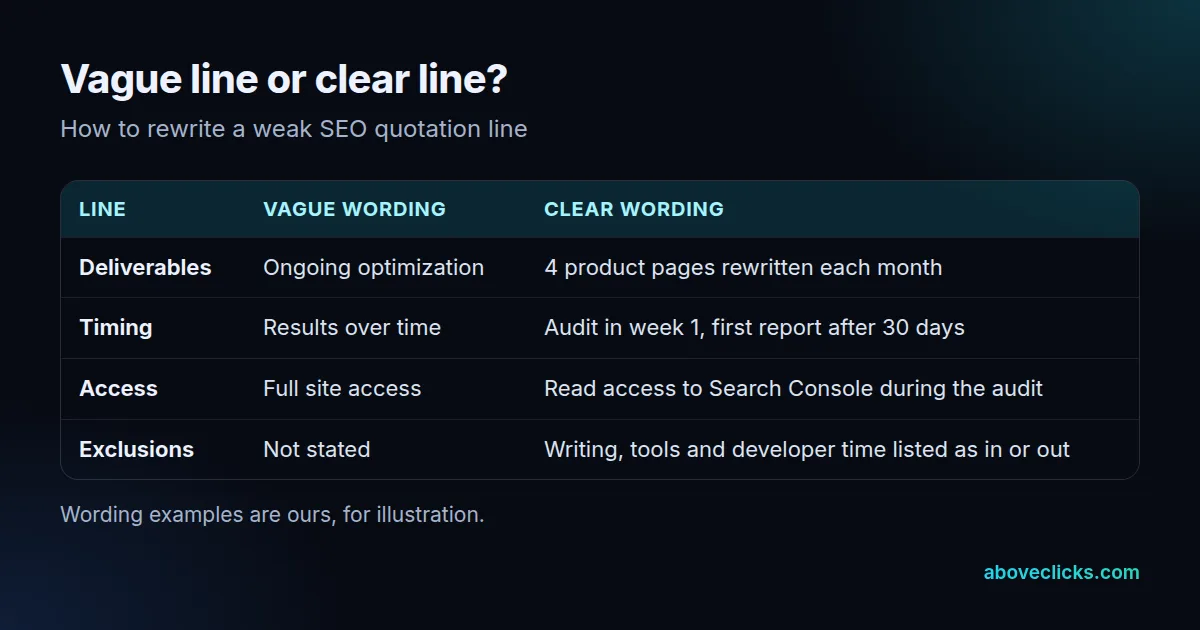
A short document with the 9 lines as headings, each filled with a specific statement instead of a phrase. The table below turns four weak lines into clear ones, and you can use it as a seo quotation template when you ask a provider to rewrite theirs.
Copy this skeleton into an email and ask the provider to fill it in:
- Scope: site address, pages covered, markets.
- Deliverables per month: a numbered list with quantities.
- Timing: audit, first fixes, first report, each with a date or a number of days.
- Fee and billing: amount, what it covers, billing day.
- Term and notice: minimum months, notice period, renewal terms.
- Access: accounts needed, with the level of each.
- Reporting: metrics, format, date each month.
- Ownership: content, accounts and the fix log.
- Exclusions: what costs extra.
Ownership deserves a closer look. In Search Console, a verified owner proves ownership with a token such as an HTML file, and a property must always have at least 1 verified owner. A delegated owner is added or removed on the user screen, and a property can hold up to 100 non-owner users. Keep your own account as owner and give the provider a user role, so ending the work means removing one user.
How do you compare two SEO quotes?
Divide each fee by the number of items delivered, then compare the cost per item. Two quotes with similar totals can differ by more than 2 times once you count what is inside; the cost per item is the number that tells them apart.
Take two invented quotes for the same store. Quote A totals $1,500 and, when you ask, lists 4 items. Quote B totals $1,800 and lists 12 items. The cost per delivered item is $375 for A and $150 for B.
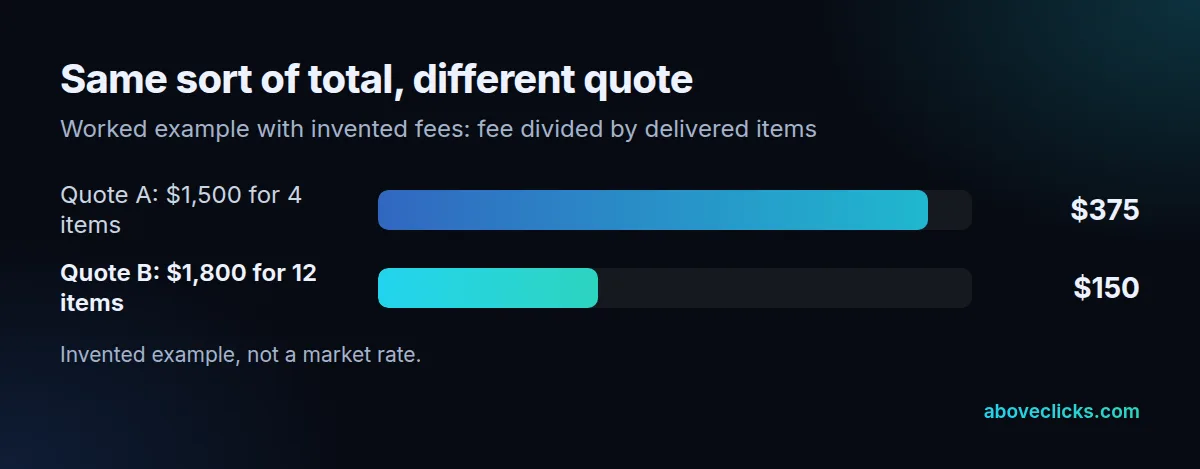
Quote B costs $300 more but delivers 3 times the items. Whether that is better depends on what the items are: 12 small fixes may matter less than 4 rewritten category pages. So after the division, read the item list and ask which ones move your goal.
Three more checks keep the comparison honest:
- First month: an audit may make month 1 look larger. Compare the first 3 months, not 1.
- Who does the work: a senior specialist and a junior produce different items for the same hour.
- What is outside the fee: writing, tools and developer time can double the real total.
If the quote is for one defined fix, a fixed price SEO quote should name the problem and the finish line instead.
Which lines in an SEO quote are red flags?
Any promise of a number-one ranking, any hidden method and any line that depends on buying links. Google’s hiring guide names each of these.
Watch for these seven lines in any SEO quote:
- A promised ranking: Google says no one can promise a number-one ranking, and warns about claims of a special relationship with Google or a “priority submit”.
- Hidden methods: Google says to be careful if a company is secretive or won’t clearly explain what it intends to do. You are responsible for the companies you hire.
- Link buying: Google’s spam policies list exchanging money for links as link spam. A quote with “link packages” needs a clear explanation.
- A link to the provider: Google says you should never have to link to an SEO.
- Submission to thousands of search engines: Google calls these typically useless exercises.
- Full access before an audit: read access is enough at this stage.
- No exclusions line: the extras will show up on the invoice.
Google also suggests 8 interview questions, starting with whether the provider follows Google Search Essentials, and including how success is measured and whether all changes will be shared with you. A quote that answers none of them is a template for any site, not a plan for yours. Any 1 of the first 3 flags is reason enough to walk away; the others justify a written question, answered within 2 days.
When should you accept, question or reject an SEO quote?
Accept an SEO price quotation once every line is filled and none of the red flags appears. Question it when 1 or 2 lines are vague. Reject it when it promises rankings or hides its method.
A simple decision rule:
- Accept: every line is specific, the items are listed, and the term and ownership lines are clear.
- Question: 1 to 3 lines are vague. Send the skeleton above and ask for a revised quote within a few days.
- Reject: the quote promises a ranking, asks for links or refuses to explain the work.
Ask for the revised version in writing, even when the provider offers to explain it on a call. A call is easy to forget, while a quote can be checked against the first month of work, the first report and the first invoice.
Set expectations for the first months before you sign. Google’s starter guide says some changes take effect in hours and others several months, and suggests waiting a few weeks to assess whether work helped. A quote that promises results in the first week is promising what Google says can’t be assumed.
If you want a second opinion on a quote you already hold, our free audit reads your Search Console with read-only access. More guides are in buying guides.