Fixed price SEO means one agreed fee for one defined piece of work, such as fixing a named error across a set of pages. The fee is fixed; the ranking effect is not, so judge the offer by how well the problem is written down.
This guide to fixed price SEO covers which problems suit a fixed quote, the problem sheet to hand over, what sets the fee for a single fix, and the test that proves the work is done.
What is fixed price SEO?
It is a quote for a repair or a defined task, paid as one fee, instead of hours or a monthly retainer. You know the cost before the work starts, and the agency knows exactly what it has to deliver.
Buyers like fixed price SEO for one practical reason: the maximum bill is known and easy to approve. Agencies like it because the end is clear. Both gain only when the work is written in numbers.
That differs from a retainer, which pays for a repeating list of work every month. Our guide to the monthly SEO package covers that model, and the one time SEO package guide covers a whole project. This one is narrower: a single problem with an end point.
A fixed fee is only as firm as the sentence behind it. “Improve technical SEO” can mean 3 hours or 3 months. “Redirect 320 old product URLs to their new pages and show zero 404s on that list” can be quoted and checked. For our own work, the audit PDF that scopes a fix arrives within 2 workdays, as published on the ecommerce SEO page.
Which SEO problems suit a fixed price?
The ones where the cause is known and the end can be seen. If you can name the error, list the pages it touches and point to a report that will show it gone, a fixed price SEO quote is safe for both sides.
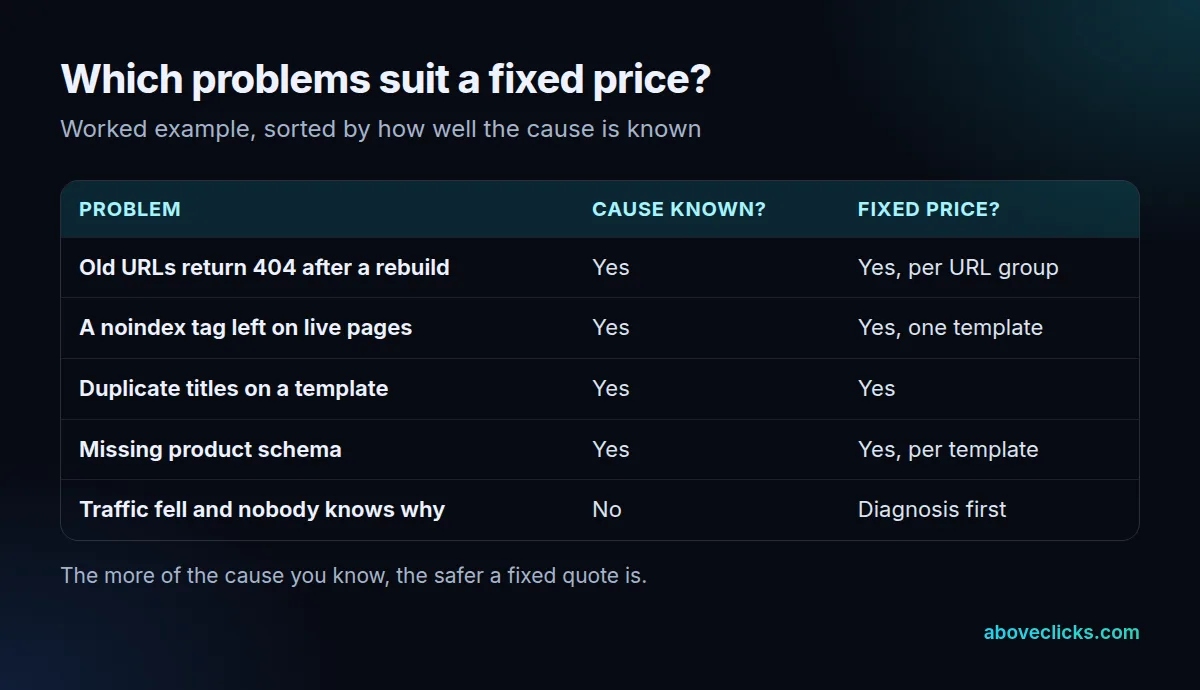
The table sorts five common problems. For fixed price SEO, the first four have a visible cause and a countable scope. The last one, a traffic drop with no known reason, does not: nobody can price a repair before the cause is found. Pay for a short diagnosis first, then get a fixed price SEO quote for the fix it points to.
Google’s own advice for traffic drops says some changes take effect in a few days while others take several months, and it recommends the last 16 months of the Performance report to see whether a drop is seasonal. A fixed quote written before that check risks paying to fix a problem you do not have.
How should you write the problem for a fixed price SEO quote?
On a one-page problem sheet: one sentence naming the error, 3 example URLs, the count of affected URLs and the report that shows it. That sheet is what turns a vague worry into something an agency can quote without padding the fee.
Worked example: an invented store rebuilt its theme and 320 old product URLs now return 404. The problem sheet says: “320 URLs on the old path return 404; 12 template groups; the new pages exist; Search Console lists the 404s.” With that, the quote becomes a redirect map of 320 pairs, a test of 20 sampled rows, and a re-check of the same list.
Without the sheet, the agency has to guess how deep the problem goes and adds a margin for the unknown. A clear sheet shortens that guess, which is the main way you lower a fixed price SEO quote without cutting the work.
Attach the evidence, not only the description. An export from Search Console, a crawl list or a screenshot of the error report lets the agency count the problem itself instead of trusting your estimate. If your count and theirs differ by more than a few percent, settle that before signing, because the number of URLs is what the quote rests on. Treat the sheet as part of the contract for any fixed price SEO job, and keep a dated copy.
Add three more lines to the sheet:
- What must not change: pages that already rank and must keep their address.
- Who deploys: whether the agency edits the site or hands a file to your developer.
- The done test: the report and the filter that must show the fix.
What sets the SEO fixed price for a fix?
The count of affected URLs, the number of templates involved, and who has to touch the site. A fixed price SEO quote that ignores these three is guessing. The fee for one fix moves with scope and risk, not with the hours someone happens to log.
An SEO fixed price for a single problem usually moves with four things:
- URL count: a redirect map for 320 pairs takes longer to build and test than one for 30.
- Template count: 12 template groups mean 12 places to change and check, even when the URL count is the same.
- Risk: a fix on checkout or category pages needs a staging test first.
- Deployment: if your developer must ship the change, the agency’s part ends at a clear file and a test plan.
Technical limits matter too. Google says to use permanent redirects (301 or 308) when you are sure the redirect will not be reverted, and for a site move it advises avoiding chains, keeping them no longer than 3 hops and ideally fewer than 5. It also says to keep the redirects for generally at least 1 year. Ask the quote to state which redirect type it uses and how long they stay.
How do you know a fixed price SEO fix is done?
When the report you named in the problem sheet shows it, not when the agency says so. For indexing and crawl errors, that report is Search Console, and Google’s own validation tells you when it is fixed.
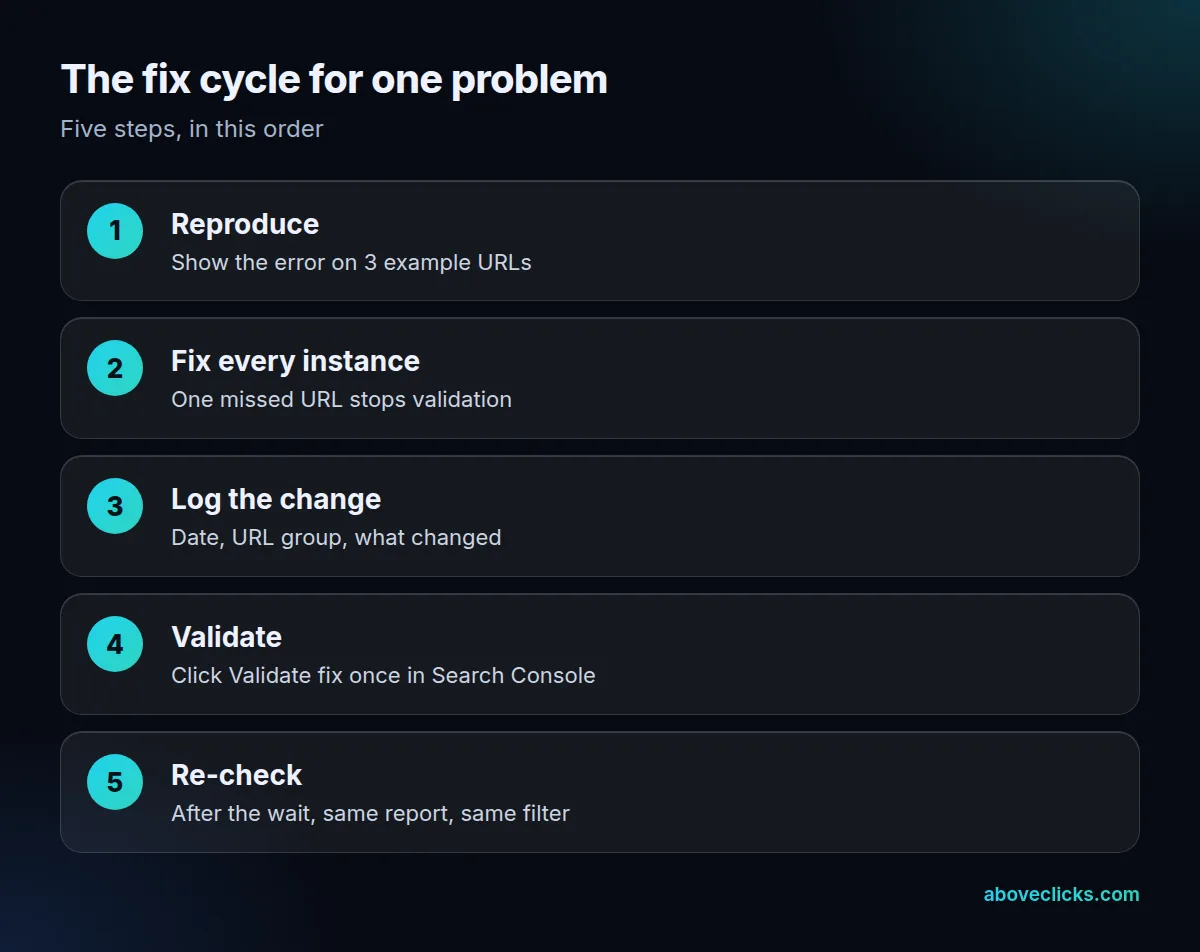
Google’s Page indexing report says validation typically takes up to about 2 weeks and can take much longer. It also says to fix all instances first, because validation stops when Google finds a single remaining instance, and not to click Validate fix again until the first attempt has succeeded or failed. Crawling itself can take from a few days to a few weeks, so a re-check on the day of delivery proves nothing.
That is why a fixed quote should have two dates: one when the fix is live and one when the done test passes. Pay the second part of the fee on the second date. If validation fails, the agency fixes the URL that failed and you restart it, at no extra charge, because the original sentence was “show zero 404s on that list”.
In practice, plan for a 14-day validation window plus a few days either side, so the second payment date falls about 3 weeks after the fix goes live. A change log completes the proof. It lists the date, the URL group and what changed, so a later problem can be traced to its cause.
What access does a fixed price SEO fix need?
The least that gets the job done, which keeps fixed price SEO low-risk for your site. Google’s guide to hiring an SEO says to give only read access to Search Console for an audit, and that an SEO with server access should be willing to explain every change.
For a fix, that translates into three rules:
- Read access first: the diagnosis and the redirect map need no write access.
- Your login stays the owner: add the agency as a user, so you remove one user when the job ends.
- A staging copy for risky changes: test on a copy before touching live pages.
On a 320-URL fix, one read-only export and 1 staging copy of the template are usually all the agency needs before the change ships. If the quote asks for full access to the site before it names the problem, treat that as a warning sign. Our free audit works on read-only access, and the sample report shows what a written finding looks like.
When is a fixed price the wrong choice?
When the cause is unknown, when the problem keeps coming back, or when the work never ends. In those cases a fixed fee either hides a margin for the unknown or ends up in a dispute about scope.
Look at 16 months of Performance data first, so you know the drop is real and not seasonal. Then use this short test for your fixed price SEO request:
- Can you name the error in one sentence? If not, buy a diagnosis.
- Can you count the affected URLs or templates? If not, count them first.
- Is there a report that will show the fix? If not, agree one.
- Will you add products or pages every week? If so, the fix will be needed again, and monthly work fits better.
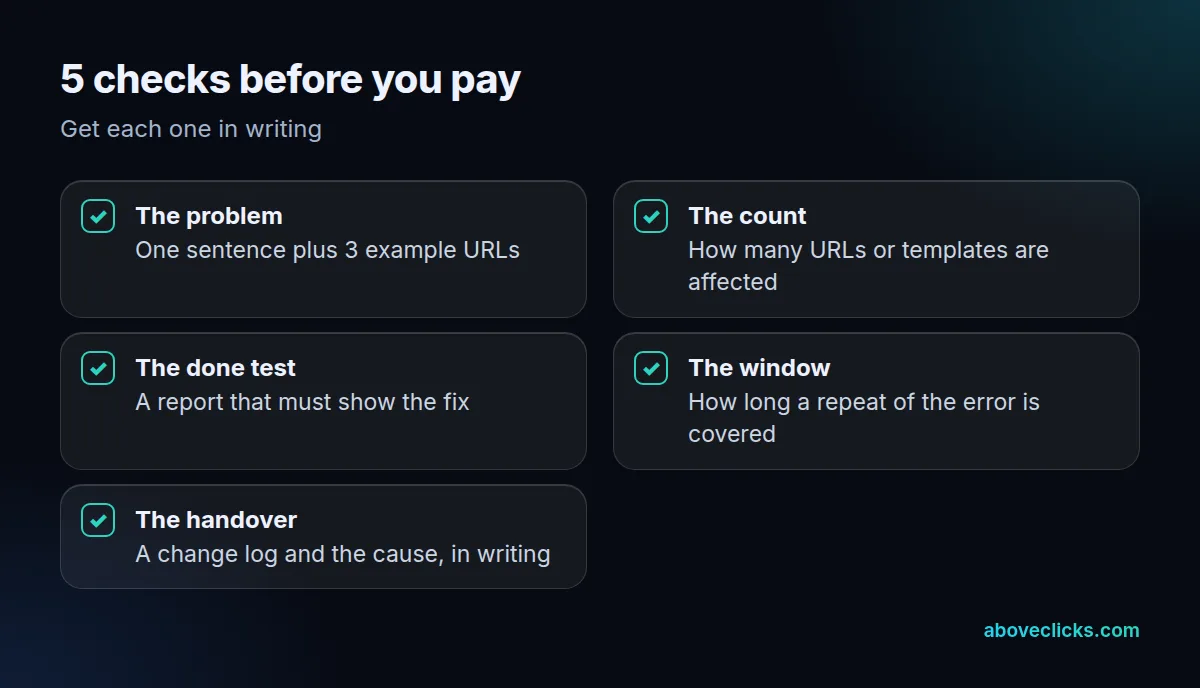
If all 4 answers are yes, a fixed price SEO quote is safe to ask for. Send us the error, the count and the report where you see it, and we will say if it fits a single fixed quote. The ecommerce SEO page has the starting price cards, and more guides are in buying guides.