A sample real estate marketing plan is a finished plan for one hypothetical agent: a goal, a lead target, a short routine for each channel, the rules that apply and a monthly review. Copy the shape of this sample real estate marketing plan, then replace the invented numbers with yours.
Most pages offer a blank template. This sample real estate marketing plan fills one in, shows the arithmetic behind each line, and flags the advertising rules that a blank real estate marketing plan sample leaves out.
What is a sample real estate marketing plan?
It is a completed plan you can read as a model. A template gives you headings; a sample real estate marketing plan gives you the answers under them, so you can see how a goal becomes a weekly routine.
The agent in this sample real estate marketing plan is invented. They work alone in one suburb, aim for 12 closings a year, which is 3 a quarter, and have no paid-ads history. Every rate and routine below is a worked example, not a market average.
A sample real estate marketing plan suits two readers. The first is an agent writing a plan for the first time, who needs to see what a finished line looks like. The second is an agent whose plan exists but is vague, and who wants to test it against a model. If your plan says “post on social media more”, the sample shows what a checkable version looks like: a count, a day and a reason.
We already cover the blank structure, the budget split and a 90-day calendar in our real estate marketing plan guide, and a weekly-hours view in the real estate agent marketing plan guide. This page does something different: one finished plan, with sums.
What does a filled-in real estate marketing plan look like?
Like one table with a target and a routine on every line. If a channel has no number and no monthly routine, it is a wish rather than a part of the plan.
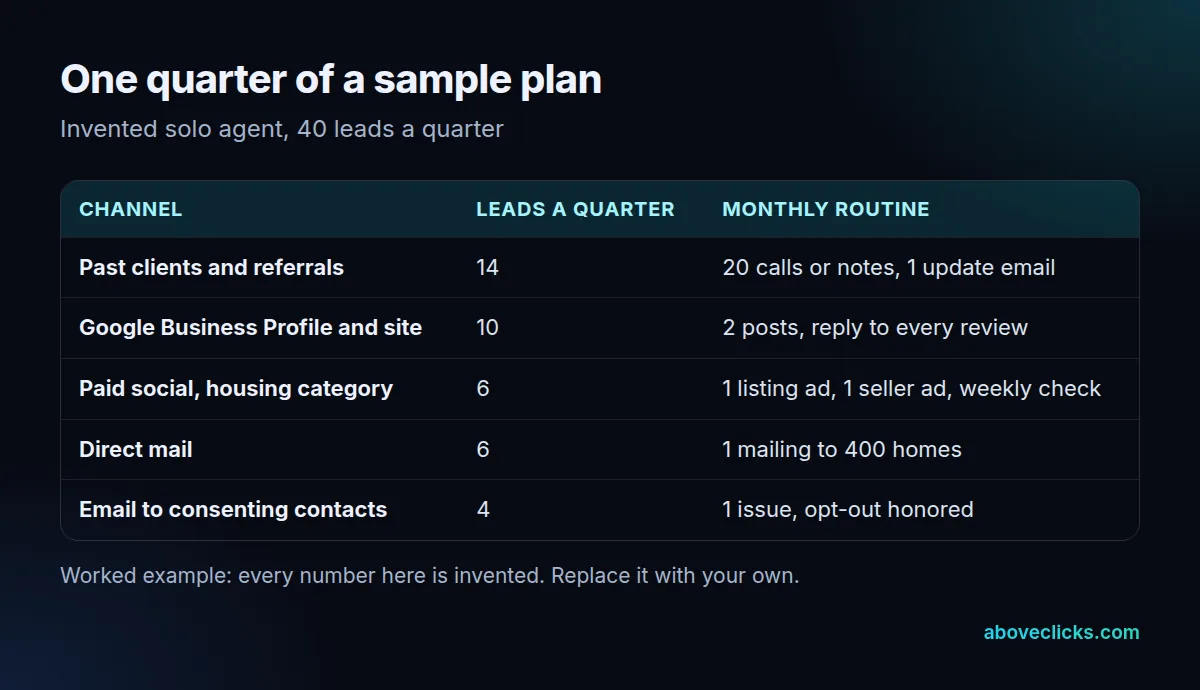
The five lines of the sample real estate marketing plan add up to the 40 leads the next section calculates. A real estate marketing plan sample like this one also needs a short header above the table:
- Goal: 3 closings this quarter.
- Area and audience: one suburb, home sellers and move-up buyers.
- Owner and time: the agent, 6 hours a week on marketing.
- Review date: the last Friday of each month.
Read the table the way a buyer of marketing would. Every row can be audited in a month: either 20 notes went out or they did not, and either 6 leads arrived from mail or they did not. That is the main thing a sample marketing plan for real estate teaches that a list of tips does not.
Notice what is missing: no logo work, no brand video, no “increase awareness”. Each line either produces a lead you can count or supports one that does.
How do you turn a closings goal into a lead target?
Divide the goal by each conversion step, working backwards. At the sample’s invented rates, 3 closings need 4 signed agreements, 10 appointments and 40 leads.
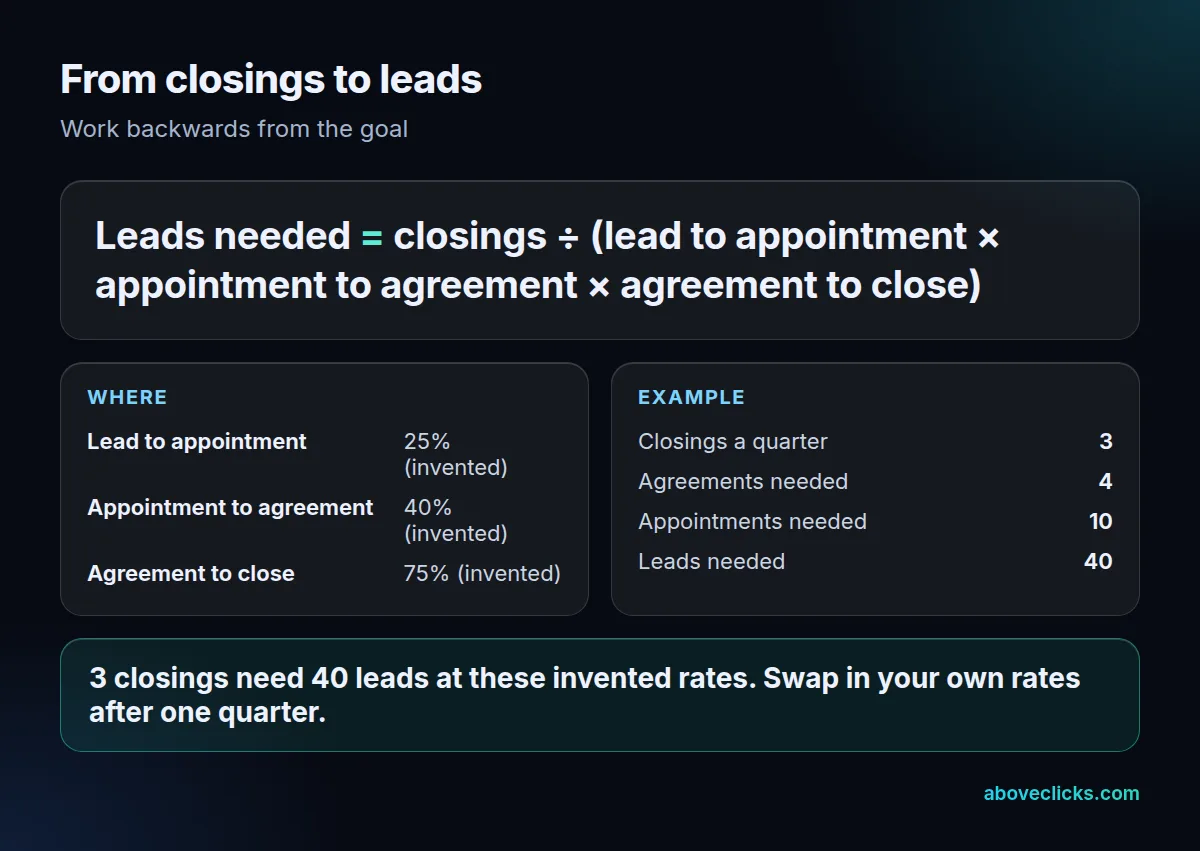
The sums, step by step:
- 3 closings ÷ 75% of agreements that close = 4 signed agreements.
- 4 agreements ÷ 40% of appointments that sign = 10 appointments.
- 10 appointments ÷ 25% of leads that book = 40 leads.
Every real estate marketing plan sample online has this step hidden somewhere, usually as a single “lead goal” with no explanation. Showing it lets you see which rate is the weak link. If only 10% of your leads book an appointment, the lead target for the same 3 closings triples the work on the top row, and the plan should say so.
The three rates are invented. We found no primary source for a market-average lead or conversion rate, so we don’t quote one. After one quarter, your CRM gives you real rates; use those, and the lead target moves with them.
This is also how we judge campaigns for property clients. As our real estate marketing page says, we count site visits and bookings rather than cost per lead, because the cheapest lead is not always the one that books.
What should each channel line in the plan say?
Four things: a lead target, a monthly routine, an owner and a stop rule. A good line fits on one row and can be checked by someone who did not write it.
Here is how the sample real estate marketing plan fills each one:
- Past clients and referrals: the largest line, at 14 of 40 leads, and the cheapest to run. The routine is a list of 20 people and a dated note or call to each.
- Google Business Profile and website: Google asks for the real-world name you use on signage and stationery, and verification options vary by business type. The routine is two posts and a reply to every review.
- Direct mail: one mailing a month to 400 homes. USPS lists EDDM Retail flats at $0.26 per piece as of November 2026, so postage for 400 pieces is $104, before printing and design.
- Email: only to people who agreed to hear from you. Our real estate email marketing guide covers the list and the rules.
Each line should also name a record. Past-client calls go in a spreadsheet or CRM with a date, mail gets a unique phone number or web address, and ads get their own form. Without that, the sample marketing plan for real estate cannot tell you which line produced a lead, and the monthly review has nothing to count.
The stop rule is the part people skip. For example: if a channel reaches less than half its lead target two quarters running, change it or drop it.
Which advertising rules belong in the plan?
Fair housing wording, housing-category targeting limits and email opt-outs. Write them into your sample marketing plan for real estate as checks, so nobody has to remember them on the day an ad goes live.
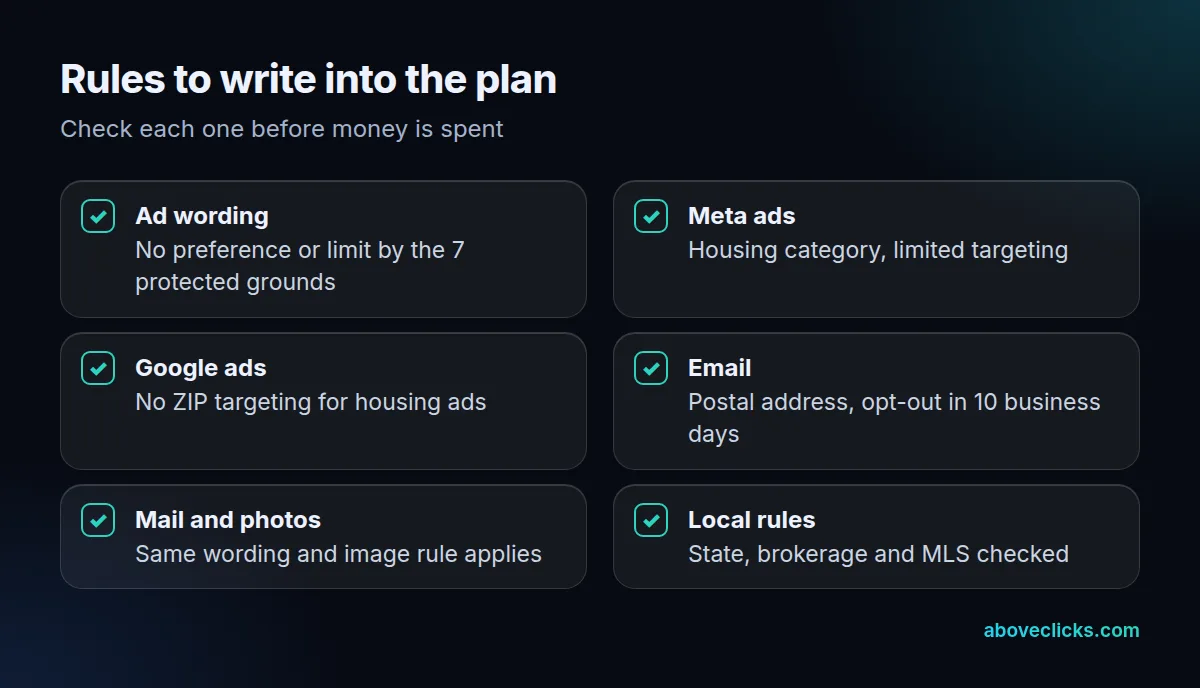
The rules behind the checklist:
- Wording and images: 24 CFR 100.75 makes it unlawful to publish a dwelling advertisement that shows a preference or limit by race, color, religion, sex, handicap, familial status or national origin. Words, photographs, illustrations and symbols all count.
- Meta: under its special ad category, housing ads for US advertisers lose age, gender, ZIP code, exclusion targeting, lookalike audiences and saved audiences.
- Google: its personalized advertising policy bars age, gender, marital and parental status targeting, and ZIP code location targeting, for housing ads in the US and Canada.
- Email: the FTC’s CAN-SPAM guide requires a valid postal address and a clear opt-out, and says to honor opt-outs within 10 business days.
Two things we have not checked: your state, brokerage and MLS advertising rules, and whether a particular agent ad counts as a housing ad on each platform. Read each platform’s definition and add your local rules to the checklist.
Put the checklist at the end of the one-page sample real estate marketing plan, next to the review date. A rule that is written down on the page gets checked; a rule that lives in someone’s memory gets missed in the week of a launch.
How do you adapt a sample real estate marketing plan for a listing?
Treat the listing as a short plan of its own, built around the list date. The quarter in the sample real estate marketing plan stays the same; the listing adds a three-stage routine on top.
- Before the list date (2 weeks): photos, description, a page for the home and a Business Profile post ready to go.
- Launch week: one housing-category social ad, a mailing to nearby homes, an update to past clients.
- Days 8 to 14: count showings and enquiries. At day 14, hold a review with the seller.
The 14-day review is an invented example, not a rule. Pick a date you can keep, and decide before launch what you will look at, such as showings and enquiries, so the conversation with the seller is about numbers.
For sellers, put the same advertising checks on the listing plan: wording, photos and targeting are the same rules as above, applied to one home.
How do you review the plan each month?
In 30 minutes, with four numbers: leads by channel, appointments, signed agreements and closings. Compare each with the quarter’s target and write one decision per channel: keep, change or stop.
A simple monthly test for the sample real estate marketing plan:
- Did each channel run its routine? If not, the plan was not tested.
- Is any channel below half its lead target for the second time? If so, change it.
- Are the three conversion rates still close to the invented ones? If not, update the formula.
- Did every ad and email pass the rules checklist before it went out?
One more habit makes a sample real estate marketing plan useful after the first quarter: keep each old version. When the next quarter’s leads come in, compare the new rates with the invented ones and write down the difference. After two or three quarters, you have your own plan instead of a sample, which is the aim.
If the numbers do not move after a full quarter of following the routines, the problem is usually the offer or the follow-up speed, not the channel list. Our free audit reviews your ads, pages and lead handling and sends a PDF report within 2 workdays. More on our real estate digital marketing work is on the industry page, and more guides are in industries.