Social media marketing fees are the charges for planning, creating and running a brand’s social content and ads. They usually cover the agency’s own work only, while ad spend, creator payments and tools are billed separately.
This guide splits a quote into five lines, shows who is paid for each, works one example through, and lists the terms to check before you sign.
What are social media marketing fees?
The money you pay, to the agency or to others, for social media work. Social media marketing charges rarely arrive as one number, because several different parties are paid for different parts of the work.
Most quotes for social media marketing fees mix five lines: the agency fee, creative production, creator fees, ad spend and tools. The agency may invoice only the first two, or all five. Either way, you pay for all five, so compare quotes on the total and on who receives each line. In the worked example further down, those five lines add up to $5,700 for the month, of which the agency invoices $2,700.
A short quote is not a cheap quote. A quote that fits on one line often hides the same five costs, just without the names, and that is where a month 3 argument about “what we thought was included” usually starts.
Our guides on monthly social media packages and the hourly rate for social media marketing cover tiers and hours. This one covers the bill itself.
What do social media marketing fees include?
The agency fee covers planning, posting, community replies and reporting. Social media management fees often exclude production, creators, tools and ad spend, so read each line of your social media marketing fees against the table below.
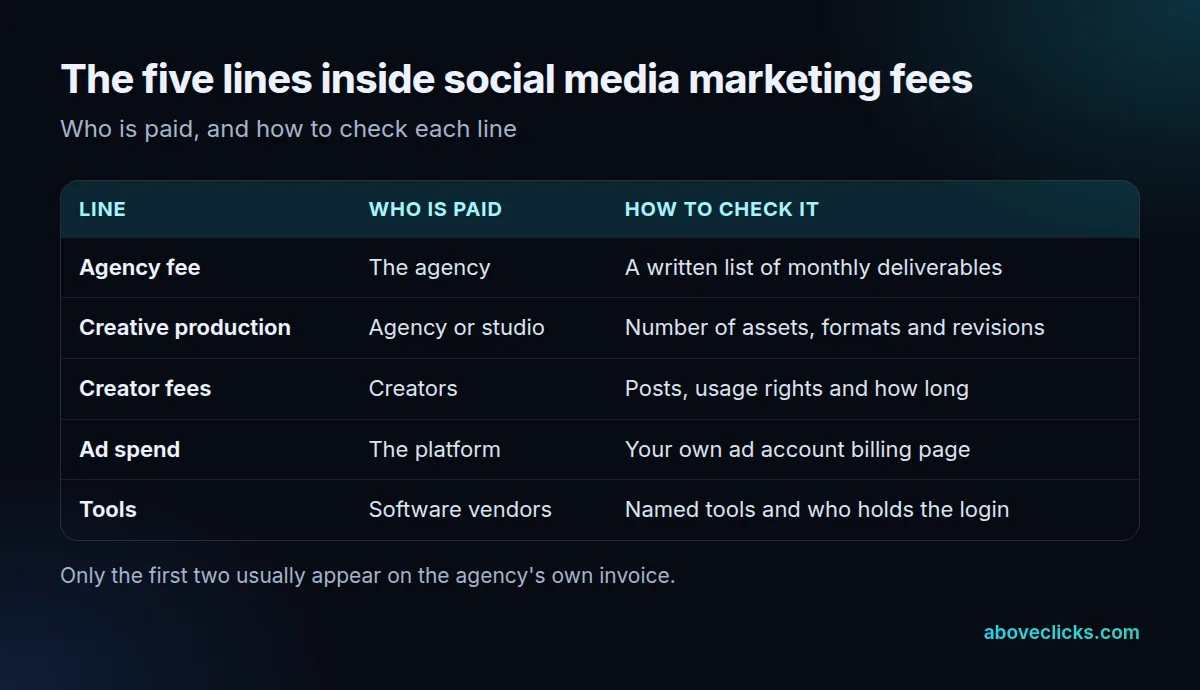
In that example, creative production is $800 of a $2,700 invoice, and the creator posts and the ad budget are billed to someone else. Ask the quote to name every line, even a line that costs nothing. A line marked “included” with no deliverables is the one that causes disputes in month 3.
Two lines hide most surprises, and a third, creator payments, depends on how the content is made:
- Creative production: photos, short videos and graphics. Ask for the number of assets, the formats and how many revision rounds are included. We don’t run studio or on-location shoots; filming stays with your team or creators.
- Creator fees: the payment to the people who appear in or make the content. Ask how many posts are included, how long the brand may reuse each one, and whether renewing that right is billed again.
- Tools: scheduling, design and reporting software. Ask whether the agency’s tools are in the fee and who holds the logins if you leave.
Is ad spend part of social media advertising fees?
Usually not. Social media advertising fees paid to an agency cover the work of building and managing ads. The ad budget itself is charged by the platform to the payment method on the ad account.
Platform billing rules show why. On TikTok, manual payment needs a 100% advance deposit before ads run, automatic payment bills when the billing threshold or bill date arrives first, and monthly invoicing is due 30 days from the invoice date unless agreed otherwise. Each option charges the account holder. Monthly invoicing is available only to eligible businesses, so check which option your account has before you assume an agency can pay on your behalf, as of November 2026.
Meta works the same way through the ad account. Its permission roles are Admin, Advertiser and Analyst, and only an Admin can change the payment method or manage who has access. Advertisers can build and edit ads but cannot change payment.
If an agency does pay the platform and bills you afterwards, ask for the platform’s own invoices alongside its bill, so the ad budget is never marked up without you seeing it. That gives you a simple setup. Keep the ad account and the payment method in your name, and give the agency the Advertiser role. Then the platform bills you directly, and the agency fee stays a separate line.
How do social media management fees add up each month?
Add all five lines of social media management fees and costs, not just the invoice. The agency invoice is often the smaller part of what leaves your account in a month.
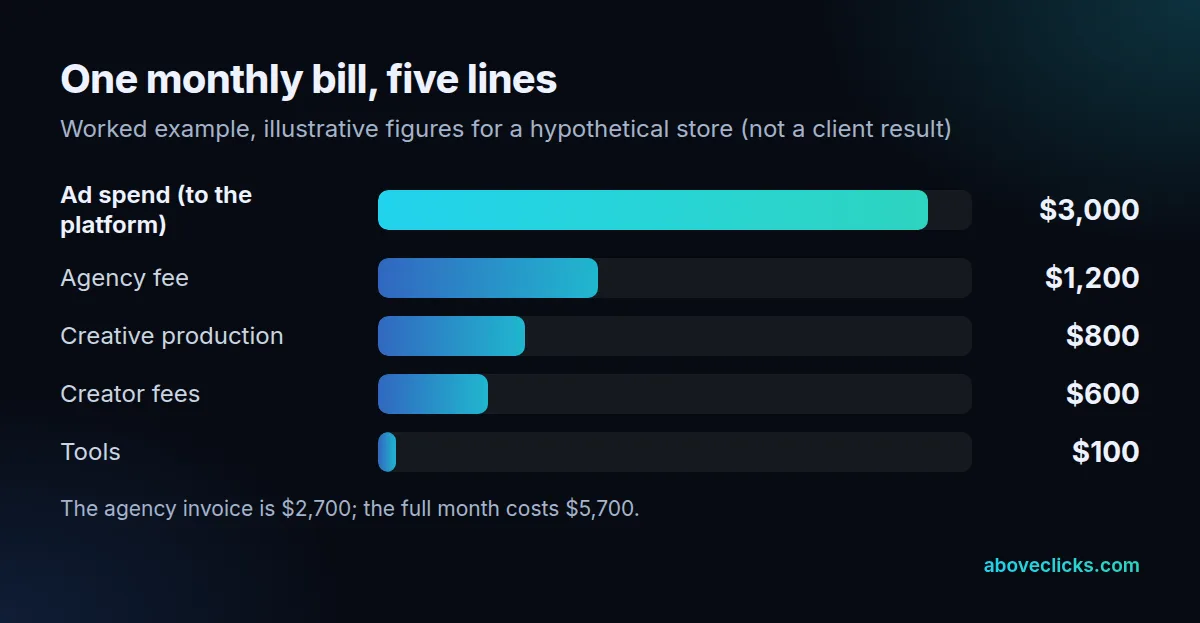
Example: a hypothetical store gets a quote for $1,200 of agency work, $800 of creative production, $600 of creator posts and $100 of tools. That is a $2,700 invoice. The store also sets a $3,000 ad budget, which goes to the platform. The month costs $5,700, which is more than double the number on the quote. These are illustrative figures, not market rates.
The split matters more than the total. Media share is $3,000 ÷ $5,700, or 53%, and the other 47% pays for work. If the share of media drops to 20%, the store is paying a lot for content that few people will see. If it rises to 80%, the ads may be running on thin creative.
This is why a social media marketing cost quoted as one low number tells you little, and why social media marketing fees should always be read as a total. Ask for the total with the ad budget shown, so you can see what share of the month goes to work and what share goes to media.
How do agencies structure social media marketing charges?
Most use one of three shapes for their social media management fees: a flat monthly fee, a percentage of ad spend, or a fee per deliverable. Each moves the risk to a different side. Our pricing models guide covers the wider options.
- Flat monthly fee: easiest to budget. Check that the deliverables are listed, or the scope drifts.
- Percentage of ad spend: 10% of a $3,000 budget is $300, and 10% of $6,000 is $600. Ask what extra work the second $300 buys.
- Per deliverable: a set fee per post, video or campaign. Good for variable months, but busy months cost more.
A percentage method is common for paid social, while organic work is usually flat or per deliverable. Mixing them is normal, as long as each line says which method applies.
One mixed setup looks like this: a flat amount for organic posting and reporting, plus a 10% share of ad spend for managing the campaigns. Read together, those two social media marketing charges should still be explainable in one sentence each. If the agency can’t say what the second one pays for, ask before you sign.
What should a social media marketing contract say about fees?
It should name each of the social media marketing fees, who owns the ad account, who pays creators and for what rights, and how you can leave. The checklist below covers the terms that change the real cost.
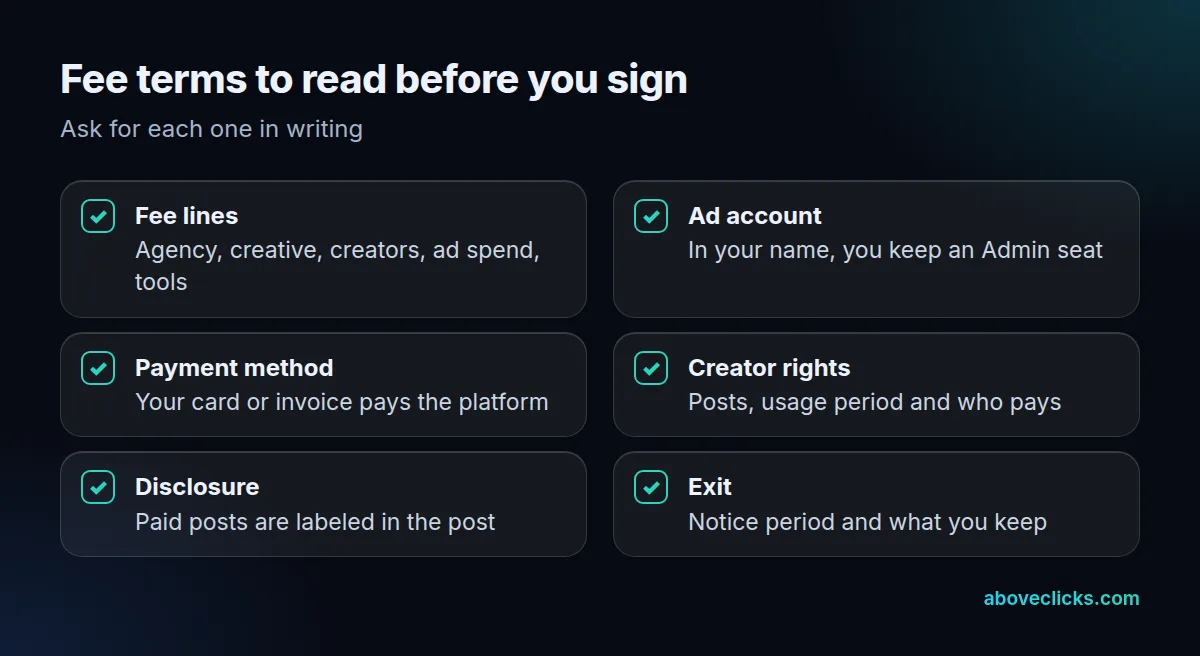
Account access is the term people forget. In Meta’s business portfolio, people can have full or partial access, and finance access is a separate permission covering transactions, invoices, account spend and payment methods. Temporary access lasts from 3 to 75 days, which suits a short test project.
Creator posts add a legal line. The FTC’s influencer guidance says a financial relationship, including payment, must be disclosed, and the disclosure belongs in the post itself, not only on a profile page. Its Q&A on the Endorsement Guides adds that enforcement focus usually falls on advertisers or their ad agencies. Put the labeling duty in the contract, and say who checks it.
Also ask, in writing:
- Do you own the posts, briefs and images made for you if you leave in month 2?
- How long may the brand reuse a creator’s content, and is renewal a new fee?
- What is the notice period, and is the last month billed in full?
How do you check a fee quote before you sign?
Ask four questions about the social media marketing fees and write the answers beside the quote. If any answer is vague, the line behind it is probably not priced yet.
- Which of the five lines are in this quote, and which are billed elsewhere?
- Whose account and whose payment method run the ads?
- What exactly is delivered each month, as a list?
- What changes the fee: more spend, more posts or a new tier?
Then compare quotes on the same basis: total monthly cost with ad spend shown separately. In the worked example, that means writing $5,700 beside the quote, not $2,700. Two quotes with different lines can’t be compared by their headline number.
Red flags are easy to spot once the lines are written down: a single figure with no deliverables, an ad budget that sits inside the agency’s own account, creator posts with no usage period, and a minimum term longer than 3 months with no exit clause.
If you want a second opinion on a quote, our free social media strategy audit checks your profiles and what you post today, and we send a PDF report within 2 workdays. It is a good way to see which of your current social media management fees pay for work you can actually see. The social media strategy service page shows what the plan covers. Or start with the free audit. More guides are in buying guides.