A commercial real estate marketing plan is a written budget, calendar and scorecard for a year or a portfolio of spaces. Judge one by its cost per tour, proposal and signed lease, not by clicks or leads.
This guide shows how to set the spend cap from the deal, split it across channels, lay out four quarters of work, measure the result and avoid five costly gaps. It takes the budget view; for a single 90-day vacancy, see our commercial real estate marketing guide.
What is a commercial real estate marketing plan?
A one-to-two page document that names the assets, the audiences, the budget cap, the channels, the dates and the numbers you will review. It turns a commercial real estate marketing strategy into something a team can check.
The strategy says who you want to reach and why. The plan says how much you will spend on each asset, in which weeks, and what has to happen before you spend more. A commercial real estate marketing strategy without a cap tends to grow with every new idea, and a commercial real estate marketing plan without a review date tends to run until the space is let.
Writing it down also settles who decides. When the owner, the broker and the marketing lead all see the same cap and the same dates, a change in the middle of the year is a decision against the plan instead of a surprise.
It also differs from the vacancy plan in our commercial real estate marketing guide. That one follows a single space for 90 days. This one covers the year: several assets, the firm’s own profile and the budget that ties them together. Residential teams will find the home-sales version in our real estate marketing plan guide.
What should a commercial real estate marketing plan include?
Seven things: the assets, the audiences, the budget cap, the channels, the calendar, the tracking and the review dates. If one is missing, the plan cannot be checked.
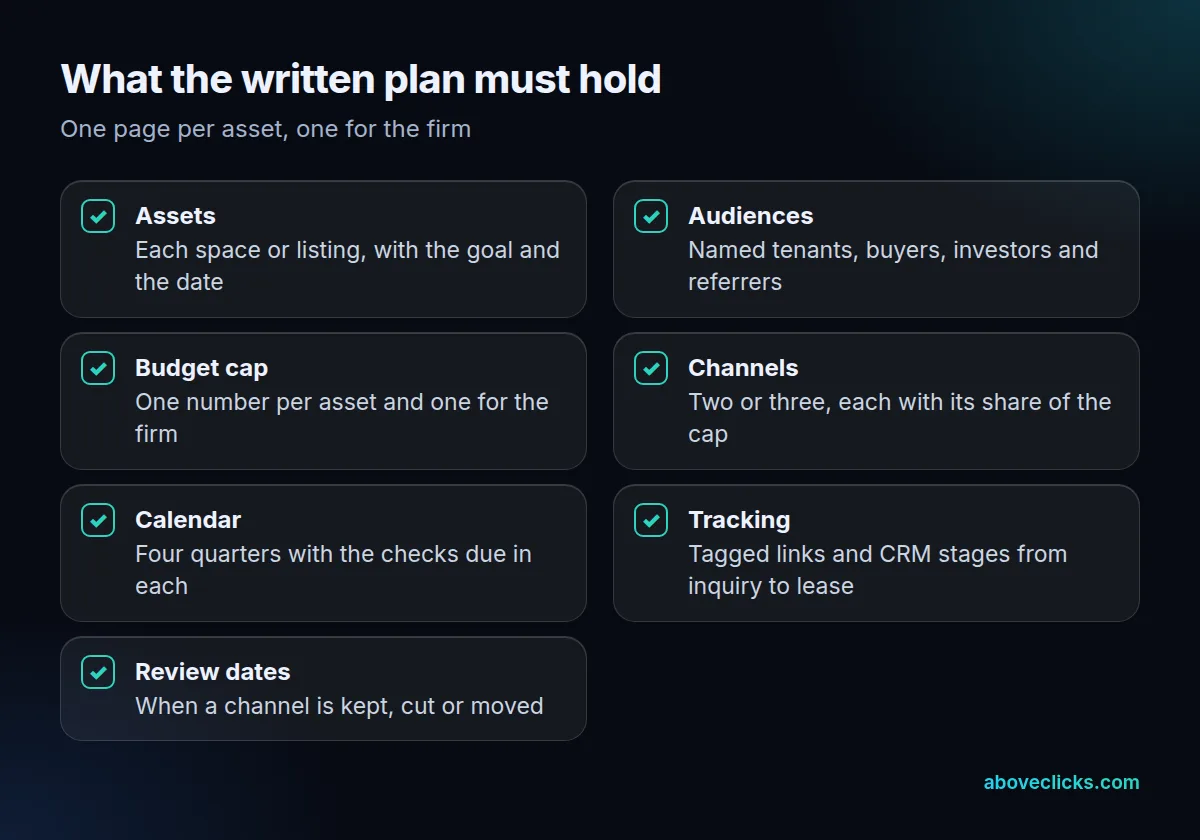
Keep each item short. For example, an industrial unit might name 15 to 25 target companies and 5 to 10 tenant brokers. Under “Assets”, list the space, size, asking terms and the date you want it let or sold. Under “Audiences”, name companies and roles rather than segments such as “growing businesses”. Under “Channels”, pick two or three you can measure, because six channels with a small share each rarely produce enough data to learn from.
The tracking line is the one most plans skip, and it is where a commercial real estate marketing plan earns its keep. Write down which CRM stages count (inquiry, tour, proposal, signed) and who updates them. Without those four stages, the scorecard later in this guide cannot be filled in.
The sections above also work as a template: copy the seven items into a document, fill in one page per asset, and add one page for the firm.
How much should a commercial real estate marketing budget be?
As much as the deal can carry, written as a cap. Take the expected fee from one signed deal and decide what share of it you will risk on marketing. A 10% share is a starting point to adjust, not a market norm.
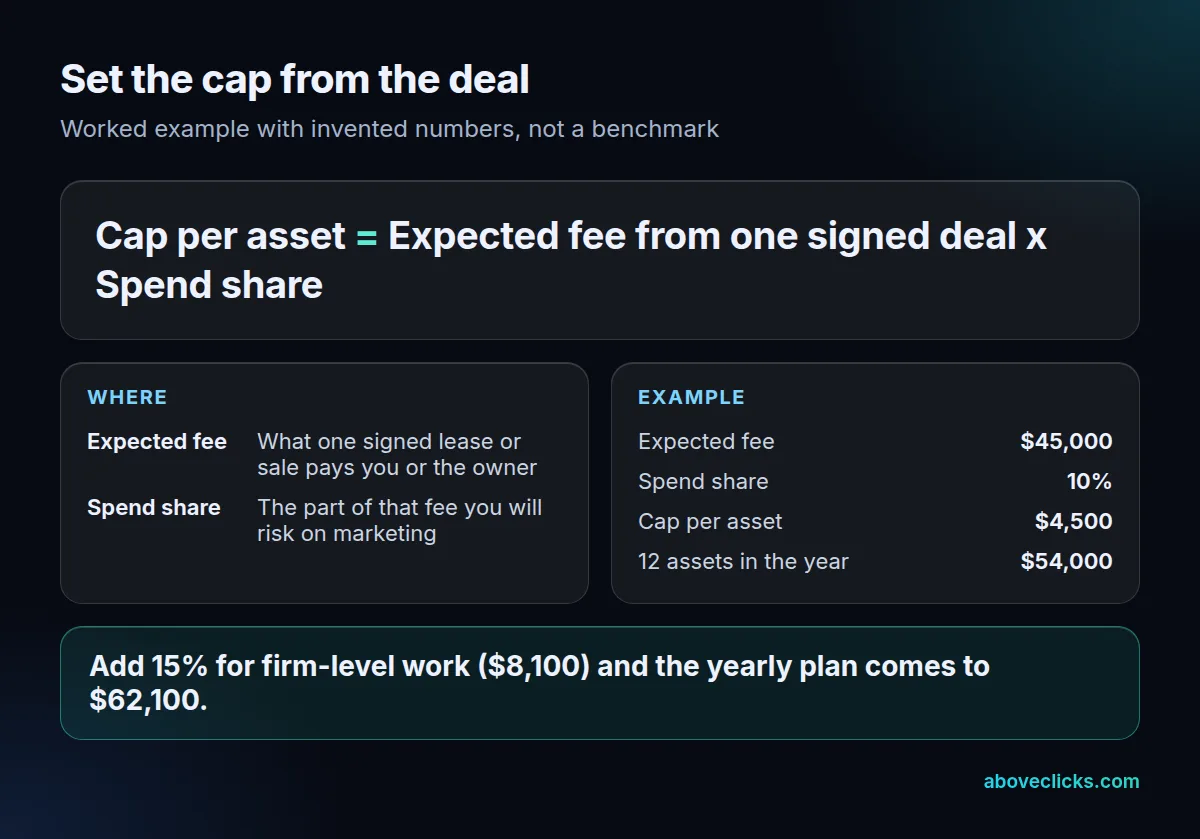
The worked example above uses invented numbers. If one signed lease earns you $45,000 and you risk 10% of it, the cap for that asset is $4,500. With 12 assets marketed during the year, the listing caps add up to $54,000. A further 15% for firm-level work, such as keeping a Business Profile current and writing referral updates, is $8,100, so the commercial real estate marketing budget for the year is $62,100. Test any quote against that number.
That is a cap, not a target. If a space lets in week 3, you stop spending. The commercial real estate marketing cost then ends below the number on the page, and the unspent part returns to the next asset.
To turn a monthly amount into an ad setting, use Google’s own rule. As of November 2026, Google Ads sets an average daily budget, and a day’s spend can reach two times that amount for most campaigns, with a monthly limit of 30.4 times the daily figure. In the example, search takes 40% of the $54,000 listing total, or $21,600 a year. That is $1,800 a month, and $1,800 divided by 30.4 is about $59 a day.
How do you split the budget across channels?
By the job each channel does for that asset: search finds people already looking, account-based ads reach named companies, email follows up with known contacts, and the proof page converts all of them.
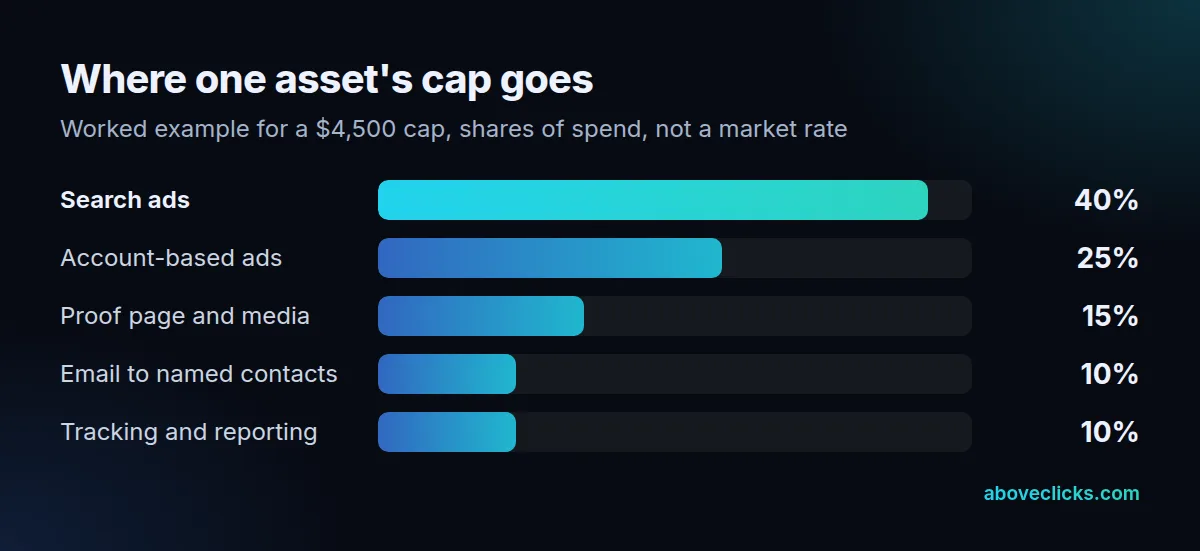
The chart breaks the same $4,500 cap of the commercial real estate marketing budget into five lines. It is one worked example, not a benchmark. Search gets 40% ($1,800), account-based ads 25% ($1,125), the proof page and media 15% ($675), email 10% ($450) and tracking and reporting 10% ($450). Shift the shares by asset: a niche industrial unit with a handful of possible tenants may put more into account-based ads and less into search.
Media is worth its share. Google’s Business Profile photo guidance asks for JPG or PNG files between 10 KB and 5 MB, and accepts videos up to 30 seconds and 75 MB at 720p or higher. A brokerage with a staffed office can reuse the same walkthrough clips on the profile, the proof page and in email.
For more on the commercial real estate marketing strategy behind each channel, see our guides to commercial real estate email marketing and the real estate digital marketing work we do.
What does a year of the plan look like?
Four quarters: set up and baseline, first assets live, review and move money, then plan the next year from the data. Each quarter ends with something you can check, and each asset is reviewed every 4 to 6 weeks.
- Quarter 1: write the asset pages, tag every link, connect the CRM stages and launch the first 2 to 3 assets. Check: every inquiry shows its source.
- Quarter 2: run the assets in market and review each at the date written in the plan. Check: a cost per tour for each channel.
- Quarter 3: move unspent cap from assets that let to those that have not, and drop channels with no tours. Check: spend against cap for every asset.
- Quarter 4: compare the year with the cap, keep what produced proposals and write next year’s plan. Check: cost per signed lease for the year.
Every commercial real estate marketing plan will see its quarters overlap, because assets come to market at different times. The calendar fixes the review dates, not the launch dates, which keeps the commercial real estate marketing strategy tied to checks rather than to hopes.
How do you measure the plan against the budget?
In cost per outcome, from the cap and the CRM stages: per qualified inquiry, per tour, per proposal and per signed lease. Cost per lead alone says little when a commercial real estate marketing plan covers a space that needs only a few right-fit businesses.
Here is a worked example with invented numbers. An asset with a $4,500 cap produces 30 qualified inquiries, 9 tours, 3 proposals and 1 signed lease.
| Outcome | Count | Cost each, if the full $4,500 is spent |
|---|---|---|
| Qualified inquiry | 30 | $150 |
| Tour | 9 | $500 |
| Proposal | 3 | $1,500 |
| Signed lease | 1 | $4,500 |
The last row equals 10% of the $45,000 fee, which is exactly the share the cap allowed. A second lease from the same spend would halve it. Redo the table with your own cap and counts after each review.
To fill it in, every link needs tags. Google Analytics asks for the campaign source, medium and name, and warns that capitalization differences such as Meta and meta create separate rows, so use lowercase. Then send the later stages back: Google says that offline conversion data matched with customer details, such as email addresses, produced a median 10% increase in conversions compared with standard offline imports. For a commercial real estate marketing plan, that means signed leases and tours can feed the bidding, not just form fills.
Which 5 gaps make a commercial real estate marketing plan cost more than it should?
Five: no cap, untagged links, slow replies, unchecked email rules and no review date. Each one hides what the spend produced, so the plan keeps paying for channels that do not work.
- No cap per asset. Without a number, spend follows the last idea. Write the cap before the first ad runs.
- Untagged links. If three channels send the same visitor to the same page, you cannot tell which one earned the tour. Tag every link.
- Slow replies. A named person should answer each inquiry the same day. Paid traffic that waits two days is budget lost after the click.
- Email sent without checking the rules. As of November 2026, the FTC’s CAN-SPAM guide says each separate email in violation can bring penalties of up to $53,088, and that opt-out requests must be honored within 10 business days.
- No review date. A plan that says “optimize ongoing” never moves money. Put the dates in the calendar.
A commercial real estate marketing plan that survives its first review date is usually one with a cap, tags and a named owner for every reply. If you want a second opinion on the numbers in your own plan, our free audit reads your ads and tracking with read-only access, and the real estate marketing page lists what we do. More guides are in the industries section.