Drip marketing in real estate is a pre-written series of emails that goes out on a schedule after a trigger, such as a form fill or a closing anniversary. Good drip marketing real estate teams run is built around its spacing, its job per email and its stop rule.
This guide compares the three real estate drip campaign sequences worth building first, walks through a 21-day buyer example, and covers when a drip should stop and which rules apply.
What is drip marketing real estate agents use?
A set of automatic emails sent to one person at planned intervals, starting from something that person did. A buyer fills in a form, receives email 1 at once, email 2 one day later and email 3 three days after that.
The aim of drip marketing for real estate is to stay useful while the lead decides, without an agent typing each message by hand. The same real estate drip campaign can serve a lead who enquired this morning and one who enquired last week, because each person starts their own clock.
A drip is not a way to send more email. It is a way to send the right email at the right moment, then stop. A real estate drip campaign that never ends is a newsletter with extra steps. Most drip marketing real estate agents run should end within 21 days and hand the lead to a monthly list.
How is a drip campaign different from a newsletter?
A drip starts for each person at their own trigger. A newsletter goes to the whole list on one date. A drip is about where a person is in their search; a newsletter is about what is new this month.
A newsletter might go out once a month to 400 people on the same day, while a drip of 6 emails starts separately for each of them. Most teams need both. Use a drip campaign for real estate leads in their first 3 weeks, then move them onto the newsletter. Our guides to real estate email marketing and marketing automation for real estate agents cover the newsletter and the wider rules; this one stays on the sequence itself.
Which real estate drip campaigns should you build first?
Three: a new buyer enquiry, a seller valuation request and a past client. They start from different triggers, run for different lengths and stop for different reasons.
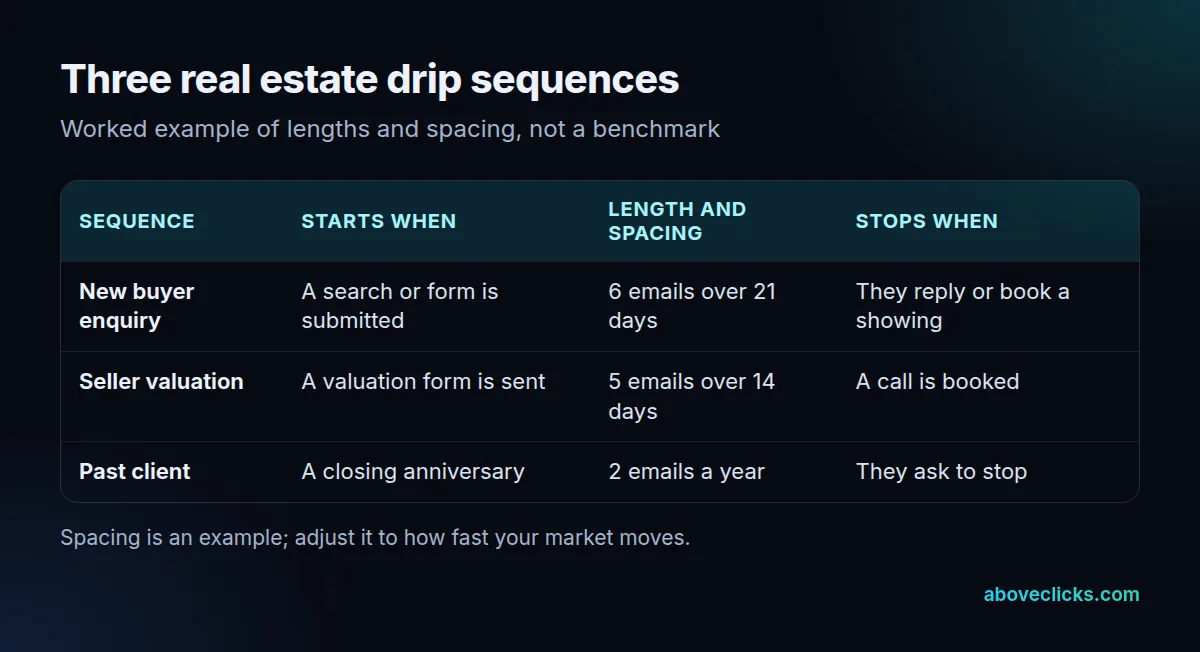
The lengths above are a worked example, not a benchmark: 6 emails in 21 days, 5 in 14 days and 2 a year. The buyer real estate drip campaign is the busiest because a buyer enquiry goes cold fastest. The seller sequence is shorter because someone asking for a valuation usually wants a call quickly. The past-client sequence is slow on purpose: two emails a year, tied to the closing anniversary, are enough to stay remembered without feeling like marketing.
If you can build only one real estate drip campaign first, build the buyer sequence, since it covers the most new leads. Real estate drip campaigns for other segments, such as landlords or investors, can reuse the same pattern with different questions.
How many emails should a real estate drip campaign have?
Five or six for a new lead, spread over two to three weeks, then a slower list. The number matters less than the gaps, and the gaps are set with time delays, not left to chance.
Klaviyo’s documentation on time delays says components placed back to back without a delay all happen at once, so you will almost always want a delay between two consecutive emails. Delays can be set in minutes, hours or days. A delay in days can also target a time of day, in the recipient’s local time zone, or limit sending to chosen weekdays.
Weekday limits stretch the wait. In Klaviyo’s own example, a person who enters on Tuesday with a two-day delay and only Monday, Wednesday and Friday allowed finishes waiting on Thursday and receives the email on Friday. Check the real gap in a test before you promise a lead “an email in two days”.
The costly mistakes are usually timing ones. A lead who gets email 2 and email 3 on the same afternoon sees two near-identical messages and may unsubscribe. A lead who waits 10 days for email 2 may have moved on to another agent by then, and the first email’s question has gone cold. Set the first gap to one day, read the test send as the lead would, and only then widen the later gaps. Write down the gap you intended for each email next to the gap the test actually produced; if the two differ by more than a day, fix the delay settings before any real lead enters the sequence.
Two guards against over-sending:
- Space the first three emails close together (day 0, day 1, day 4) and widen after that.
- Switch on a skip rule for people emailed recently. Klaviyo calls it Smart Sending and lets you turn it on or off for each flow email.
What should each email in a drip campaign for real estate say?
One job each. The first confirms the enquiry and asks one question; the later ones explain a step, answer a worry or show something that fits what the lead said.
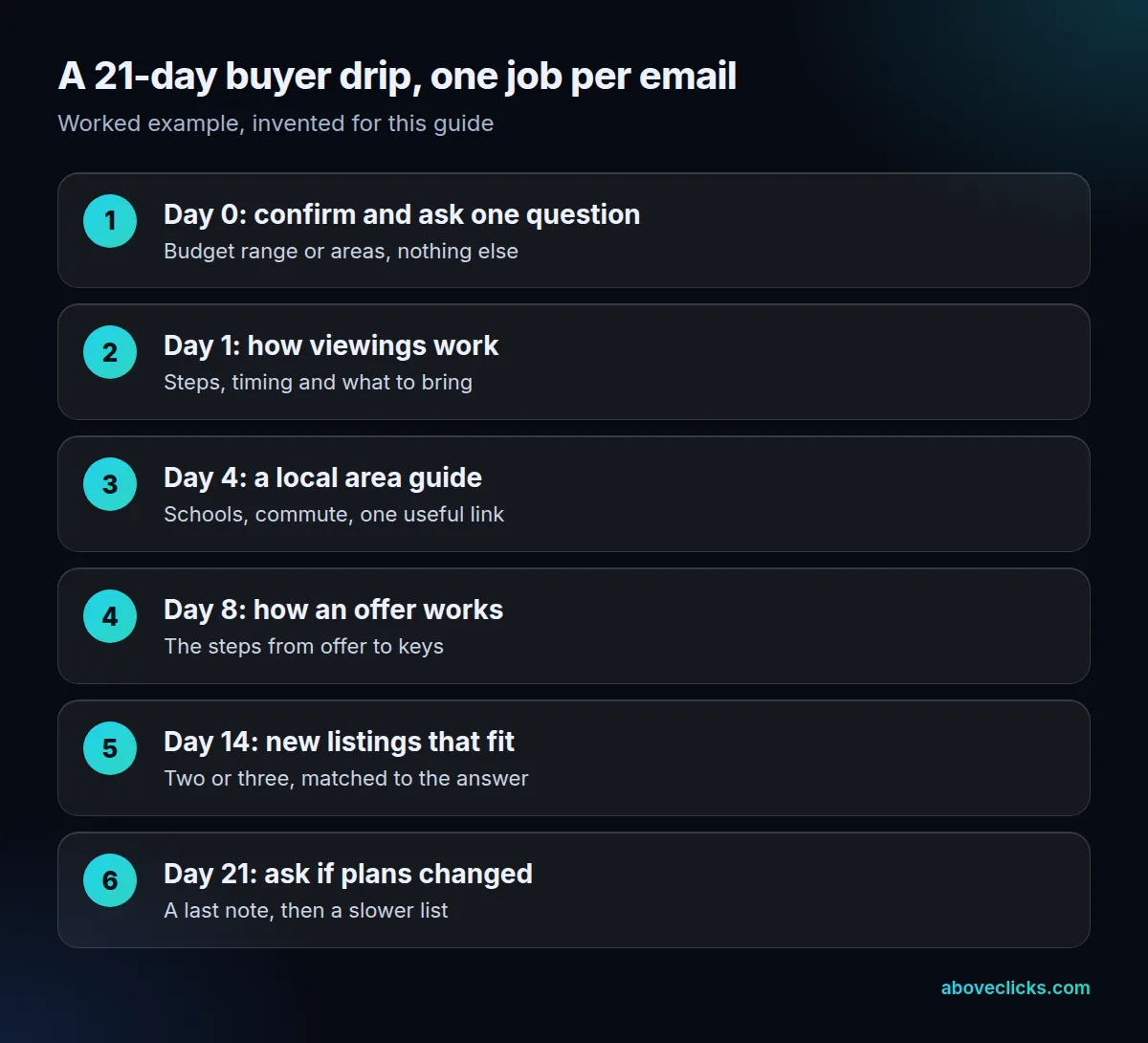
The drip campaign real estate example above is invented for this guide, but the pattern is how we structure email flows for any business: the first message asks a single question, and every later message earns a reply with one idea. A drip campaign real estate buyers receive that opens with five listings and a long bio gets skimmed. Ask for the budget range or the areas, then use the answer in email 5.
Keep each email in a real estate drip campaign under 150 words, short enough to read on a phone, with one link or one question. In a 6-email drip campaign, that is under 900 words of writing in total. Put the agent’s real name in the sender field, because the reply should go to a person, not a no-reply address.
When should a drip campaign stop?
When the person replies, books a showing or valuation, becomes a client or unsubscribes. A drip that keeps sending to someone who has already answered looks careless and loses the lead’s goodwill.
Stopping is the part of drip marketing real estate teams get wrong most often, because a split in the flow is not a live check. Klaviyo’s page on splits says a profile is evaluated once, when it reaches the split, and is not moved to another path if its activity changes afterwards. So a reply on day 2 does not remove the person from a branch they entered on day 1.
Use these stop rules instead:
- Add a filter to each email so it re-checks the person at send time.
- Record bookings and replies in the same system as the drip, so the filter can see them.
- Send unsubscribes to the suppression list automatically.
- End every series with a slower list rather than silence, so the lead is not dropped.
- Treat an opt-out as final: the FTC’s 10-business-day rule is a legal limit, not a target, so remove the person from every sequence at once.
Test each rule of your real estate drip campaign with a fake contact before launch: submit the form, reply as that contact, and confirm the next email does not send.
Which rules apply to real estate drip emails?
Three groups: the CAN-SPAM rules for any commercial email, mailbox-provider rules for bulk senders and the Fair Housing Act for what the emails say.
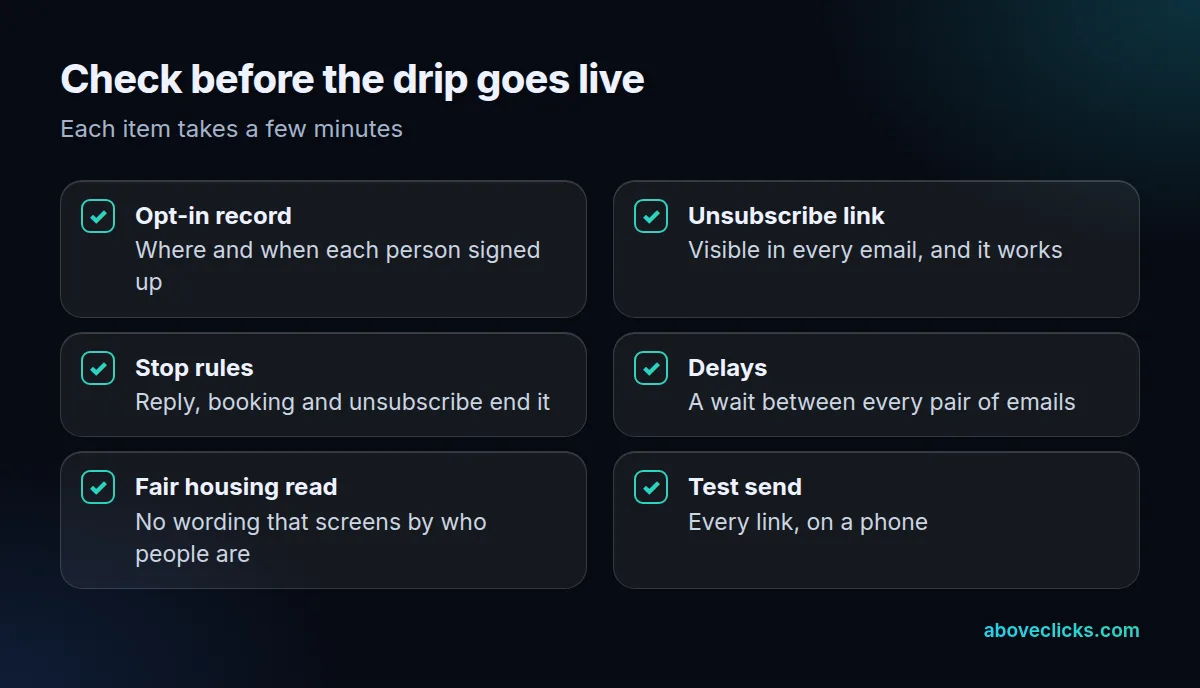
CAN-SPAM. The FTC’s compliance guide says every commercial message needs accurate header information, a non-deceptive subject line, a clear opt-out and a valid postal address. You must honour an opt-out within 10 business days, and the opt-out method must keep working for at least 30 days after you send. The FTC states penalties of up to $53,088 per violating email, as of November 2026.
Mailbox providers. Gmail’s sender guidelines say that senders of more than 5,000 messages a day need one-click unsubscribe on marketing messages, as well as a visible unsubscribe link in the body. The same page says to always give recipients an easy way to unsubscribe. Most agents sit well below 5,000 a day, so the one-click header is rarely required for a single agent, but a working link in each of the 6 emails is.
Fair housing. HUD’s overview of the Fair Housing Act lists seven protected characteristics: race, color, national origin, religion, sex, familial status and disability. Have someone read every email in a real estate drip campaign with that list in hand, and avoid wording that steers a reader toward or away from a neighbourhood because of who they are.
Build the buyer real estate drip campaign first, test every stop rule, then add the other two. Drip marketing real estate teams rely on works only if the stop rules do. If you want help setting up the flows, our Klaviyo email marketing service builds and tests them, and the real estate digital marketing page shows where drip sits in a wider plan. For a second opinion on an existing setup, request a free audit. More industry guides are in the industries section.