Marketing for real estate leads is the work of capturing each enquiry, following up inside the rules and tracing it to a closed deal. Most leads are lost after the form is submitted, not before.
This guide shows the five costly mistakes behind most lost leads, a worked ledger that ranks each source of real estate marketing leads by cost per signed client, and a 30-day follow-up cadence for marketing for real estate leads.
What is marketing for real estate leads?
It is everything that turns an ad click, a call or a form into a conversation with a buyer or seller, plus the record that shows which source paid off. Ads are one part; capture, follow-up and tracking are the rest.
A lead here means a person who gave you contact details and asked for something: a valuation, a viewing or a call. Real estate marketing leads usually take weeks or months to decide, so the work after the form matters as much as the ad in marketing for real estate leads.
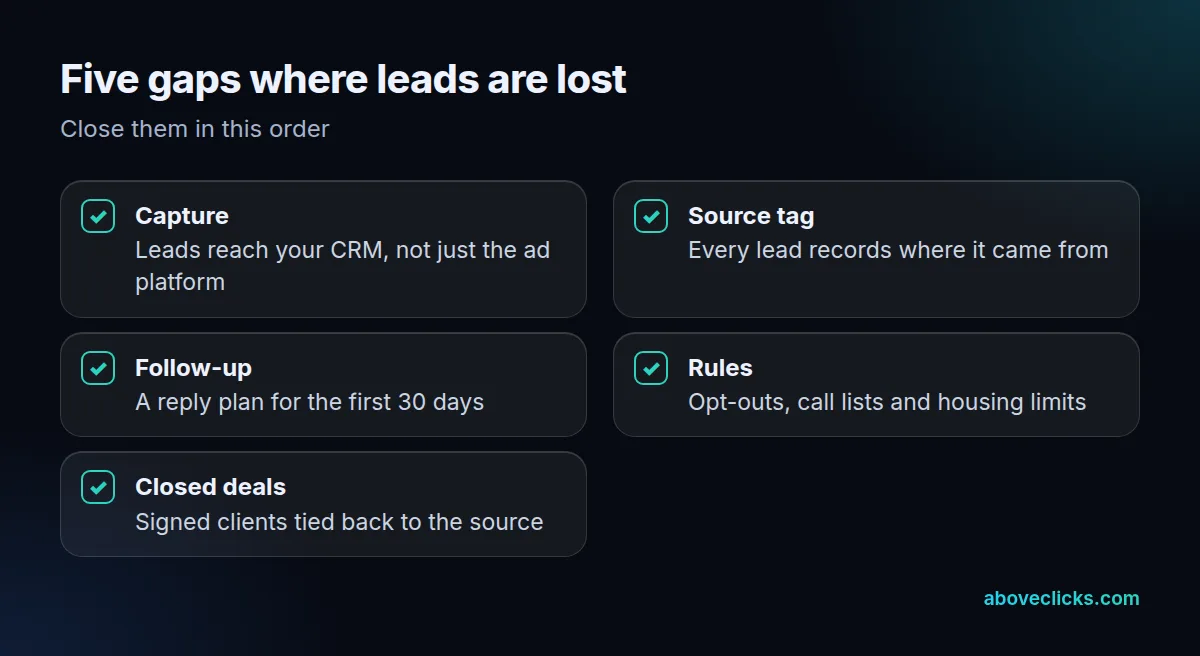
The five gaps in the figure are five costly mistakes, listed in the order we would fix them. Each one gets a section below:
- Capture: leads reach your own CRM, not only the ad platform.
- Source tag: each lead records the channel, campaign and date.
- Follow-up: a reply plan covers at least the first 30 days.
- Rules: email, calls and housing ad limits are respected.
- Closed deals: signed clients are tied back to the lead source.
If you also need the budget split or ad setup, our guides to PPC for real estate and the real estate marketing plan cover those. This one starts after the click.
How do real estate agents get leads?
From a small set of sources: paid search, social lead ads, email to past clients, a website with forms, referrals and a Business Profile. Each source behaves differently, so each needs its own line in your records. Start every source with a 30-day test of at least 10 leads before you judge it.
Paid search catches people who are already looking. Social lead ads reach people who weren’t searching, so more of those leads need a first conversation to find out if they are serious. Email to past clients costs little and usually produces few leads, but of higher quality. Referrals and a Business Profile cost time more than cash.
One rule applies to paid sources. Meta treats housing as a special ad category: in the US, age, gender, ZIP code, lookalike audiences and exclusion targeting are limited or unavailable for those ads (Meta Business Help Center, accessed November 2026). Google’s policy likewise says that age, gender, marital status, parental status and ZIP code targeting cannot be used for housing ads in the United States and Canada (accessed November 2026). Plan marketing for real estate leads around area and intent, not around who someone is.
Our real estate marketing service page describes how we set up these sources, and our real estate industry page shows where each fits.
Why do real estate marketing leads go cold after the form?
Because the lead sits in a place nobody checks, arrives without a source, or waits too long for a reply. Fixing capture means getting each of your real estate marketing leads into one record the moment it is submitted.
Google’s lead form assets show the risk. Google Ads stores leads for 60 days and lets you download only the last 30 days as a CSV, so leads you don’t export are lost for good (Google Ads Help, accessed November 2026). The same page lists the safer routes: email notifications, the Google Ads API, a webhook to your CRM or a Zapier connection. Lead forms can be added to Search and Performance Max campaigns, and Google lists OTP verification as a way to get better-qualified prospects.
Whatever the source, store these fields with every lead, because marketing for real estate leads needs one consistent record:
- Source and campaign: where the lead came from, as a fixed list, not free text.
- Date and time: to the minute, so you can measure reply time.
- Contact details and what they asked for: valuation, viewing, buyer or seller.
- Consent: whether they agreed to calls, texts or email, and when.
- Click ID: the Google click ID, if the lead came from a Google ad (see below).
- Stage: new, replied, qualified, appointment, signed or lost.
Our own rule for reply time is simple: answer within minutes during working hours, and set an alert so a lead never waits for someone to open a spreadsheet. That is a working rule, not a platform statistic.
How do you nurture real estate leads?
Nurturing is the follow-up half of marketing for real estate leads: a short, dated cadence that mixes calls, texts and email, stops when the person replies or opts out, and follows the contact rules. Most leads need several touches over weeks, because buyers take weeks or months to decide.
A 30-day cadence for your real estate marketing leads, which we would start from, to adjust with your own numbers:
- Minutes 0 to 5: reply by the channel they used, and answer the question they asked.
- Day 1: a call attempt and a short message with one useful link.
- Day 3: an email with a relevant example, such as a market snapshot for their area.
- Day 7: a call attempt and a question: what would make a move worthwhile now?
- Day 14: an email offering a viewing or a valuation.
- Day 30: a final message, then move the lead to a slower monthly list.
Three rules shape this cadence, as of November 2026. Under CAN-SPAM, every marketing email needs a valid postal address and a clear opt-out, and you must honor an opt-out within 10 business days; each email in violation can carry a penalty of up to $53,088 (FTC). On calls, the FTC says a number added to the Do Not Call Registry can take up to 31 days to stop sales calls, and a prerecorded sales call needs written permission. Checking a number against the registry before you call is cheaper than a complaint.
For email-specific campaigns, see our guide to real estate email marketing.
How do you track a lead to a closed deal?
Marketing for real estate leads only proves itself when you record the lead’s source at capture, update its stage as it moves, and send the signed result back to the ad platform. That is the only way to see which source produces clients and not just forms.
Google Ads supports this directly. Its offline conversion import lets you save the Google click ID (GCLID) with the lead, then upload the later result, such as a signed contract, with the time it happened (Google Ads Help, accessed November 2026). The same page says that from June 15, 2026, offline conversion and enhanced conversions for leads uploads move to the Data Manager API and are blocked in the Google Ads API, so check which route your CRM uses.
This is also how we report on our own real estate marketing leads work: a weekly report that shows leads, qualified leads, site visits and cost per site visit, with every lead sent to the CRM within seconds and a PDF audit of your lead ads and landing pages within 2 workdays. Closed deals take longer, which is why the ledger for marketing for real estate leads below keeps a column for them.
Keep the stage names for your real estate marketing leads short and define “qualified” in writing before you count anything. In the example below, qualified means the person replied and said they plan to buy or sell within 6 months.
How much does a lead really cost?
Divide spend by signed clients, not by leads, when you judge marketing for real estate leads. Cost per lead rewards the sources that produce the most form fills, which are often the weakest conversations.
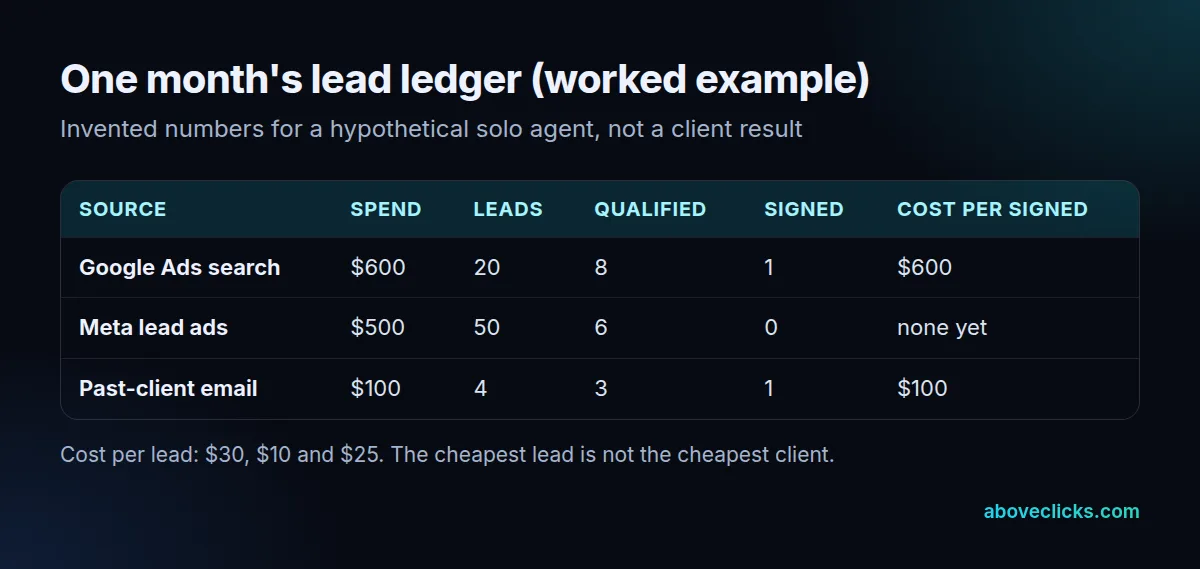
Example: a hypothetical solo agent spends $1,200 in one month across three sources. The invented numbers show the pattern, not a market rate.
- Google Ads search: $600 for 20 leads is $30 a lead. 8 were qualified, and 1 signed, so the cost per signed client is $600.
- Meta lead ads: $500 for 50 leads is $10 a lead, the cheapest. 6 were qualified and none has signed yet.
- Past-client email: $100 for 4 leads is $25 a lead. 3 were qualified and 1 signed, so the cost per signed client is $100.
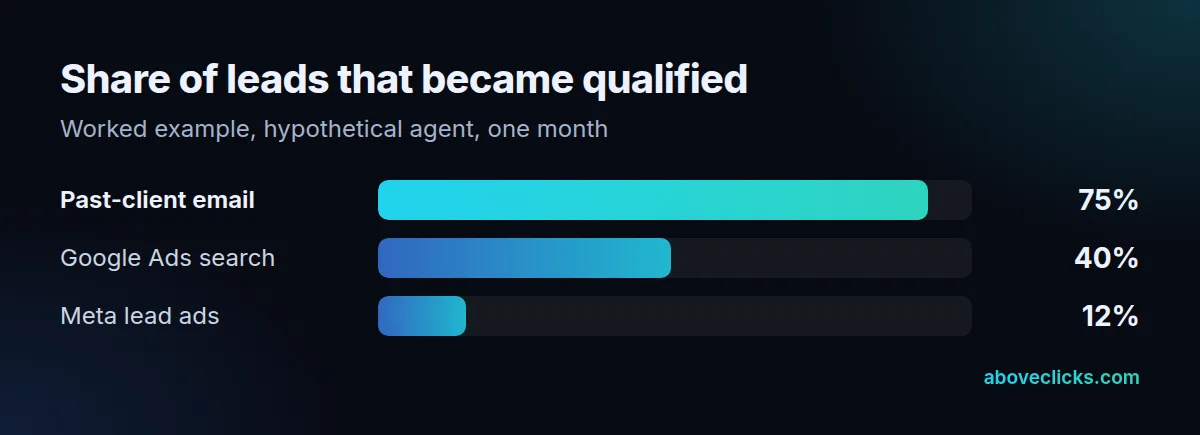
The bars show why. Only 12% of the Meta leads were qualified, against 40% from search and 75% from email. The cheapest lead cost $10, yet its cost per qualified lead was about $83, higher than the $75 from search. Past-client email cost $33 per qualified lead.
One month is too short to judge marketing for real estate leads, because signing takes longer. Keep the unsigned leads in the ledger and update it each week.
When should you keep, change or cut a source?
After each source has produced at least 30 leads, or 90 days have passed. Before that, the numbers are mostly noise.
Use rules like these for marketing for real estate leads, with your own thresholds:
- Keep a source if its cost per qualified lead is falling and at least 1 in 4 leads is qualified.
- Change the form, the offer or the follow-up if a source has more than 30 leads and under 10% qualified.
- Cut a source that has produced no signed client after 90 days and whose cost per qualified lead is above your target.
- Protect cheap, small sources, such as past-client email, because they are rarely the bottleneck.
Review the ledger of real estate marketing leads on the same day each week and compare the last 4 weeks with the 4 before. If you want a second pair of eyes on your lead ads, forms and follow-up, our free audit covers them, and the industries guides go deeper on each channel.