In PPC vs CPC, PPC is the way you buy ads, paying only when someone clicks, and CPC is what each of those clicks costs. They are not rivals: one is the method and the other is the number you measure.
This guide explains the difference between PPC and CPC, shows how Google works out your CPC, separates CPC from CPM, and gives a break-even formula so you can tell whether a click price is good for your store.
What is the difference between PPC and CPC?
PPC (pay per click) is the buying model. CPC (cost per click) is the price of one click under that model. Saying ppc vs cpc is like asking whether renting differs from rent: one is the arrangement, the other is the amount.
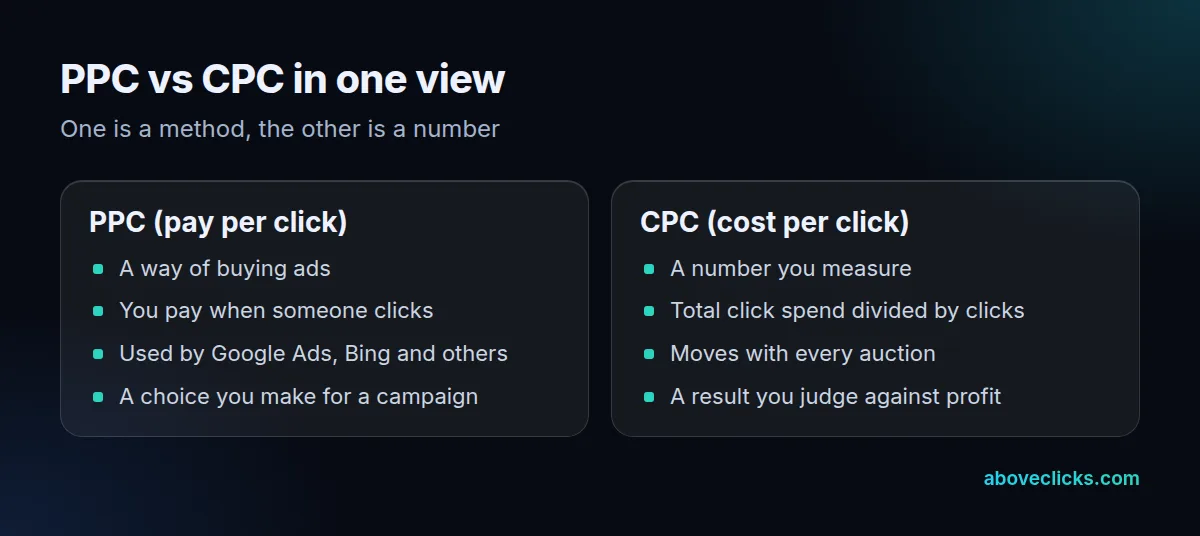
Google’s definition of cost-per-click says CPC bidding means you pay for each click on your ads. You set a maximum cost-per-click bid, or “max. CPC”, the highest amount you are willing to pay for a click.
That is why people mix the two terms up. A campaign that uses PPC is billed by clicks, so its main number is the CPC. Example: if 40 clicks arrive at $1.50 each, the campaign costs $60.00 and the CPC is $1.50. Searches for pay per click vs cpc usually come from someone who has seen both terms in a report and wants to know which one to watch.
How does PPC vs CPC work in Google Ads?
You choose to pay per click, then set a maximum CPC, and the auction decides what each click actually costs. Your maximum CPC is a ceiling, not a bill.
Google explains in how the ad auction works that your bid is the maximum you are willing to pay for a click, and that what you end up paying is often less. The auction also weighs the quality of your ad and landing page, the context of the search and how competitive the auction is.
Google’s page on actual CPC adds that the final amount charged is often less, sometimes much less, than your max. CPC. It also says the actual CPC for a spot above the search results is often higher than below them, because those spots have higher thresholds.
You have two main ways to control bids, according to Google’s bid strategy guide:
- Manual CPC: you set the maximum CPC yourself, per ad group or keyword.
- Maximize Clicks: Google sets bids to get the most clicks within your daily budget. Google says it suits new campaigns without enough conversion data, or when the goal is traffic.
Example: with a $2.00 max. CPC, a click charged at $1.35 leaves $0.65 of that ceiling unspent. Neither option promises a good result. Both only control how clicks are bought, which is why the ppc vs cpc split matters: PPC is the choice, CPC is the outcome. The wider job of structuring campaigns, bids and budgets sits in our Google Ads guides.
How is CPC calculated?
In ppc vs cpc terms, this is where the metric gets its value. Average CPC is the total cost of your clicks divided by the number of clicks. If 500 clicks cost $400 in total, your average CPC is $0.80.
Google’s page on average CPC gives the same formula and notes that it is based on your actual CPC, so it can differ from your maximum CPC. Our guide to the CPC cost per click formula covers actual versus maximum CPC and how to convert from CPM in more detail.
Think of it as a weighted average, so a few expensive clicks pull it up. Average CPC hides a spread. Split it by device and by match type too, since each can behave very differently from the account total. Brand searches, product searches and broad terms each cost different amounts, so check CPC by campaign and by search term, not only for the whole account.
What is a good CPC?
One that sits below your break-even click price. There is no single good number, because a click is worth different amounts to different stores, so any ppc vs cpc rule of thumb from another account can mislead you.
Break-even CPC depends on three things: what an order brings in, how much of it is margin, and how many clicks turn into orders. Google defines conversion rate as the average number of conversions per ad interaction, shown as a percentage. The formula is simple.
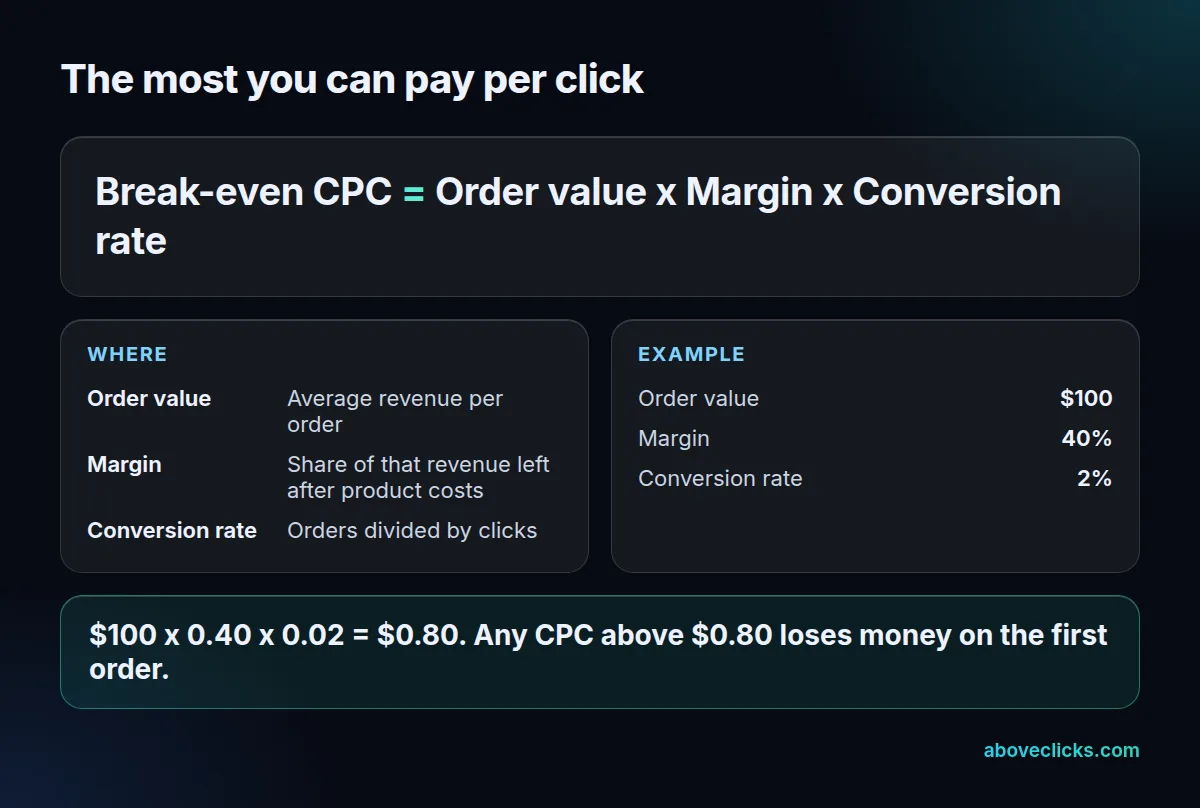
Example: a store with a $100 average order, a 40% margin and a 2% conversion rate can pay up to $0.80 per click before the first order loses money. That is the same logic as our break-even ROAS approach, where the target comes from your own margin and not from a benchmark.
We do not quote typical CPC figures here, because they change by industry, country and month. Your own account and the Keyword Planner estimates in Google Ads are better guides than a table from someone else’s data.
PPC vs CPC vs CPM: which one are you really comparing?
CPM is a third thing. It is the cost per 1,000 impressions, so you pay for being shown, whether or not anyone clicks.
Google’s CPM definition uses the same unit, cost per thousand impressions. In a ppc vs cpc vs cpm comparison, PPC and CPC belong together, and CPM is the alternative way of paying.
The risk sits in different places. Under CPC, a weak ad costs you nothing extra, because no click means no charge. Under CPM, a weak ad still costs the full amount for every 1,000 showings. Our guide to cost per click vs CPM shows both on one scale.
The two figures measure different events, so a lower number on one scale says nothing about the other. Do not compare a CPC with a CPM directly. Convert one to the other with the click-through rate, or compare the cost of the result you care about, such as an order.
The conversion is CPC = CPM ÷ (1,000 × click-through rate). Example: a $10.00 CPM with a 1% click-through rate gives 10 clicks per 1,000 impressions, so the equivalent CPC is $1.00. At a 0.5% click-through rate, the same CPM works out to $2.00 per click.
What does PPC vs CPC mean for your budget?
It means the click price is only the first half of the answer. The second half is how many clicks become orders, which together give cost per acquisition (CPA).
Example, an invented store with a $100 average order and 40% margin, so each order leaves $40 after product costs. Campaign A gets clicks at $1.20 with a 2% conversion rate. Campaign B pays $2.40 per click and converts at 8%.
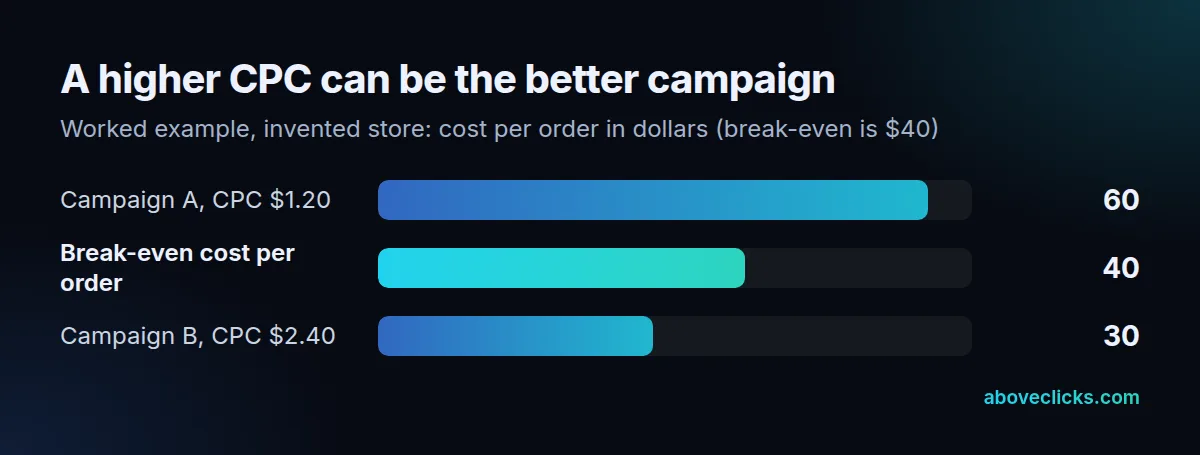
Per 1,000 clicks, Campaign A spends $1,200 for 20 orders, a cost per acquisition of $60. That is $20 above the $40 break-even on every order. Campaign B spends $2,400 for 80 orders, a CPA of $30, which is $10 under break-even.
The cheaper click is the worse campaign, and that is the whole point of comparing ppc vs cpc with profit in mind. This is how we read accounts: we start from break-even and set targets from your own margin, not from a market average. If you want that done on your own numbers, our Google Ads service starts with a free review of the account.
Which mistakes do people make with CPC?
The difference between ppc and cpc is easy to blur in a report, and three mix-ups come up most often: treating PPC and CPC as rivals, chasing a lower CPC, and putting CPC and CPM on one scale.
- Treating them as a choice. You do not pick PPC or CPC. You pick pay per click, and CPC is what it costs.
- Chasing a lower CPC. A cheap click from the wrong searches lowers CPC and raises cost per order. Judge CPC against break-even, as in the example above.
- Mixing CPC and CPM. A $2 CPC and a $2 CPM are not comparable figures. One is per click, the other per 1,000 views.
A fourth is reading average CPC without splitting brand from non-brand. Branded clicks are cheap and flatter the account average, so a campaign mix that looks efficient can hide the generic searches that lose money. Report the two groups on separate lines, and set a separate break-even for each if their conversion rates differ.
So which number should you watch? Use this order when reading a PPC report:
- CPA first. Cost per order tells you whether the campaign pays back.
- Conversion rate second. It explains most of the gap between a cheap click and a cheap order.
- CPC last. It tells you what the auction charged, which you can only influence through bids, ad quality and search terms.
The difference between ppc and cpc is therefore the difference between how you buy and what you pay. A ppc vs cpc report should never stop at the second.
If your CPC looks fine but orders cost too much, the cause is usually in the search terms, the landing page or the tracking. Our free audit reviews all three, in writing, and tells you which to fix first.