Cost per click vs CPM comes down to what you pay for: with cost per click you pay when someone clicks, and with CPM you pay for every thousand impressions. Convert one to the other before you compare them.
This guide uses Google Ads Help definitions as of October 2026, a worked $1,000 budget under both models, and a short checklist for choosing by goal. Every budget and rate below is an invented worked example.
Cost per click vs CPM: what is the difference?
Cost per click (CPC) bills you when a person clicks your ad. CPM bills you per one thousand impressions, whether anyone clicks or not. Google Ads Help defines CPM as bidding where you pay per one thousand views (impressions) on the Google Display Network.
Google also describes average CPC as the total cost of clicks divided by the total number of clicks. So cost per click vs CPM is not only a billing choice. It decides who carries the risk of a weak ad: under CPM you pay even if nobody clicks, while under CPC the cost rises only with clicks.
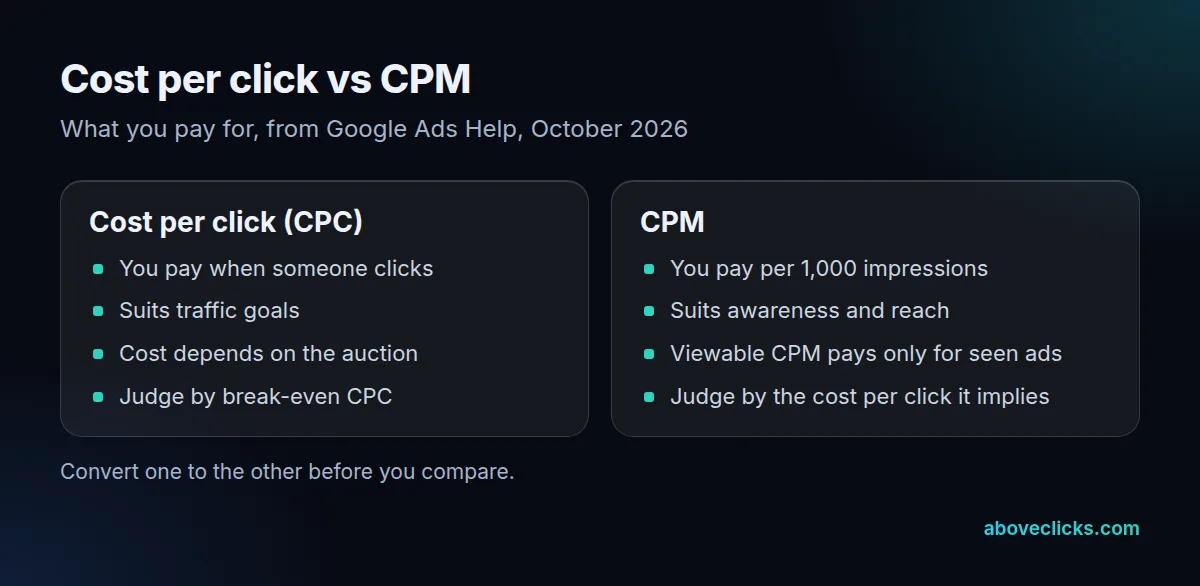
Google’s bid strategy guide lists five basic types of goals to consider before you choose a bid strategy: conversions, clicks, visibility, views and, for video, product or brand consideration. In a cost per click vs CPM decision, the first two goals point to CPC and the third points to CPM. That is the quickest way to narrow the choice before you run any numbers.
Here is the risk difference in numbers. Show an ad 1,000 times at an $8 CPM and you pay $8 even if there are 0 clicks. Under CPC, the same 1,000 impressions with 0 clicks cost $0. That is the trade at the heart of cost per click vs CPM: who carries the risk of a weak ad.
Viewable CPM, written vCPM, narrows the CPM side. Google says viewable CPM bidding ensures you only pay when your ads can be seen, and that existing CPM bids are converted to vCPM automatically.
Which is cheaper in cost per click vs CPM?
Neither is cheaper in general, so CPC vs CPM has no fixed winner. The same CPM gives a different cost per click at every click-through rate, so the answer in a cost per click vs CPM comparison depends on how often people click.
Take an invented $1,000 budget at an $8 CPM. It buys 125,000 impressions ($1,000 ÷ $8 × 1,000). At a 1% CTR that is 1,250 clicks, so each click costs $0.80. At 0.5% it is 625 clicks and $1.60 each. At 2% it is 2,500 clicks and $0.40 each.
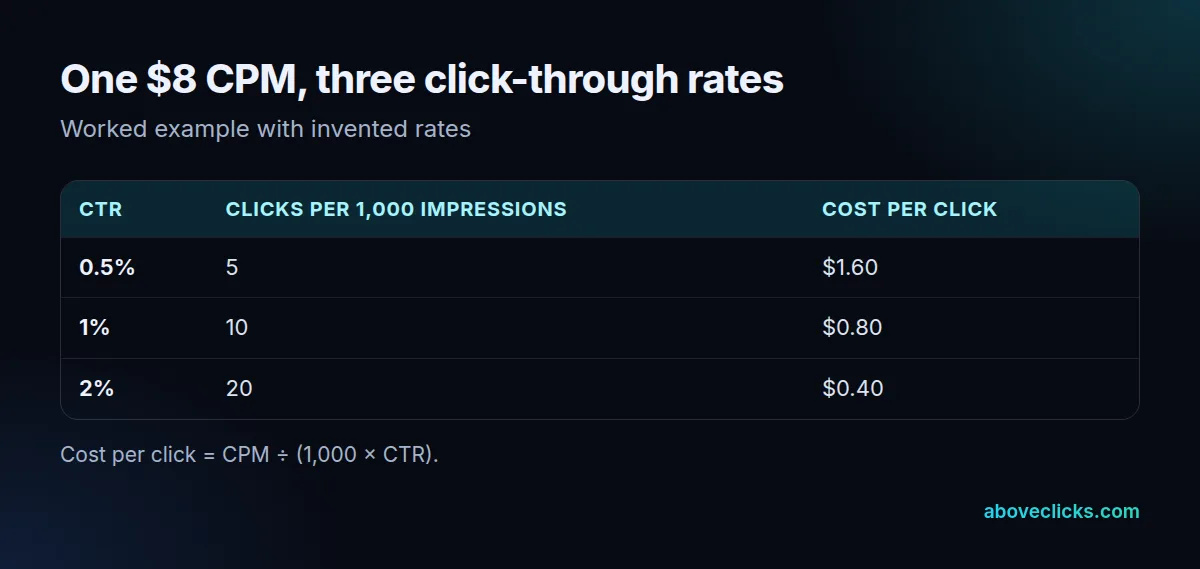
Google defines CTR as clicks ÷ impressions: 5 clicks from 100 impressions is 5%. So a CPM campaign with strong creative can beat a cost-per-click campaign, and a weak one can lose to it. In the cost per click vs cpm test, ask what click-through rate you can realistically hold, not which label looks cheaper.
In a CPC vs CPM test, if you bid by CPC at $0.80 in the same market, you would pay about the same per click as the 1% CPM example. The difference is control: CPC caps what a click costs, while CPM caps what a thousand views cost.
When should you pay per click?
Pay per click when the goal is traffic to your site. Google’s bid strategy guide says that if you want to generate traffic to your website, focusing on clicks may be ideal, and cost-per-click bidding may be right for the campaign.
Cost per click also fits a store that cannot yet measure sales. You pay only for visitors, and you can set a ceiling per click. Pair it with a break-even figure: multiply your profit per order by your conversion rate. Google defines the conversion rate as conversions ÷ interactions, so 50 conversions from 1,000 interactions is 5%.
With a $24 profit per order and a 2% conversion rate, each click is worth $0.48. Any cost per click above $0.48 loses money on that store, so it should not bid above it.
If you do track purchases, the same guide says Smart Bidding may be best for conversion goals. Our target ROAS bidding guide covers that route.
When should you pay per thousand impressions?
Pay per thousand impressions when the goal is reach. The same Google guide says that if you want to increase brand awareness, focusing on impressions may be your strategy, and you can use cost-per-thousand viewable impressions (vCPM) bidding to put your message in front of customers.
For video, it lists cost-per-view (CPV) or CPM bidding to increase views or interactions. That makes CPM the natural model for launches, sales announcements and remarketing to a small audience, where being seen matters more than a click that day.
A $10 CPM works out to $0.01 per impression, so a 100,000-impression test costs $1,000 whatever the audience does. Two cautions apply. First, a CPM campaign tells you little about sales unless you track what happens after the view. Second, impressions on a wide audience can be cheap and still reach nobody who would buy. Use an audience you can describe, set a frequency limit, and check the click-through rate after a week. If it sits far below your other campaigns, the creative or the audience needs work before you add budget.
For a store, a sensible split is most of the budget on conversion-focused campaigns and a small test budget on awareness, reviewed against the cost per click it implies. Our Google Ads for ecommerce guide shows how store accounts are usually structured.
How do you compare CPC and CPM on one scale?
Convert CPM to cost per click with this formula: CPC = CPM ÷ (1,000 × CTR). It puts both billing models on the same scale, so you can compare them with your break-even figure.
Worked example: an invented campaign has a $12 CPM and a 1.5% CTR. A thousand impressions bring 15 clicks (1,000 × 0.015), so each click costs $12 ÷ 15 = $0.80. Another has a $5 CPM and a 0.25% CTR: 2.5 clicks per thousand impressions, so each costs $2.00.
The cheaper CPM is the more expensive click. That is the central lesson of cost per click vs CPM, and of any CPM vs CPC check: compare on cost per click, then on cost per order, then on profit.
To go one step further, divide the cost per click by the conversion rate to get a cost per order. At $0.80 per click and a 2% conversion rate, an order costs $40. If your profit per order is $24, that campaign loses $16 on each order, whichever way it is billed.
CPC vs CPM for a store: what a $2,000 month looks like
Take an invented store with a $2,000 monthly budget, a $60 average order, a $24 profit per order and a 2% conversion rate. Here is how CPC vs CPM plays out when you split the money.
Put $1,600 into cost-per-click campaigns at a $0.40 average CPC. That buys 4,000 clicks, and at 2% they produce 80 orders worth $1,920 in profit. After the $1,600 spend, the campaign nets $320.
Put the other $400 into CPM awareness at an $8 CPM. That buys 50,000 impressions, and at a 1% CTR it brings 500 clicks, so each costs $0.80. At the same 2% conversion rate those clicks give 10 orders and $240 in profit, which is $160 short of the $400 spent. The awareness money paid back 60% of its cost within the month.
That does not make awareness a mistake. It means the CPC vs CPM comparison must include the time horizon: awareness may lift later searches and returning visits, but you only know that if you measure it. Cap the test share, say 20% of budget as here, and set a review date before you spend.
Use the same layout for your own numbers: budget, cost per click or CPM, click-through rate, conversion rate, profit per order. If any input is a guess, mark it as one and revisit it after 30 days of real data.
What mistakes make CPC or CPM look better than it is?
Four mistakes distort a cost per click vs CPM comparison. Check each one before you move budget.
- Comparing the labels, not the clicks. A low CPM is not a low cost per click. Convert first.
- Ignoring the click-through rate. The same CPM costs four times as much per click at 0.5% as at 2%.
- Stopping at the click. A cheap click that never converts is still a loss. Compare with your break-even CPC.
- Mixing placements. Search clicks and Display impressions behave differently, so report them separately.
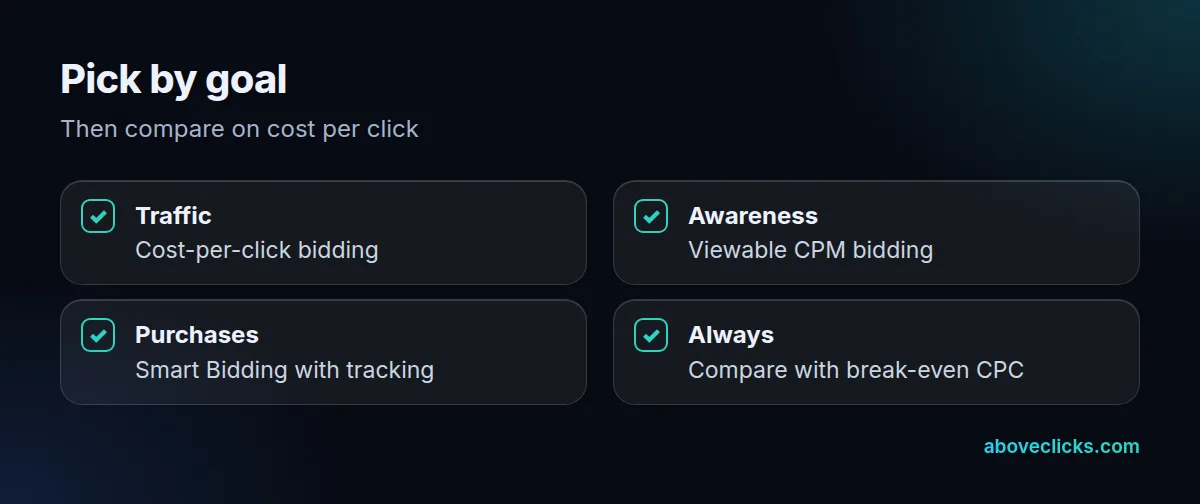
Whichever model you pick, write down the goal, the review date and the number that would make you stop. A test with no stop rule tends to run on until the budget is gone.
If you want a second pair of eyes on your account, our Google Ads team reviews bidding, tracking and creative together, and the free audit is a no-cost first look. For what management and ad spend cost on top, see PPC pricing, and for more, browse Google Ads topics.