Affordable SEO services for gyms spend a small budget on the local basics that bring in trial sign-ups: the Business Profile, a page for each location, class and trial pages, and reviews. Judge a quote by what it delivers each month, not by how long its list is.
This guide shows what to buy first, what a small package must still include, how to check a quote with six questions and how to read the first results.
What are affordable SEO services for gyms?
They are SEO services for gyms limited to the work that moves local searches, priced so a single-site or small-chain owner can keep them running. They cut volume, not the essentials.
Affordable SEO services for gyms are worth buying only when the scope is written down. A typical small gym has one site, 1 to 3 classes that bring in most trials and a handful of searches that matter, such as “gym near me” and the name of the neighbourhood. That narrow target is what makes affordable SEO services for gyms possible: the work is small because the goal is small.
A gym is a local business. Most people searching for a gym want one near them, so SEO for gyms is mostly local search: showing up in the map results and in the pages under them. National link-building and long blog calendars matter far less than a correct profile and a clear page for each site.
Local SEO for gyms also has one advantage over most trades: the offer is simple. A 7-day trial pass or a free first class is easy to explain on a page, easy to track and easy to ask for in an ad or a review reply.
That is also why affordable need not mean weak. Our guide to affordable SEO services for small business covers the general case; a gym adds classes, trial passes and opening hours that change by day.
What does local SEO for gyms need first?
The Business Profile, then one page per location. Google says local results are mainly based on relevance, distance and prominence, so the first spend should make a gym easy to match, easy to place and easy to trust.
According to Google’s local ranking tips, relevance is how well a profile matches the search, distance is how far each business is from the searcher, and prominence is how well known a business is, based partly on links and reviews. Google also says there is no way to request or pay for a better local ranking. Anyone who promises that, in a pitch for affordable SEO services for gyms or any other trade, is selling something Google does not offer.
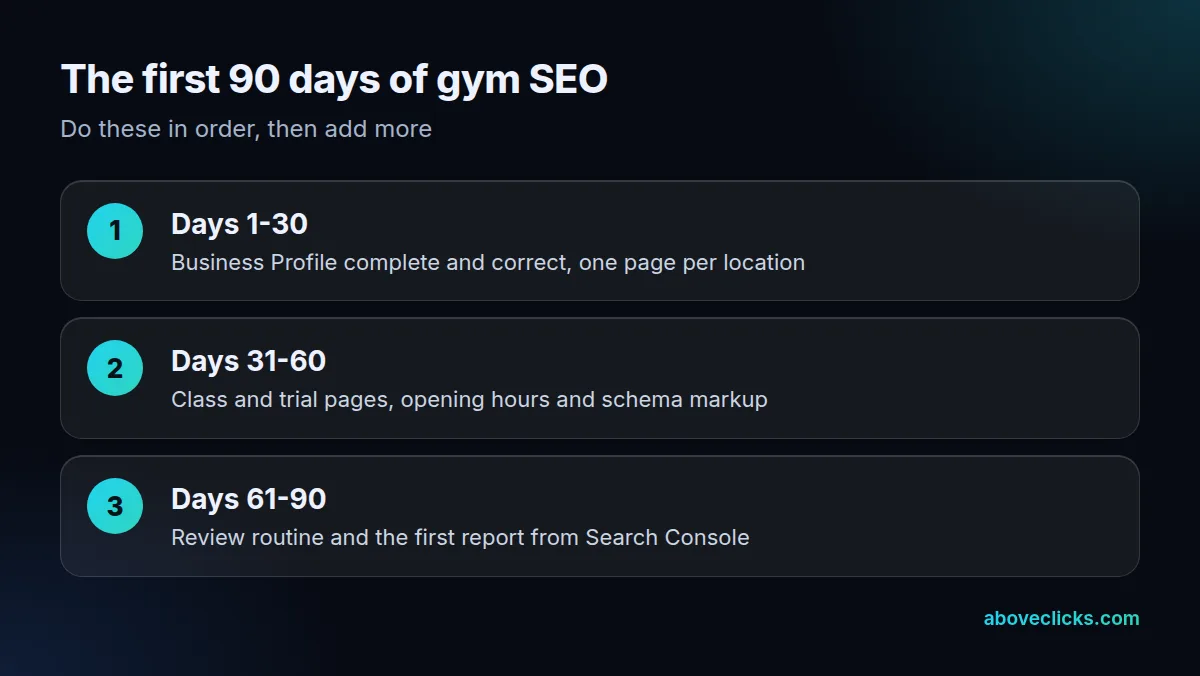
The 90-day order above is our suggestion, not a Google rule. In the first 30 days, check the profile: the right category, accurate hours, photos of the floor and the classes, and a website link that goes to the location page. Google’s guidelines for representing your business say the profile name must reflect the real-world name used on your signage and website, so do not add keywords such as “cheap gym near me” to it.
If your gym is open around the clock, set the hours that way. Google’s business guidelines show the hours of a 24-hour business entered as “Open 24 hours” rather than as a long list of times, which keeps the profile and the website in step. If your staffed hours differ from your access hours, say so on the location page, because members search for both.
Then give each location a page of its own, which is the first thing to ask about in any seo services for gyms quote: address, map, hours, parking, classes and a clear trial button. A site that sends every search to one home page forces Google to guess which gym you mean. This is the core of local SEO for gyms.
It is also the part where a small package pays back first. For a gym with 2 or 3 sites, that means 2 or 3 pages and 2 or 3 profiles, each with its own hours, photos and reviews, not one page with a list of addresses.
What should an affordable package still include?
Six things: Business Profile care, location pages, class and trial pages, a review routine, markup and a monthly report. If a quote drops one of these, ask why before you ask about price.
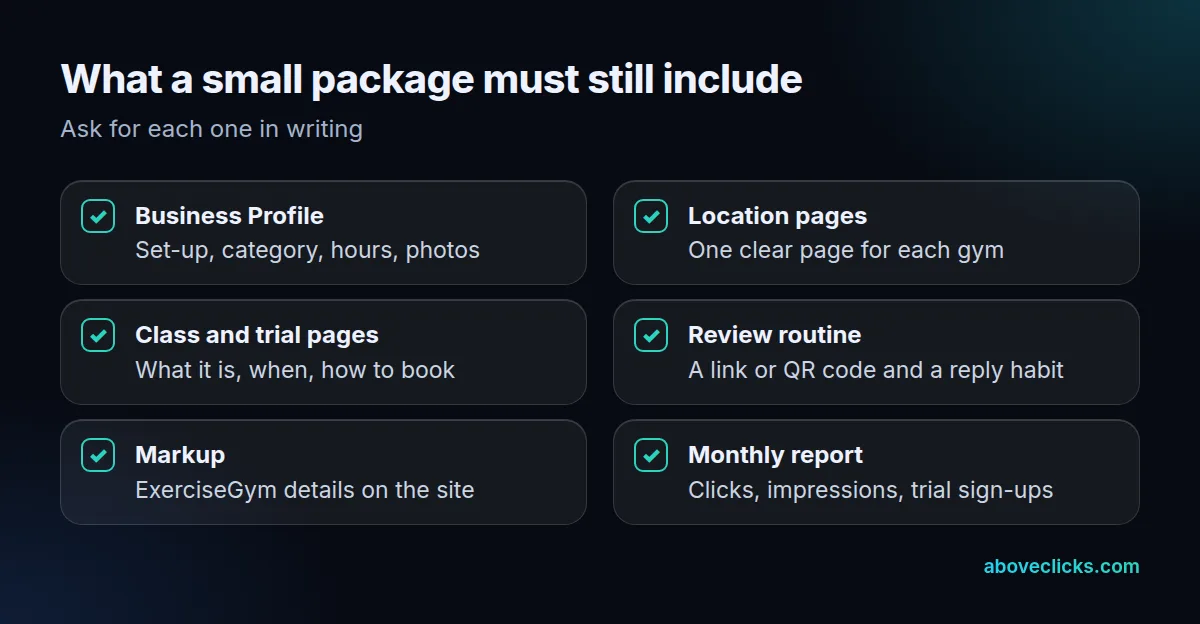
The markup item is cheap and often missed in gym SEO quotes. Google documents LocalBusiness structured data, including fields such as opening hours and coordinates, and schema.org has a specific type for this trade, ExerciseGym, which sits under SportsActivityLocation. Gym SEO that adds this markup gives search engines the hours and place in a form they can read without guessing.
For a single-site gym, all six items are a limited amount of work: a set-up in month 1, then upkeep. That is why gym SEO can stay affordable. If a quote asks for far more than that for 1 site, ask what the extra time is for.
Google’s LocalBusiness documentation lists the fields to fill, and the schema.org page lists SportsActivityLocation as the parent type.
Class pages deserve their own line in every seo services for gyms package. A page for each class type, such as strength, spin or beginners, matches the searches people make before they walk in, and it gives the trial offer a natural home. Keep each page honest: real timetable, real coach, no claims about results you cannot back up. Aim for 300 to 500 words on each class page, with the timetable, the level, what to bring and one clear button to book the trial.
How do you check a quote for gym SEO?
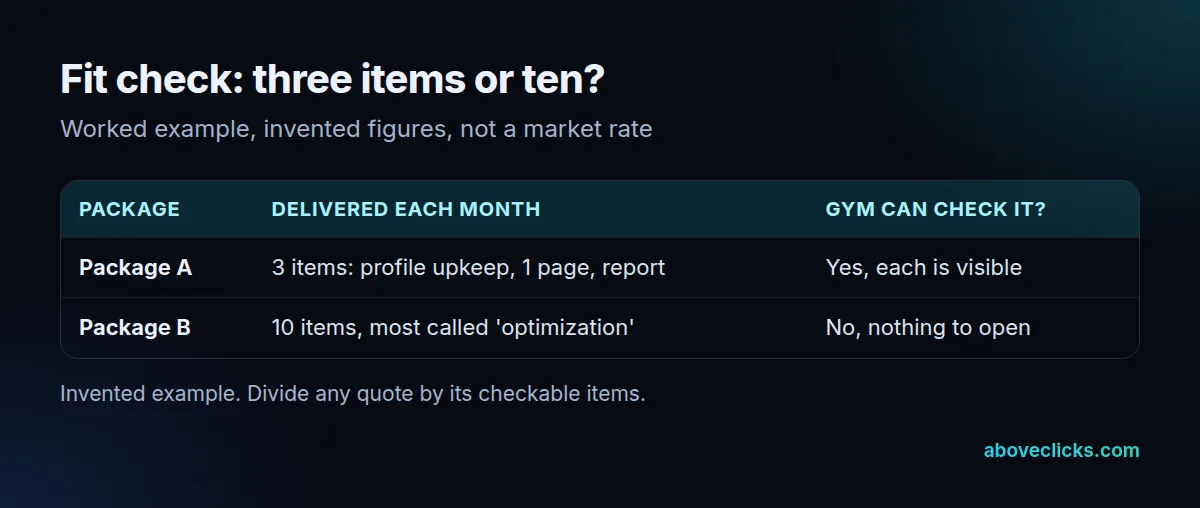
Divide it by what you can open or count each month. A short list of visible deliverables beats a long list of vague ones, whatever the fee.
Here is a worked example with invented figures, so you can see the method. Package A lists three items each month: Business Profile upkeep, one new or improved page, and a report. Package B lists ten items, most called “optimization”. You can open and check every item in Package A; for Package B there is nothing to open.
Ask for a notice period of 30 days or less, and a first report within 30 days of starting. Put six questions to any quote, from any agency, ours included:
- What exactly is delivered each month, as a list?
- Which locations and classes does it cover?
- Who owns the Business Profile and the website pages when it ends?
- How are reviews handled, and is any incentive used?
- What goes in the monthly report, and does it count trial sign-ups?
- What happens when you add a second location?
Run the fit check over 3 quotes, not 1, and compare them over the first 3 months, not the first invoice. Two quotes tell you which is cheaper; three tell you what is normal, and which line items appear in all of them. A line that appears in only one quote needs an explanation, and an item missing from two quotes may be one you do not need.
Question 3 matters more than it looks. Keep your own login as the owner of the profile and add the agency as a manager, so leaving is a matter of removing one user. For general pricing logic, see the local SEO packages guide, and for cost drivers see the average cost of local SEO. We do not repeat market ranges here because they go out of date quickly.
How should a gym get more reviews?
Ask every member who finishes a trial or a class series, using a link or a QR code, and reply to every review. Never offer a discount or free item in return.
Reviews feed the prominence factor above, and they matter more for local SEO for gyms than for most trades, because members choose a gym by who else trusts it. Google’s review tips say customers can be asked to visit a Google link or scan a QR code, and that offering incentives, such as free or discounted goods, in exchange for posting, changing or removing reviews is not allowed. Google’s local ranking tips add that reviews and ratings are part of prominence, so the routine feeds the ranking too. A front-desk card with a QR code, handed over at the end of a first month, is a simple routine that costs almost nothing.
Replying matters too. A short, specific reply to a good review and a calm one to a bad review shows prospective members how the gym treats people. Aim for a reply within 2 days of each review, which is a habit any gym SEO plan should include. A small budget for SEO for gyms is often better spent on a reply habit than on a fourth blog post. If you run several sites, give each manager the same 3-line reply guide: thank the member by first name, mention one real detail, and invite them back.
What can you skip while the budget is small?
Skip high-volume blogging, national keywords and anything that needs a long wait before the basics are done. Add them only after the first 90 days are complete.
Google’s name and review rules, covered above, explain two of them. Seven costly mistakes show up again and again when a gym buys SEO too widely:
- Paying for blog posts before the Business Profile is correct.
- Targeting “fitness” nationally instead of the gym’s own area.
- Adding keywords to the Business Profile name, which Google’s rules do not allow.
- Using one page for every location.
- Offering a discount for reviews.
- Accepting a report with rankings but no trial sign-ups.
- Signing without checking who owns the profile and website pages.
Our local business marketing page shows how we approach local work in general, and the retail local SEO service is the closest match for a gym with a visitor-facing site.
How do you know gym SEO is working?
Watch clicks and impressions for the location pages in Search Console, and count trial sign-ups yourself. Rankings alone do not pay the rent.
The Performance report in Search Console shows clicks, impressions and positions for each page, so you can see whether the location and class pages are being shown and clicked. Pair that with your own count of trial sign-ups by location, from the booking system or the front desk.
The same report has 6 dimensions you can use: queries, pages, countries, devices, search appearance and dates. For a gym, the pages and queries views matter most, and Google notes that results vary by the time, place, device and recent history of the person searching, so a rank you check from your own phone may not match what a new member sees. Check on a schedule, for 28 days at a time, rather than every morning.
In the first quarter, expect completed work and growing impressions; sign-ups follow once the pages and the profile are in place.
If you would like a second opinion on affordable SEO services for gyms or any other quote, our free audit reads your Search Console with read-only access, and the sample report shows what a monthly report can look like. More guides sit under buying guides.