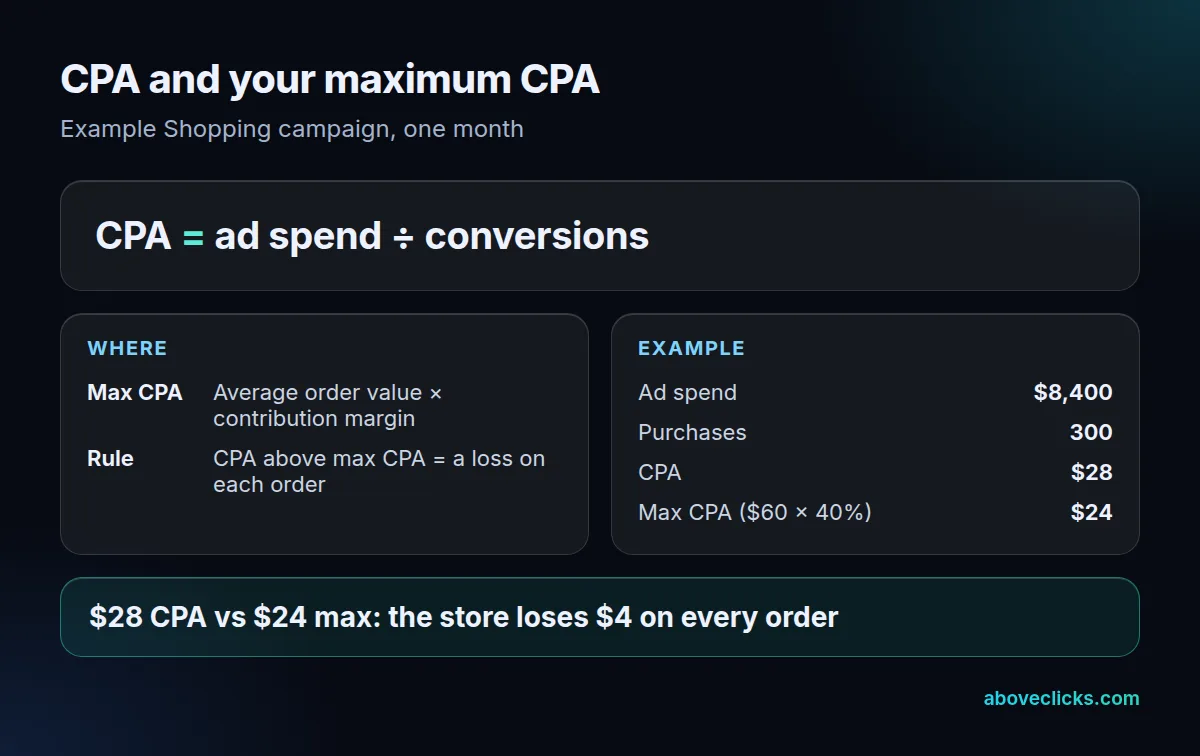
Cost per acquisition (CPA) is the average amount you pay in ad spend for one conversion, usually a purchase for a store. Divide ad spend by conversions: $8,400 for 300 purchases is a $28 CPA. Google Ads calls it cost per conversion. Whether $28 is good depends on what each order is worth.
FormulaCPA = ad spend ÷ conversions
Cost per acquisition (CPA) is the average amount you pay in ad spend for one conversion, usually a purchase for a store. Divide ad spend by conversions: $8,400 for 300 purchases is a $28 CPA. Google Ads calls it cost per conversion. Whether $28 is good depends on what each order is worth.
CPA formula
CPA = ad spend ÷ conversions
“Acquisition” here means whatever conversion you count: a purchase, a lead, a sign-up. For stores it’s almost always a purchase. Make sure the conversion you divide by is the one you care about. A CPA based on add-to-carts looks cheap and tells you little.
It also helps to see where a CPA comes from. Google Ads charges you per click (cost per click), and your conversion rate is conversions divided by ad interactions. So CPA = average cost per click ÷ conversion rate. If the Shopping campaign below paid $1.40 a click and 5% of clicks bought, each purchase came to $1.40 ÷ 0.05 = $28. A cheaper click or a better landing page both lower it.
The number that gives CPA meaning is your maximum CPA:
Maximum CPA = average order value × contribution margin
That’s the most an order can absorb in ad costs before it loses money. Your average order value and contribution margin set it.
How to calculate cost per acquisition across 3 campaigns
A hypothetical outdoor-gear store runs three Google Ads campaigns. Its contribution margin is 40% on every product. Here’s one month:
| Campaign | Ad spend | Purchases | CPA |
|---|---|---|---|
| Shopping (best sellers) | $8,400 | 300 | $28 |
| Non-brand Search | $4,500 | 100 | $45 |
| Performance Max | $6,000 | 100 | $60 |
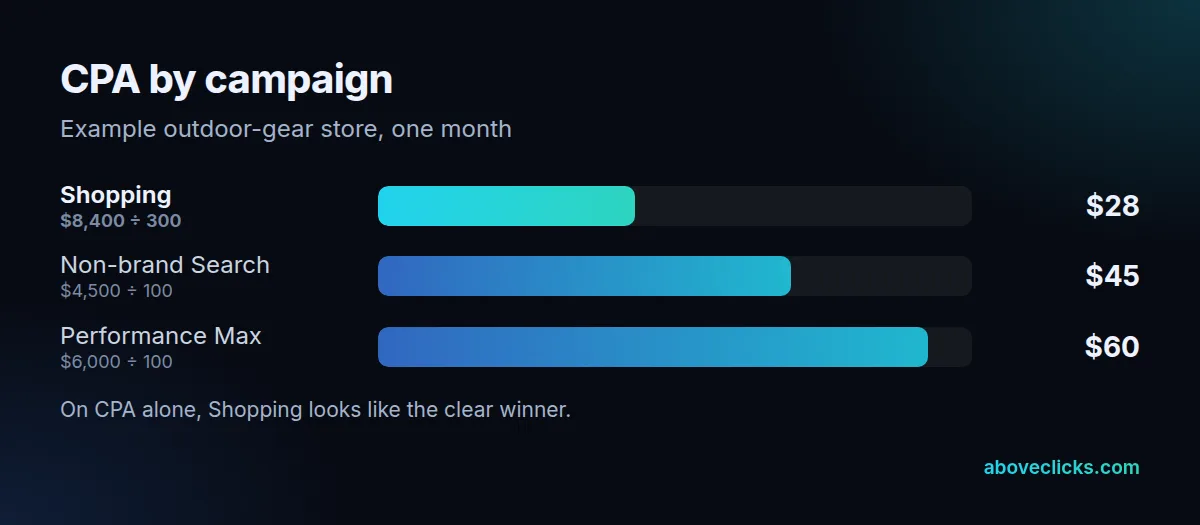
Ranked by cost per acquisition, Shopping wins easily and Performance Max looks worst. Now add what each campaign’s orders are worth.
Why the cheapest CPA lost money
The Shopping campaign sells the store’s cheapest items, so its orders average $60. At a 40% margin, the most it can pay per order is $24. Its $28 CPA loses $4 on every sale.
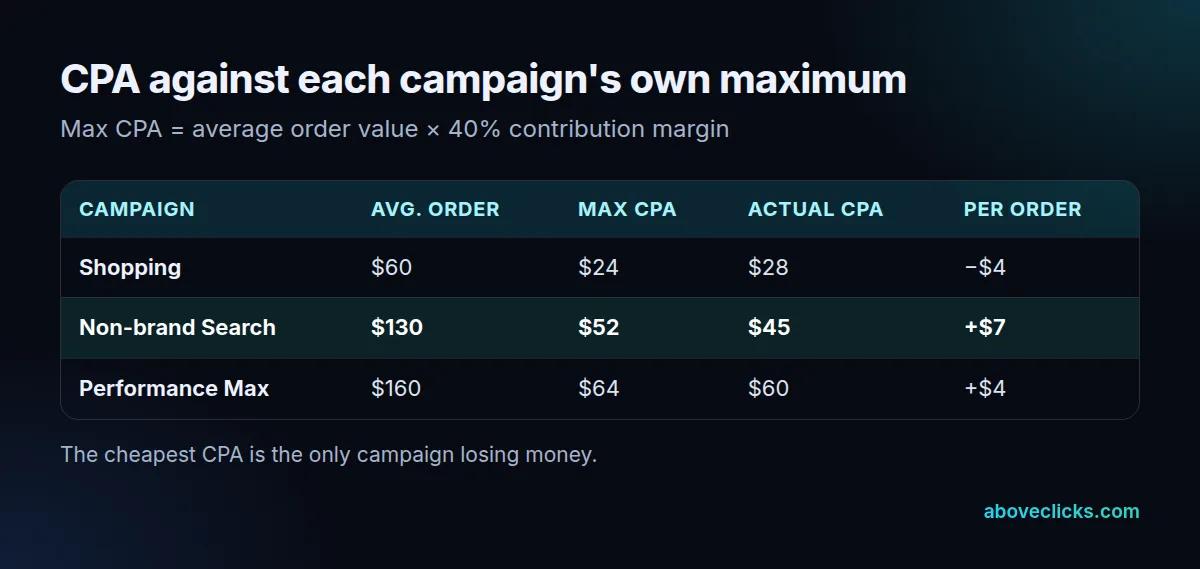
Performance Max brings in $160 orders, so a $60 CPA still leaves $4 per order. Non-brand Search does best of all. We checked both ceilings in our own break-even ROAS calculator: at a 40% margin it gives a maximum cost per order of $24 for a $60 order and $64 for a $160 order. In our client work, we set any target CPA from that ceiling, not from last month’s average. Cutting the “expensive” campaigns and feeding the cheap one would have made things worse.
That’s the core weakness of CPA: it treats every conversion as equal. When order values differ, bidding on return is usually the better fit. Our guide to target ROAS bidding explains when to switch.
Target CPA in Google Ads
Target CPA is the Google Ads strategy that sets bids to get as many conversions as possible at the average cost per conversion you choose. Some conversions cost more than the target and some cost less; Google aims for the average (Google Ads Help).
Google’s documentation adds three useful points:
- A target that’s too low may make you miss clicks that would have converted, so you get fewer conversions overall.
- If the campaign has history, Google recommends a target based on the average CPA of the last 30 days, adjusted for conversion delays.
- To judge results, compare the CPA you got with the Avg. target CPA column, which reflects what the strategy actually aimed for.
Set your target at or below your maximum CPA, but not far below what the campaign achieves today.
CPA vs CAC
Cost per acquisition counts every conversion the platform attributes to its ads, including repeat buyers. Customer acquisition cost counts only new customers and usually includes non-ad costs too. Use CPA to manage campaigns and CAC to judge growth. The same calculator gives you that threshold expressed as a return. For campaign structure and bidding in one place, see the Google Ads for e-commerce guide, or ask our Google Ads team to check your targets.