Fixed price SEO packages charge one set fee for a written list of work. The fee is fixed; the ranking result is not, so judge a package by its scope.
This guide shows what a fixed price SEO package should list, how to count its scope in units, how to compare two quotes per delivered item, and what to settle before the scope changes.
What are fixed price SEO packages?
A fixed price SEO package is a quote for a defined piece of SEO work at a set fee, usually after an audit. You pay for the list, not for the hours the agency happens to spend.
Most packages combine three parts: an audit, a set of fixes and a handover report. Some add a batch of page rewrites or a redirect map. Our guide to a one time SEO package covers the five deliverables that belong in such a project, so this guide does not repeat them.
The set fee helps in one way: you know the maximum bill for the listed work before it starts. It protects you only if the list is precise. A line such as “on-page optimization” can mean 5 pages or 500, and the same fee covers both.
Buyers like fixed price SEO packages for a simple reason: the bill is capped, which makes the spend easy to approve. Agencies like them because the work is easy to schedule. Both sides gain only when the package is written in numbers.
Example: one of the fixed price SEO packages a small store might buy could run 6 weeks, with the audit in weeks 1 to 2, the fixes in weeks 2 to 5 and a handover in week 6. A clear calendar like that is a good sign in any fixed price SEO package, because it shows the agency has thought about the sequence and not only the fee.
What does a fixed price SEO package include?
Whatever the quote lists in units you can count: reports, fixes made, pages rewritten, redirect pairs and a re-check. If a line has no unit, it is a description and not a deliverable.
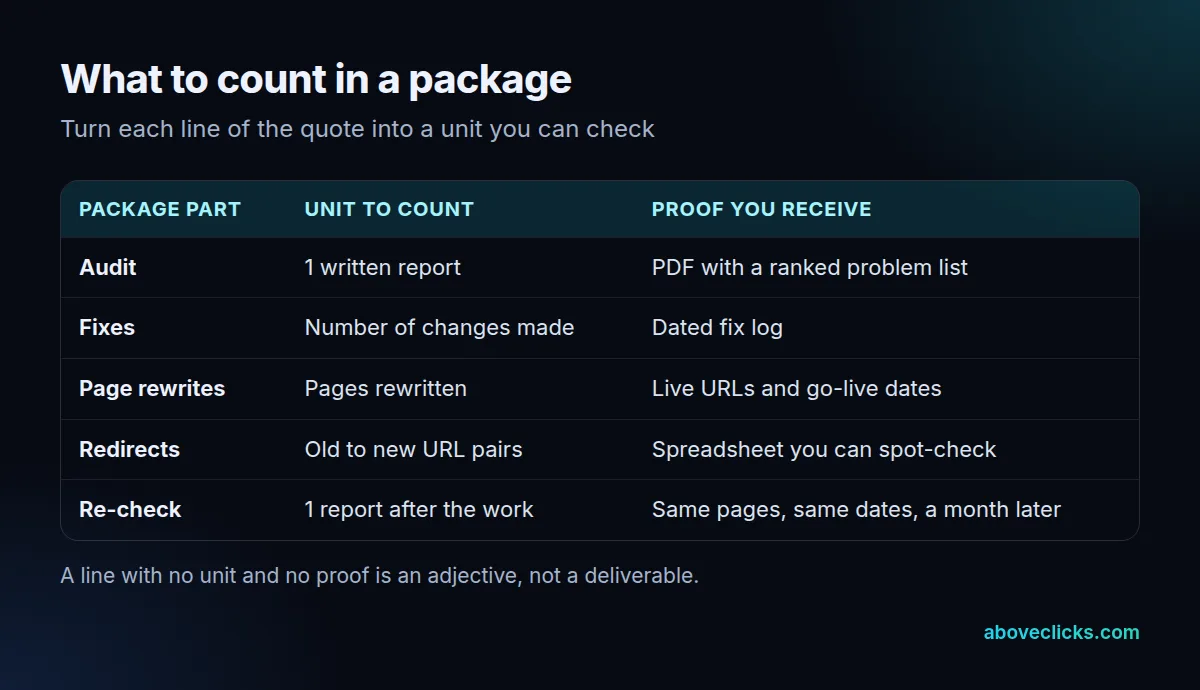
Worked example: Store A sells garden furniture and has 40 collection pages. Its quote says “technical fixes and content optimization”. That sentence can be read 3 ways: 10 fixes, 25 fixes, or a review with no fixes at all. The same quote with units says “1 audit report, 25 logged fixes, 12 pages rewritten and 1 re-check report”. Now both sides can check the work.
Ask for the proof beside each unit. A fix log with dates shows what changed and when. A list of live URLs shows which pages were rewritten. A redirect spreadsheet lets you spot-check 10 rows after launch. Google’s guide to hiring an SEO says your SEO should be willing to explain all the changes they make to your site, which is easy to honor when each change sits in a log.
Does a fixed price promise a result?
No. A fixed price fixes the work and the fee. Google says no one can promise a #1 ranking, so treat any package that does as a reason to look elsewhere.
Google’s hiring guide adds that an audit should give you realistic estimates of improvement and of the work involved. It also advises granting only read access to Search Console during an audit, not write access.
Time matters as well as promises. Google’s recrawl guide says crawling can take anywhere from a few days to a few weeks. A project that ends in week 4 therefore cannot show its full effect in week 4.
Plan the calendar around that. In a package of 6 weeks, those weeks are for the work, and the result reads best 4 weeks after the last fix. That puts the honest re-check at about week 10, and a quote that promises results by week 6 has skipped the waiting time.
If a core update lands during the wait, Google suggests waiting at least a full week after it completes before analyzing the change. Put the re-check after both waits, and write its date into the quote.
How does flat rate SEO compare with a monthly fee?
Flat rate SEO pays once for a closed list, while monthly SEO pays every month for a repeating list. The better choice depends on whether your list ends.
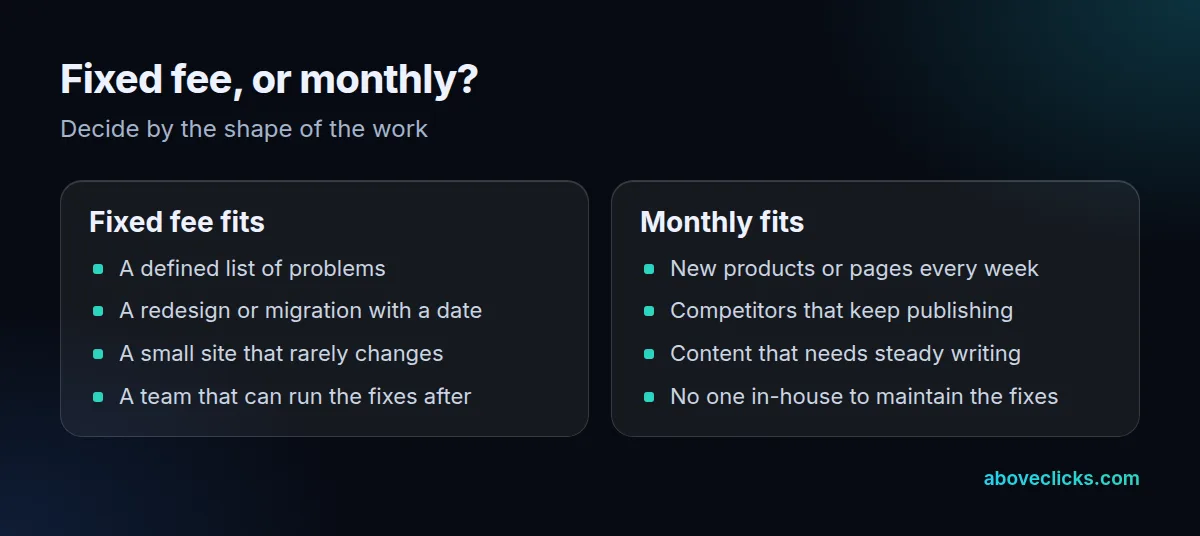
The difference is in what happens after the last fix. With flat rate SEO, the site is only as good as your team keeps it. New products, new templates and new plugins can bring the same problems back. A monthly arrangement keeps someone watching, and our monthly SEO package guide explains how its first year should run.
To judge seasons, set Search Console’s Performance report to the last 16 months, as Google’s traffic-drop guide suggests. The same guide says some changes take effect in a few days while others could take several months, which is why neither model should be judged after 2 weeks.
For how fees are billed in general, see the pricing models guide.
How do you compare two fixed price SEO quotes?
Divide each fee by the number of units it delivers. The quote that looks cheaper often costs more per delivered item, because it lists fewer units.
Worked example with invented numbers, for two quotes to the same store:
- Quote A: $1,800 for 1 audit report and a list of 40 problems. Fixes are left to your developer. That is 1 delivered unit at $1,800.
- Quote B: $2,600 for 1 audit report, 25 logged fixes, 12 rewritten pages and 1 re-check report. That is 39 delivered units, or about $67 per unit.
Quote A looks $800 cheaper. But your developer still has to make the fixes, and if that work takes 20 hours at $60 an hour, the real total is $3,000. Quote B is the cheaper job. Replace the numbers with your own and the method still works.
The same method works on any fixed price SEO package, including ones that bundle design or content. Count the delivered units, add the cost of anything left to your own team, and compare the totals over the same 12 weeks.
Check what each quote leaves out. Ask three things:
- Who makes each change, the agency or your team?
- Are the pages written from scratch or lightly edited?
- Is a re-check part of the fee?
Our own audit arrives as a written PDF; see the sample report for what a deliverable looks like when it is shown, not described.
What happens when the scope changes?
Extra work gets quoted before it starts, in writing, as new units. That is the change rule, and it is the line that decides whether a fixed fee stays fixed.
Scope usually changes for one of three reasons: the audit finds more problems than the quote assumed, your developer needs an extra step, or you ask for more pages. None of these is wrong. Surprise is the problem.
Worked example: the audit for Store A finds 15 extra broken redirects that the quote did not count. A good package handles that in 3 steps, the way the best fixed price SEO packages do: the agency reports the 15 extra items, quotes them as new units, and starts only after you approve. A weak one absorbs the work silently, cuts something else to make room, or bills it at the end.
Put these 6 checks into the quote before you sign:
- Units: pages, fixes and reports as numbers.
- Exclusions: a short list of what the fee does not cover.
- Change rule: extra work is quoted first and approved by you.
- Stages: each part of the fee is tied to a delivered item.
- Ownership: accounts and content stay yours.
- Re-check: a report about 4 weeks after the last fix.
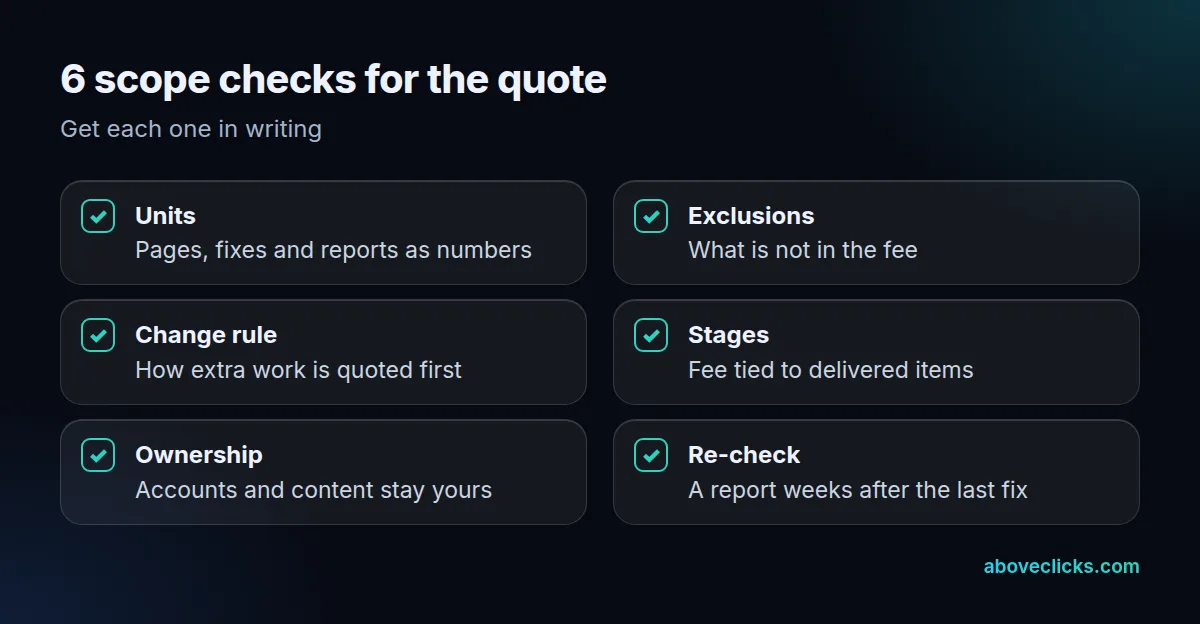
Every one of these checks applies to fixed price SEO packages of any size. Ownership deserves one more line. In Search Console, a property must keep at least 1 verified owner, and delegated owners are added or removed in user management. Keep your own login as owner and add the agency as a user, so a fixed price SEO package ends cleanly when the work does.
When does a fixed price SEO package fit your site?
When your problems form a list that can end: a redesign, a migration, an audit with clear fixes, or a small site with a short backlog. If new work appears every week, monthly work fits better.
A quick fit test:
- Can you count the pages and open problems today? If yes, a fixed price SEO package can be quoted precisely.
- Will someone on your side maintain the fixes afterwards? If not, plan for monthly work.
- Is there a launch or migration date? If yes, a package with a hard end date helps.
For a store, the first answer is often “not quite”. An online store with 3,000 product URLs and new items every week has a list that never ends. Our own ecommerce SEO work starts with an audit PDF within 2 workdays, so you can see the scope as units before you commit to either model.
A free audit reads your Search Console with read-only access and tells you which model your list points to, and whether fixed price SEO packages suit your site at all. More guides are in buying guides.