Quick answer
Neither wins for every store. Magento suits stores that need deep custom logic and have a developer team to run the servers and upgrades. Shopify suits stores that would rather pay a monthly fee and work within fixed limits than maintain software. Check your catalog against Shopify's limits before you decide.
| Magento | Shopify | |
|---|---|---|
| Who runs the servers | You or your host | Shopify |
| Security patches | You apply them, at least once a year | Applied by Shopify |
| Support per release | 3 years standard (Adobe Commerce) | No release versions to track |
| Variants per product | Set by your build | Up to 2,048, with 3 options |
| Product URL paths | Set by you | Fixed /products and /collections |
| B2B | Built in on Adobe Commerce | Basic, Grow, Advanced and Plus plans |
Magento
- Who runs the servers
- You or your host
- Security patches
- You apply them, at least once a year
- Support per release
- 3 years standard (Adobe Commerce)
- Variants per product
- Set by your build
- Product URL paths
- Set by you
- B2B
- Built in on Adobe Commerce
Shopify
- Who runs the servers
- Shopify
- Security patches
- Applied by Shopify
- Support per release
- No release versions to track
- Variants per product
- Up to 2,048, with 3 options
- Product URL paths
- Fixed /products and /collections
- B2B
- Basic, Grow, Advanced and Plus plans
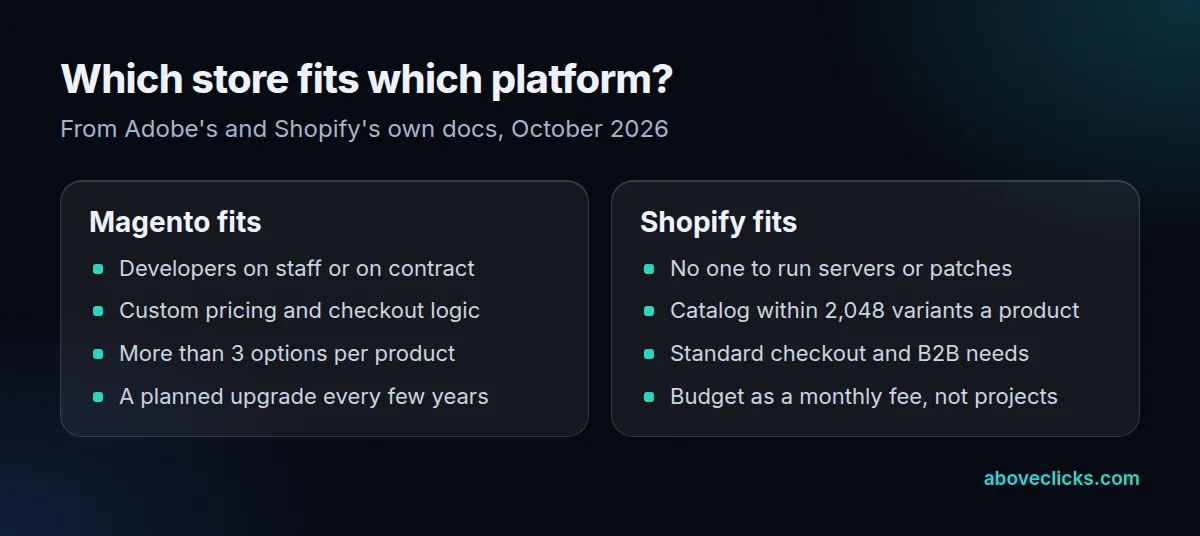
Choose Magento if…
- Your catalog needs more than 3 options per product
- You have developers who patch and upgrade on a schedule
- Custom pricing or checkout logic is core to the business
Choose Shopify if…
- You'd rather not run PHP, a database and a search server
- Your catalog fits 2,048 variants per product
- You want upgrades to stop being projects
Magento vs Shopify comes down to who runs the software. Magento gives you the code and leaves the servers, patches and upgrades to you; Shopify runs all of that for a monthly fee, inside limits you can’t change.
This magento vs shopify guide compares the two as of October 2026: what a Magento store has to keep current, what the upkeep really costs, where Shopify’s limits bite, what each means for SEO, and how to decide whether to stay, upgrade or move.
Magento vs Shopify: what’s the real difference?
Control against upkeep. Magento lets you change almost anything because you run it; Shopify takes the running off your hands and gives you fixed rules in return.
Magento (Magento Open Source, and Adobe Commerce, Adobe’s paid edition of the same code) is software you install on a server. Your developers can rewrite checkout logic, pricing rules or the URL structure, but they also own every security patch and every upgrade.
Shopify is a hosted platform. You don’t install anything, patches arrive without you, and there are no release versions to track. In exchange, some things are fixed: how many variants a product can have, the paths in your URLs, and how deep you can change checkout.
So the honest shopify vs magento question isn’t “which has more features”. It’s “do we want to run software, or rent it?” A store with a developer team and unusual logic may want to run it. A store whose team sells, not codes, usually doesn’t.
The gap shows up in 3 places in any magento vs shopify comparison:
- Upkeep: Adobe supports each Adobe Commerce release for 3 years of standard support, so a Magento store plans an upgrade at least that often. Shopify has no versions to upgrade.
- Limits: Shopify caps a product at 2,048 variants; Magento’s limits are whatever your build and servers allow.
- URLs: Magento lets you design every path; Shopify fixes its product and collection paths.
The rest of this magento vs shopify guide takes those 3 in turn, then the cost and the decision.
What is Magento used for today?
Mostly for larger stores with custom logic and a team to maintain it, which is where the magento vs shopify choice usually starts. It’s flexible, but every store runs its own stack of server software, and that stack has to move forward with each release.
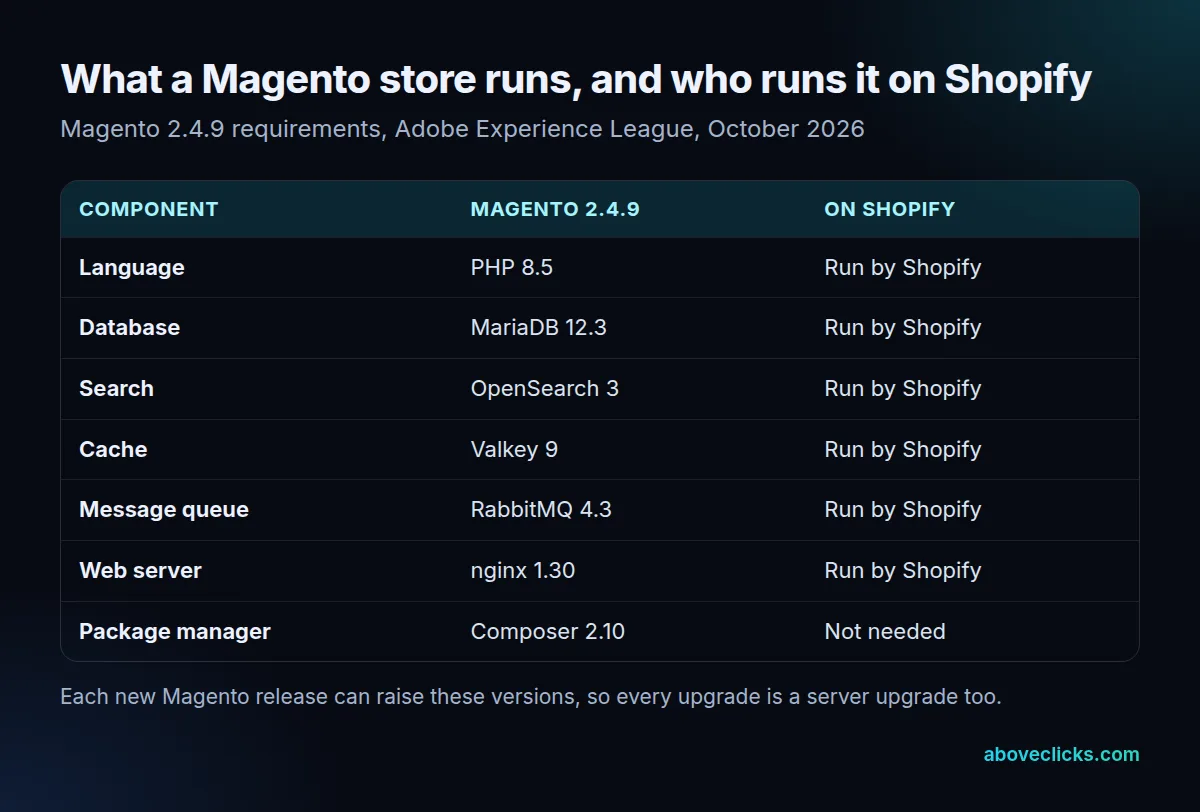
Adobe’s system requirements for release 2.4.9 list PHP 8.5, MariaDB 12.3, OpenSearch 3, Valkey 9, RabbitMQ 4.3, nginx 1.30 and Composer 2.10, as of October 2026. Adobe also says it only supports the combinations it lists, so an upgrade to 2.4.9 means upgrading the database first.
That’s the hidden part of the magento vs shopify choice, and the part most shopify vs magento feature grids leave out. On Shopify, none of those 7 components is yours to run. On Magento, each one is a version to track, a server to size and a thing that can break during an upgrade.
We see this side every week. Our Magento development work is mostly maintenance, security patches, upgrades and fixes on existing stores, not large new builds. The most common problem we meet is a store on a release whose support has ended, with patches postponed because the last update broke an extension.
How does Magento vs Shopify pricing compare?
Magento’s cost is mostly upkeep: hosting, developer hours, extensions and a planned upgrade every few years. Shopify’s cost is mostly a monthly plan plus apps and payment fees.
We don’t publish plan prices or hosting ranges here; they move too fast to stay true. The structure doesn’t move, though, and it decides the magento vs shopify pricing comparison more than any price list.
Adobe gives each Adobe Commerce release a three-year standard support window from its release date. Adobe also states that it doesn’t fix third-party software such as PHP and MySQL, even when those reach end of life inside that window. On top of that, Adobe’s patch schedule says security patches come at least once a year for every supported line.
So a Magento budget has 3 recurring lines Shopify doesn’t:
- Patching: at least 1 security patch a year, tested against your extensions before it goes live.
- Upgrades: a move to a newer release at least every 3 years, with the server upgrades it needs.
- Hosting: servers sized for the full stack above, whether orders grow or not.
Compare both platforms over the same 3 years, not 1 month. A Magento store with no planned upgrade in that window isn’t cheaper; its budget is just incomplete.
The Shopify side of a magento vs shopify pricing sheet has its own lines: the monthly plan, paid apps that replace Magento extensions, payment processing and, in the first year, the move itself. Apps are the line people miss. A Magento store with 40 extensions rarely needs 40 apps, because many of those extensions add things Shopify already includes, but each remaining one is a monthly charge. List them before you compare.
Is Magento better than Shopify for big catalogs and B2B?
Sometimes. In magento vs shopify catalog terms, Magento has no fixed per-product limits, while Shopify caps each product at 2,048 variants and 3 options, which most catalogs fit but some don’t.
Shopify’s variant guide says you can create up to 2,048 variants per product, and that products with more than 3 options need a third-party app. A furniture store selling sofas with size, fabric, leg finish and cushion fill needs 4 options, so it fails the test before cost is even discussed. For catalogs like that, the magento vs shopify answer depends on whether a combined-listing app or a different product structure is acceptable.
Magento vs Shopify for B2B stores
For shopify vs magento B2B, the gap is closer than it used to be. Shopify B2B is available on the Basic, Grow, Advanced and Plus plans, but not on Starter or Retail, and the features depend on the plan. It lets you set up business customers as companies, each with its own pricing, products, payment and shipping methods, plus draft orders, in one store with your direct sales or in a separate B2B store.
Magento still wins where B2B rules are truly custom, such as quotes built from an ERP or contract pricing calculated per order. If your B2B needs fit company price lists and payment terms, test them on Shopify before you assume you need Magento.
Which ecommerce platform is best for SEO?
Both can rank well. In magento vs shopify SEO, the difference is control: Magento lets you set every URL, while Shopify fixes its product and collection paths, which matters most when you move.
Shopify’s redirect guide lists 3 fixed paths that can’t be redirected: /products, /collections and /collections/all. Every product page lives under /products/ and every category under /collections/, whatever your Magento URLs looked like before.
That doesn’t make Shopify weak for SEO. Titles, descriptions, structured data, sitemaps and redirects are all available. It means a Magento store moving to Shopify changes almost every URL it has, so the move needs a full redirect map. Our Shopify vs WooCommerce SEO comparison covers the same fixed-path question against WordPress.
For SEO, the magento vs shopify gap is mostly about effort, not ceilings. On Magento, a developer can tune layered navigation, canonical tags and URL suffixes, but every one of those settings is also a way to create thousands of duplicate filter pages. On Shopify, filtered collection pages follow the platform’s own pattern, so there’s less to tune and less to break. A store with 50 categories and a few filters each is easier to keep clean on Shopify; a store whose rankings depend on custom landing pages built from filter combinations may need Magento’s control, or a careful rebuild of those pages as Shopify collections.
Should you stay on Magento, upgrade or move?
Stay if your release is supported and your team keeps up with patches. Upgrade if you need Magento’s control. Move if the upkeep costs more than the control returns.
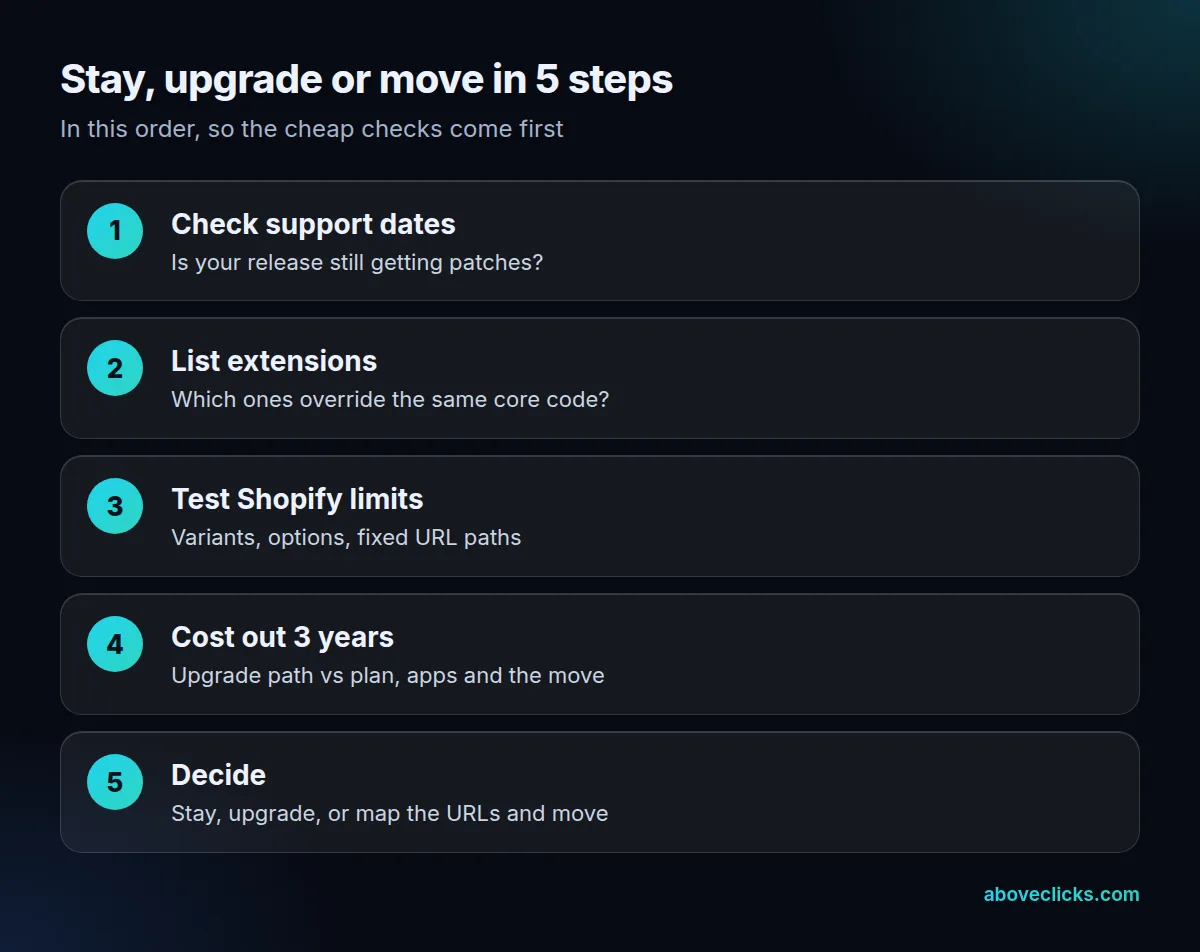
Work through it in order:
- Support dates: check your release against Adobe’s lifecycle page. A release past its end dates gets no fixes.
- Extensions: list every extension and note which ones change the same core code, because those break together at upgrade time.
- Shopify limits: test your 10 largest products against 2,048 variants and 3 options.
- 3-year price: compare the next upgrade plus hosting with a Shopify plan, apps and the move itself.
If steps 1 and 2 show a store that hasn’t been patched in a year, the decision is urgent whichever way you go. If step 3 fails, Magento vs Shopify is already decided for that catalog unless you can restructure the products. Step 4 is where most magento vs shopify decisions are really made, so write the 3-year numbers down and compare them side by side. Our free audit covers the current setup in writing, with the order we’d fix it in.
What does moving from Magento to Shopify involve?
A URL map, a data move and checks after launch, whatever made the magento vs shopify case. Products are the easy part; the redirects and the tracking decide whether search traffic and orders survive the switch.
Shopify’s own migration guide lists the ways to move data, from copy and paste and CSV files to migration apps, a Shopify Partner or a custom build on the Shopify API. Google’s site move guide asks for permanent server-side redirects from each old URL to its new one, kept for as long as possible and generally at least 1 year.
Here is the process we publish for our Shopify migration work: the URL inventory and redirect map in the first week, the move in 2 to 4 weeks depending on the size of the store, and close monitoring for 4 weeks after launch. On one migration published there, 1,126 old paths were reviewed, 1,082 got permanent redirects and 44 were retired; organic clicks in the first 28 days after launch were 2.89% lower than the 28 days before, then rose above the old level in the next 28 days.
Whichever way your magento vs shopify decision goes, keep the URL map: it’s the record of what the old store ranked for. If the decision is to build or rebuild on Shopify, our Shopify development team handles the theme, apps and integrations. More platform comparisons are in buying guides.