CPC on Amazon is the average amount you pay each time a shopper clicks your ad: total ad spend divided by total clicks. Whether it is too high depends on what a click earns you, and you can work that out from three numbers.
This guide shows what CPC on Amazon means, how it connects to conversion rate and ACOS, and a 4-step check for the most one click can cost. The stores and figures in the examples are invented. If you want the auction mechanics, read our guide to Amazon advertising cost per click.
What is CPC on Amazon?
It is the amount you pay for one click on a Sponsored Products or Sponsored Brands ad. Amazon’s CPC guide says the final click cost is set by an auction and is based on your adjusted bid plus other factors.
The same guide says that, generally, the more in-demand a keyword is or the more visible the placement, the higher the cost. PPC is the system of paying per click, and CPC is the metric that measures it.
A worked example: two clicks cost $0.40 and $0.20, so you spent $0.60 and your CPC is $0.30. Amazon CPC always means that average over the dates you pick.
How do CPC, conversion rate and ACOS fit together?
CPC feeds ACOS, but conversion rate and order value feed it too. The identity is ACOS = CPC ÷ (conversion rate × average order value), which is spend divided by sales rewritten per click.
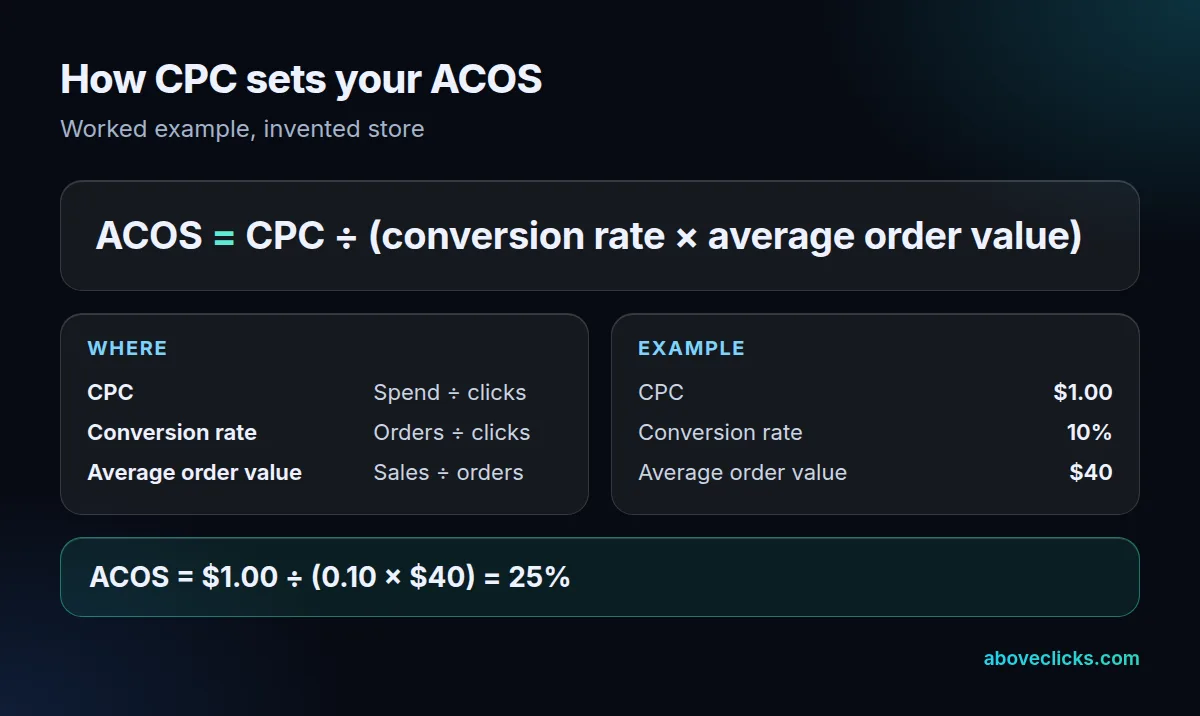
Amazon’s ACOS guide defines ACOS as ad spend divided by ad revenue, as a percentage. Its example: $50 spent on a campaign that earned $100 is a 50% ACOS, and a ROAS of 2. ROAS is the inverse, revenue divided by spend.
Take an invented store with a $40 average order, a 10% conversion rate and a $1.00 CPC. Ten clicks cost $10 and bring one order worth $40, so ACOS is 25%. The identity gives the same answer: $1.00 ÷ (0.10 × $40).
That is why Amazon CPC alone never tells you whether ads work. Two stores with the same CPC can have very different ACOS if one converts 4% of clicks and the other 12%.
What is the most one click can cost on Amazon?
Profit per order, before ad spend, multiplied by your conversion rate. That is your break-even CPC: above it, each click loses money; below it, each click earns something.
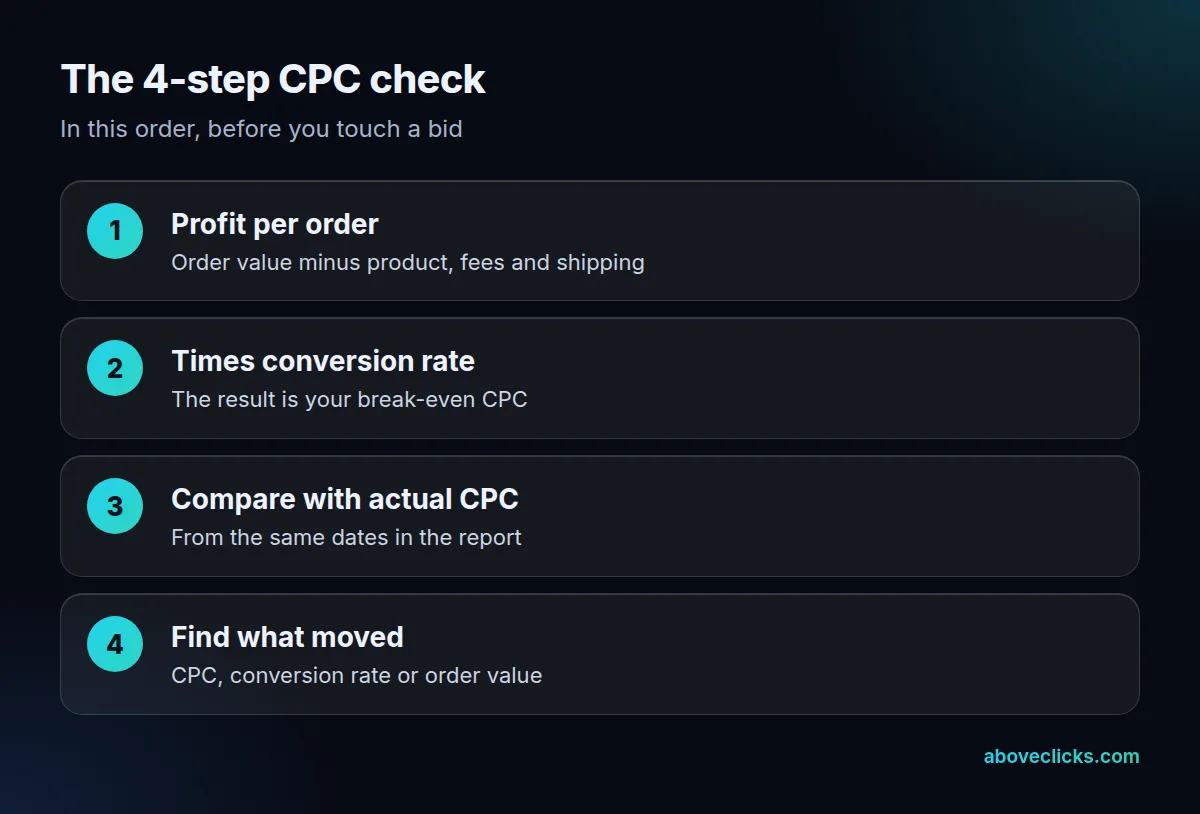
Amazon’s ACOS guide ties break-even ACOS directly to profit margin: to stay in profit your ACOS must stay below your margin. The 4-step check turns that into a CPC:
- Work out profit per order before ads. Take the order value and subtract the product cost, Amazon fees and shipping. Invented store: a $40 order with a 35% margin leaves $14.
- Multiply by your conversion rate. With 10% of clicks becoming orders, $14 × 0.10 = $1.40. That is the break-even CPC.
- Compare it with your actual CPC. Use the same dates and the same product group. At a $1.00 CPC the store keeps $0.40 per click, or $40 for every 100 clicks.
- Find what moved. If actual CPC now exceeds the break-even, ask whether CPC rose, conversion fell or order value dropped.
Run the check again whenever an input changes. A discount lowers profit per order, a stock-out or a weak review lowers conversion, and a new shipping fee lowers both. Each one moves your break-even CPC without any change in your ads.
Check each product, not the account. Amazon’s best-practices guide recommends grouping ASINs by price range and conversions, because a high-order-value product can bid higher and still hold a good ROAS.
What is the average CPC on Amazon?
There is no official figure. Amazon’s CPC guide says the rank of ads changes frequently, so there is no set number for any brand’s cost per click, and we do not quote a market average because no primary source publishes one.
What Amazon does publish is the cap on your spend. Its FAQ says a $100 daily budget may bring up to $3,100 of clicks in a 31-day month, as of November 2026, and the Sponsored Products page confirms there are no monthly or upfront fees, so you pay only when an ad is clicked.
So a stranger’s average Amazon CPC is the wrong benchmark. Your own break-even CPC is the right one, because it carries your margin, your conversion rate and your product.
The budget ceiling also shows why CPC on Amazon changes how far a budget goes. At a $1.00 CPC, a $30 daily budget buys about 30 clicks a day. At $1.30 it buys about 23, and with a 10% conversion rate that is roughly 3 orders instead of 2.3. Same budget, fewer chances to sell.
What happens to profit when CPC on Amazon or conversion rate moves?
Both raise ACOS, but a conversion fall often does more damage than a rise in CPC on Amazon, because it is easy to miss. The table below runs the same invented store through four months.
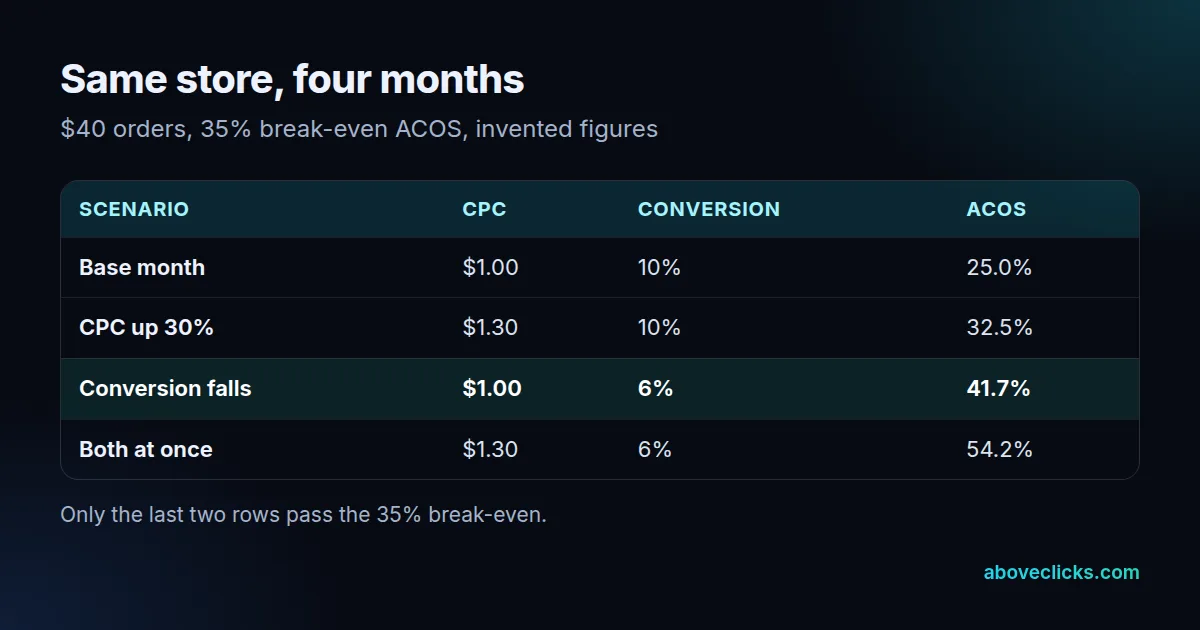
The base month has a $1.00 CPC and a 10% conversion rate, so ACOS is 25% against a 35% break-even. A 30% CPC rise to $1.30 lifts ACOS to 32.5%, which is still profitable. A conversion fall from 10% to 6% at the same $1.00 CPC lifts ACOS to 41.7%, which is over break-even even though no bid changed.
When both happen, ACOS reaches 54.2%. Amazon CPC that looked fine in the base month is now a loss. Break-even CPC at a 6% conversion rate is $14 × 0.06 = $0.84, so a $1.00 click already loses $0.16.
Read the two ratios together every week. A falling conversion rate with a flat CPC points at the listing or the offer. A rising CPC with a flat conversion rate points at the auction, a new placement adjustment or a broader keyword. Both falling and rising at once usually means a change to the ad itself.
The common mistake is cutting bids when conversion fell. A lower bid can cost you the top placements without fixing the reason shoppers stopped buying, such as a price change, a stock-out, weaker reviews or a competing offer.
How do you reduce CPC on Amazon?
To reduce CPC on Amazon, remove the clicks that never convert first, then adjust bids and placements. Amazon’s guides give four levers for lowering your Amazon CPC, in the order we would try them.
- Search term report. Amazon’s best-practices guide says to download it, raise bids on terms with high sales and conversion, and lower them on terms with low sales and conversion.
- Negative targeting. Adding negative keywords or negative ASINs stops your ad appearing where it does not meet your goals, so you stop paying for those clicks.
- Placement report. It compares top of search with other placements. Placement adjustments go up to 900%, so check that one you raised is not pulling most of your spend.
- Bidding strategy. Dynamic bids down only, up and down, or fixed bids change how far above your base bid a click can go. A final click never exceeds your maximum adjusted bid.
Be careful with automatic targeting. It is useful for finding terms, but its clicks often include searches you would never choose, so review the search term report after the first two weeks and move the winners to exact match.
Conversion rate is the lever that raises your break-even CPC, so it is worth a look before bids. A clearer title, better images or a corrected offer lift it for every keyword at once. That is the work behind Amazon SEO, and our team handles the ads side through Amazon Ads management.
When should you stop chasing a lower CPC?
When your actual CPC is already under your break-even and orders are still falling. A lower CPC on Amazon is not the goal; profit per click and total profit are. Squeezing an Amazon CPC that already clears break-even can only cost you impressions and orders.
Amazon’s CPC guide says that after a campaign has run for about two weeks you should have enough insight to make informed decisions. Wait for that data before you act, and change one thing at a time so you can see what worked. A product with 20 clicks and no orders has not proved anything yet. A product with 300 clicks and no orders has.
A short test for each product:
- Is the actual CPC under the break-even CPC from step 2? If yes, leave it alone.
- Did conversion rate fall against the previous 2 weeks? Fix the listing first.
- Is a placement or search term spending more than it sells? Cut it, not the whole campaign.
Write the break-even CPC next to each product in your reporting sheet and update it monthly. When the number sits beside the actual CPC on Amazon, a gap shows up in seconds instead of at the end of the quarter.
If you cannot answer these from your reports, ask for a free audit: we read your Amazon Ads and listing data and show which of the three numbers is costing you. The cost per click formula guide covers the same break-even logic for Google Ads. More guides are in buying guides.