Commercial real estate marketing platforms are the tools a broker or owner uses to list space, keep prospect records, send email, run ads and count inquiries. Choose them by the job each one does, not by brand, because most missed inquiries come from gaps between tools.
This guide maps the six jobs, shows how data should move between them, covers the one email rule you must follow, and ends with a scorecard. For the wider plan, see our guides to commercial real estate marketing and the marketing plan.
What are commercial real estate marketing platforms?
They are the software services a commercial property team uses at each step from listing space to closing the inquiry. No single tool covers every step, so most teams connect two or three.
Think in 5 verbs: list, track, email, advertise and measure. A listing marketplace lists. A contact database tracks. Email software sends. LinkedIn and Google advertise. Analytics measures.
Scale makes the point. A brokerage with 12 listings and 20 inquiries a month can run on three tools. A firm with 150 listings and 300 inquiries a month needs records that survive staff changes, which is when a spreadsheet stops being enough.
Buying commercial real estate marketing platforms by job keeps the stack small. If a new platform does not replace one of those five verbs, it is probably a duplicate of something you already pay for.
Which commercial real estate marketing platforms do which job?
Six kinds cover almost everything: listing marketplaces, a CRM or spreadsheet, email software, paid ad platforms, local search tools and analytics. The table shows what each does and the one thing to check before you commit.
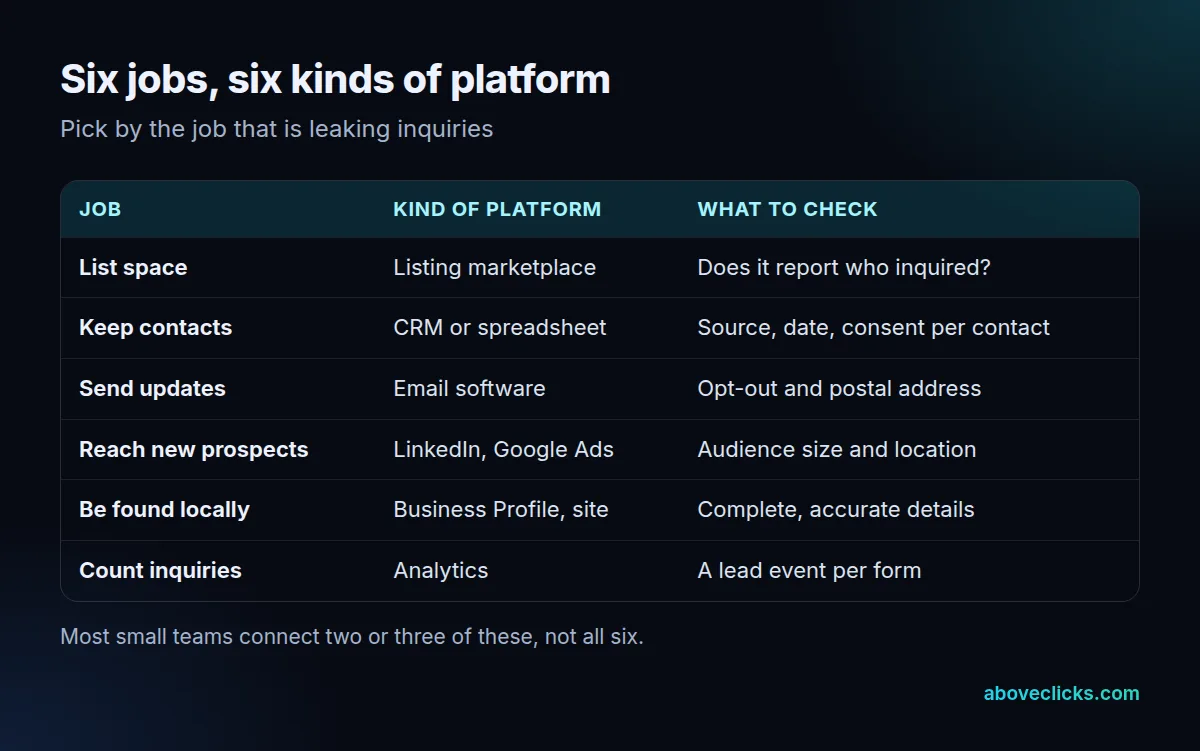
Commercial real estate marketing software is often sold as a bundle of several rows. That is fine if each row works. Test the weakest row, not the demo of the strongest one.
A practical test: send 10 real inquiries through the whole chain, from form to record to follow-up email, and count how many arrive with a source and a date. Anything under 10 of 10 points to the row to fix first.
How do commercial real estate listing platforms fit in?
They put your space in front of people already searching for property. They bring inquiries in, but they are not where you should keep the relationship.
Take Crexi as an example. Its own site shows a listing-tools menu with at least 7 items, including My Listings, Lead Activity, Integrations, My Contacts, Email Lists and Email Campaigns. Features differ by plan and change, so confirm what your plan includes.
We could not open LoopNet’s site from our build environment (it returned an access error), so we make no claims about its tools. Whichever commercial real estate listing platforms you use, and however many of them there are, ask 3 questions: does it show who inquired, can you export those people, and does a listing stay visible and editable if you stop paying?
Test before you commit. Put one listing on a new platform for 30 days, tag its inquiries, and compare them with the other 11 listings before you move more.
Do you need a commercial real estate CRM?
Yes, once you have more than a few dozen contacts. A commercial real estate CRM is where each prospect, property interest and note lives, so the history stays with you when a marketplace subscription ends.
A spreadsheet is enough to start a commercial real estate CRM if every row has a source, a date and an opt-out column. The contact list also feeds your ads. Google’s Customer Match lets you upload customer data to reach those people on Search, YouTube and other surfaces, and a list stays eligible only if at least 100 members are added or updated within a 540-day window.
So a list you never refresh stops being usable for ads after 540 days. Treat the CRM as the master copy and export from it, not the other way round.
Which paid platforms reach commercial prospects?
LinkedIn reaches people by employer and role; Google Ads reaches people searching for space in a place. Use LinkedIn when the buyer or tenant is a business decision-maker, and Google when the need is local and active. Both sit in the paid row of any set of commercial real estate marketing platforms.
LinkedIn’s targeting options include job title and company industry, plus contact or company list audiences. It also states a minimum audience of 300 member accounts to run an ad set, so a very narrow list of 40 named owners will not run on its own.
For Google Ads, location targeting can use a country, regions, cities or postal codes, or a radius of at least 1 km around a point. Google calls it a best effort and says it cannot promise 100% accuracy in every situation. That matters for a single building: a radius around the property can still show ads to someone outside it.
Keep ad audiences small and specific at first. A list of 300 or more named contacts or one tight industry and job-title mix is easier to judge than a broad audience of tens of thousands, and it tells you within a few weeks whether the message works.
Our real estate marketing service and the real estate digital marketing industry page explain how we plan paid work.
What rules apply to email in commercial real estate marketing software?
The US CAN-SPAM Act applies to commercial email. Each message needs accurate sender details, a non-deceptive subject line, your postal address and a working opt-out that you honor quickly.
The FTC’s CAN-SPAM guide says you must honor an opt-out within 10 business days, and the opt-out method must keep working for at least 30 days after you send. It lists penalties of up to $53,088 per violating email (as of the page’s January 2024 update). It also says you cannot sell or transfer the address of someone who opted out.
That is why the CRM needs an opt-out column, whichever commercial real estate marketing software sends the mail. If email software and the CRM disagree, someone gets mail they declined. Our guide to commercial real estate email marketing covers lists, templates and blasts in detail.
How do you measure inquiries across platforms?
Count one event per inquiry and tag its source. Without a source, you can see that 20 inquiries arrived but not which platform earned them.
Google Analytics has a recommended event, generate_lead, for when a user submits a form or a request for information. Fire it on each property inquiry form and keep the source in your CRM too.
Local search needs separate attention. Google’s Business Profile help says local results rest on 3 factors: relevance, distance and prominence, and that there is no way to pay for a better local ranking. Complete, accurate details are the part you control.
A simple habit keeps the numbers honest: once a month, open the inquiry list and check that each of the last 20 rows has a source, a date and a property. Rows with a blank source are the ones to chase. If more than 5 of 20 are blank, the form or the marketplace export is dropping the field, and that fix comes before any new ad spend or new commercial real estate listing platforms.
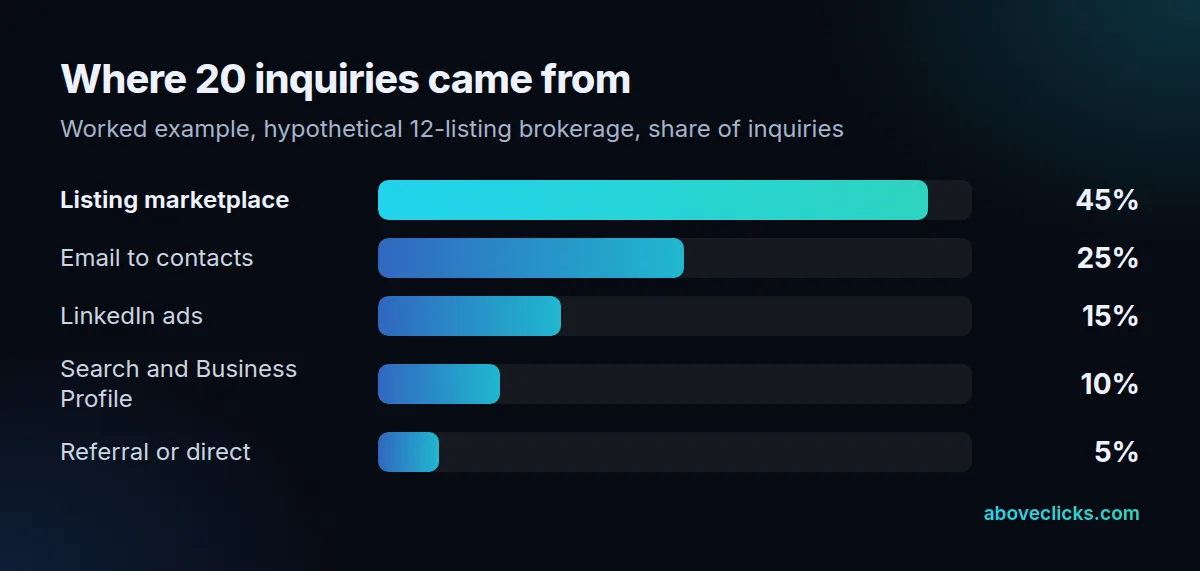
The worked example above is hypothetical: a 12-listing brokerage with 20 inquiries in a month. Only the marketplace and email numbers are visible if sources are tagged. Untagged, 20 inquiries look like one lump, and the 3 from LinkedIn get no credit.
How do you choose between commercial real estate marketing platforms?
Score each candidate on six written questions and drop any that fail 2 of the 6. The scorecard below keeps the choice about your job and your data, not a sales demo.
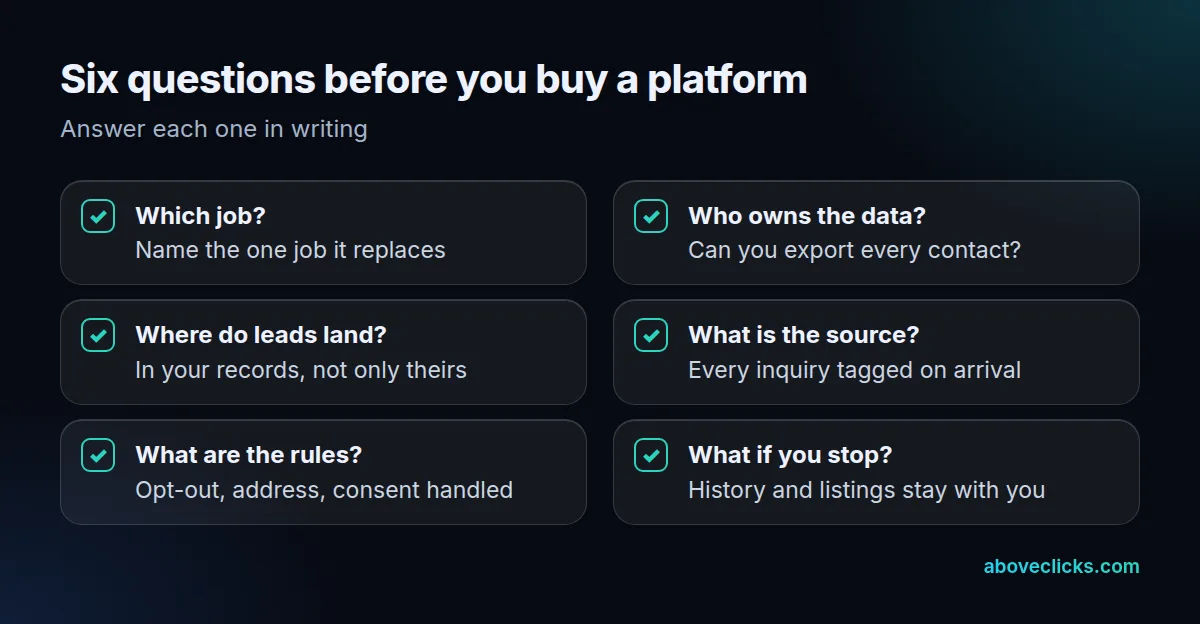
Worked example, hypothetical: a brokerage with 12 listings compares 3 candidate tools. Tool A answers 5 of the 6 questions, Tool B answers 3 and Tool C answers 6. Tool B is out because it fails more than 2 of the 6, and the choice between A and C comes down to the one question A misses. That is a 20-minute decision instead of a 3-week one.
Write the answers down and share them with whoever signs off the budget. When the same 6 questions are asked of every vendor, the comparison between commercial real estate marketing platforms stops depending on who gave the best demo.
Here are the six gaps that cost inquiries, in the order to fix them:
- No source field on inquiries.
- Inquiries stuck inside a marketplace, not in your records.
- A contact list with no dates or consent notes.
- Email without a working opt-out or postal address.
- A location target wider or narrower than the real market.
- No lead event in analytics.
Start with the first 2 gaps, since both are free to fix: a source field costs one extra column, and an export takes an afternoon. If you want a second opinion on your current tools, our free audit looks at tracking and ads first. More guides are in industry guides.