A real estate email marketing campaign is a planned series of emails sent to one defined group of contacts, with one goal such as booked viewings or valuation requests. Plan one around a trigger and a single number to check, not around a calendar of blasts.
This guide covers who belongs on the list, the five campaigns an agent or small team can run, a 90-day drip example, the sender rules to follow and how to measure the result. It’s written for residential agents; the commercial side has its own guide.
What is a real estate email marketing campaign?
A set of emails with one purpose, sent to the people most likely to act on it. A single email to everyone is a blast; a real estate email campaign picks the group first and the message second.
Most agents already hold the raw material: past clients, enquiries from listing portals, open house sign-ins and neighbors. Email is the channel that keeps those people in touch between the months when they are ready to buy or sell. For how it compares with other channels, see our ranking of real estate marketing channels.
Example: an invented agent holds 1,200 contacts, made up of 300 past clients, 500 old portal enquiries, 250 open house sign-ins and 150 neighbors. Sending one message to all 1,200 wastes it on at least 3 groups. Splitting the same list into 4 groups lets each real estate email campaign speak to one situation.
Who belongs on a real estate email list?
Everyone who gave you their address and agreed to hear from you, split into groups by what they want: buying, selling, past clients and neighbors. Don’t send the same email to all four.
Groups work best as segments, not fixed lists. Klaviyo’s help center explains that segments are dynamic: they grow as people meet the conditions and shrink as they stop, and they update in close to real time. A fixed list only grows when someone adds a name.
Four segments cover most agents:
- Buyers: people who enquired about a listing or saved a search.
- Sellers: people who asked for a valuation or own a home in your farm area.
- Past clients: everyone you closed with, who should hear from you every quarter.
- Neighbors and sphere: people who signed in at an open house or know you locally.
Size matters less than fit. A farm area of 400 homes with 60 subscribed owners is a better seller segment than 2,000 unrelated addresses, because every email can mention streets those owners know.
Keep a note of where each address came from and what the person agreed to. You’ll need it for the rules section below.
Which real estate email campaign ideas are worth sending?
Five: new listing, open house, past-client nurture, buyer drip and a monthly newsletter. Each has a trigger, a goal and one number to check, so you can drop any that don’t pay back.
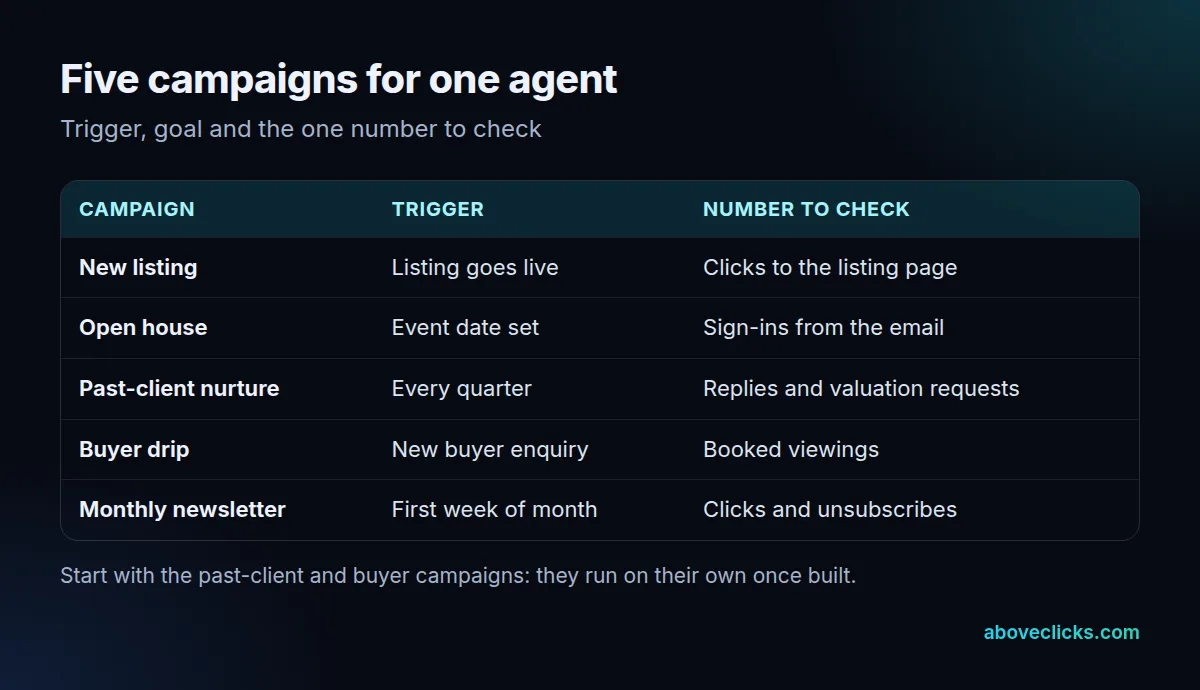
Each real estate email campaign in the table has its own trigger. The first two are tied to events, so they take effort every time. The other three can be built once and left running. That’s why we’d start with the past-client and buyer campaigns: an hour of setup keeps working for months.
Plan the work in small blocks so it gets done:
- Past-client nurture: about 2 hours to write 4 quarterly emails once.
- Buyer drip: about 3 hours to write and schedule the 6 emails in the next section.
- New listing and open house: about 30 minutes each time, using one saved template.
Keep each real estate email campaign to one ask per email. A new listing email asks for a click to the listing page; an open house email asks for a reply or a sign-in. If an email asks for three things, the reader usually does none.
How does a real estate drip campaign work?
A drip campaign sends a short sequence of emails automatically after a trigger, such as a new buyer enquiry. Each email waits a set number of days after the last one and stops when the person replies or books.
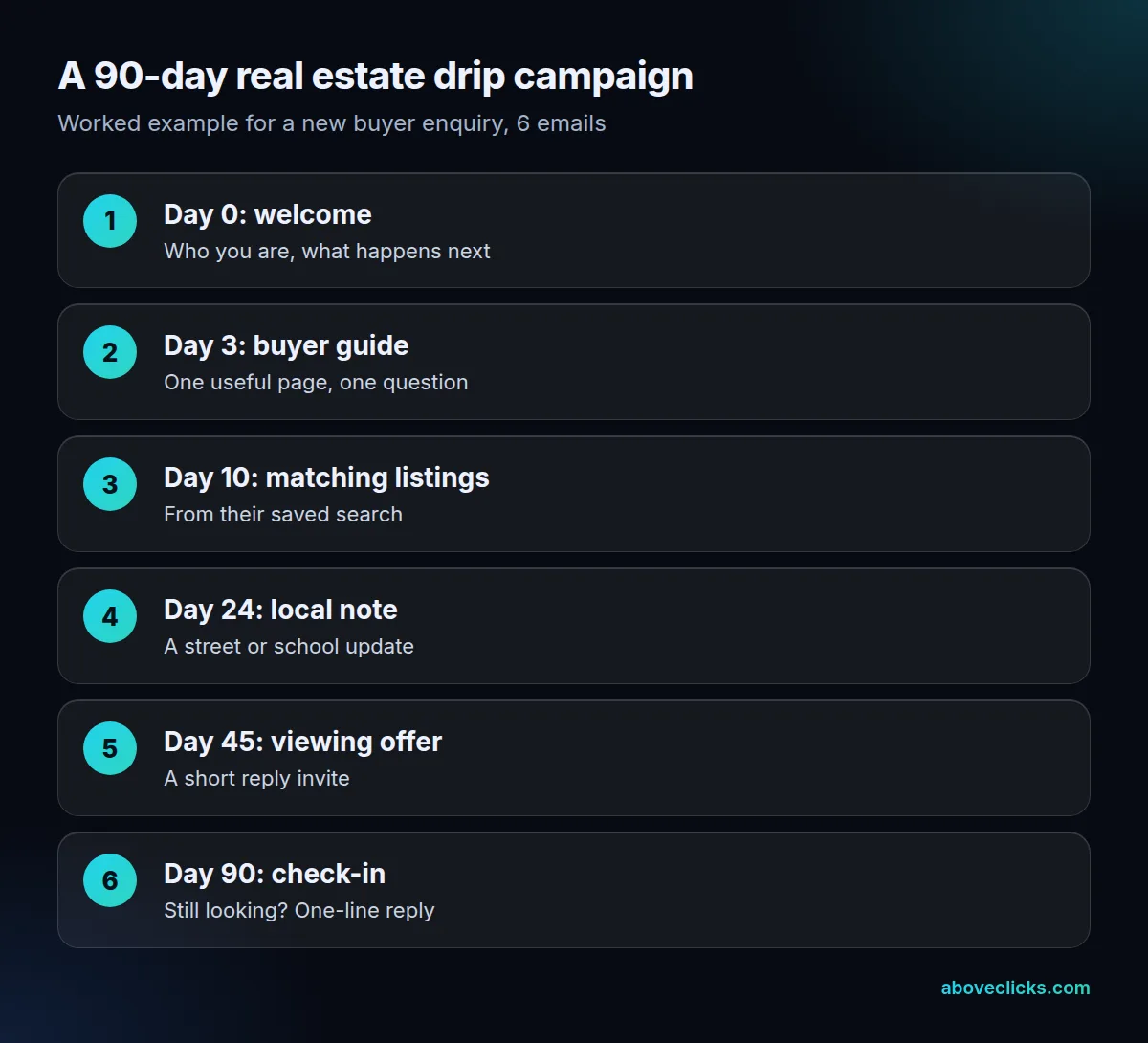
Example: an invented agent gets a new buyer enquiry. The plan above sends 6 emails across 90 days. Day 0 says who you are and what happens next. Day 3 shares one buyer guide and asks one question. Day 10 sends listings matching the saved search. Day 24 adds a local note. Day 45 offers a viewing and day 90 is a one-line check-in.
Personalization in a real estate drip campaign comes from data you already hold. Klaviyo’s help center describes how event data in flows lets a message use details of the action, such as the product a customer viewed. In a real estate drip, the equivalent is the listing or area the buyer looked at, when your site or CRM records it.
A short real estate drip campaign is easier to keep honest than a long one. Six emails over 90 days is roughly one every 2 weeks, which leaves room for the newsletter without doubling up. If the same person would get a drip email and the newsletter within 2 days, hold the newsletter for that contact.
Two rules keep a drip campaign honest: stop it when the person replies, and move them into another segment when their situation changes. A buyer who bought through you belongs in past clients, not in a buyer drip.
What should a real estate newsletter include?
One local story, one useful tip and one clear ask. A real estate newsletter is the only campaign that goes to most of your list, so it should be short enough to read in a minute.
A simple layout for a monthly real estate newsletter:
- A local market note in plain words: what sold on your streets, with no invented statistics.
- One tip for the season, such as what to fix before listing or what to check before an offer.
- One featured listing or a recent sale, with a single button.
- A reply line: “Thinking of moving this year? Hit reply.”
Aim for under 300 words, which reads in about 1 minute, and keep it to 3 blocks. Send it in the first week of the month and compare each issue’s clicks and unsubscribes with the last one. If you want the newsletter built and sent for you, our Klaviyo email marketing service does the flows and segments.
What rules keep a real estate email campaign out of spam?
For every real estate email marketing campaign, authenticate your domain, keep complaints low, make unsubscribing easy and honor opt-outs fast. These are the rules major mailbox providers and the FTC publish; they apply before the first send.
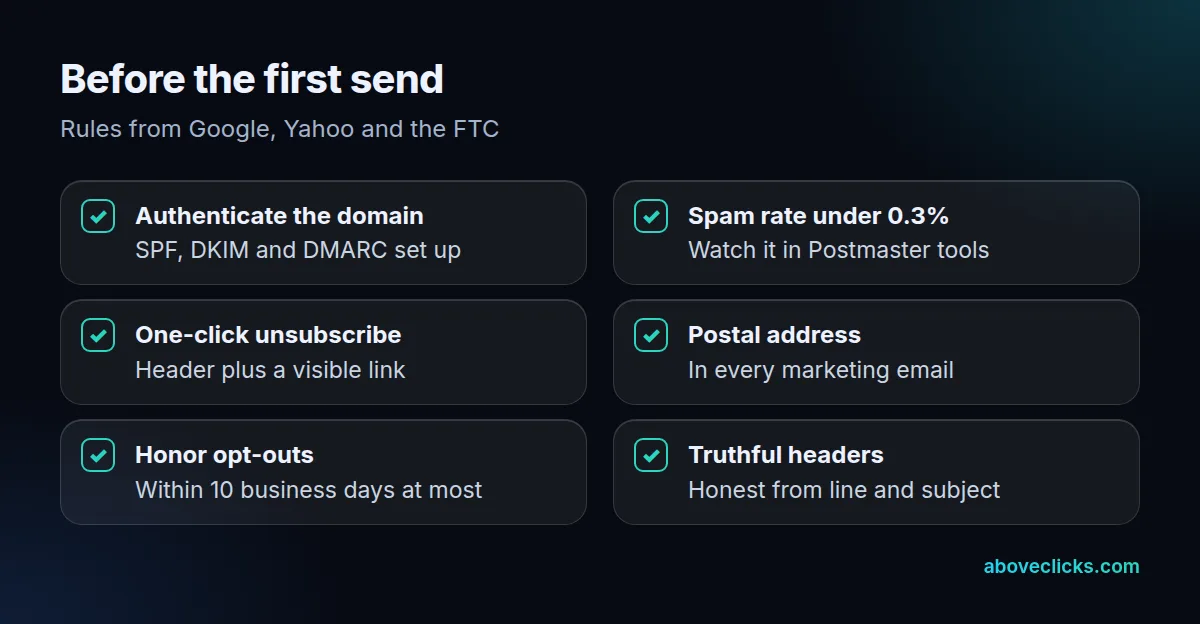
The numbers to know:
- Gmail: senders of more than 5,000 messages per day to Gmail accounts must set up SPF, DKIM and DMARC, keep the spam rate below 0.3% and support one-click unsubscribe. Most agents send far fewer, but the same habits protect a small list.
- Yahoo: its sender guidance also asks for a spam rate below 0.3% and says to honor unsubscribes within 2 days.
- FTC: under the CAN-SPAM Act, each email must carry your valid postal address and a clear way to opt out, and you must honor an opt-out within 10 business days. Each violating email can draw penalties of up to $53,088.
Check your own numbers first: in Google’s Postmaster Tools you can see the spam rate for your domain, and under 0.3% is the line both Gmail and Yahoo name. For a list of 1,200 contacts, that is fewer than 4 complaints per send.
If your emails land in spam, start with the sending domain. Our email deliverability page covers SPF, DKIM and DMARC. This is general information, not legal advice; check local rules for your market.
How do you measure a real estate email marketing campaign?
By the action you asked for, not by opens. For each campaign, count replies, clicks to the listing, sign-ins or valuation requests, then compare them with the size of the segment.
Example with invented numbers: an agent emails a past-client segment of 300 people out of a 1,200-contact list. The email gets 12 replies, 3 valuation requests and 1 listing agreement. That’s a reply rate of 4% (12 divided by 300), which you can compare with the next quarter’s send.
Write the target down before you send. For example, decide that the past-client email should bring at least 10 replies from 300 people, and that a result under 5 replies means rewriting the subject line and the ask, not adding more emails. A written target turns each send into a test you can learn from.
Two habits make the numbers useful for any real estate email marketing campaign:
- Check each campaign against its own number from the table, not one overall average.
- Watch unsubscribes and spam complaints beside replies. A campaign with good clicks and rising complaints is costing you the list.
If you’d like a second pair of eyes on your list, flows and sender setup, our free audit is a good place to start. More industry guides are in industries, and our page on real estate digital marketing shows how email fits the wider plan.