Real estate marketing classes teach agents how to find, reach and follow up buyers and sellers. Judge one by what its syllabus covers, not by the certificate at the end.
This guide gives seven checks for any class, shows what free courses cover, lists the rules a class should teach, and explains what only your own accounts can show you.
What are real estate marketing classes?
Taught sessions, live or recorded, that cover how to market listings and yourself: profiles, ads, email, follow-up and tracking. They differ from licensing courses, which prepare you for the exam and are set by your state commission.
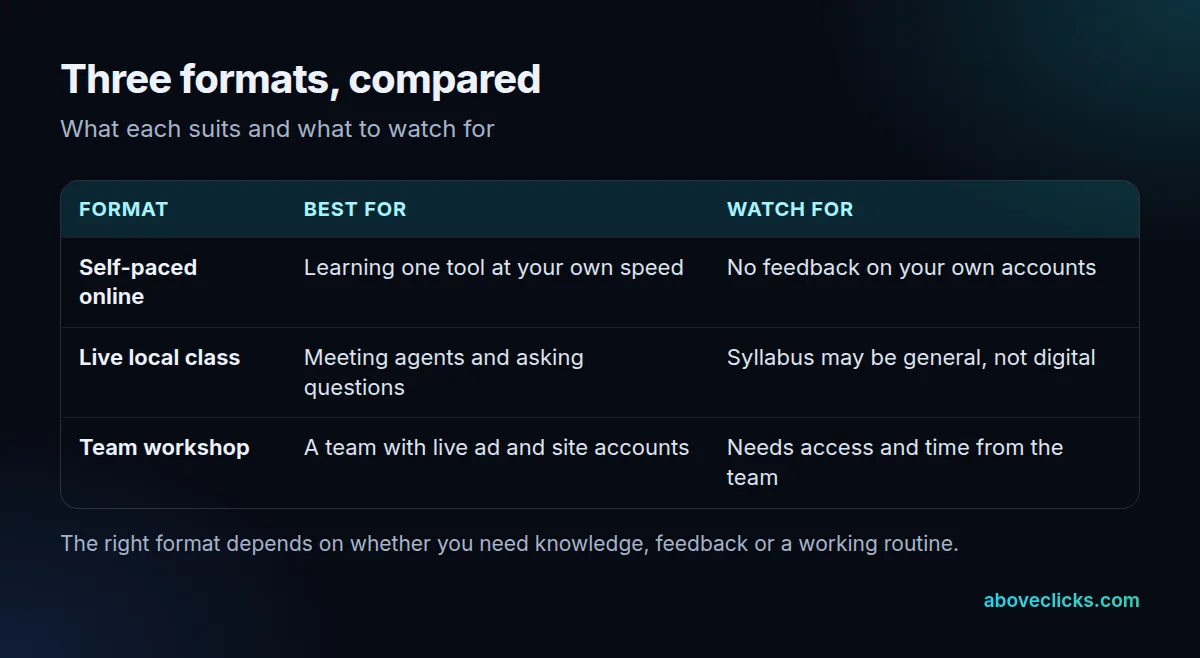
Most real estate marketing classes fall into three formats: self-paced online lessons, live classes or seminars run locally, and workshops for a whole team. The table below shows what each suits.
If you are newly licensed, start with the first-90-days order for new agents and use a class to fill the gaps. A class works best when you already have a list of people to contact and one accurate profile to send them to.
What should a real estate marketing course teach?
One lead source from first click to booked viewing, how fast to reply, how to track the source, the rules for housing ads and email, and exercises on your own listings. A real estate marketing course that skips these teaches vocabulary, not a routine.
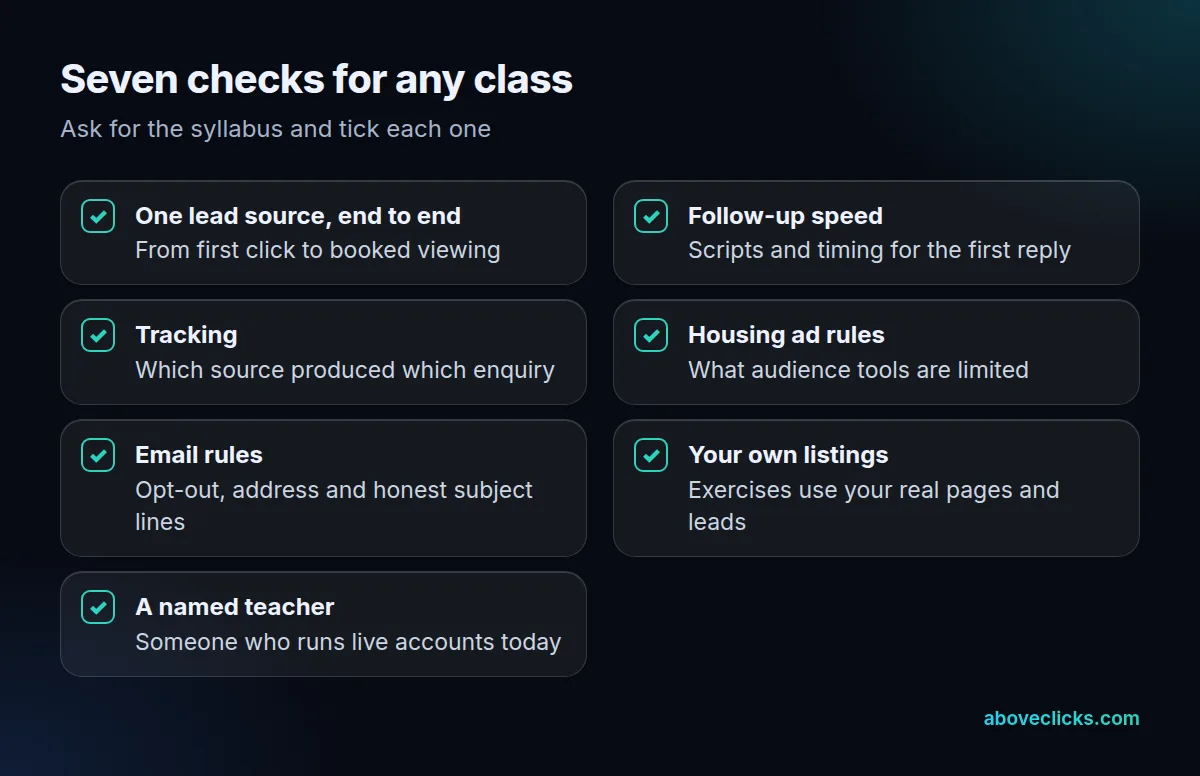
Use the seven checks above as a filter. For the platform-rules check, the Meta, HUD and FTC pages listed in the rules section below are the official sources a syllabus should point to; for the tools, Google’s Skillshop lists courses for 5 product families, including Google Ads, Analytics and Business Profile. Ask the seller for the syllabus before paying and mark each check as covered, partly covered or missing. A worked example of scoring: a course that scores 5 or more out of 7 is worth a trial; one that scores 3 or fewer is usually a general marketing talk with a real estate title.
Two checks decide most outcomes. Follow-up speed matters because an enquiry that waits a day has often spoken to another agent by then, and tracking matters because without it you cannot tell which lesson paid off. If the syllabus never mentions either, treat the rest of the content as background reading.
Are there free real estate marketing courses?
Partly. Google’s Skillshop offers online courses that cover part of a real estate marketing course, the tools side: self-paced courses on Google Ads, Analytics and Business Profile, with certification. As of November 2026, its home page describes e-learning designed by Google product experts; check its page for current terms before you start.
Skillshop’s home page lists Google Ads, Google Marketing Platform, Google Analytics, Google Business Profile, Google Ad Manager, AdMob, Authorized Buyers and Waze, so the ones that matter to an agent are the first four. These courses teach the tools, not real estate.
They explain how the platform works, not how to price a listing campaign or reply to a buyer. That makes them a low-risk first step.
As a worked example, 1 hour a day for 10 days gives you 10 hours of tool training before you commit to a paid class, and the courses are self-paced, so you can stop at any lesson. A free real estate marketing course, where you find one, is also a fair test of whether you enjoy the subject: finish the Business Profile and Analytics lessons before you pay for anything that claims to cover the same ground.
For a local-search angle, our guide to Google Ads for realtors shows how the tool is used for property searches, and the one on email marketing for real estate agents covers the other free channel most classes teach.
Does a real estate marketing certification matter?
Rarely to clients. A real estate marketing certification can look good on a card, but it is not what a buyer or seller reads first. Buyers and sellers judge you by reviews, replies and listings, not by a certificate. A real estate marketing certification matters when your brokerage or a platform program requires it, so ask your broker first.
Platform certificates prove you completed that platform’s training, and the 3 products an agent uses most (Google Ads, Analytics and Business Profile) each have a path on Skillshop. Skillshop, for example, lets you get Google product certified after its courses. They show you know the tool, not that your campaigns work. A certificate from an unknown school proves even less, so check who teaches and whether they run live accounts today.
Treat a certificate as a bonus. A simple worked example: before the class, time 5 enquiries from reply to first call; after the class, time 5 more. The things that should change after any class are measurable: faster first replies, a profile that is complete, and a report showing which source produced each enquiry.
Which rules should real estate marketing training cover?
Housing ad targeting limits, fair housing, email opt-out and Business Profile rules. Real estate marketing training that skips them can get your ads rejected or lead to penalties.
- Housing ads on Meta: Meta’s help page says that for ads about housing, certain audience options are limited or unavailable for US advertisers, including age, gender, ZIP code, exclusion targeting, lookalike audiences and saved audiences. Meta encourages broadening, not restricting, the audience. See Meta’s special ad category page (as of November 2026).
- Fair housing: the Fair Housing Act prohibits housing discrimination because of race, color, national origin, religion, sex, familial status and disability. Ask your broker or state commission how it applies to your ads and wording.
- Email: the FTC’s CAN-SPAM guide says each violating email can carry penalties of up to $53,088, that you must honor an opt-out within 10 business days, and that the opt-out must work for at least 30 days after you send.
- Profiles: Google’s Business Profile guidelines treat real estate agents as individual practitioners and say a practitioner shouldn’t have multiple profiles for specializations.
Meta also notes that using a special ad category may limit your audience options and that audiences based on a city or pin drop get an expanded radius, so a class that teaches tight radius targeting for housing ads is out of date. The FTC guide adds that a commercial email needs a disclosure that it is an ad and the sender’s physical postal address. And Google’s guidelines say sales associates or lead generation agents for corporations aren’t individual practitioners and aren’t eligible for a Business Profile, so the profile advice in a class should start from whether you qualify.
None of this is legal advice. A class should name these rules and point to the official page, not summarize them from memory.
How do you choose between online and local real estate marketing classes?
Choose by feedback, not location. Online classes suit learning a tool at your pace; local ones suit meeting agents and asking questions. Neither gives feedback on your own accounts unless you ask for it.
A worked example of the cost of choosing wrong: a local class that meets for 3 hours a week over 6 weeks takes 18 hours, and if the syllabus is general sales skills, you have spent them learning none of the 7 checks. Before you book a class near you, ask three things:
- Is the syllabus about digital marketing, or general sales skills?
- Will the teacher look at your listings, profile or ad account?
- Can you see a sample lesson or the teacher’s own live work first?
An online real estate marketing course with a sample lesson, or a 30-minute preview call, and a written syllabus is easier to test than a local seminar sold on a flyer. If you prefer to learn in person, ask for the same syllabus in writing. Good real estate marketing classes, online or local, should answer these 3 questions before you pay.
When is a class not enough?
When you need results on live accounts. A class teaches the tools and rules, but only your own listings, ads and replies show what your market responds to.
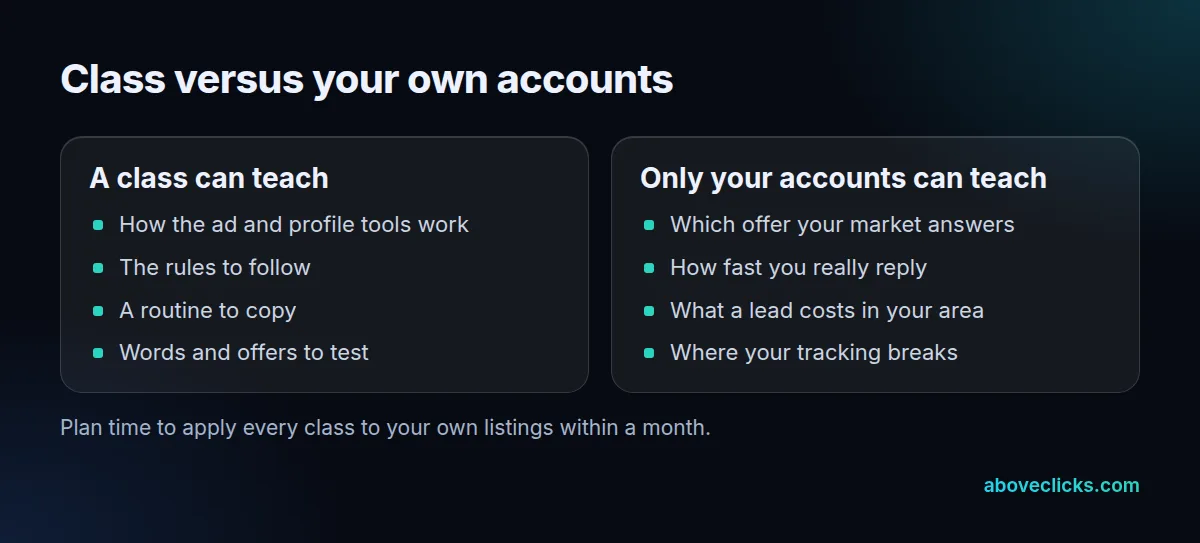
Give any class 4 weeks of application, because a lesson you don’t use in 30 days is usually forgotten:
- Week 1: complete your Business Profile and check your contact page works on a phone.
- Week 2: write your first-reply script and time how long you take to answer enquiries.
- Week 3: tag every enquiry by source so you know where it came from.
- Week 4: run one small, capped test and review it against the source tags.
If your team wants the same learning on live ad and site accounts, our marketing team training runs workshops on your own accounts and leaves written SOPs. It starts with a free account audit: 20 checks and a PDF report within 2 workdays. Our real estate marketing service and the real estate industry page show how we run the lead engine when you would rather hand it over, and the free audit is the fastest way to see where your own accounts stand. More guides are in industries.