Commercial real estate marketing is the work of getting a commercial property or brokerage in front of the small group of tenants, buyers, investors and referrers who decide on it. Judge it by tours, proposals and signed deals, not by clicks.
This commercial real estate marketing guide covers who those audiences are, a 6-step plan for a 90-day vacancy, the channels that fit, the traps that cost leads and the records that tie spend to signed leases.
What is commercial real estate marketing?
It is marketing aimed at businesses and investors rather than households: office, retail, industrial and mixed-use space for lease or sale, plus the brokerages and owners behind it. The buyer is usually a company, and several people sign off.
That changes the numbers you watch. A residential campaign can live on volume, but one commercial vacancy may need only a handful of right-fit businesses to see it. Cost per lead tells you little here. For example, one residential lead-form account we publish on our real estate industry page recorded 112 conversions at $50.43 each between 1 and 30 September 2026. Even there, we judge the work on site visits and deals, because a cheap form fill can still be a person who never answers.
The same logic applies at the top of the market: fewer, better-informed inquiries beat a long list, and commercial real estate marketing is built around that. If you sell homes rather than space, our real estate marketing plan guide covers the residential version.
How do you market commercial real estate?
Start with the people who decide, not the channels. Marketing commercial real estate works when each audience gets the facts it needs, in the place it already looks, with one clear next step.
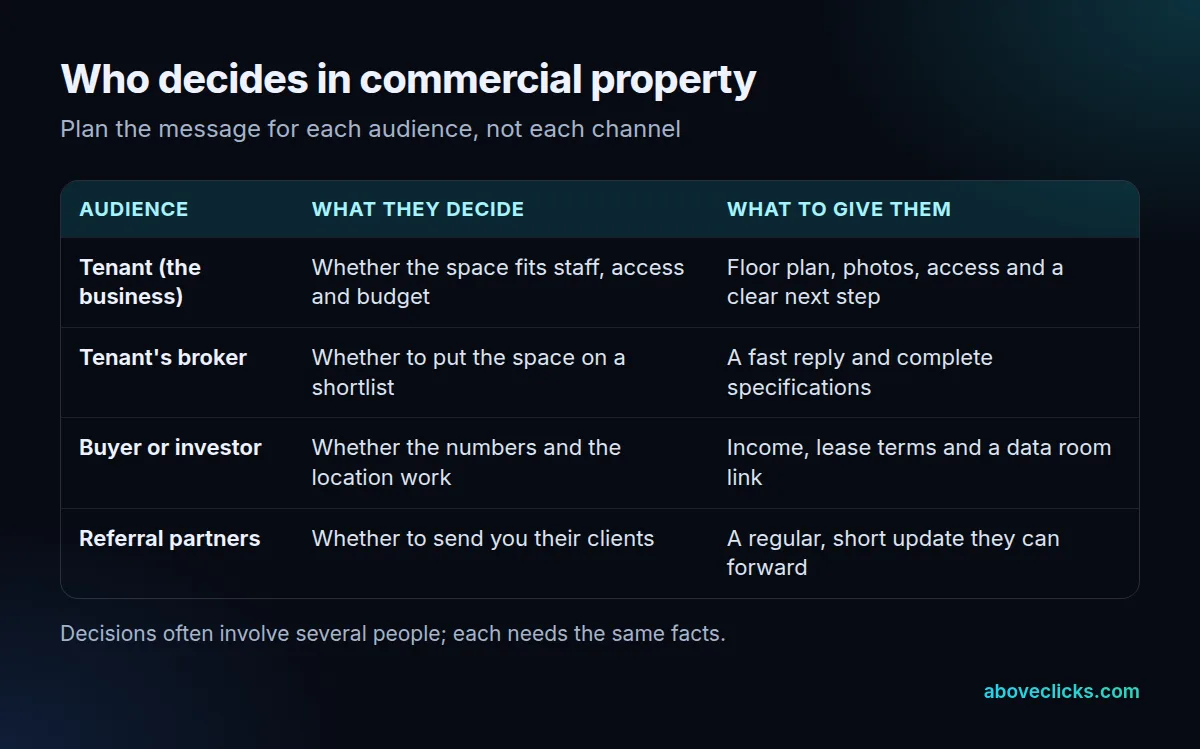
Most commercial audiences are small and can be named. That makes account-based marketing practical: you build a list of target companies and brokers, then reach them with ads and direct email. LinkedIn supports this directly. It lets you target by job title, company, industry and seniority, and its Matched Audiences can be built from contact lists, website visitors or company page followers. The catch is size. LinkedIn needs a minimum audience of 300 member accounts to run an ad set, so a list of 40 named firms has to be widened by industry or location.
Two jobs run side by side when you are marketing commercial real estate: marketing the property and marketing the firm. The property needs a proof page and fast replies. The firm needs a profile that referral partners trust, kept current with a short regular update.
What goes into a commercial real estate marketing plan?
Six steps, dated, with a review built in. A plan for one vacancy should fit on a page and name who does each step.
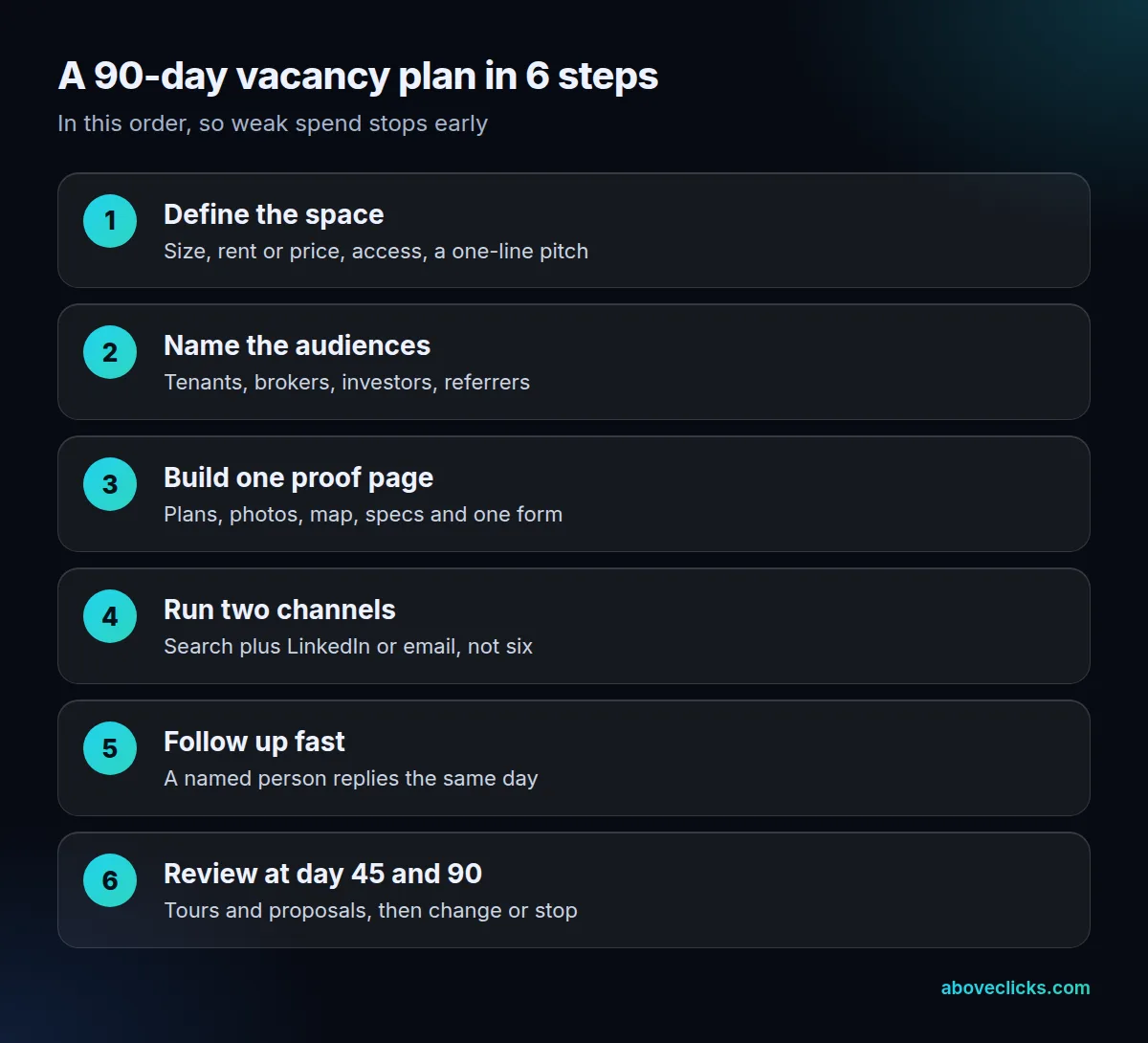
Here is a worked example with invented numbers, not a benchmark. A landlord has 18,000 sq ft of vacant office space and a 90-day window. In the first 2 weeks the team defines the space, lists 60 target companies and 15 tenant brokers, and builds one proof page with plans, photos, a map and a single form. From week 3 it runs Google Search for people looking for space in that area, plus LinkedIn ads to the company list. One named person replies to every inquiry the same day.
At day 45 the review shows 40 qualified inquiries, 12 tours and 3 proposals. That is enough to keep the two channels and drop a third that produced clicks but no tours. At day 90 one lease is signed and two proposals are still open. That is a normal outcome for commercial real estate digital marketing on one space. The point is the review: each channel has to earn its place through tours and proposals, and the plan names the day you decide.
Keep the plan honest about what it cannot control: rent, location and timing. Marketing finds the right audience; it does not change the space.
Set the budget from the deal, not from a percentage of last year’s spend. If one signed lease is worth a year of rent, a few thousand dollars of search and LinkedIn spend over 90 days is a small share of it. Write the cap down at step 1, so a review at day 45 changes the mix instead of reopening the whole commercial real estate marketing plan.
Which channels suit commercial real estate digital marketing?
Search, your own listing page, a verified Business Profile and direct email carry most of the weight. Commercial real estate digital marketing works best with two channels you can measure rather than six you cannot.
- Google Search and lead forms: people looking for space in a named area are already in the market. Google’s lead form assets can be added to Search and Performance Max campaigns, and Google keeps the leads for 60 days, so download or connect them to your CRM before that.
- Business Profile for the office: a brokerage with a staffed office can use one. Google’s Business Profile guidelines say a virtual office is not eligible, and a co-working office qualifies only with clear signage, customers received on site and your own staff during business hours.
- Direct email to named contacts: tenants’ brokers and past clients respond to a short, specific message. See the email rules below, and our real estate email marketing guide for sequences.
- Your own site: one proof page per property beats a shared listings page, because the ad, the search result and the email can all land on the same facts.
Commercial real estate online marketing also includes listing marketplaces. Treat them as another source to measure, not as the plan. Tag every link to your proof page so the report shows which source sent each tour.
How does LinkedIn fit social media marketing for commercial real estate?
It fits as the main paid social network, because you can reach decision makers by role and company. LinkedIn’s ad targeting uses member-reported job title, company, industry and seniority, and offers company targeting for account-based campaigns.
Use it for three jobs in social media marketing for commercial real estate: reach the company list from step 2 of the plan, retarget visitors to the proof page, and keep referral partners aware of new availability. Pair each ad with a specific offer, such as a floor plan pack or a tour slot, rather than a general brand message.
Remember the 300-member minimum from above, which matters for any commercial real estate online marketing built on named companies. If the estimate is too small, widen by location or industry before you raise the budget. Posts from the brokerage’s own team add reach for free, but treat them as brand support, not as lead generation for one space.
Other networks suit different jobs. Short video and photo posts can show a building to a wider audience, but they rarely replace direct contact with the people who decide.
How do you generate commercial real estate leads?
Give each lead a fast path to a person. Marketing for commercial real estate wins or loses on the first reply, because a tenant’s broker is often asking several landlords at once. Lead generation here means a small number of right-fit conversations, not a large list.
Four costly traps to avoid:
- A virtual office on your profile. It can lead to suspension, since Google treats it as ineligible. Use a staffed office or a service area instead.
- A leased page left as a live page. If a page says “no longer available” but returns a 200 status, Google reports a soft 404. A real 404 or 410 response is dropped from the index. Either remove the page or turn it into a “recently leased” proof page with a link to current availability.
- Email without the basics. The FTC’s CAN-SPAM guide says the law makes no exception for business-to-business email. Each violating message can carry a penalty of up to $53,088, as of October 2026. Include your postal address and honor opt-outs within 10 business days.
- No owner for replies. A form that lands in a shared inbox gets answered late. Name one person and a same-day rule.
A short page also helps. Ask for name, company, space needed and a phone or email, then show the next step on screen. Long forms cost inquiries from busy decision makers.
How do you measure commercial real estate online marketing?
Measure to the stages that matter: tour, proposal, signed lease. Commercial real estate online marketing is only measurable if the deal stage comes back to the ad platform.
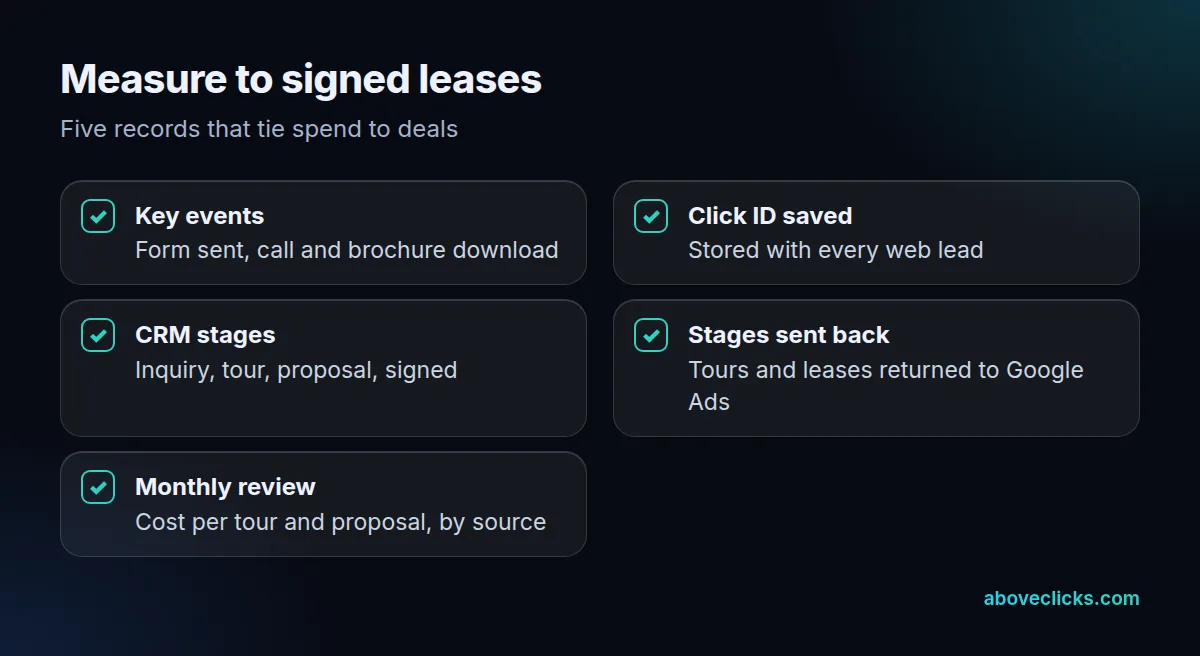
Start in Analytics: any event can be marked as a key event, such as a form sent, a click-to-call or a brochure download. Then save the Google click ID (GCLID) with every web lead in your CRM. When that lead signs a lease, you give the ID back to Google Ads with the date and conversion type, as Google’s offline conversion guide describes. Google also recommends enhanced conversions for leads, which adds hashed email or phone data, and reports a median 10% increase in conversions for advertisers using it compared with standard imports.
Then review monthly by source, using the same commercial real estate marketing report each time: cost per tour and cost per proposal for Search, LinkedIn, email and referrals. A source with many inquiries and no tours is a signal to change the targeting or the page, not to spend more. A source with few inquiries but several proposals deserves a larger share of the budget.
If you want a second opinion on the tracking and the proof page, our free audit reads your site and ad accounts and lists fixes in order. For the wider picture, see more guides in industries, or our real estate marketing service page.