Commercial real estate email marketing is sending planned emails to owners, investors, occupiers and brokers about your listings and your market. It works best by role and property type, to a small list kept clean.
This guide covers who goes on the list, what a newsletter and a listing blast should each do, the templates to keep, the rules that apply to business email and what to measure. It is not legal advice.
What is commercial real estate email marketing?
It is a repeat channel for people who may trade, lease or refer property over years, not a one-off ad. The audience is smaller and more varied than a home-buying list.
Think of five roles on one list: occupiers looking for space, investors looking for yield, owners who may sell, brokers who share deals, and lenders. Each wants a different email. An occupier cares about the 40,000 sq ft warehouse; an investor cares about the lease term and the cap rate.
Email suits this audience for a plain reason: deals take months, and the people who matter are few. A broker who writes useful notes twice a quarter is still remembered when an occupier’s lease ends in 14 months. That is the case for commercial real estate email marketing over a one-off flyer.
Most of the work happens before the send: a tidy list, a segment for each role and one reason to write. Our wider commercial real estate marketing guide places email next to LinkedIn, listings and direct outreach. For the residential version, with five lifecycle flows, see real estate email marketing.
Who belongs on a commercial real estate email list?
People who know you or asked to hear from you: past clients, tenants, owners you have met, brokers you work with and enquiries from your listings. Then tag each one by role and property type.
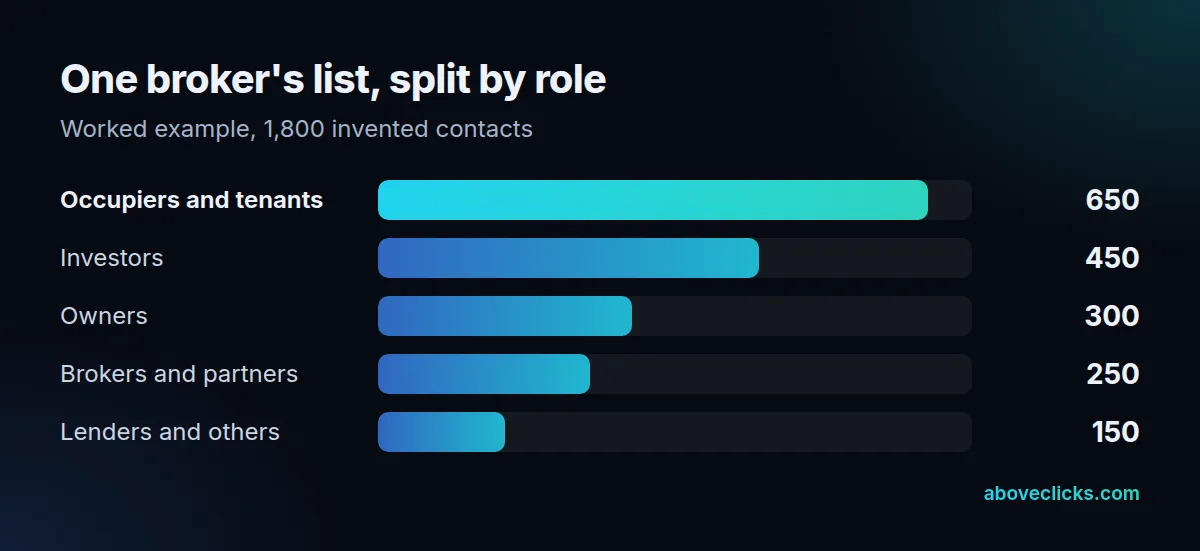
The example above is an invented broker with 1,800 contacts. Occupiers are the largest group at 650, so most listing emails should go there. The 150 lenders and others get the newsletter only.
Tag a second field for property type (industrial, office, retail, land) and market. A segment is a saved filter on those tags. In Klaviyo, segments are groupings defined by conditions that update as contacts meet or stop meeting them, while lists stay static. Other platforms use similar terms.
A commercial real estate email list built this way is easy to defend. Each address has a reason to be there, which is better for complaints than a bought file. Our Klaviyo email marketing service builds segments like these, and the email deliverability service covers the authentication behind them.
What should a commercial real estate newsletter include?
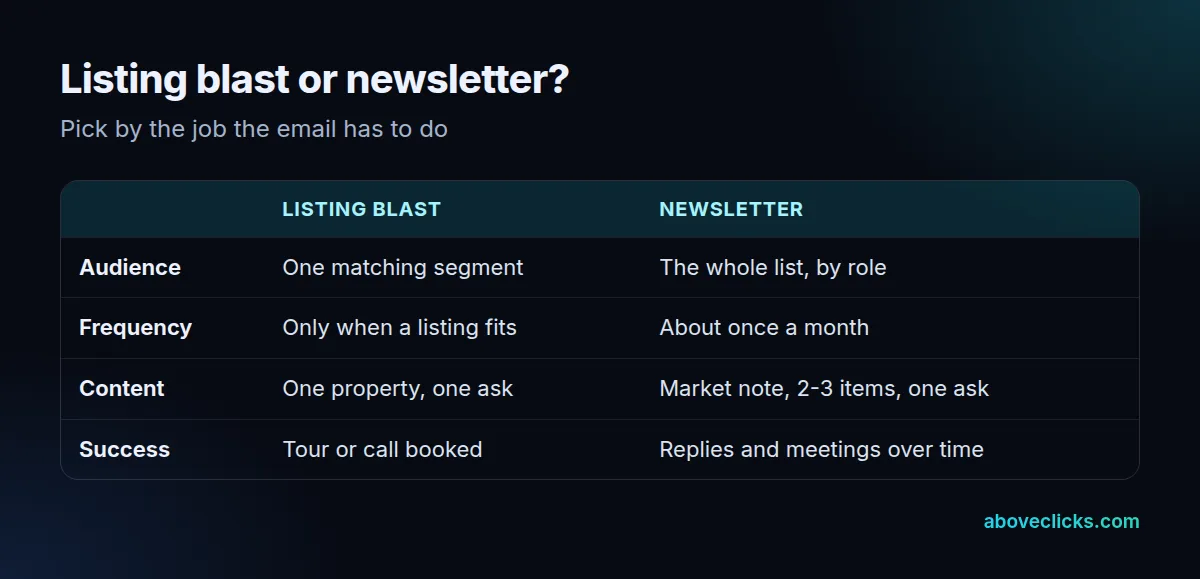
A short market note, two or three items matched to the reader and one clear ask. Send it about once a month to the whole list, with a few blocks that change by role.
A worked example of a 12-issue year for an industrial broker (invented):
- Q1 issues (3): vacancy and rent notes for your submarket, plus one new listing; ask: reply with your space needs.
- Q2 issues (3): a recent lease or sale you handled, shown without client names; ask: book a market call.
- Q3 issues (3): a short explainer for owners on preparing a building for the market; ask: request a free opinion of value.
- Q4 issues (3): a year summary and next year’s outlook; ask: book a planning call.
Keep every commercial real estate newsletter to one ask. Three links to three different pages split attention and are harder to measure. If you cite market figures, name the source and the date next to the number.
How do commercial real estate email blasts differ from a newsletter?
A blast is one property to one matching segment, sent only when a listing fits. A newsletter is regular and broad. Use commercial real estate email blasts rarely and the newsletter steadily.
The difference matters because of list size. Take an invented blast for a 40,000 sq ft industrial listing, sent to the 220 contacts who tagged industrial. Gmail asks senders to keep their reported spam rate under 0.3%. On 220 sends, one complaint is 0.45%, which is already above the limit. Roughly one complaint in every 333 sends reaches 0.3%.
Here is a worked four-week calendar for the same invented broker. Week 1: the monthly commercial real estate newsletter to all 1,800 contacts. Week 2: a listing email to the 220 industrial contacts. Week 3: no mass send, only one-to-one follow-ups to people who replied. Week 4: a second listing email to 140 retail contacts, if a retail space is available. That is 2 group sends to subsets and 1 to everyone in a month, which keeps most readers at 1 or 2 emails.
That is arithmetic on a small example, not a penalty schedule, but it shows why a small list needs care. Do not send commercial real estate email blasts to the whole list “to be safe”. The tenant who needs 3,000 sq ft of retail has no use for an industrial listing and is the person most likely to hit “report spam”.
What do commercial real estate email templates need?
Three templates cover most work: a listing blast, a monthly newsletter and a one-to-one follow-up. Each has one headline, one ask and the same footer.
- Listing blast: address or submarket, size, asking terms, a photo or plan, and one button to book a tour. Five facts, one ask.
- Monthly commercial real estate newsletter: a market note of about 100 words, two or three items and one ask.
- One-to-one follow-up: three or four sentences, written like a plain email from a person, short enough to answer from a phone.
Each template should fit on one phone screen without scrolling more than twice. If a reader needs to scroll through 10 screens to find the ask, the email is doing the job of a brochure.
Reuse commercial real estate email templates for layout, not for the wording itself; the same goes for commercial real estate email blasts. A reader who gets the same sentence from three brokers deletes all three. Add one detail only you know, such as the street, the tenant’s industry or the date the space opens.
Which email rules apply to commercial real estate senders?
The CAN-SPAM Act covers all commercial email, with no business-to-business exception. Gmail and Yahoo add their own sender rules. Commercial real estate email marketing therefore needs a short checklist on every send.
The FTC’s CAN-SPAM guide says the law “makes no exception for business-to-business email”. Each email in violation can bring penalties of up to $53,088 (as of November 2026). Its main rules are below.
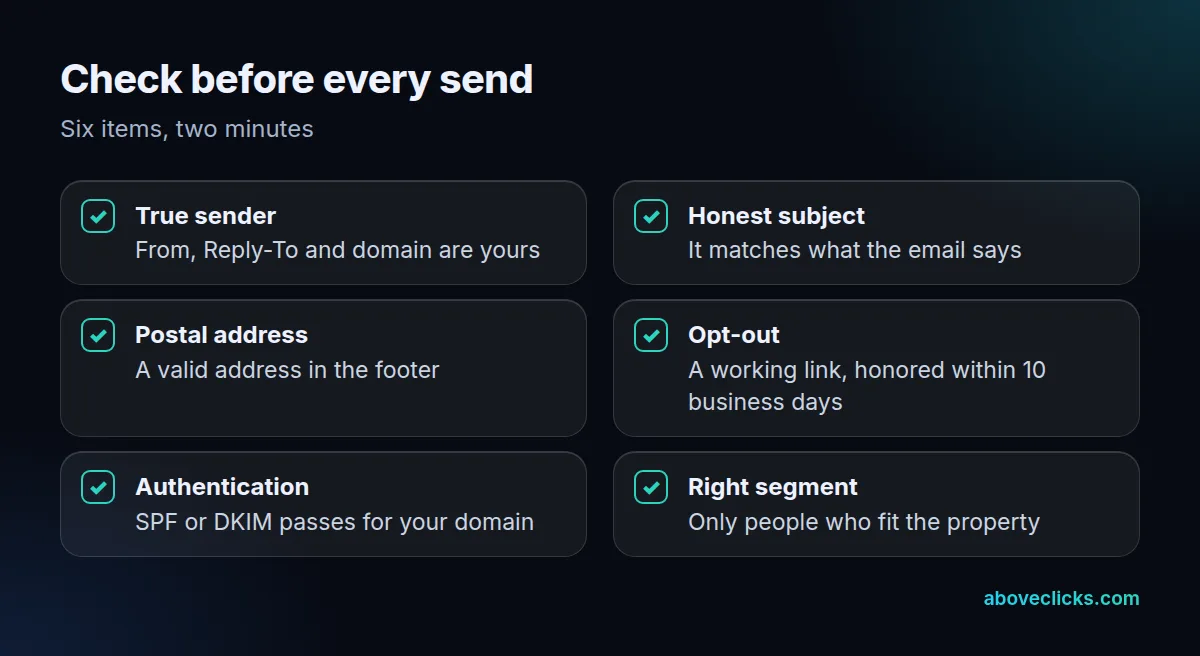
Four details sit behind the checklist:
- The opt-out must keep working for at least 30 days after you send, and you must honor a request within 10 business days, per the FTC.
- Google requires every sender to set up SPF or DKIM; senders of more than 5,000 messages a day to Gmail also need DMARC and one-click unsubscribe.
- Yahoo asks bulk senders to honor unsubscribes within 2 days and to keep spam rates under 0.3%.
- Most commercial lists send far fewer than 5,000 messages a day, so the bulk rules may not apply to you, but the authentication and spam rate rules do.
Read the current pages before you set up, because limits and dates change. If your domain fails authentication, fix it before you grow the list.
How do you measure commercial real estate email marketing?
Count replies, booked calls and tours, and watch spam complaints. Opens are unreliable, and the sale or lease happens months after the email.
Opens are unreliable because mail apps can load images automatically. A reply or a booked tour is a person acting. Track four numbers per segment:
- Replies to the commercial real estate newsletter, counted by hand at first.
- Calls or tours booked from the listing blast’s button.
- Unsubscribes per send, which tell you when a segment is over-mailed.
- Spam rate in Google’s Postmaster Tools, which shows spam rate, reputation, authentication and delivery errors for mail to Gmail. Keep it under 0.3%.
Four mistakes cost brokers the most on a small list:
- One list, one email for every role. Occupiers, investors and lenders each unsubscribe from the wrong message.
- Blasting the whole list. A single mismatched send can trigger the complaint that breaks the 0.3% limit.
- Assuming B2B is exempt. It is not, so the postal address and opt-out stay in every email.
- Judging by opens. Count replies and booked tours instead.
A worked reading of the invented broker’s month: the newsletter drew 18 replies from 1,800 contacts (1%), the industrial listing email booked 3 tours from 220 contacts, and 2 people unsubscribed. The newsletter replies were mostly brokers and owners; the tours came from occupiers. That tells the broker to keep both formats and to route replies by role.
Tie the leads back to the deal in your CRM, so a lease signed nine months later still credits the email that restarted the conversation. If you want a second opinion on your setup, our free audit looks at tracking and email as part of the review. More guides are in industries.