A jewelry ad is one paid message for a piece of jewelry: a picture, a line of copy and a next step. Build it from 5 parts, write each part to prove something, and test one change at a time.
This guide breaks one jewelry ad into its parts, shows a worked copy example counted against Google’s limits, lists the claim words that need proof, and explains how to pick the winner between two ads. Use it as a review sheet for any jewelry ad before it goes live.
What is a jewelry ad?
A jewelry ad is a single ad unit for one piece or one product set, such as a search ad for studs or a feed ad for a ring. It is the part a shopper sees; the campaign around it only decides who sees it.
Our guide to jewelry ads covers the account side: the kinds of ads, product feed fields and budgets. This guide stays on the ad itself. A strong campaign can still fail on a weak ad, because the ad is the only thing the shopper reads before deciding to click.
Keep the unit small, and run 2 to 3 ads per product set so each one gets enough orders to judge. One jewelry ad should sell one idea about one piece, such as “lab-grown diamond studs in 14k gold, shown at true size”. Two ideas in one ad, such as price and craft, usually mean neither is read.
What are the five parts of one ad?
Five parts: the picture, the first line, one proof line, one claim line and one next step. Write them in that order, because the picture and the first line decide whether the rest is read at all.
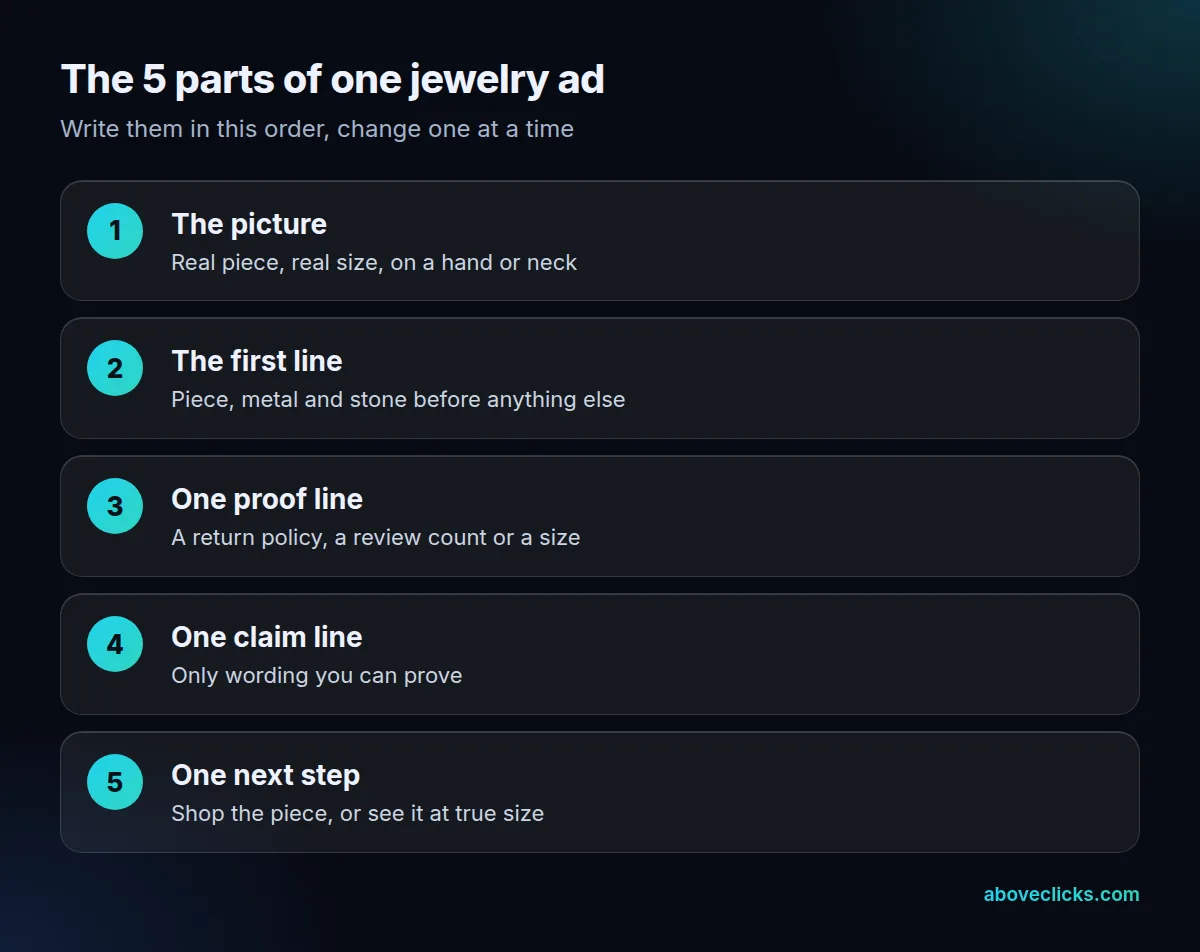
Here is what each part does:
- The picture. It carries most of the jewelry ad creative work. Show the real piece at its real size, on a hand or neck, so the shopper can judge scale. A close-up is fine when a familiar object or a hand sits beside it.
- The first line. Name the piece, the metal and the stone before any adjective: “14k gold lab diamond studs” works better than “stunning sparkle”. Search and feed placements may cut a long line, so put the nouns in the first 30 characters.
- One proof line. Give one fact a shopper can check, such as a return policy, a review count you can show on the page, or the true size. A second proof line competes with the first.
- One claim line. State what the piece is made of, using only wording you can prove. The claims section below covers the words that need care.
- One next step. Pick a single action: shop the piece, or see it at true size. Several choices in one ad lower the chance that anyone takes any of them.
How do you write jewelry ad copy?
Write each line so it works alone, because search ads mix and reorder lines. Count characters as you go; the limits are strict and a line that is too long is cut or rejected.
Google’s responsive search ads take up to 15 headlines and 4 descriptions. Headlines hold 30 characters and descriptions 90, as of November 2026. Google also says headlines and descriptions may appear in any order, so no line should depend on another.
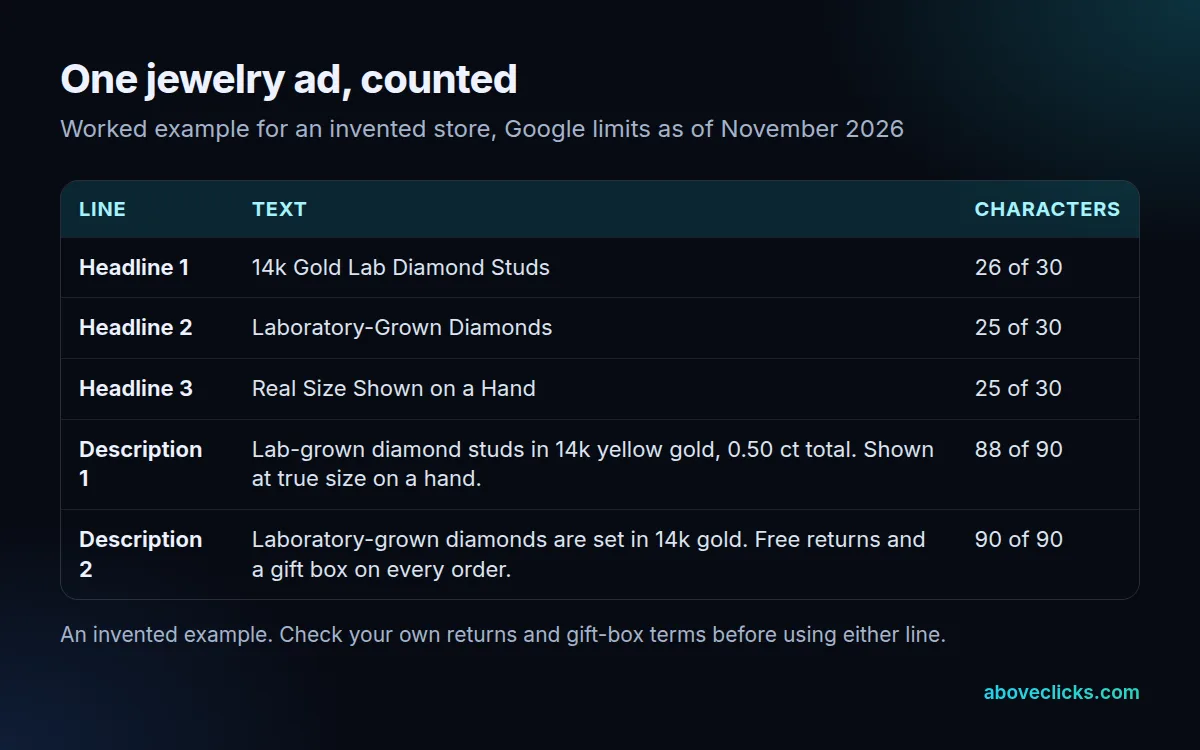
The example above is for an invented store. Headline 1 names the piece and metal in 26 characters. Headline 2 carries the claim wording in full, so a shopper who sees only that line still reads “laboratory-grown”. Headline 3 gives the proof line. Both descriptions repeat the same facts in different words, which is how you give Google options without contradicting yourself.
Good jewelry ad copy reads like a label with a reason to buy: what it is, what it is made of, why it is safe to order. Cut anything a shopper could not check on the product page. Three habits keep jewelry ad copy clean:
- Put the material and stone in a headline, not only in a description.
- Keep any qualifier, such as “laboratory-grown”, in the same line as the stone name.
- Spend your remaining headlines on distinct facts: size, returns, gift box. Repeating one fact in 15 headlines adds nothing.
Google’s editorial policy also rejects capitalization, punctuation and repetition that are not used for their intended purpose. Skip all-caps words and strings of exclamation marks.
Which claim words need proof?
Any wording you can prove, with the qualifier the FTC Jewelry Guides ask for. The Guides apply to advertising at every level of trade, so a retailer’s ad is covered, and an ad that implies a claim is held to it too.
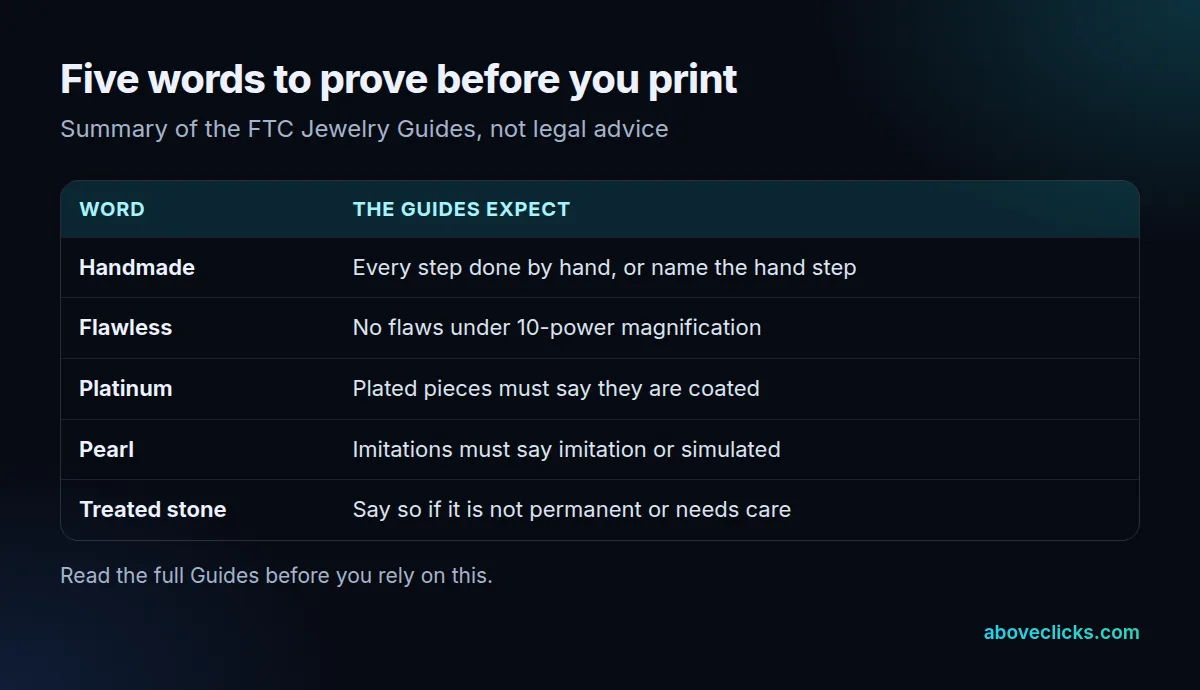
Our jewelry ads guide already covers the gold, sterling, lab-grown and weight rules. These five are the ones that slip into ad copy next:
- Handmade. Under 16 CFR 23.2, “handmade” needs the entire shaping, forming, finishing and decoration done by hand labor and manually-controlled methods. A cast piece that was hand-polished is “hand-polished”, and only if the polishing was done by hand.
- Flawless and perfect. Section 23.13 bars “flawless” for a diamond that shows flaws, inclusions or internal lasering under a corrected magnifier at 10-power. “Perfect” needs a flawless diamond that is not of inferior color or make.
- Platinum. Part 23 says a coated piece cannot be called platinum without a qualifier that shows it is only coated.
- Pearl. The same Guides bar the unqualified word “pearl” for anything that is not a pearl, and bar “cultured pearl” for an imitation.
- Treated stones. A treatment should be disclosed when it is not permanent, creates special care needs or has a significant effect on value.
The full text sits in 16 CFR Part 23. Treat this list as a summary, not legal advice. Google adds its own rule: its misrepresentation policy bars unreliable claims, including an improbable result presented as the likely outcome. That rules out “looks like a 3-carat diamond” for a 1-carat stone.
How long can the text be?
As long as the placement allows, but the useful part is always the first line. On Google, a headline stops at 30 characters and a description at 90. On social feeds, later lines may be cut, so open with the piece, the metal and one reason to buy.
Write the shortest version first, then add. A good order is the nouns, then one proof, then the claim, then the step; cut from the end if the line runs long. A 26-character headline that names the piece beats a 40-character headline that opens with an adjective. Test the short version on a phone before you spend on it, because a jewelry ad is read on a small screen first.
A jewelry ad that is short and exact is also easier to review. Anyone on your team can read it against the product page in a minute and spot a claim the page does not back up. Keep the page consistent with the ad. If the ad says “shown at true size”, the product page needs that image near the top; Google’s misrepresentation policy lists unavailable offers and unclear relevance as violations too.
How do you test one jewelry ad against another?
Run both at the same budget for the same days, change one part, and judge by ROAS against your break-even figure, not by clicks. Our practice, stated on the jewelry industry page, is that every target starts from the margin on each order, not the ROAS a platform reports.
Here is a worked example for an invented store. The average order is $140 and the gross margin is 52%, so break-even ROAS is 1 divided by 0.52, or 1.92. Our break-even ROAS entry explains the formula. Three ads each get $300 and differ in the first line only:
| Ad | First line | Spend | Orders | Revenue | ROAS | Against 1.92 |
|---|---|---|---|---|---|---|
| A | Material first | $300 | 5 | $700 | 2.33 | Above |
| B | Occasion first | $300 | 3 | $420 | 1.40 | Below |
| C | Size first | $300 | 4 | $560 | 1.87 | Just below |
Ad A is the only jewelry ad here that clears break-even, but 5 orders against 4 is a small gap. Keep it running and rerun the test with a new first line before you call it a rule. Ad B loses money at this margin, so stop it.
Change only the first line, the picture or the proof line in each round. A jewelry ad creative test, such as a hand shot against a flat-lay, follows the same rule: same copy, same budget, one picture changed. If you change two, you cannot tell which one moved the result. Our creative testing guide shows how to structure the rounds on Meta, and our ad creative service covers the production side.
Before any jewelry ad goes live, run this 4-point check:
- Does the first line name the piece, metal and stone?
- Is every claim word backed by the product page, with its qualifier next to it?
- Does the picture show real size, and does the page show it again?
- Is the one next step the same on the ad and on the page?
An ad that fails any of the 4 should be fixed before it spends a dollar, because a weak first line wastes the whole test budget.
If you want a second opinion on the ads you run today, the free audit covers your ads, feed and tracking, and returns the top fixes in a ranked list. More guides are in industries.