AEO vs GEO vs SEO is one job under three names: SEO gets your pages found and indexed, AEO makes a page the clear answer, and GEO gets your brand named on other sites. Start with SEO, then AEO, then GEO.
This guide shows what separates the three, maps 10 common tasks to them, gives an order for fixing them and lists what Google and OpenAI say you need. For the narrower split, see our guide to AEO vs GEO.
What is the difference between AEO, GEO and SEO?
SEO helps search engines understand your pages and helps people find them. AEO makes a page the clear answer an AI tool can quote. GEO makes your brand one that AI tools name when asked to recommend.
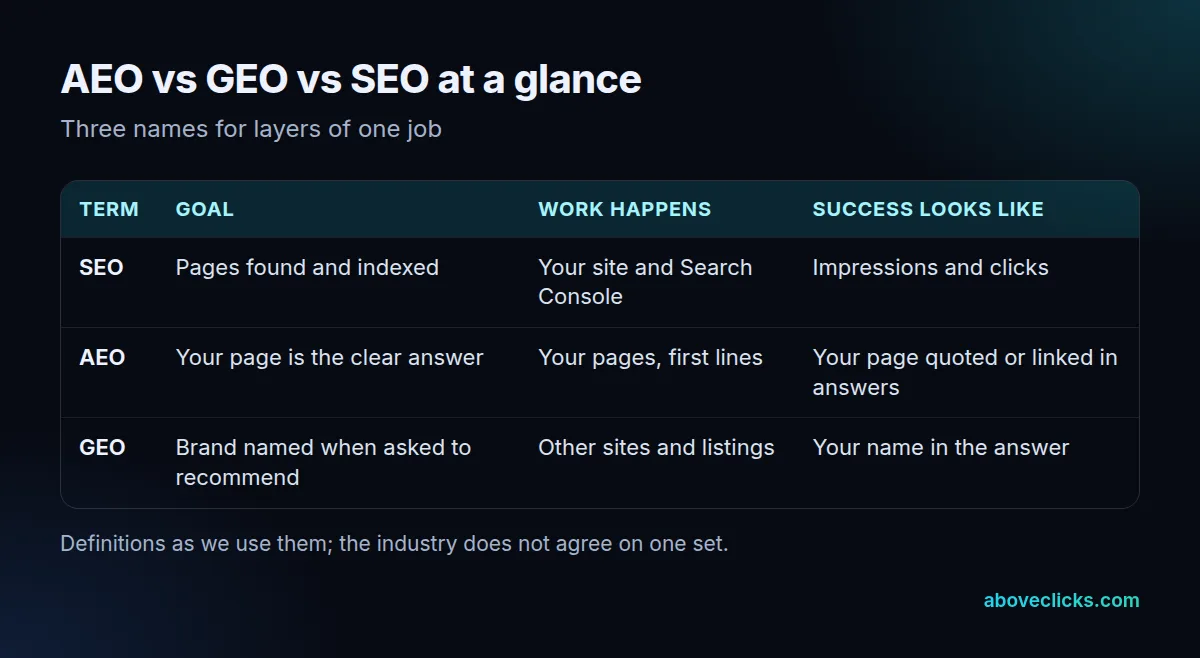
Google’s SEO Starter Guide describes SEO as helping search engines understand your content and helping users find your site. AEO, short for answer engine optimization, targets tools such as those in our answer engine entry. GEO, short for generative engine optimization, targets the tools in our generative engine entry. Both names are industry labels, not standards, so two agencies may draw the line in different places. The table shows how we use them, and the task map below splits the work into 10 common tasks.
The same guide is plain that no trick will automatically rank a site first, and that following the best practices makes it easier for search engines, not just Google, to crawl, index and understand your content. That is the baseline the other two names build on, and it is why an aeo vs geo vs seo comparison that skips indexing starts in the wrong place.
Does AEO or GEO replace SEO?
No. Google says the best practices for SEO remain relevant for its AI features, and that there are no additional requirements to appear in AI Overviews or AI Mode, as of November 2026. Even a page that meets all 7 points may still not be crawled, indexed or served.
On Google’s AI features page, the technical bar is the ordinary one: a page must be indexed and eligible to be shown in Search with a snippet. The same page lists 7 points, its SEO fundamentals, that still apply:
- Crawling allowed in robots.txt and by any CDN or hosting layer.
- Content easy to find through internal links.
- A great page experience.
- Important content available as text.
- Images and videos that support the text.
- Structured data that matches the visible text.
- Merchant Center and Business Profile details kept up to date.
Google also says you don’t need new machine-readable files, AI text files or special schema.org markup to appear. So a site that is not indexed has an SEO problem first, whatever the AI tools do afterwards. Where a vendor publishes no rule, we can’t verify what its tool needs, and we say so rather than guess.
For a store, the practical reading of aeo vs seo is simple: AEO is a way of finishing the SEO job on a page, by putting the answer where an engine, or a person in a hurry, will read it first. It is not a second site or a second strategy.
How do AEO vs SEO and GEO vs SEO differ in daily work?
Less than the names suggest, which is the useful news about aeo geo and seo. In our 10-task map, SEO appears in 9 tasks, AEO in 8 and GEO in 5, and only 1 task belongs to GEO alone.
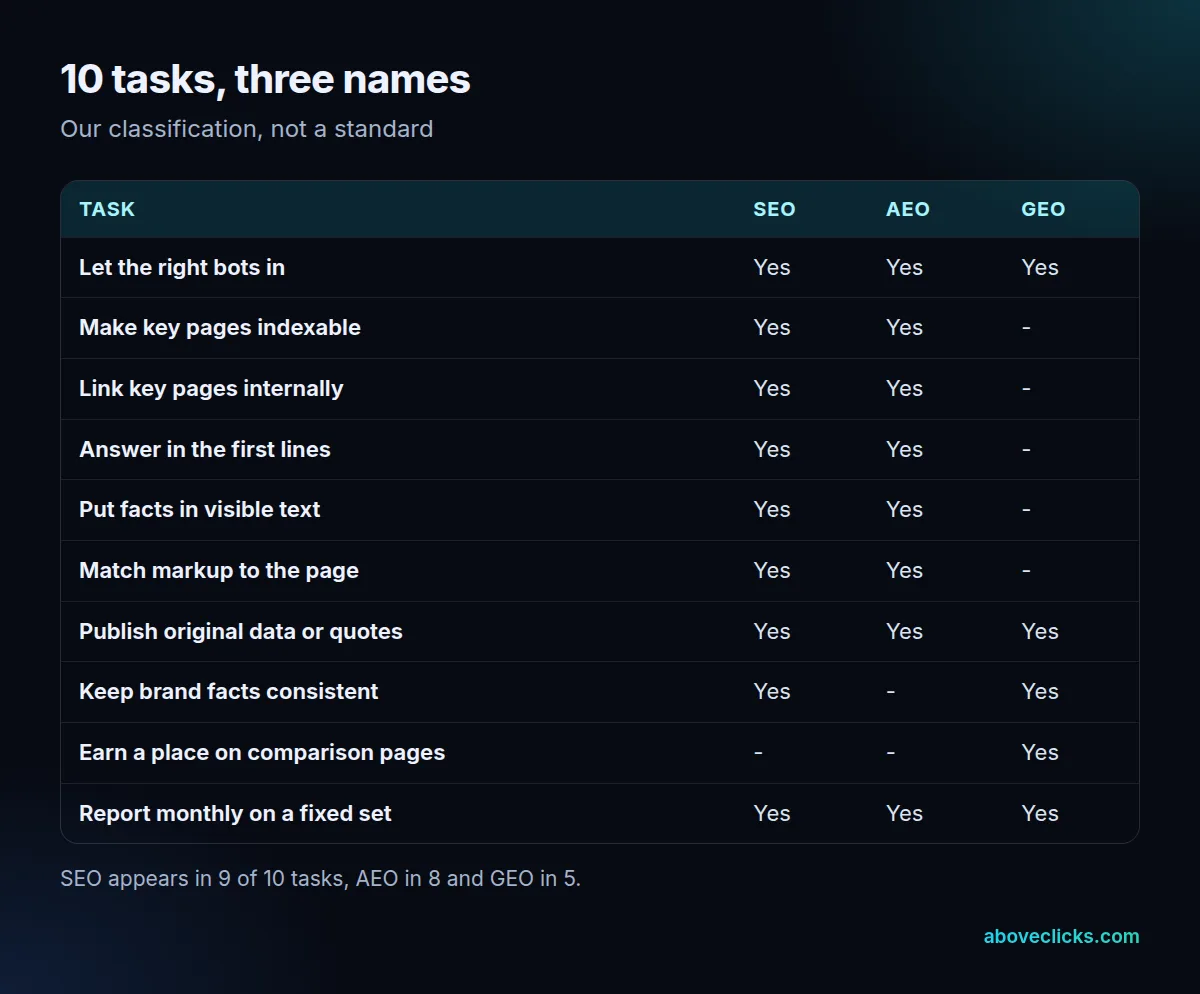
The map is our own classification, built from the scope of our AEO and GEO services, so treat it as a working tool rather than a standard. It does make three things visible.
- Three tasks serve all of AEO, GEO and SEO: letting the right bots in, publishing something original worth citing, and reporting on a fixed set each month.
- Six tasks serve two names. Most of the AEO versus SEO difference is emphasis: AEO cares more about the first two lines under a heading and about facts being visible text, but the page still needs to be indexed and linked first.
- One task is GEO alone. Earning a place on comparison and “best of” pages sits off your site, which is why GEO is slower and rarely the right first spend.
Two examples show the overlap. Moving a delivery-time answer from the foot of a product page into the first lines under its heading helps a searcher, a snippet and an AI answer at the same time. Publishing your own sizing data helps a page rank, helps an engine quote it and gives other sites something to cite. Neither is a separate project for each name.
That also settles the GEO vs SEO question for a typical store: GEO adds off-site work to an SEO base, and does not replace the base. Google’s own description of AI Overviews and AI Mode adds a reason to write complete pages. It says they may use “query fan-out”, which issues several related searches across subtopics, so a page that covers the subtopics of a question has more ways to be picked.
Which should you fix first in AEO vs GEO vs SEO?
Fix the earliest failure in this order, which is the practical answer to aeo vs geo vs seo: access and indexing, answer-first pages, bot rules, then mentions on other sites. A later step can’t make up for an earlier one that fails.
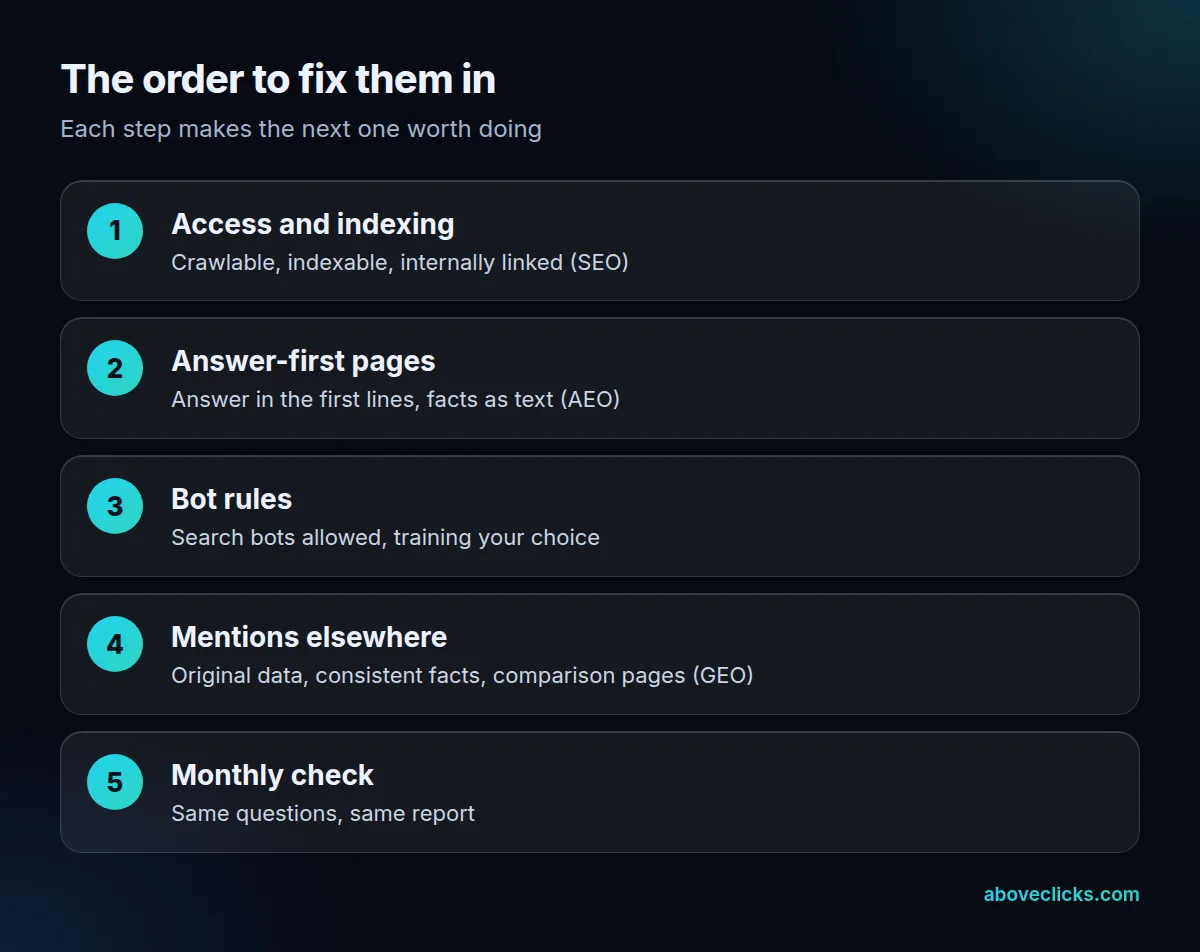
Use 3 questions to find your starting point in aeo vs seo and geo vs seo terms:
- Are your key pages indexed and getting impressions in Search Console? If not, the problem is SEO, and everything else waits.
- Does your own page appear when you ask the buyer’s question? If the answer is on your site but buried or missing from the first lines, the problem is AEO.
- Does your brand appear when you ask for a recommendation? If your pages are fine but nobody else mentions you, the problem is GEO.
Here is a worked example with invented numbers. A store has 20 hours a month and fails question 1 on its collection pages. In month 1 it spends 10 hours on indexing and internal links (SEO), 6 on rewriting the first lines of its top pages (AEO) and 4 on one original data page (the start of GEO). Once question 1 passes, the split moves toward 6, 8 and 6. The numbers are shares of a month, not a market rate.
The order matters for budgets too. Teams that start with GEO often spend months on mentions while key pages are still blocked or unindexed, and the mentions then point at pages that can’t be quoted. Teams that treat aeo vs geo vs seo as one list, worked top to bottom, tend to find the cheap fixes first.
If you want a site-level audit instead, our LLM SEO check gives 10 pass/fail tests for your own pages.
How do you measure SEO, AEO and GEO?
Measure SEO and Google’s AI features in Search Console, and measure the AEO and GEO parts of aeo vs geo vs seo by asking the same fixed questions each month and logging whether you are quoted or named.
Per the same AI features page, sites that appear in AI features are included in the overall search traffic in Search Console, reported in the Performance report under the “Web” search type. There is no separate AI report to wait for. For other tools, no vendor gives you the same dashboard, so a fixed set of 10 questions, asked the same way and logged in a sheet, is the simplest record.
Keep the three signals apart in the report, each with its own 1 line in the summary:
- SEO: indexed pages, impressions, clicks.
- AEO: how many of your fixed questions quote or link one of your pages.
- GEO: how many fixed recommendation questions name your brand.
Counts from a small set move by 1 or 2 a month, so read the trend over a quarter, about 3 months, before you change the plan. Our free audit starts from the Search Console figures and a first check of your setup. Write down the date and the wording of each question, because a changed wording changes the answer and breaks the comparison.
What do Google and OpenAI say you need?
For aeo vs seo and geo vs seo alike, Google says nothing beyond indexing and snippet eligibility; OpenAI says to allow OAI-SearchBot to appear in ChatGPT search results. Neither names a special markup or file as of November 2026.
The bot rules are where AEO, GEO and SEO most often get tangled, so keep them apart:
- Google: Googlebot rules control Search, including its AI features. Google-Extended is a separate token for Gemini training and doesn’t affect inclusion in Google Search.
- OpenAI: its crawler overview lists 3 agents. OAI-SearchBot surfaces sites in ChatGPT search, GPTBot relates to training, and ChatGPT-User acts on a user’s request, where robots.txt rules may not apply. Each setting is independent, and a change can take about 24 hours to be picked up, so wait at least 1 day before you re-test.
The third mix-up is blocking the wrong bot: a blanket rule meant to stop training can also stop search. Google’s people-first content guidance is the common thread for all three names: write for the people who will read it first. Put together, the three costly mix-ups in aeo vs geo vs seo are:
- Three budgets for one task list. Use the map above and fund each task once.
- GEO before indexing. Mentions can’t help a page that isn’t indexed or reachable.
- The wrong bot blocked. Check each bot’s rule separately, then wait for the change to be picked up.
If you want us to look at your own setup, our AI search optimization service starts with a read of exactly these points. More guides on the topic are in e-commerce SEO.