AEO vs GEO is a split between two layers of one job: AEO makes your own pages the clear answer to a buyer question, and GEO makes your brand one that AI tools name and cite. Choose by testing which of the two you are losing.
This guide shows the difference between AEO and GEO, how each differs from classic SEO, which one a store should fix first and a 10-prompt test you can run this week.
What is the real difference in AEO vs GEO?
AEO works on your pages, and GEO works on the web around them. The terms overlap because both aim at the same result: a written AI answer that uses and credits your store.
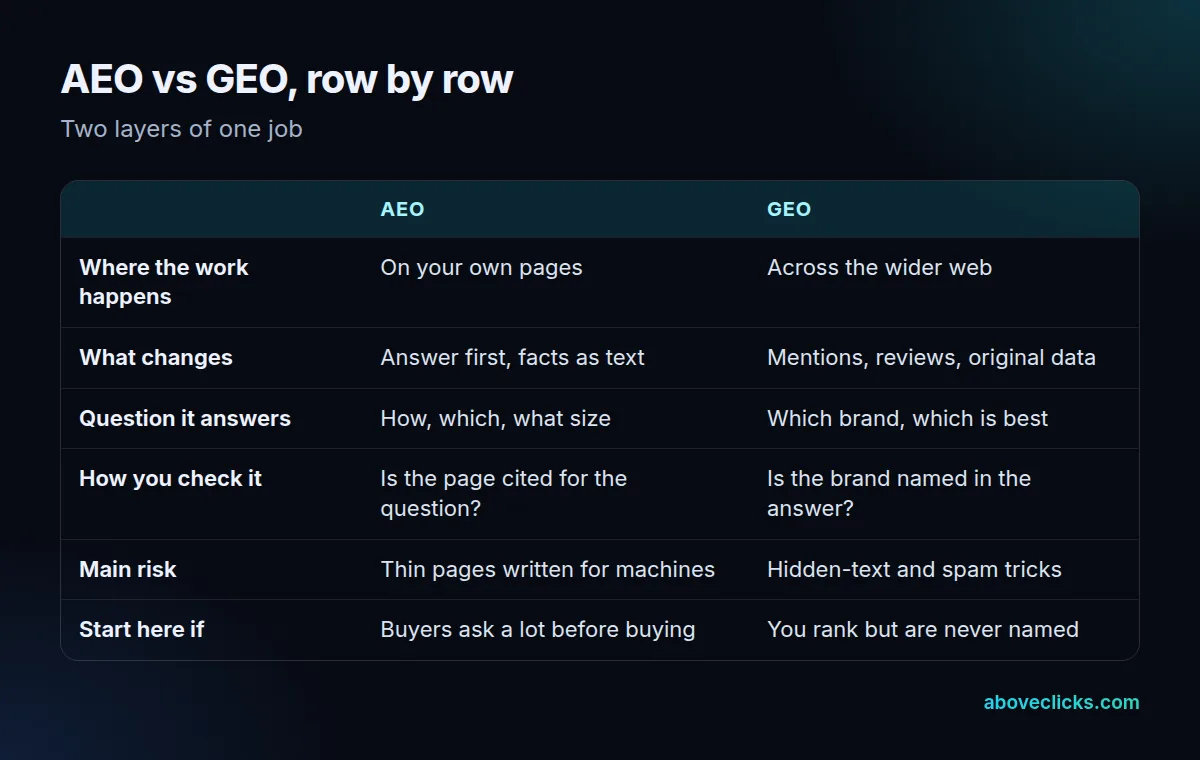
AEO stands for answer engine optimization. Our answer engine glossary entry defines the tools it targets. GEO stands for generative engine optimization, a term from a November 2023 research paper, GEO: Generative Engine Optimization. Its authors reported that their methods can raise visibility by up to 40% in generative engine responses, measured on their own benchmark of 10,000 queries.
That 40% is not a promise for any store. It came from a test set, not from ChatGPT or Google. Still, the paper shows that how a source is written changes how much of it an engine uses. That is why the AEO vs GEO question is worth testing instead of guessing.
In practice the difference between AEO and GEO is where you look for the problem. If the answer is on your site but buried, that is AEO. If your site is fine but nobody else mentions you, that is GEO.
What does AEO work on?
AEO works on the pages you control: one buyer question, answered in the first lines of the right page, with facts written out as text. It is the more concrete of the two.
Typical AEO fixes for a store:
- Move the useful sentence to the top of the section, ahead of the brand story.
- Put sizes, materials, delivery times and return windows in visible text, not only in images.
- Answer each question on the product, collection or guide it belongs to, not on one long FAQ page.
- Make structured data say what the visible page says.
These match the problems we list on our answer engine optimization page: the answer is buried, answers live in the inbox, and one FAQ page is used for everything.
AEO also means letting the engines in. OpenAI uses 2 robots.txt tags, OAI-SearchBot and GPTBot, and says OAI-SearchBot is the one that shows sites in ChatGPT search answers. A robots.txt change can take about 24 hours to take effect, per its crawler overview. A page blocked by robots.txt cannot be cited, however good the answer is.
The AEO side of the difference between AEO and GEO is also the most testable: change one page, then re-run the question and see whether the answer moves.
What does GEO work on?
GEO works on whether the web as a whole names your brand when someone asks for a recommendation. A page can be perfect and still lose here, because the answer summarizes many sources.
The causes we see most often, as listed on our generative engine optimization page:
- Reviews, guides and forums never mention the brand.
- Names, addresses or descriptions differ between the site, profiles and listings.
- The pages repeat what every competitor says, so nothing is original enough to cite.
- The brand is missing from “best of” and comparison pages.
The fixes are slower and sit mostly off your site: original data and quotes worth citing, consistent brand facts, honest reviews, and a place on the comparison pages your buyers read. The research above points the same way. On the paper’s first visibility score, no optimization scored 19.5, adding quotations scored 27.8 and keyword stuffing scored 17.8, so the classic SEO habit came out worse than doing nothing. The authors also found that results varied by domain, which is one more reason to test your own category.
On the GEO side of AEO vs GEO, patience matters, because mentions take months to build. Avoid shortcuts. Hidden text, prompt injection and bulk machine-targeted pages break search spam policies and put the whole domain at risk.
How do AEO vs SEO and GEO vs SEO compare?
Both sit on top of SEO and neither replaces it, which settles most of the AEO vs SEO and GEO vs SEO argument. Google lists 7 SEO fundamentals that still apply, from allowing crawling to keeping Merchant Center and Business Profile details current. It says the best practices for SEO remain relevant for AI Overviews and AI Mode, and that there are no additional requirements or special optimizations needed to appear in them.
On AEO vs SEO, the work is the same craft held to a stricter standard of directness: a page that is crawlable, indexed and eligible to show a snippet is the starting point, as the Google AI features guide states. AEO adds a habit, which is writing every section so it can stand alone as an answer.
On GEO vs SEO, the gap is reach. A GEO vs SEO comparison also shows why a page-one ranking is not enough. Classic SEO ranks your page; GEO asks whether the engine names your brand at all. Google also says its AI features may run multiple related searches across subtopics, so one buyer question can pull in several of your pages.
Two cautions from the same guide:
- You do not need new machine readable files, AI text files or special schema markup.
- To limit what Google shows, use one of the 4 snippet controls: nosnippet, data-nosnippet, max-snippet or noindex.
The same 10-prompt test in the next section works for both sides. Treat any advice that claims a hidden AI format with suspicion. If it contradicts the engine’s own documentation, trust the documentation.
Which should a store do first, AEO or GEO?
In the AEO vs GEO choice, fix the basics, then fix the side you are losing. For most stores that means AEO first, because it is on pages you control and it shows results sooner.
Use this rule:
- Pages not indexed or blocked: fix SEO first, before either one.
- Losing the question prompts (size, care, compatibility): start with AEO.
- Ranking in Google but missing from “best X” answers: start with GEO.
- Losing both: do AEO now and start the GEO work in parallel, since it is slower. In the example below, 6 question prompts and 4 recommendation prompts are enough to show which case you are in.
The 10 prompts in the test below tell you which case you are in. A store with a small catalog and few reviews tends to lose the recommendation prompts for a long time, whatever it does on-site. That is normal. It is a reason to start GEO work early, not to skip AEO.
How can you test which one you are losing?
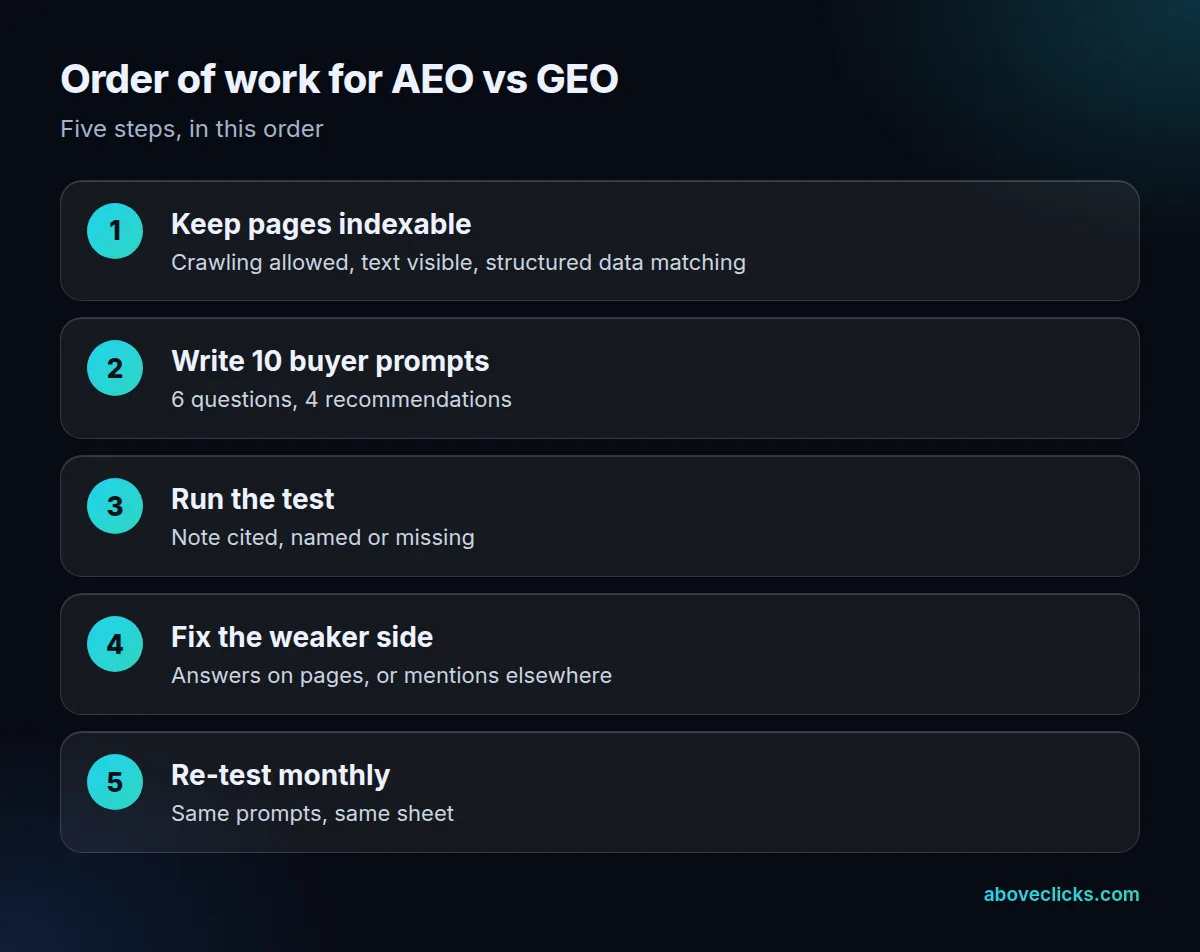
Write 10 real buyer prompts, as the AEO vs GEO test needs,, run each in the engines your buyers use, and mark whether your store was cited, named or missing. No tool is needed; a sheet and an afternoon are enough.
Split the prompts: 6 questions that a page can answer (size, material, care, compatibility, delivery) and 4 recommendations (best, which brand, alternatives). Run each prompt in a fresh session and record the result.
Worked example, with invented numbers: an online linen shirt store runs the test. It is cited in 2 of the 6 question prompts and named in 0 of the 4 recommendation prompts.
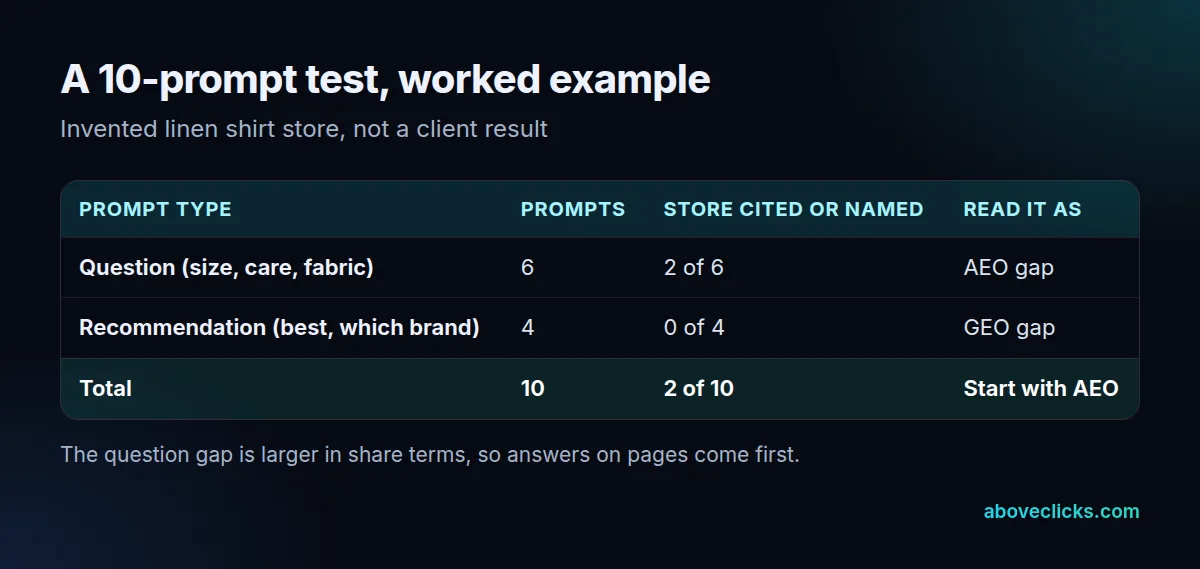
The question prompts show the larger fixable gap, because the answers could sit on its own pages. So the store starts with AEO: it moves the size and fabric answers to the top of its product pages. It also starts a slow GEO list of review sites and comparison pages to approach. Re-run the same 10 prompts next month.
Keep the sheet simple and fixed. Engines vary between runs, so a single result means little; the trend across 3 months means more. If you want a second pair of eyes, our AI visibility audit runs this kind of check, and the free audit is the quickest way to start.
What do the engines say about being included?
Each engine publishes its own rules, and none of them describes a hidden route. Read the vendor’s page for the engine you care about, and decide per crawler, not for all AI at once.
- Google: AI Overviews and AI Mode use the same index and the same controls as Search. Robots.txt rules for Googlebot are the control for crawling, and Google’s crawler overview groups its clients into 3 categories: common crawlers, special-case crawlers and user-triggered fetchers.
- OpenAI: OAI-SearchBot is for search and GPTBot is for training. OpenAI says each setting is independent, so a site can allow the first and disallow the second. Those 2 settings are the clearest example of why one AEO vs GEO plan cannot treat all AI crawlers alike.
- Perplexity: PerplexityBot is designed to surface and link websites in search results, and Perplexity says it is not used to crawl content for foundation models, per its crawler guide.
This is how things stand as of November 2026, and the pages change. Re-read them every 3 months, and before any robots.txt change.
For the overall work, start with the AI search optimization hub, then read about the generative engine term. More guides on this topic are in e-commerce SEO.