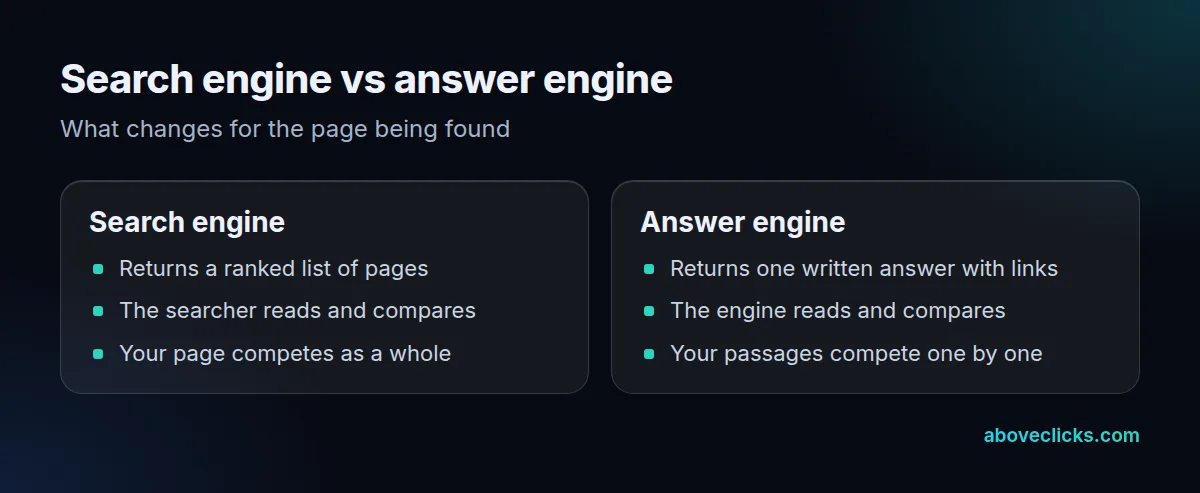
An answer engine is a search tool that replies to a question with a written answer, usually generated by AI from several web sources and linked to them, instead of a ranked list of links. ChatGPT search, Perplexity, Microsoft Copilot and Google's AI Mode all work this way, and each one reads pages in passages.
An answer engine is a search tool that replies to a question with a written answer, usually generated by AI from several web sources and linked to them, instead of a ranked list of links. For a store, the shift is that pages are read in passages.
Which tools count as answer engines?
ChatGPT search, Perplexity, Microsoft Copilot and Google’s AI Mode are the best-known ones; AI Overviews work the same way inside the normal results page. OpenAI launched ChatGPT search on 31 October 2024 promising “fast, timely answers with links to relevant web sources” (OpenAI).
Each runs its own crawler or search backend. OpenAI says ChatGPT search draws on third-party search providers and on content from its partners, and Perplexity says its crawler exists “to surface and link websites in search results” (Perplexity docs). An ai search engine like these doesn’t replace Google for every query; it’s strongest on long, comparing questions.
How are its sources picked?
It retrieves passages that match the question, then writes from them. Google says its AI features may run “multiple related searches across subtopics” before writing, and the same retrieval-then-writing pattern sits behind ChatGPT search and Perplexity.
We tested the retrieval step on our own text: 345 passages from 28 of our glossary pages, 5 real buyer questions, ranked with BM25, a standard keyword-ranking formula. Answer-first opening paragraphs came out on top for 3 of the 5 questions.
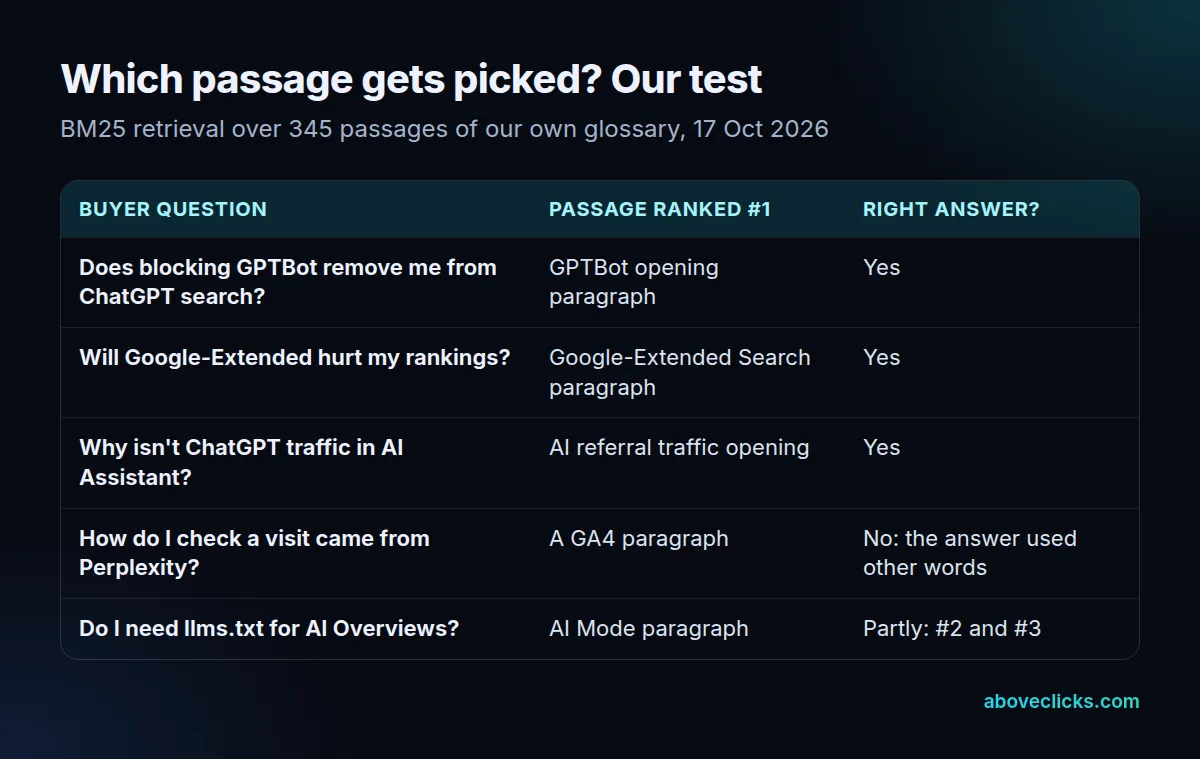
The 2 misses taught more. The passage that answers how do I check a visit came from Perplexity says “match the request’s IP address”, so a retriever looking for “check” and “visit” ranked other passages above it. Real engines use smarter retrievers than BM25, but the lesson holds: answer in the words people ask with.
What changes for a store’s pages?
Each section has to stand alone as an answer. When we wrote 14 glossary pages for answer engines on 17 October 2026, all 14 first drafts failed at least one of our automated checks, and 11 had a section with no citable fact.
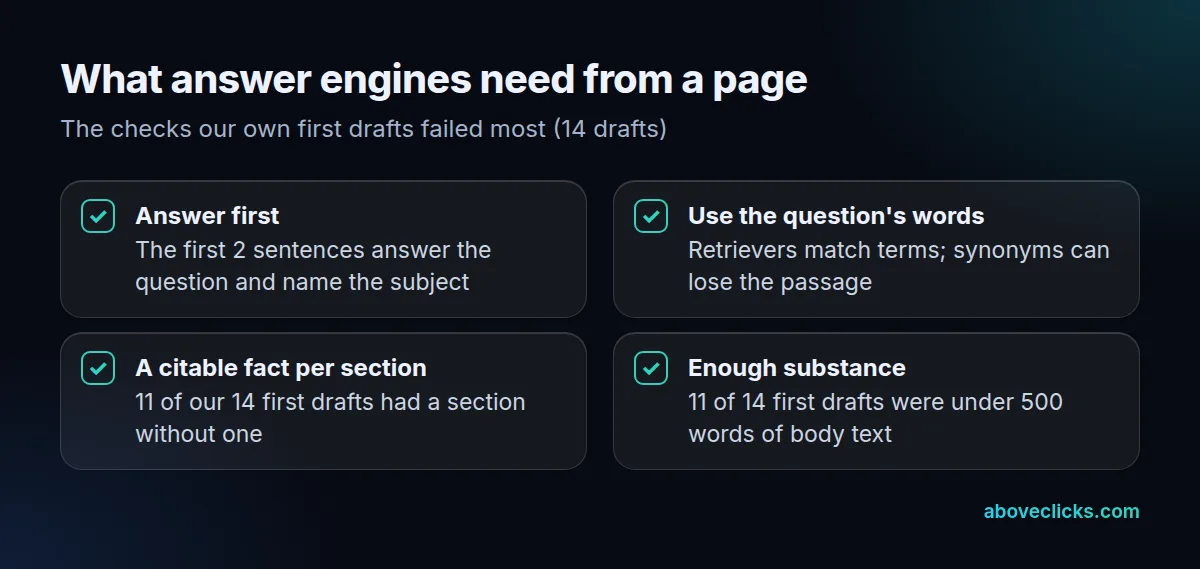
For a store that means product and policy pages with facts written out in text (sizes, materials, delivery days, return windows), guides that answer one buyer question per section, and structured data that matches the page. None of it is new SEO; it’s the same work, held to a stricter standard of directness.
How is an answer engine different from a search engine?
A search engine ranks pages and lets you choose; an answer engine reads them for you and writes the result. Google’s AI features documentation says its AI responses link to “a wider and more diverse set of helpful links” than a classic search, so more pages can be cited, but each one gets a smaller share of attention than a top-3 ranking. Pew Research Center found that 88% of Google’s AI summaries cited 3 or more sources in March 2025 (Pew).
There’s no separate index to submit to. Google says there are no extra requirements for its AI features, and ChatGPT search reaches pages through OAI-SearchBot and its search partners. Our answer engine optimization work starts with an AI visibility audit; the AI search optimization hub covers each engine.