A generative engine is a search system that uses a large language model to gather information from several sources and write one answer to a query. The term comes from the 2023 research paper that coined generative engine optimization (GEO), which found that adding quotations, statistics and citations raised a source's
A generative engine is a search system that uses a large language model to gather information from several sources and write one answer to a query. The term comes from the 2023 research paper that also coined generative engine optimization, or GEO.
Where does the term come from?
From computer-science research. Aggarwal and colleagues wrote that generative engines “satisfy queries by synthesizing information from multiple sources and summarizing them using LLMs” in their paper GEO: Generative Engine Optimization, first posted in November 2023 and published at the KDD conference in August 2024.
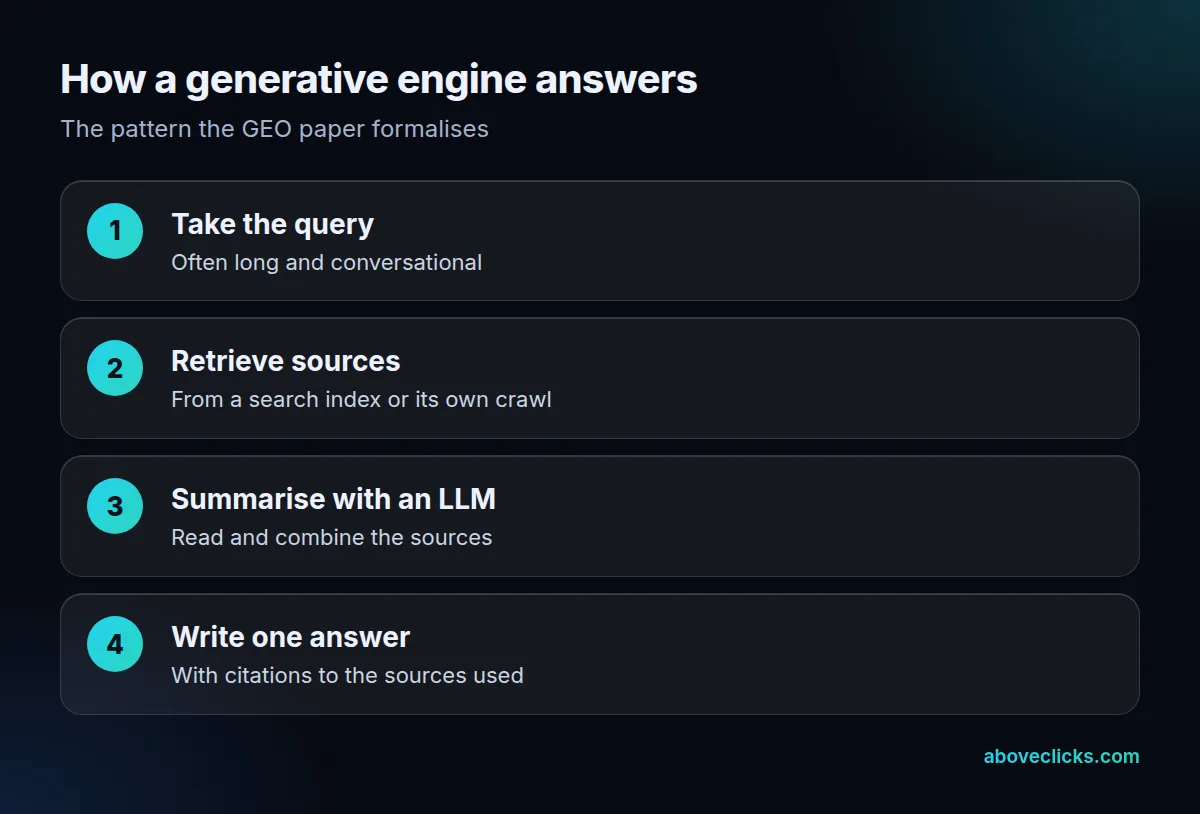
To test it, they built GEO-bench, a set of 10,000 queries from 9 sources, about 80% of them informational questions, split 8,000 for training and 1,000 each for validation and testing. ChatGPT search, Perplexity and Google’s AI Mode all fit the definition; the paper’s term simply describes the whole class of system. The writing step relies on an LLM, which Google’s ML Crash Course describes as a model that predicts text a token at a time.
What did the GEO study find?
Changing how a source is written changes how much of it a generative engine uses. The abstract reports that GEO “can boost visibility by up to 40%” in generative engine responses, on the study’s own benchmark and metric.
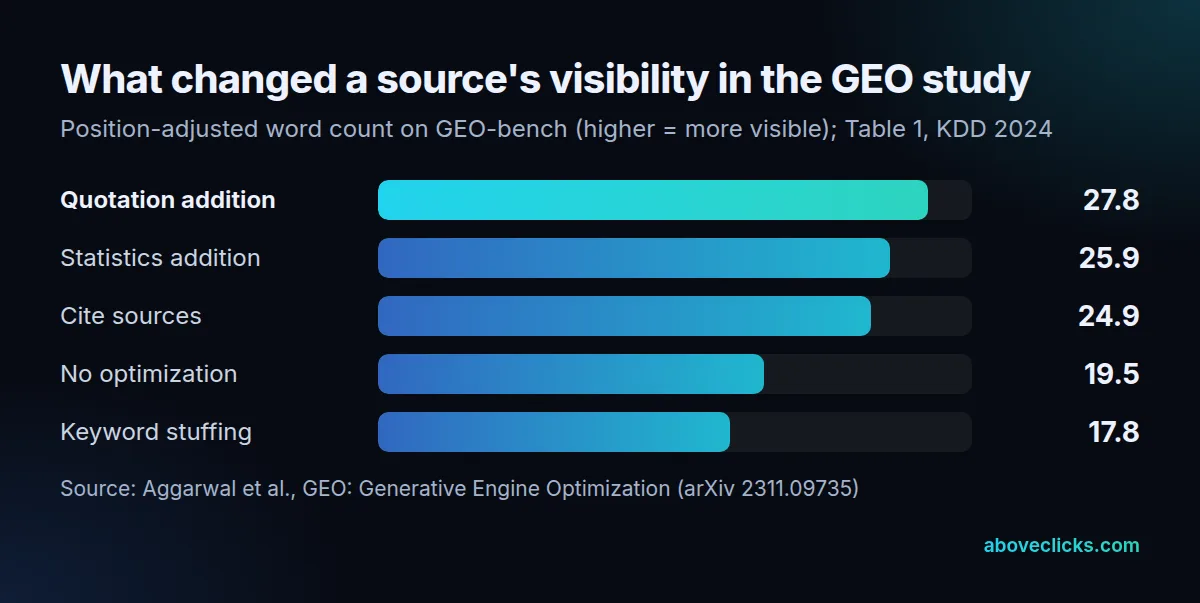
The details matter more than the headline. On the main visibility metric, adding quotations from credible sources scored 27.8 against 19.5 for no change, adding statistics 25.9 and citing sources 24.9. Keyword stuffing, the classic SEO habit, scored 17.8: worse than doing nothing. The authors call quotations, statistics and citations their “top-performing methods”, with relative gains of 30-40% on that metric.
Is a generative engine the same as an answer engine?
In practice, yes: both describe tools that write an answer from sources instead of listing links. “Answer engine” is the plain-language and marketing term; “generative engine” is the research term that stresses the large language model doing the writing.
The distinction worth keeping is between the engine and the optimisation. Generative search changes what wins: in the study, a source competed for a share of one answer, not for a position in a list of 10 results. That’s why the study’s main metric counts how many words of the answer come from a source, weighted by how early they appear.
What should a store take from the research?
Write pages that are easy to quote: specific numbers, cited sources and sentences that hold up out of context. Those are exactly the things the GEO study rewarded, and exactly what our own first drafts lacked: 11 of the 14 glossary pages we drafted on 17 October 2026 had a section with no citable fact before revision.
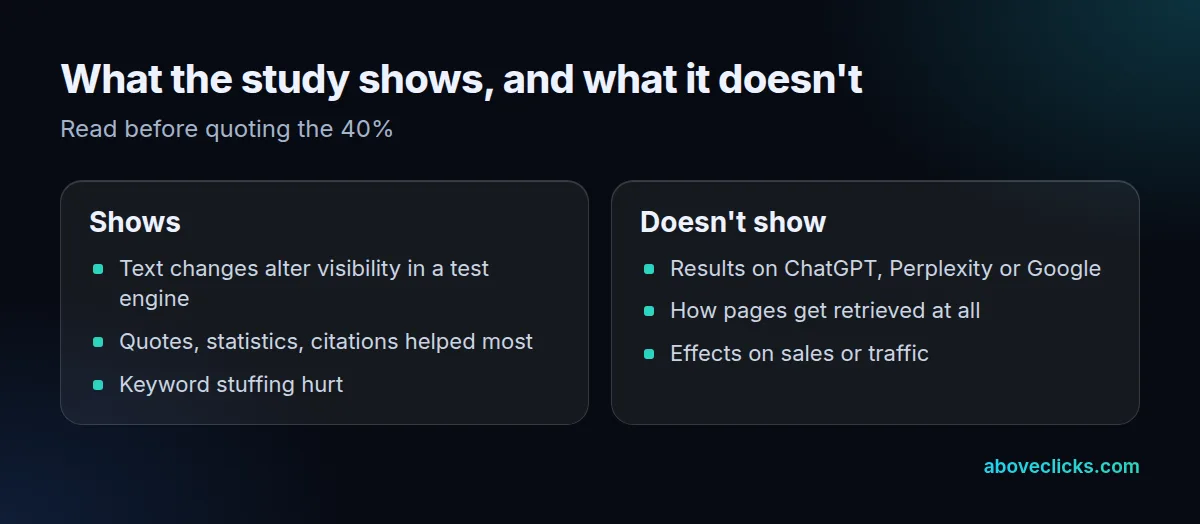
Keep the limits in view before quoting the 40% to anyone. The study measured a benchmark engine, not ChatGPT or Google, and it changed only the text of pages already retrieved; getting found still depends on crawling and indexing. Google, for its part, says its AI features need no special optimisation (Google Search Central). Our generative engine optimization work applies the research where it holds; answer engine optimization and the AI search optimization hub cover the rest.