Performance Max vs Demand Gen comes down to one choice: capture demand that already exists, or create demand among people who have not searched yet. Performance Max is Google’s goal-based campaign across all Google Ads inventory, including Search, and it works best when the goal is conversions or conversion value. Demand Gen runs on Google’s visual surfaces, and it works best when the goal is to build interest before a search happens.
This comparison of performance max vs demand gen covers channels, control, bidding, budgets and the October 2026 changes, then gives a budget split you can copy. If you sell through a store with a product feed, the short answer is usually both, with Performance Max campaigns taking the larger share.
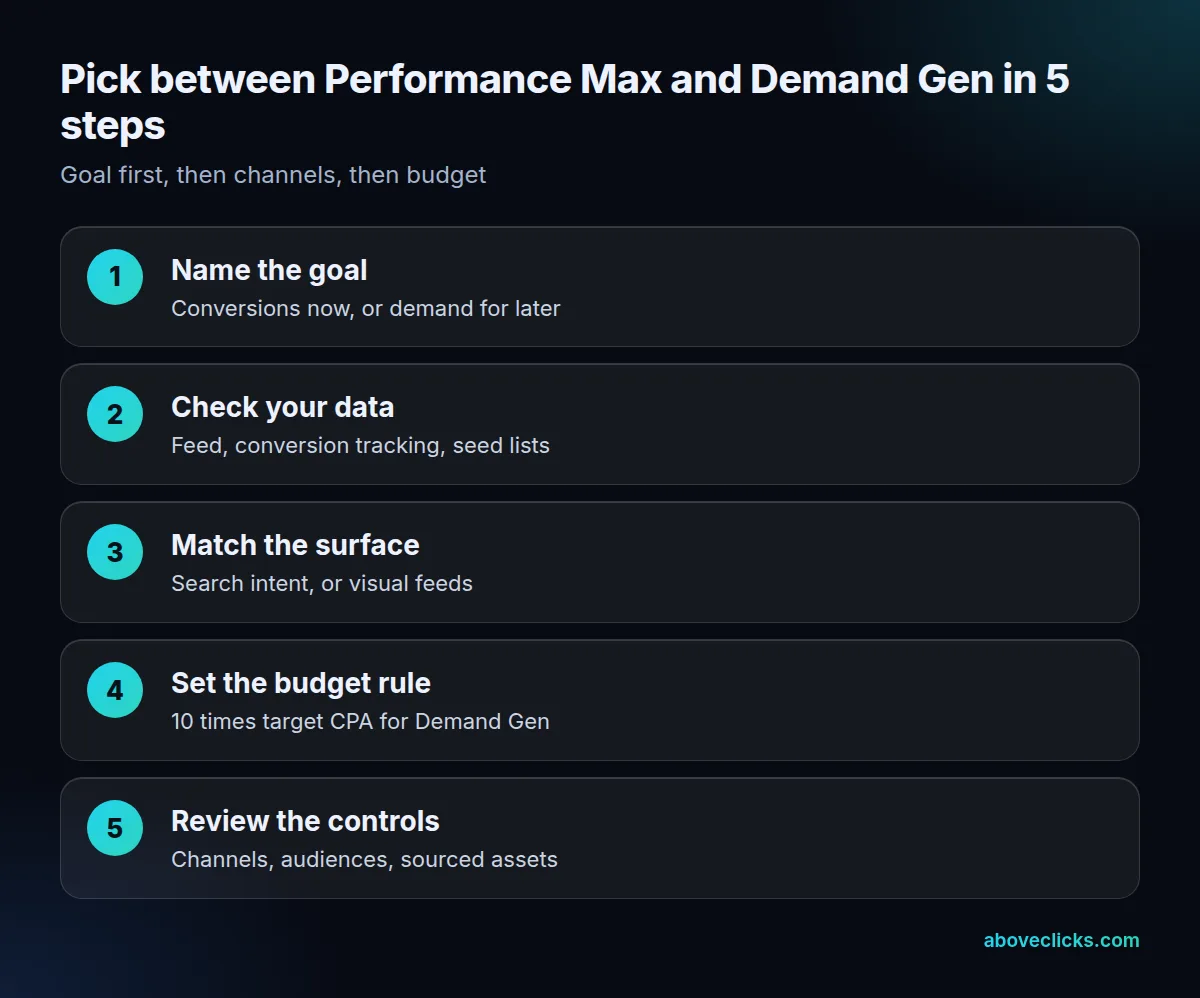
What is the difference between Performance Max and Demand Gen?
In this performance max vs demand gen comparison, Performance Max is a conversion campaign and Demand Gen is a demand campaign. That one line explains most of the differences that follow: Performance Max finds people likely to convert across every Google channel, while Demand Gen puts visual ads in front of people chosen by audience, before they search.
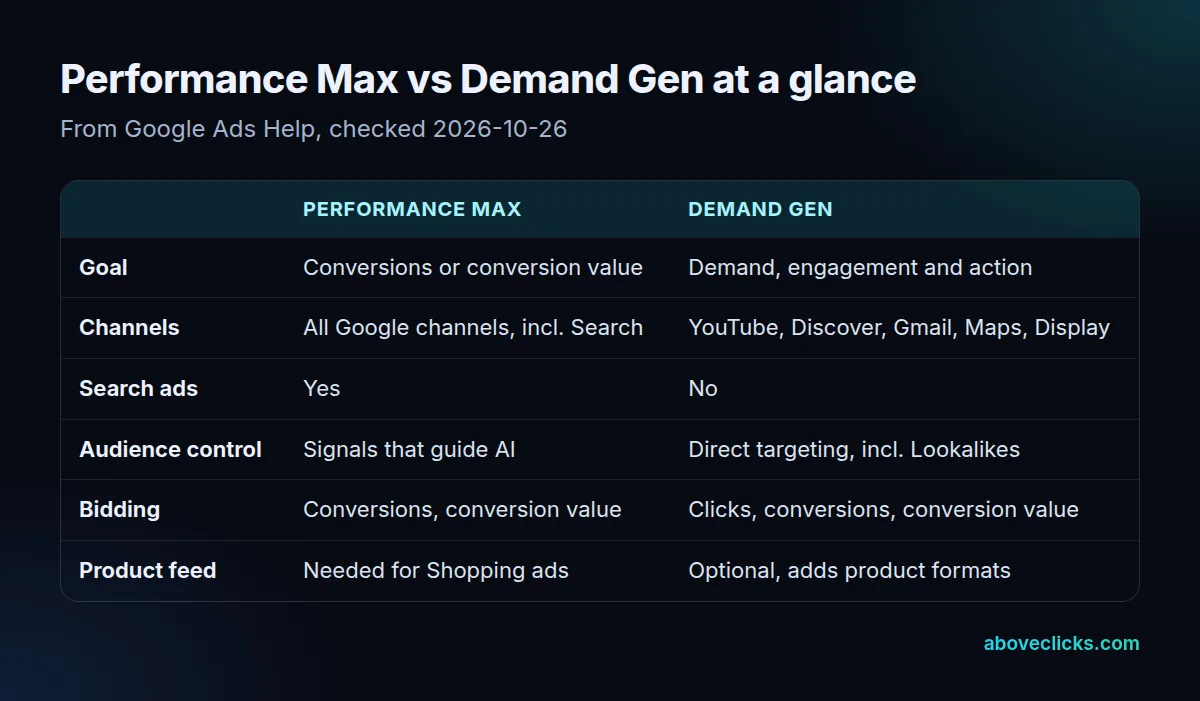
The 7 differences that matter:
- Goal. Performance Max maximizes conversions or conversion value. Demand Gen generates demand and action on visual surfaces.
- Search. Performance Max serves on Search and Shopping. Demand Gen does not serve on Search at all.
- Audience control. Performance Max takes audience signals, which guide its AI but do not fence delivery. Demand Gen lets you target an audience directly.
- Channels. Performance Max covers all Google channels from one campaign. Demand Gen covers only the visual surfaces, but lets you pick them per ad group.
- Bidding. Performance Max bids for conversions or conversion value only. Demand Gen can also bid for clicks, which suits traffic and consideration goals.
- Creative. Performance Max builds ads from asset groups of headlines, images, videos and logos. Demand Gen adds carousel ads and product-feed formats on visual surfaces.
- Data needs. Performance Max needs conversion data and, for Shopping, a product feed. Demand Gen needs audiences and strong visual creative, and can run without a feed.
| Difference | Performance Max | Demand Gen |
|---|---|---|
| Goal | Conversions or conversion value | Demand, engagement and action |
| Search | Yes, including Shopping | No |
| Audience control | Signals that guide AI | Direct targeting, including Lookalikes |
| Channels | All Google channels | Visual surfaces only |
| Bidding | Conversions, conversion value | Clicks, conversions, conversion value |
| Creative | Asset groups | Carousel ads, product-feed formats |
| Data needs | Conversion data, feed for Shopping | Audiences, strong visual creative |
For a store, the practical read is this: Performance Max harvests demand, Demand Gen plants it. Running only Performance Max when few people search for your products yet leaves the top of the funnel empty.
Which channels does each campaign reach?
Performance Max campaigns reach all Google Ads inventory from a single campaign: YouTube, Display, Search, Discover, Gmail and Maps, plus Shopping when a Merchant Center feed is attached. Google describes it as the way to maximize performance across all of Google’s channels, and positions it as a complement to keyword-based Search campaigns, not a replacement for them.
Demand Gen campaigns reach YouTube (including Shorts), Discover, Gmail, Maps and the Google Display Network. Google says, as of October 2026, that Demand Gen campaigns can reach up to 3 billion monthly active users across these surfaces, with more than 50 billion global daily views on Shorts alone. That reach is the reason Demand Gen suits product launches and categories where people do not yet search by brand.
One control difference matters here. In Demand Gen you can pick channels per ad group: all Google channels, or your own selection from YouTube in-stream, in-feed and Shorts, Discover, Gmail, Maps and the Display Network. In Performance Max you set priority tiers across inventory instead, with Google channels grouped together so cross-channel optimization stays intact. That channel choice is the first performance max vs demand gen decision to make, because it fixes where your money can go.
How does audience targeting differ between Performance Max and Demand Gen?
Performance Max uses audience signals, not hard targeting. You share customer lists, site visitors and search intent to guide learning, and Google’s AI then finds converting customers beyond that starting audience. You cannot fence a Performance Max campaign to only your list.
Demand Gen campaigns target audiences directly. You can target custom segments, your own data segments and, only in Demand Gen, Lookalike segments built from your first-party lists. Lookalike segments come in 3 sizes: Narrow, aimed at the most similar 2.5% of users in the location; Balanced at 5%; and Broad at up to 10%. Google refreshes them every 1 to 2 days, and the seed lists behind a constraint-style segment must total more than 100 active matched people. You can build a Lookalike from up to 10 seed lists, including website visitors, app users, customer lists and YouTube audiences.
That direct targeting is why Demand Gen fits prospecting: you decide who sees the ad, then watch which audience converts. In Performance Max you judge the audience signals by the conversions they produce, not by who was reached. That targeting difference is the second reason the performance max vs demand gen choice matters for prospecting.
Performance Max vs Demand Gen: how do bidding and budgets differ?
Performance Max campaigns bid with Smart Bidding for conversions or conversion value, with an optional target CPA or target ROAS. Demand Gen bids for clicks, conversions or conversion value, so a traffic goal is a valid Demand Gen goal in a way it is not for Performance Max.
The budget rules differ too. For Demand Gen campaigns using target CPA bidding, Google recommends a budget at least 10 times your target CPA, as of October 2026. On a $40 target CPA that means a $400 budget level before the campaign can learn properly. Performance Max instead shows Low, Medium and High daily budget suggestions in its budget panel, based on your settings and account history, and funnels spend toward the best-performing inventory.
A further rule protects existing Search campaigns. When a query matches an exact-match keyword in a Search campaign, that Search campaign is prioritized to serve over Performance Max. So Performance Max does not silently take your brand searches: your exact-match Search terms still win, and Performance Max picks up the rest. Settle the bidding question before you set the budget: it decides what a performance max vs demand gen test can even optimize for.
How should you split budget between Performance Max and Demand Gen?
Split by funnel stage, not by habit, when you budget for performance max vs demand gen. Start with the share of revenue that comes from people already searching, and give the rest to demand creation.
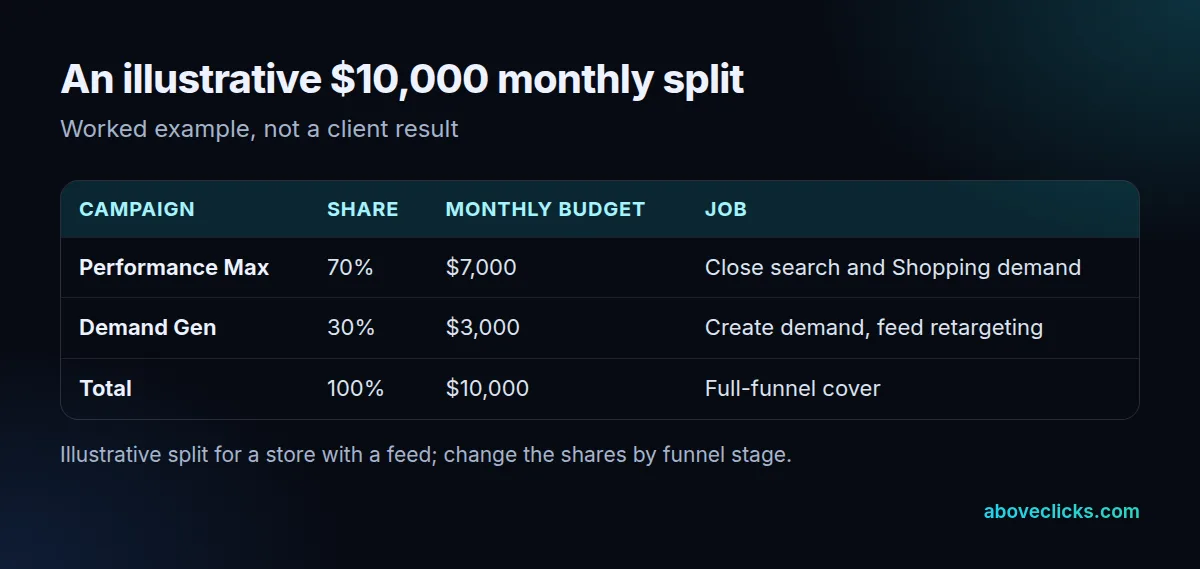
The worked example above is illustrative, not a client result. A store with a $10,000 monthly budget and a working product feed puts $7,000 into Performance Max to close search and Shopping demand, and $3,000 into Demand Gen to build the audience that searches next month. The Demand Gen share earns its keep through new visitors, video views and retargeting-pool growth, which Performance Max then converts when those people search.
Adjust the split with 3 signals. If branded search volume is flat for 2 months, raise Demand Gen: nobody new is entering the funnel. If Demand Gen clicks cost far less than Search clicks but never convert, tighten its audiences before raising its budget. If Performance Max is capped by budget on converting queries, move money back to it first: proven demand beats hoped-for demand.
For Demand Gen campaigns, keep the 10-times-target-CPA rule in view. At a $40 target CPA, a $3,000 monthly Demand Gen budget supports roughly 75 conversions a month at target, which is enough to judge an audience. Below that volume, judge Demand Gen on traffic quality and assisted conversions, not on last-click sales alone.
What changed in October 2026 for Performance Max and Demand Gen?
Two changes as of October 2026 are worth checking in your own account before you change anything else. First, Demand Gen Lookalike segments are moving from strict targeting constraints to suggestions: Google’s AI uses the segment as a starting point and may serve beyond the Narrow, Balanced or Broad size you picked. Advertisers who need the old strict behavior can apply to keep Lookalike segments as a targeting constraint, through the form Google links from its Lookalike help page, as reported in October 2026.
Second, Performance Max campaigns gained 2 asset-sourcing options in its asset optimization settings, reported in October 2026: Landing page images, which lets Google use images from your website as creative assets, and Sourced videos, which lets Google add videos from approved sources such as social media, campaign landing pages and linked YouTube channels. Trade coverage reports up to 10 sourced videos per asset group, against a 5-video manual upload limit, and that the setting can switch on for new campaigns. Check the asset optimization settings on every Performance Max campaign, and turn off any sourcing you did not approve.
A third shift frames both: as of October 2026, Google Display Ads campaigns are moving into Demand Gen, with a voluntary migration tool available since June 2026 and new Display campaigns eventually creatable only inside Demand Gen. If you still run standalone Display campaigns, plan that move on your own schedule rather than waiting for an automatic migration. Those 2 checks belong on every performance max vs demand gen review from now on.
Should you run Performance Max and Demand Gen together?
Yes, when you have both a product to sell and an audience still to build, performance max vs demand gen is not an either-or choice. Performance Max alone leaves demand creation to chance. Demand Gen alone leaves Search and Shopping demand to rivals. Together they cover the funnel: Demand Gen introduces the product on YouTube, Discover and Gmail, and Performance Max closes the sale when the same person searches or browses Shopping.
Run them together only with separate jobs and separate measurement. Give Performance Max campaigns the conversion goal and the feed. Give Demand Gen the audience goal, the visual creative and a prospecting budget. The table below settles the performance max vs demand gen pairing with one job, one measure, and the illustrative share from the $10,000 example.
| Campaign | Job in the pair | Measure it on | Illustrative share |
|---|---|---|---|
| Performance Max | Close search and Shopping demand | Conversions and conversion value | 70% ($7,000) |
| Demand Gen | Create demand and retargeting pools | New visitors and retargeting growth | 30% ($3,000) |
Measure Demand Gen on new visitors, view-through interest and retargeting growth, and measure Performance Max on conversions and conversion value. If both campaigns are judged on last-click sales alone, Demand Gen will always look weak, because its job happens before the search.
What to do next
Start with the goal, then the data. If conversions this month matter most, build Performance Max first and add Demand Gen with a small prospecting share. If search volume for your category is thin, build Demand Gen first and let Performance Max catch the demand it creates. Either way, once you have picked your side of performance max vs demand gen, check the October 2026 controls above in your account before launch: Lookalike mode in Demand Gen, and asset sourcing in Performance Max.
For a store that wants help setting up its performance max vs demand gen split, our Google Shopping agency page covers feed setup and campaign migration, and a free audit reviews your current setup before you change it. More Google Ads guides sit under Google Ads. More comparisons live in our Google Ads guides.