A real estate marketing platform is software that puts lead capture, a CRM, email and text, ad connections and reporting in one login. Judge one by how it handles a single lead from the first click to a booked visit, not by its feature list.
This guide covers what a real estate marketing platform includes, how it differs from a CRM, six checks for choosing one, the rules it can’t switch off and how to track leads. For the plan behind the software, see our real estate marketing plan guide.
What is a real estate marketing platform?
A single system that runs the path a property enquiry takes: capture, record, reply and report. Most real estate marketing platforms bundle 5 parts; the best ones connect them so no lead is typed in twice.
Vendors sell the same idea under other names, such as real estate marketing software or an all-in-one system. The label matters less than what happens to one lead. On our own real estate marketing work, every lead reaches the CRM within seconds, is assigned by project or area, and gets a first reply inside a goal of 5 minutes in working hours, as our industry page describes.
A real estate marketing platform is the tool that makes that path fast, which is why it pays off only when leads arrive in volume. It doesn’t write the ads, choose the budget or call the buyer, so the people and the process still decide the result.
What do real estate marketing platforms include?
Five parts: lead capture, a CRM, email and text, ad connections and reporting. Some real estate marketing platforms add a listing website or social scheduling, which many teams already run elsewhere.
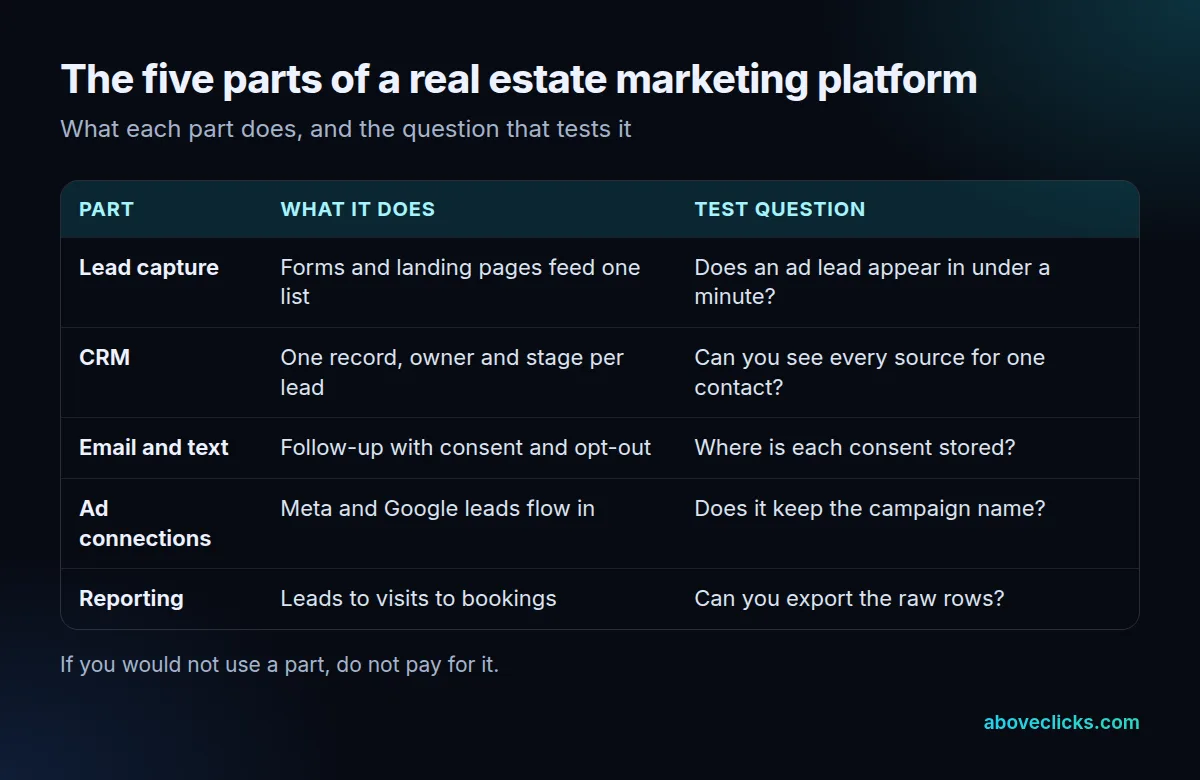
The lead-capture part is where the platform meets the ad accounts, and the limits there are specific. Google lead forms keep leads for 60 days, and a manual CSV download only covers the last 30 days. Delivery by webhook or the Google Ads API sends them to your CRM automatically instead.
Meta works the same way: its lead ads guide describes a webhook that fires when a lead is created. A platform that already holds these connections saves a developer’s time. A platform without them leaves you downloading files by hand.
Ask which MLS or listing feeds the website part can show, and whose rules govern them. We haven’t verified any MLS or IDX terms here, so confirm them with your own MLS before you rely on that feature.
Reporting is the part to look at closely. A good one joins the ad platform’s spend to the CRM’s outcomes, so you can see cost per booked visit and not just cost per lead. A weak one shows clicks and form fills and stops there.
Two parts are easy to overpay for. Listing websites and social scheduling are common add-ons, and a team that already has a site may never log in to either.
How is a marketing platform different from a real estate CRM?
A CRM stores contacts, stages and notes. A platform includes a CRM and adds the tools that create and follow up demand, such as forms, ad connections, messages and reports.
The difference shows in an invented example. An agent gets 40 leads in a month from 3 sources: a property portal, Meta lead ads and Google Search. The leads sit in a CRM that has no ad connection, so someone pastes each one in. At month end, 12 of the 40 have no source recorded, and the agent can’t say which source brought the 3 viewings.
A real estate marketing platform would have tagged the source at the moment of capture. That gap, not a feature count, is what you pay to close.
If your CRM already works, ask whether you need a real estate marketing platform or only two connections. A platform you use for 2 of its 5 parts costs more per part than a CRM with a form and a lead webhook. Many teams do better adding a form and a lead webhook to the CRM they have. Those who need to change tools can use our business automations service to connect them.
How do you choose the best real estate marketing platform?
Score each candidate on six checks, weight them for your team and compare totals. The best real estate marketing platform for a broker with 3 lead sources is not the best one for a developer with 1.
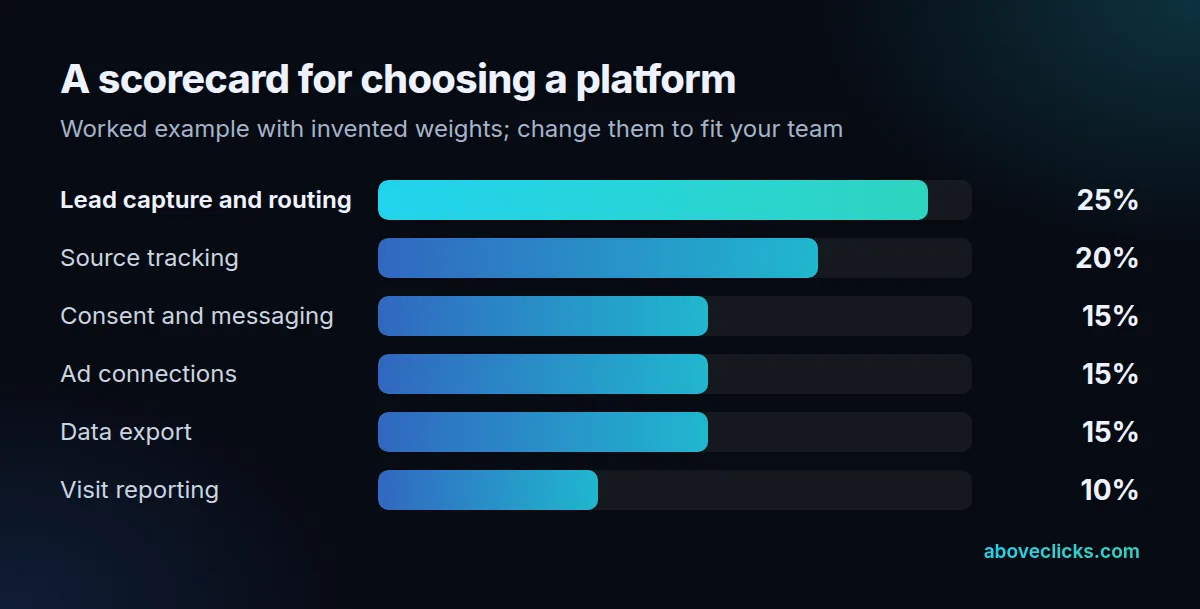
The weights above are an invented example for a team that buys leads from ads and replies by phone. Change them to fit your own work. The six checks, in order of weight:
- Lead capture and routing: a lead from a form or ad appears in the CRM in under a minute and goes to a named person.
- Source tracking: the campaign, ad and page stay on the record after the lead is created.
- Consent and messaging: every email or text address carries its consent and a working opt-out.
- Ad connections: Meta and Google leads flow in without a manual file.
- Data export: you can export every contact, note, tag and source in a standard file.
- Visit reporting: reports show cost per booked visit, not only the number of leads.
Score each check from 0 to 5, multiply by its weight and add up the results to a total out of 500. In an invented comparison, platform A scores 4, 5, 3, 4, 2 and 3 on the six checks and totals 365. Platform B scores 3, 3, 4, 4, 5 and 4 and totals 370. They look equal, but A is weak on data export (2 of 5), which is the check that costs most to fix after you sign.
When you compare real estate marketing platforms, write the scores in a sheet and keep the demo notes beside them. Memory fades after the third demo.
Run each demo with a test lead of your own. Our free audit can review a shortlist against this scorecard if you want a second opinion.
Which ad, email and text rules can’t a platform switch off?
The platform can send the message, but the law and the ad networks set the limits. Housing ads restrict targeting, commercial email needs an opt-out and commercial texts need written consent.
Start with ads. Meta lists housing among its special ad categories, and for advertisers reaching the US, age, gender, ZIP code, exclusions, lookalike and saved audiences are limited or unavailable. Google’s housing policy bars age, gender, parental status, marital status and ZIP code targeting in the US and Canada, and radius targeting must be at least 1 km. Each platform decides which ads count as housing, so check its definition before you assume an agent’s ad is exempt.
Then email. As of November 2026, the FTC says each separate email in violation of CAN-SPAM can bring penalties of up to $53,088. You must honor an opt-out within 10 business days and include a valid postal address.
Your real estate marketing platform sends whatever you schedule, so these rules are your job, not the vendor’s.
Texts are stricter. The FCC says commercial texts need written consent, and people may opt out at any time in any reasonable manner. Ask the vendor where the platform stores each consent and how it records a stop request. Our real estate email marketing guide covers the email side in more depth.
How do you track leads in a real estate marketing platform?
Tag every link with a source, medium and campaign, keep the spelling identical, and make the platform copy those tags onto the lead record. Without the tags, reports can’t say what produced a viewing.
Google Analytics expects 3 core parameters: utm_source, utm_medium and utm_campaign. Its help page says values are case sensitive, so google and Google appear as different rows, and a missing parameter shows as (not set). Pick lowercase names once and write them down. Most real estate marketing platforms can copy these tags onto the lead record, so check that yours does before you rely on its reports.
A short routine keeps the data clean:
- Write one naming sheet: one source per platform, one medium per channel, one campaign name per effort.
- Add the tags to every ad, email and QR link before it goes live.
- Submit a test lead from each link and check the source shows on the record.
- Review 10 recent leads each month and fix any that came in untagged.
In the invented 40-lead month above, if 28 leads (70%) carried all three tags, the other 12 are your blind spot. Fixing that is worth more than a new module. When the sales team marks leads as visited or booked, send those outcomes back to the ad platforms so budgets follow visits, not form fills.
When is software alone not enough?
When leads arrive but nobody replies fast, tests ads or reads the results. A real estate marketing platform moves data; it does not run campaigns. Teams that lack the time often need a managed service, not a bigger platform.
Check your own last 20 leads before you buy any real estate marketing platform. If half got their first reply after a day, the problem is the process, and a new tool will store the delay more neatly. If the leads are weak, the ads and landing pages are the issue.
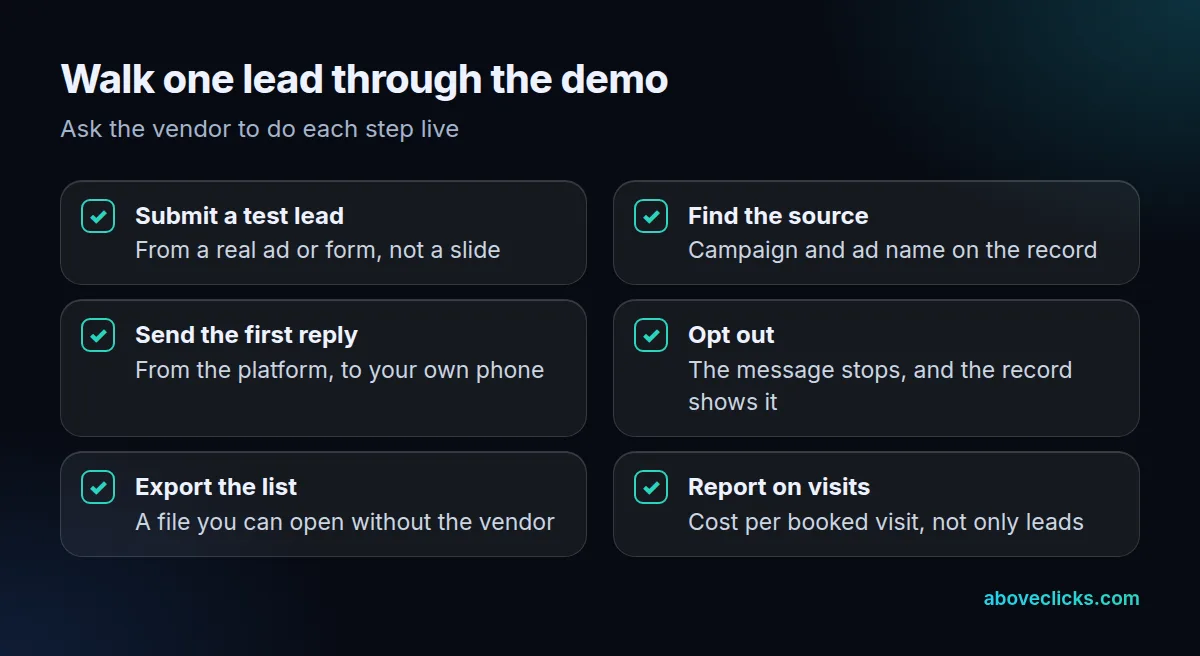
Use the checklist above in any demo. If the vendor can’t do a step live, assume your team won’t manage it alone either. When you want someone else to run the campaigns, CRM routing and follow-up, our real estate marketing service does that, and the free audit comes as a PDF within 2 workdays. For the budget side, read the agent marketing plan guide, and find more in the industries guides.