Email marketing for real estate agents is regular, permission-based email to the people in an agent’s own database. It rests on a proper sender address, a sorted list and one clear action in every message.
This guide to email marketing for real estate agents covers the order a solo agent should work in: the sender, the list, the first email, the sending rhythm, the tool and the measurement. Four mistakes cost most agents leads, and each has a section below:
- Sending from a free address that fails authentication.
- Treating the whole database as one list.
- Breaking the sender rules or the fair housing wording rules in the email itself.
- Judging the results by opens.
What is email marketing for real estate agents?
Email you send on a schedule to people who asked to hear from you, so they remember you when they buy or sell. It differs from one-to-one follow-up, where you write each message by hand.
Email marketing for real estate agents earns its place because it is cheap to repeat. A person who bought from you three years ago will not call unprompted, but a short monthly note keeps your name in front of them. The sender rules are not optional, though. Each separate email that breaks the CAN-SPAM Act can bring a penalty of up to $53,088, according to the FTC’s compliance guide as of November 2026.
For flows such as the welcome, viewing follow-up and home anniversary, see our guide to real estate email marketing. This one covers what comes before the flows: the foundation of real estate agent email marketing.
Which email address should a real estate agent send from?
One on your own domain, such as [email protected], with authentication set up. A free gmail.com address works for one-to-one mail but is a poor base for email marketing for real estate agents sent to a list.
Google’s sender guidelines say that, as of November 2026, every sender to Gmail accounts needs SPF or DKIM authentication and a spam rate below 0.3% in Postmaster Tools. Senders of more than 5,000 messages a day to Gmail also need SPF, DKIM and DMARC, plus one-click unsubscribe. A solo agent is unlikely to reach 5,000, but the same setup helps every real estate agent email marketing message arrive.
The free-address problem is in the Gmail FAQ: putting an @gmail.com address in the From header of a message that did not come from Gmail’s own servers counts as spoofing, and bulk senders that do it start getting failures. Most email tools send through their own servers, so your own domain is the safe route.
Yahoo asks bulk senders for the same 0.3% ceiling, a DMARC policy of at least p=none and unsubscribes honored within 2 days, according to its sender best practices as of November 2026.
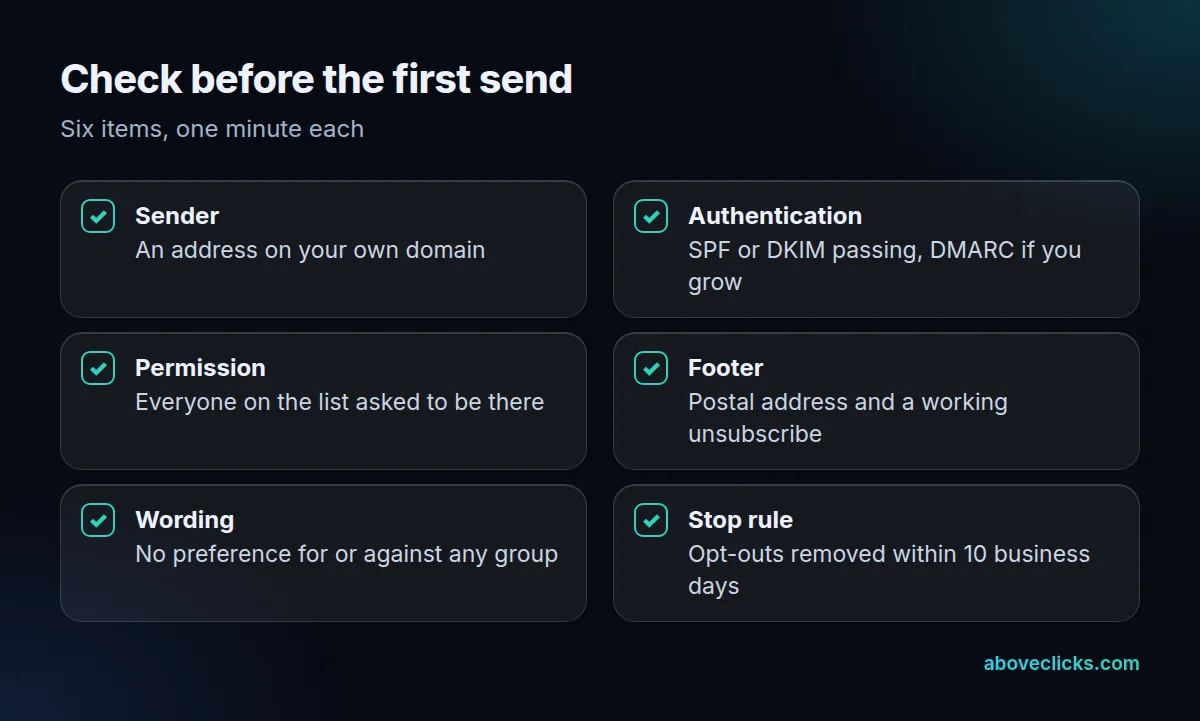
Your email tool or domain host shows the exact DNS records to add. If you use a brokerage address, ask the brokerage whether it already has authentication in place and whether you may use it for marketing.
Who belongs on a real estate agent’s email list?
Only people who asked to hear from you or have a clear relationship with you: past clients, enquiries, open house sign-ins, valuation requests, neighbors you have spoken to and referral partners. Then split them by what each should receive.
A one-list approach fails because a past client, an active buyer and a neighbor need different emails. Here is a worked example for an invented agent with 300 contacts.
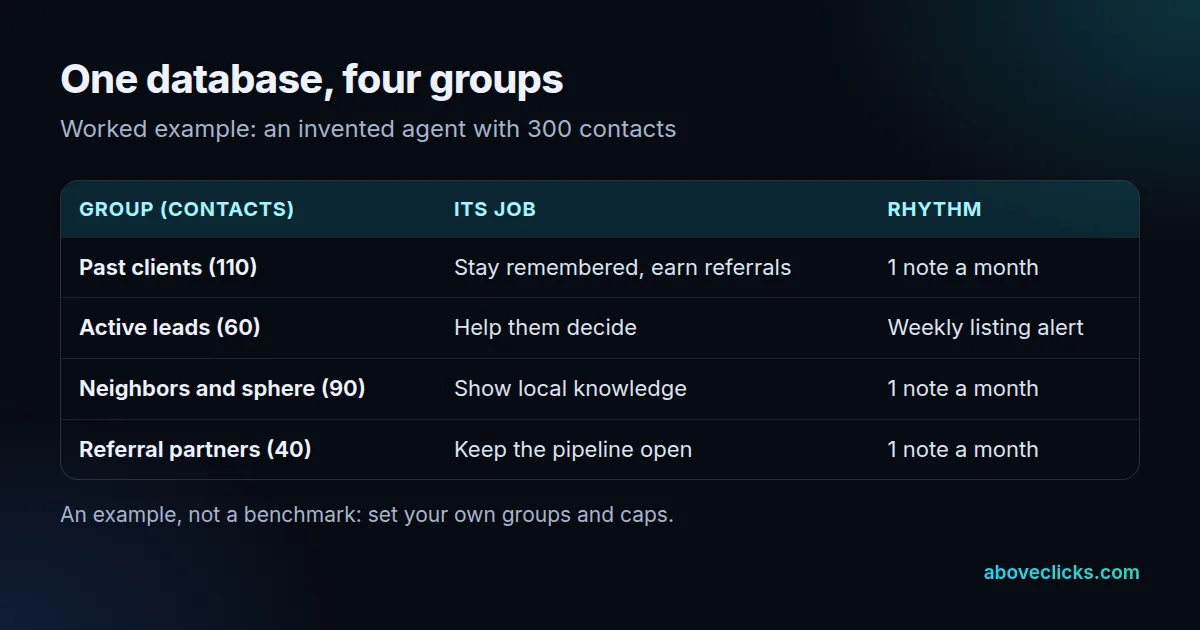
The groups also set the volume of real estate agent email marketing. Past clients, neighbors and partners get one note a month: 110 + 90 + 40 = 240 emails. Active leads get a weekly listing alert, or 4 a month to each of 60 people, which adds 240. The agent sends about 480 emails in a month, but no one contact receives more than 4.
Two rules apply to the list in real estate agent email marketing. Under CAN-SPAM, every marketing email needs a clear opt-out that keeps working for at least 30 days after sending, and you must honor a request within 10 business days, as of November 2026. Second, buying a list of homeowners breaks the first principle here: those people never asked, and complaints are what push you over the 0.3% limit.
If you have a mix of old spreadsheets and phone contacts, put them into one sheet with a column for group and a column for how each person joined. Anyone you cannot place goes to a short “do you still want these updates?” email, or off the list.
What should an email campaign for real estate agents say?
One market note with one action is the core of an email campaign for real estate agents. It works for past clients and neighbors alike, and the active-lead alert is the same shape with listings instead of a note.
Here is a sample market note, written for an invented suburb. Replace the bracketed parts with your own figures and check them against your MLS data.
> Subject: What sold on [street or area] in [month] > > Hi [first name], > > [Number] homes sold in [area] last month, [number] of them within [number] days of listing. The one that moved fastest was a [type of home], because [one honest reason]. > > If you are curious what your own home would sell for today, reply with “valuation” and I will send you a short written estimate. > > [Name], [brokerage and licence number if your state requires it] > [Postal address] · [Unsubscribe link]
Each part of this email marketing for real estate agents example does a job. The subject says what is inside. The opening gives a local fact the reader cannot get from a portal. The single action is a reply, which keeps the message simple and gives you a signal to count. The footer carries the address and the unsubscribe that the FTC requires, and the licence line covers any state rule on agent advertising, which you should confirm with your brokerage.
Wording needs a second check. The HUD rule at 24 CFR 100.75 says ads for the sale of a dwelling must not indicate a preference or limitation because of race, color, religion, sex, handicap, familial status or national origin. It covers written notices, including flyers and brochures. Describe the home and the area, not the kind of person who should live there, and use the same check on every email you send.
How often should a real estate agent send emails?
For email marketing for real estate agents, monthly to most of the list, weekly only to people who asked for listing alerts, and never more than a contact has agreed to. A small, steady rhythm beats a burst followed by silence.
The volume count above shows the point: 480 sends in a month, with the heaviest contact receiving 4. The risk with frequency is complaints, because the Google and Yahoo ceiling of 0.3% means 3 spam reports per 1,000 messages. At the 480 sends in the example, 2 complaints would already be more than the ceiling allows, so send only to people who want it.
Three habits keep the rhythm of real estate agent email marketing safe:
- Start with the group that knows you best, past clients, and add groups one at a time.
- Remove or re-ask anyone who has not opened or replied in a year, using a reply-based check, not opens alone.
- Set a cap per person, such as 4 emails a month, so a new campaign never stacks on top of the alerts.
For where email marketing for real estate agents fits among the other channels, our real estate agent marketing plan shows the weekly hours.
What is the best email marketing for real estate agents?
For email marketing for real estate agents, the tool whose limits and setup fit your list size and your CRM, not the one with the longest template gallery. Choose by sending needs, sender setup and how well it handles groups.
A short test beats a feature table:
- Limits: if you send from your mailbox, check its caps. Google Workspace allows 2,000 messages a day, 1,500 for mail merge, and 500 external recipients per message, according to Google’s sending limits as of November 2026. A 300-contact list fits, but a growing database soon needs a sending platform.
- Authentication: can it send from your domain and show you the DNS records?
- Groups: can it keep your four groups separate and stop a lead who replied from getting the next alert?
- Unsubscribes: does every marketing email carry the unsubscribe and postal address automatically?
- CRM link: does it connect to the system where your leads already live?
The best email marketing for real estate agents is, in practice, the best fit with these five points, and the best email marketing for real estate agents on a 300-contact list may be a mailbox plus a free sending tool. We don’t rank vendors here, because their plans change often; see our email marketing cost guide for how fees are built. Agents and developers who also sell online can have us set up and manage the sending in Klaviyo email marketing.
How do you know agent email marketing is working?
In email marketing for real estate agents, count replies, booked calls and valuation requests, not opens. Google says it doesn’t track open rates and that low open rates aren’t necessarily a sign of deliverability problems.
That statement is in Google’s sender guidelines, as of November 2026, along with the note that it can’t verify open rates reported by third parties. Opens are also affected by how mail apps load images, so real estate agent email marketing needs better signals. Treat them as a rough hint at most.
Track four numbers of real estate agent email marketing each month instead:
- Replies to the sample action, such as “valuation”.
- Booked calls or viewings that came from an email.
- Unsubscribes and complaints per send, to check you stay under the 0.3% line.
- Group growth, the number of new contacts who joined by consent.
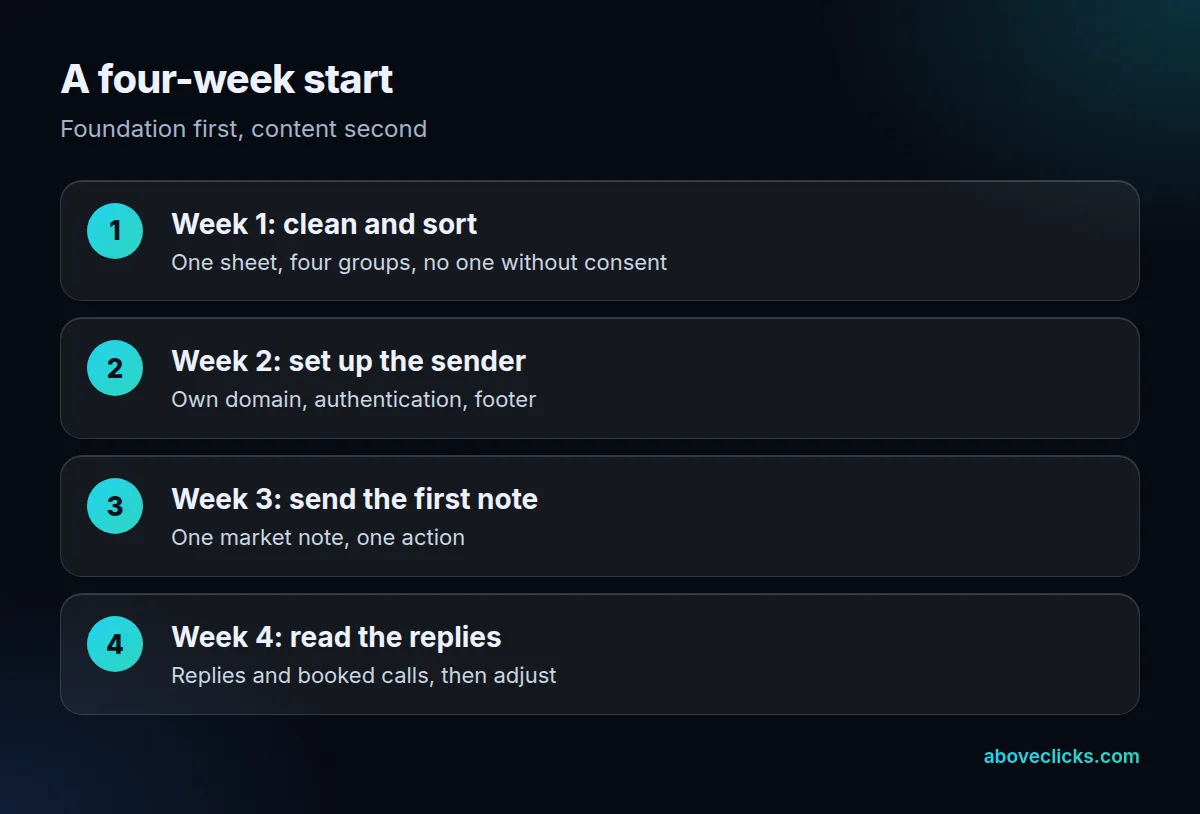
Run the four-week start of email marketing for real estate agents first, then repeat it every quarter with the list cleaned again. The agent-marketing work we do for real estate starts the same way, with the sender and the list before any campaign. If you would like a second opinion on yours, our free audit reviews it. More guides are in industries.