A real estate agent marketing plan is a written plan for one agent: how many hours a week, which channels, how much money and which rules apply to each. Decide the hours first, because a solo agent runs out of time before money.
This guide builds a real estate agent marketing plan around a 10-hour week, shows how a new agent’s plan differs from an established agent’s, covers what to spend, lists the ad, email and profile rules, and ends with a 12-week run order.
What is a real estate agent marketing plan?
A one-person plan that links your weekly hours to a short list of channels and a check at the end of each month. It differs from a brokerage plan because you are the sales team, the designer and the admin.
Most guides start from an income goal and a percentage of commission. Our real estate marketing plan guide covers that chain, including the goal math, the budget rules and the 90-day calendar, so we don’t repeat it. Here the starting point is the diary. A marketing plan for real estate agents that needs 25 hours a week will not survive a busy month of showings.
A real estate agent marketing plan also has a shelf life. Markets, platform rules and your own diary change, so put a review date on the page and treat the plan as something you edit every 3 months, not a document you file.
Write three things before choosing channels for your marketing plan for real estate agents:
- Your marketing hours per week, as a number you can keep.
- Your area and the kind of client you want, in one sentence.
- One metric you will review weekly, such as conversations held.
What should a marketing plan for real estate agents include?
Five channels at most, each with weekly hours and an owner (you), plus a rules check. Fewer channels done every week beat a long list done once.
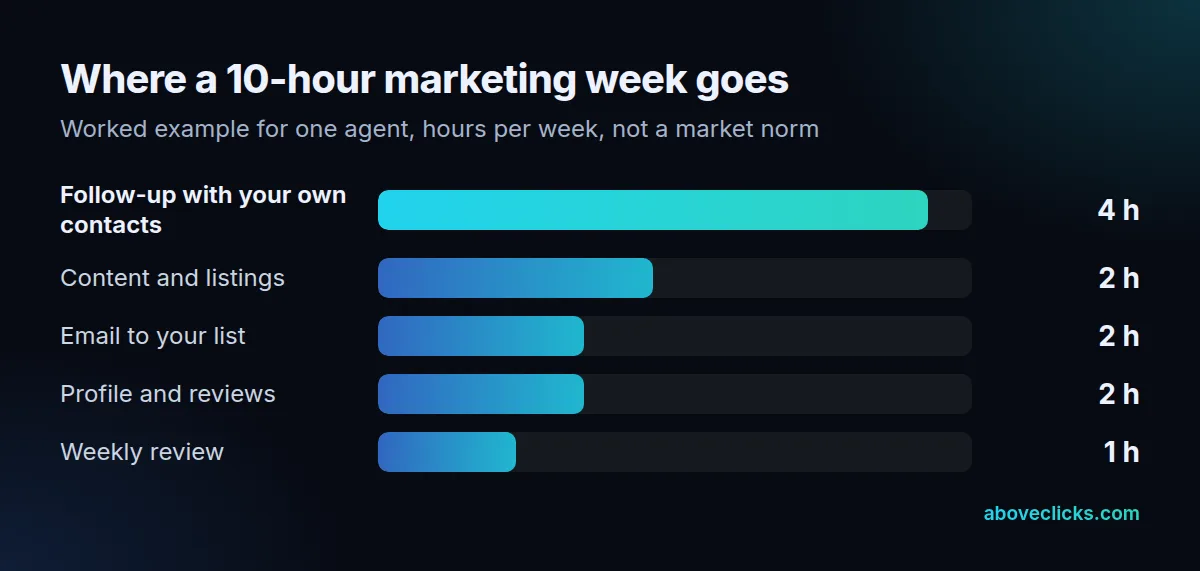
The worked example above is for one agent with a 10-hour marketing week; it is illustrative, and your own diary replaces it. Follow-up takes the biggest share because the people who already know you are the cheapest source of business. Content and listings take 2 hours, email 1.5 hours, the profile and reviews 1.5 hours, and a weekly review 1 hour.
A real estate agent marketing plan of this size should fit on one page:
- Area and client: one sentence, used in every channel.
- Channels and hours: the five rows above, adjusted to your week.
- Rules check: the table further down, ticked for each channel you use.
- Weekly number: one metric, reviewed in the same hour every week.
- Review dates: a decision to keep, cut or change each channel every 3 months.
Keep the plan honest about capacity. If the five rows add up to more than your 10 hours, cut a row rather than squeeze every row; a real estate marketing plan for agents works when the weekly list is short enough to finish. A good test is a week with 2 open houses and a closing: if the plan still gets done, it fits.
The real estate email marketing guide covers the flows for the email row, so this plan only reserves the time.
How should a new agent’s marketing plan differ from an established agent’s?
A new agent has more time than money and no past clients, so a real estate marketing plan for agents at that stage leans on follow-up and a Business Profile. An established agent has contacts and referrals, so the plan adds paid tests and reporting.
A marketing plan for real estate agent beginners should spend most of its hours on:
- Building a contact list of the first 100 people you know, with consent noted.
- Calling and writing to that list on a fixed rhythm, such as 20 calls a week.
- A single web page and a Business Profile that agree on your name, area and contact details.
Established agents can use a longer horizon. Referrals from past clients arrive over years, so a real estate agent marketing plan for that agent should reserve 1 or 2 hours a week for past-client contact even in a quiet month, and should track which referrals came from which touch.
An established agent has a different problem: the plan competes with a full diary. The weekly review matters more here, because it shows which channel produced appointments and which only produced activity. If you want an outside read of what you already run, our real estate marketing audit sends a PDF report within 2 workdays, as published on that page (as of October 2026). Developers and larger sales teams may prefer the wider real estate digital marketing work.
How much should a real estate agent spend on marketing?
Start with hours, then add cash one test at a time, because a real estate agent marketing plan that begins with ad spend skips the cheaper work. The percentage-of-income rules are in our budget guide; this section covers what sits on top of them.
Three costs belong in a real estate agent marketing plan:
- Time: the 10 hours above, which are the largest cost for most solo agents.
- Tools and paid tests: a contact system, photos and one small ad test at a time.
- Mistakes: the avoidable ones, such as an email that breaks the rules.
Some visibility costs nothing. Google says it costs nothing to appear in its organic search results and that it never accepts money to include or rank sites (as of October 2026). Anyone who sells a promised ranking is therefore a warning sign, and a profile and web page that stay accurate are a no-cost start for your marketing plan for real estate agents.
The cost of mistakes can exceed an ad budget. The FTC says each separate email that breaks the CAN-SPAM rules can carry a penalty of up to $53,088 (as of October 2026), and more than one party can be held responsible. A 500-name email to your list, sent without an opt-out, is 500 possible violations. Put the compliance hour in the plan before you add the ad budget. A 30-minute check of the unsubscribe link, the footer address and the sender name before each send is the cheapest insurance in the whole plan.
Which rules apply to a real estate agent’s ads, emails and profile?
Five rules apply to every real estate agent marketing plan, and each is checkable in minutes: housing ad targeting limits on Meta and Google, the CAN-SPAM email rules, Business Profile eligibility and the Fair Housing Act.
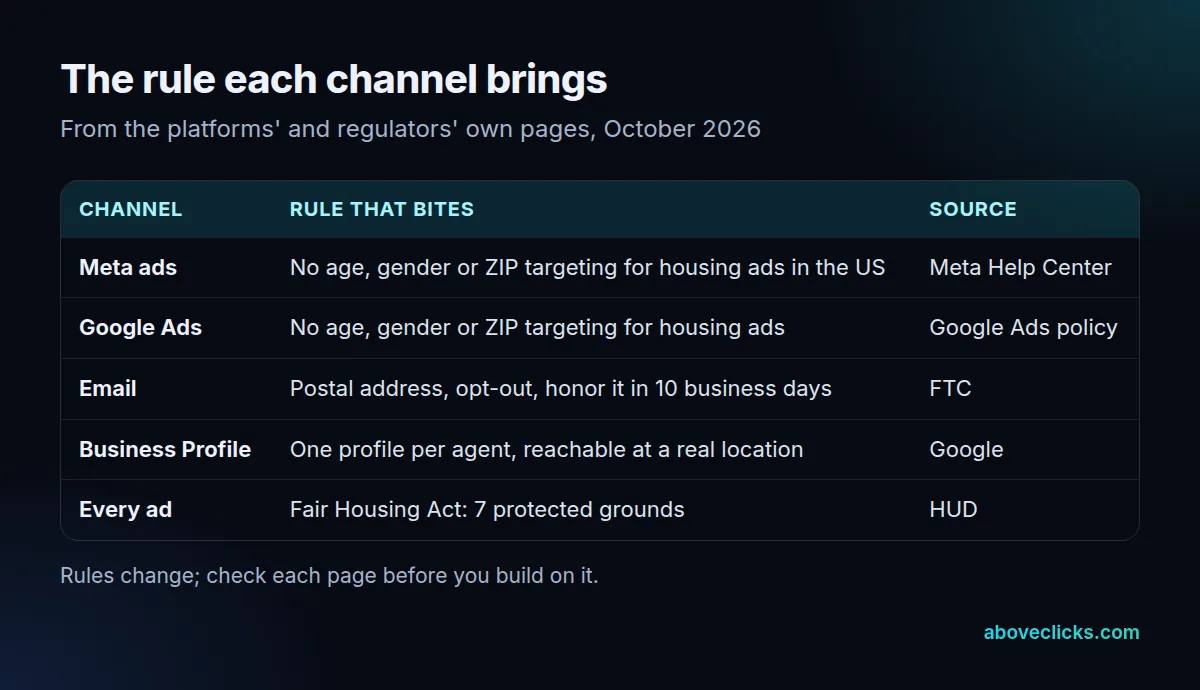
Meta ads. Meta’s help page says that for housing ads, advertisers in or reaching the US cannot use age, gender, ZIP or postal code, exclusion targeting, lookalike audiences or saved audiences, and that city or pin-drop audiences get an expanded radius (as of October 2026, Meta Business Help Center). The page does not say which agent ads count as housing, so choose the special ad category in Ads Manager when an ad is about a home for sale or rent.
Google Ads. Google’s policy says age, gender, marital status and parental status cannot be used to target housing ads in the US and Canada, and ZIP code location targeting cannot be used either (as of October 2026, Google Ads policy).
Email. The FTC requires your valid physical postal address and a clear way to opt out, and says you must honor an opt-out within 10 business days, and the opt-out must keep working for at least 30 days after you send (FTC guide, as of October 2026).
Business Profile. Google lists real estate agents as individual practitioners. A practitioner can have a dedicated profile if they are public-facing and can be contacted at the verified location during stated hours; one practitioner shouldn’t have several profiles, and a rented virtual office isn’t eligible (Google’s guidelines, as of October 2026).
Every ad. The Fair Housing Act protects people from discrimination in 7 areas: race, color, national origin, religion, sex, familial status and disability (HUD, as of October 2026). Write ad copy and choose audiences with that list beside you. This is not legal advice; your broker or association can confirm local rules.
What does a 12-week real estate agent marketing plan look like?
Four blocks of 3 weeks make up a 12-week marketing plan for real estate agents: foundation, follow-up, one paid test and a review. Doing them in this order keeps spending behind the work that costs only time.
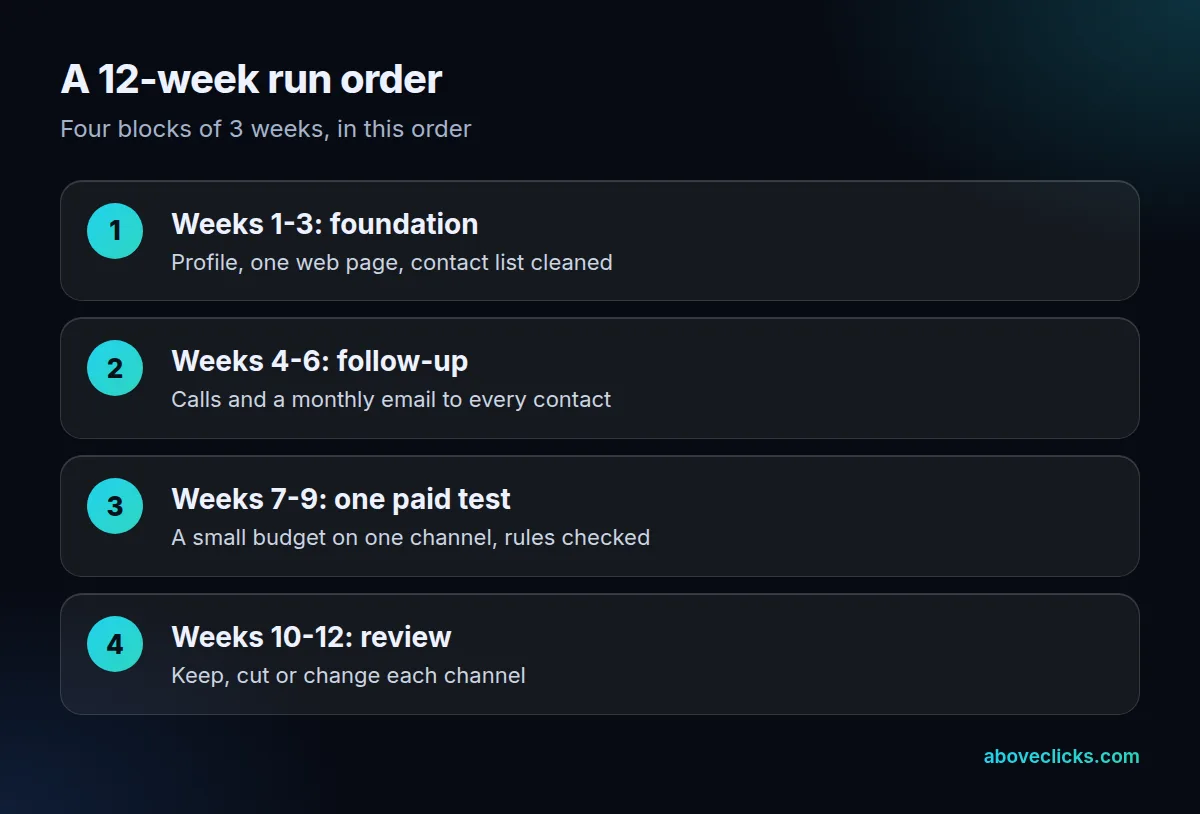
This run order for a real estate agent marketing plan is a worked example, not a benchmark, and it leaves room for the follow-up your own market needs. In weeks 1 to 3, set up the profile and one page, and clean your contact list. In weeks 4 to 6, call and write to every contact, then start a monthly email with the rules in place. In weeks 7 to 9, run one small paid test on one channel, with the targeting limits above checked first. In weeks 10 to 12, compare the weekly numbers and decide whether to keep, cut or change each channel.
Judge the first 12 weeks of your real estate agent marketing plan on activity you control, such as conversations held and appointments set. Closings take longer, so review them over a full year. If a free read of your current setup would help, ask for our free audit. More industry guides are in industries.