Real estate email marketing is the use of automated and scheduled emails to stay in touch with leads and past clients until they are ready to buy or sell. It is a long game, because most people move only once in many years.
This guide to real estate email marketing covers the 5 flows to build first, what a newsletter should hold, how to grow the list, the sender rules that decide whether your emails reach the inbox, and how to measure the results.
What is real estate email marketing?
Email that keeps an agent, team or developer in front of people between their first enquiry and the day they move, and again before they sell. Most of it runs automatically.
The gaps are long. In NAR’s 2025 Profile of Home Buyers and Sellers, sellers had owned their home for a median of 11 years before selling, an all-time high. The same survey found 88% of buyers and 91% of sellers used an agent. Most people will hire someone; the question is whether they remember you when they do.
That’s the job of email marketing for real estate: a steady, useful presence over months or years, at almost no cost per message. Paid ads and portals find the lead. Email keeps it.
Which real estate email campaigns should run automatically?
Five flows cover most of a client’s timeline: a welcome for new enquiries, listing matches, a follow-up after each viewing, a yearly home anniversary and a seller valuation path.
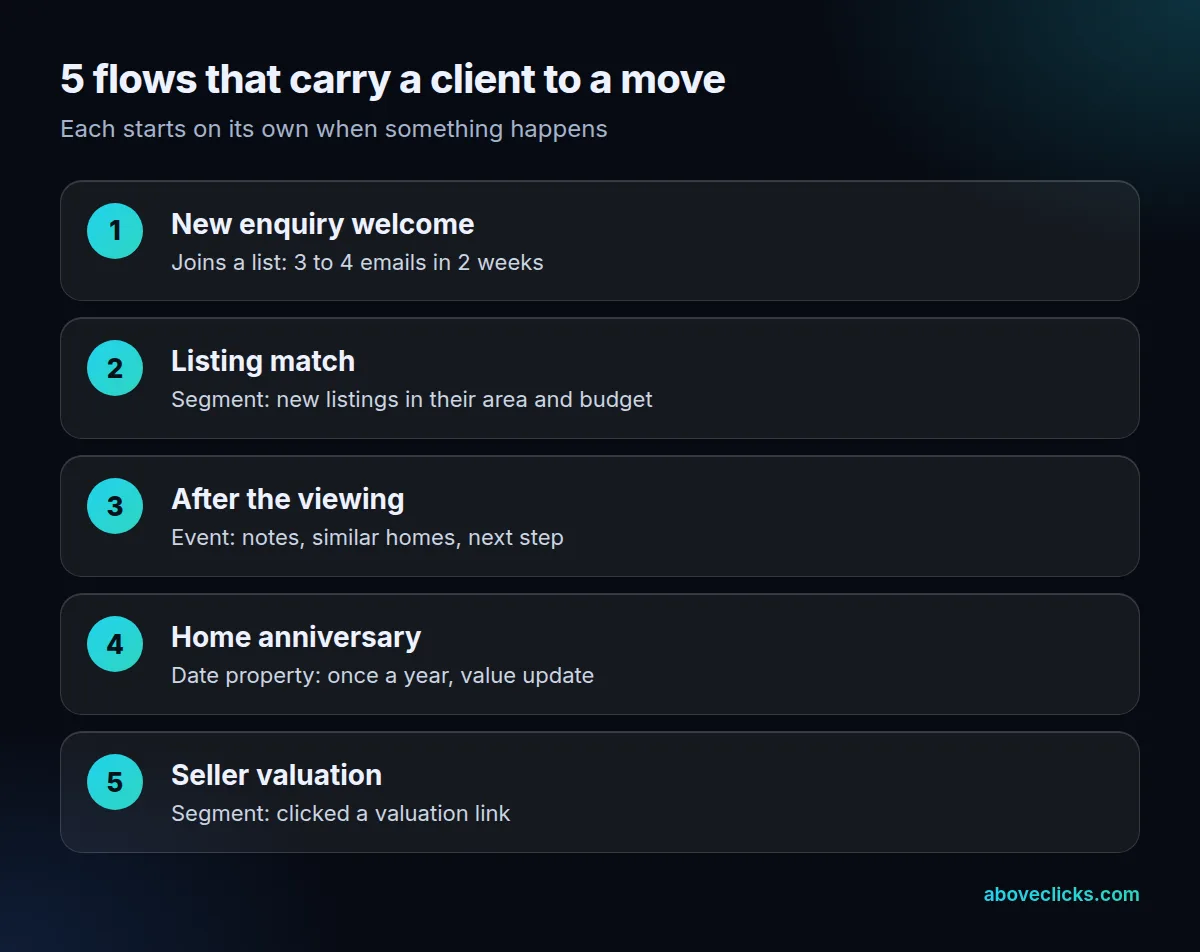
Each flow needs a trigger. In Klaviyo, for example, a flow can start from a list, segment, metric or date property, among 6 trigger types; other platforms use similar terms. A new enquiry joins a list and gets the welcome. A buyer whose saved area gets a new listing enters a segment. A purchase date stored on the contact drives the anniversary email.
Here’s a worked example of the anniversary flow. An agent with 400 past clients sends each one an email on the date they bought, with a short value update and a note. That’s about 33 emails a month, spread evenly, and none of them written by hand. Of all real estate email marketing, the anniversary flow is the one most often skipped, yet it reaches owners during the 11 years before they sell.
On our own real estate marketing work, follow-up starts on WhatsApp for leads who opted in: a welcome with the brochure and location, a reminder before the site visit and a check-in after it. A longer email sequence then carries buyers who take months to decide, with new launches, price updates and site visit invitations. We draft the follow-ups for each stage, and agents send them in their own words.
What should a real estate newsletter include?
Local market notes, new and sold listings, and one useful piece of advice, sorted by who the reader is. A first-time buyer and a downsizing owner need different emails.
The buyer mix shows why. NAR’s 2025 takeaways put first-time buyers at a record low 21% of buyers, with a median age of 40. Repeat buyers had a median age of 62, and 26% of all buyers paid cash.
So a single real estate marketing email for everyone sells short most of the list. Split it into at least 3 versions:
- First-time buyers: saving for a deposit, how offers work, homes under a set price.
- Owners and repeat buyers: what similar homes sold for, when it may pay to sell, downsizing options.
- Investors and cash buyers: new listings early, rental notes, off-market opportunities.
Keep each real estate marketing email short. One main story, 3 to 5 listings, one clear next step such as booking a call or a viewing.
What real estate email marketing ideas work month by month?
A yearly calendar of 12 newsletters, each tied to what buyers and owners think about that season, on top of the automated flows. Plan it once in January, then fill in local numbers each month.
A worked example for a suburban agent, 12 sends a year:
| Months | Newsletter theme | Next step offered |
|---|---|---|
| January to February | Last year’s local sales and prices | Book a valuation |
| March to May | Spring listings, how offers work | Book a viewing |
| June to August | Moving with children before school starts | Get the new listings alert |
| September to October | Autumn market, prep before winter | Ask for a seller checklist |
| November to December | Year-end thank you, local events | Reply with plans for next year |
Real estate email marketing ideas work best when each one ends in a single action. A seasonal real estate marketing email that asks for nothing is easy to like and easy to forget. In this example, 12 newsletters plus the 5 flows means a contact on the list hears from you about once or twice a month, never every day.
How do you build a real estate email list?
From people who asked to hear from you: website enquiries, open house sign-ins, valuation requests, portal leads that gave consent and past clients. Never from a bought list.
Email marketing for real estate only works on a list that asked for it. Bought lists cause complaints, and complaints send your mail to spam. Consent also matters inside your own tool. Klaviyo’s help page notes that segments pull from all contacts in the account, so a segment doesn’t check opt-in on its own. Add “can receive email marketing” as a condition, or a past client who never subscribed ends up in a promotional send.
Good list sources for an agent:
- A “new listings in your area” sign-up on every listing page.
- A home valuation form, which also tags the contact as a likely seller.
- Open house sign-in on a tablet, with a clear consent box.
- Past clients, asked once at closing whether they’d like the yearly update.
When someone opts out, the FTC’s CAN-SPAM guide says you must honor it within 10 business days and can’t sell or transfer their address afterwards (as of October 2026).
Which email rules apply to real estate senders?
The US CAN-SPAM Act for every commercial email, plus Gmail’s and Yahoo’s bulk-sender rules once you send a lot. Together they decide both your legal risk and whether you reach the inbox.
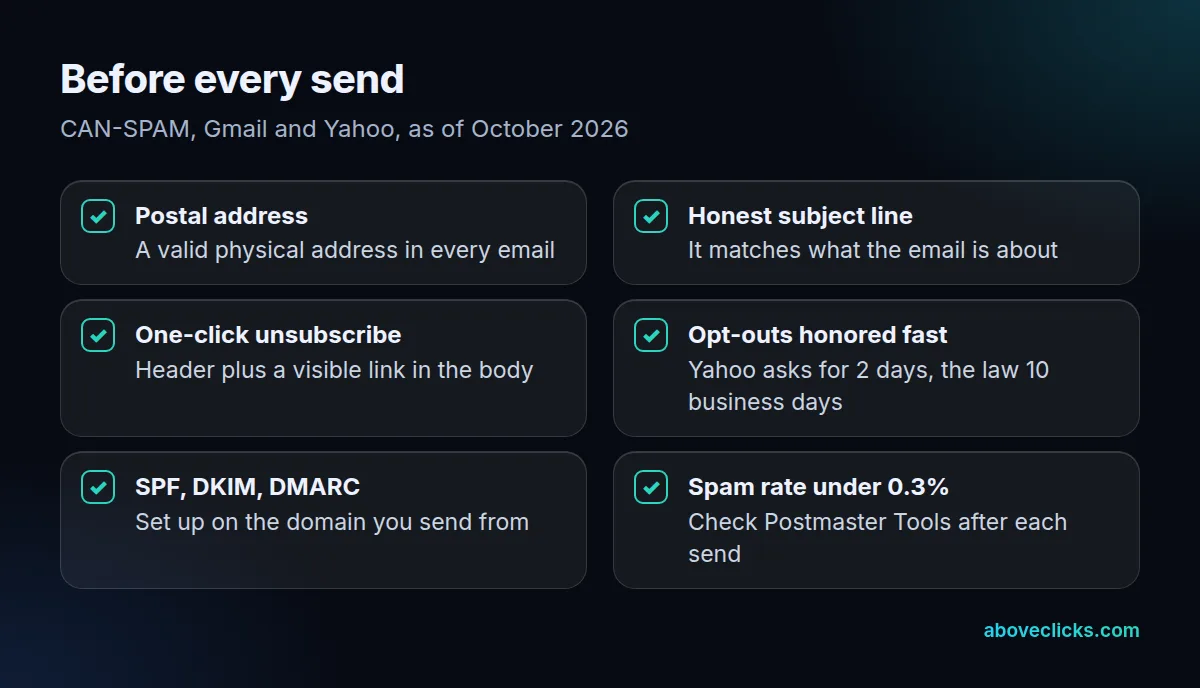
Under CAN-SPAM, each separate email that breaks the law can cost up to $53,088, according to the FTC’s compliance guide as of October 2026. Every marketing email needs an honest subject line, a valid physical postal address and a clear way to opt out that works for at least 30 days after sending. Those rules cover real estate email marketing like any other commercial email. This isn’t legal advice; check state rules and other countries’ laws for your list.
Gmail adds rules for anyone sending more than 5,000 messages a day to Gmail accounts. Its sender guidelines require SPF, DKIM and DMARC, one-click unsubscribe and a spam rate below 0.3% in Postmaster Tools, as of October 2026.
Yahoo’s sender best practices set the same 0.3% spam-rate ceiling for bulk senders, ask for DMARC with at least p=none and want unsubscribes honored within 2 days (as of October 2026). One-click unsubscribe is a header defined in RFC 8058; any decent platform adds it for you.
What makes the best real estate email marketing software?
The tool that triggers flows from your own events, segments by area and budget, and handles authentication and unsubscribes for you. Brand matters less than whether it connects to your CRM.
Real estate email marketing software checklist
Most tools sold for email marketing for real estate can send a newsletter; fewer can run the 5 flows. Before you choose, ask each vendor these 5 questions:
- Can a flow start from a date stored on a contact, such as a purchase date?
- Can it segment by area, price range and buyer type from your CRM or forms?
- Does it set up SPF, DKIM and DMARC on your own domain?
- Does every marketing email carry one-click unsubscribe automatically?
- Can you see complaints and unsubscribes per send?
The best real estate email marketing setup is often a CRM for the people plus an email platform for the sending. For stores and developers already selling online, we build this in Klaviyo, and our email marketing cost guide shows what each part of the stack costs.
List size decides how careful you have to be. The worked example below shows how few complaints a list can take before it crosses the 0.3% line.
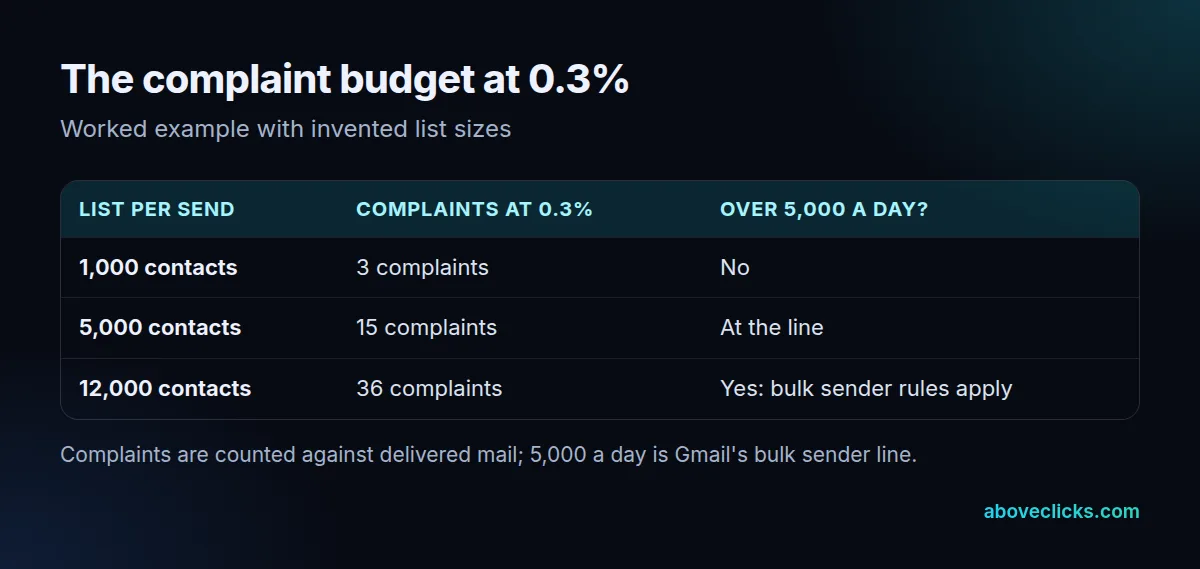
A brokerage with 12,000 contacts that sends one newsletter in a day is over Gmail’s 5,000-a-day line, and 36 complaints from a single send already reach 0.3%. If your domain is already landing in spam, our email deliverability fix starts with authentication and complaint sources.
How do you measure email marketing for real estate?
By replies, booked calls and viewings, and listing clicks per send, with complaint and unsubscribe rates as guardrails. Opens are the weakest signal, because some mail apps count an open when images load.
A worked example from an invented test log: a newsletter goes to 2,000 contacts and gets 8 replies and 3 booked valuations. That’s a 0.4% reply rate and 1.5 valuations per 1,000 sends. Track those numbers for 6 sends before you change the format. Real estate email marketing moves slowly, so one weak send says little; a trend over 6 sends says a lot more.
Three checks after every send:
- Replies and bookings: tag them in the CRM so each one traces back to an email.
- Complaints: stay well under 0.3% in Gmail’s Postmaster Tools.
- Unsubscribes by version: if one newsletter version loses more readers than the others, change that version’s content first.
Email is one channel in a wider plan. Our real estate marketing plan guide shows how it fits with ads, portals and the website, and more guides for property businesses are in industries. If you’d like help setting up real estate email marketing with the 5 flows, see our Klaviyo email marketing service, or sign up for our monthly email below for one practical marketing guide a month.