Real estate direct marketing is reaching a list of people you chose with one offer and one way to respond, through mail, email, calls, texts or doors. Judge it by the cost of each lead and appointment, not by how the piece looks.
This guide covers direct marketing for real estate in the order you need it: the five channels, the federal rules for each, how to build the list and offer, how to count a mailing, and a 90 day test.
What is real estate direct marketing?
It’s marketing sent straight to a named person, household or route, with a reply you can count. That separates it from a billboard or a portal ad, where you can’t tell who saw it.
Every piece of real estate direct marketing has four parts: a list, an offer, a message and a way to measure. If one is missing, you can’t tell what worked. A farm is the usual example. Example: an agent picks 400 homes and mails them 3 times, which is 1,200 pieces. The list is fixed, so each mailing can be compared with the last.
Real estate direct marketing differs from a portal ad in another way. A portal ad is rented space: when you stop paying, it stops. A list you built and a record of who answered stay with you, so the second mailing starts from what the first one taught you.
Direct marketing in real estate suits work that depends on a place and a person: farming a neighborhood, reaching past clients, following up inquiries and pitching owners. It suits a one-off brand message less. Good real estate direct marketing is small, repeated and counted. For a wider plan, see our real estate agent marketing plan.
Which real estate direct marketing channels should you test?
Five: postal mail, email, live calls, texts and door to door. Start with the one where you already hold the list and the permission.
In real estate direct marketing, postal mail reaches people who never gave you an address, so it works for farming. USPS’s Every Door Direct Mail lets you pick routes online. As of November 2026 the retail option needs at least 200 pieces and allows up to 5,000 per day per ZIP Code, and the pieces are addressed to “Postal Customer”.
The other four need a list of people who know you:
- Email: the cheapest to repeat, and the best for past clients and open house guests. Our real estate email marketing guide covers flows and newsletters.
- Live calls: useful for follow-up on a recent inquiry.
- Texts: quick, but they need recorded consent first.
- Door to door: a walking route with a printed note, such as a “just listed” hanger.
Pick your real estate direct marketing channel by the list you hold, not by fashion. An agent with 300 past clients and no neighborhood focus should start with email and one personal call a month. An agent who wants a new area has no list there yet, so mail is the first step. A new agent with neither should start with door to door in one street and build a list from the people who answer.
Printed pieces also carry what a buyer or seller needs to see. Our guide to real estate marketing materials lists them.
Which rules apply to direct marketing for real estate?
Each channel of real estate direct marketing has its own rule, and none of them is the same. The table below sets them side by side. Breaking the email or call rules can cost up to $53,088 per violation, as of November 2026.
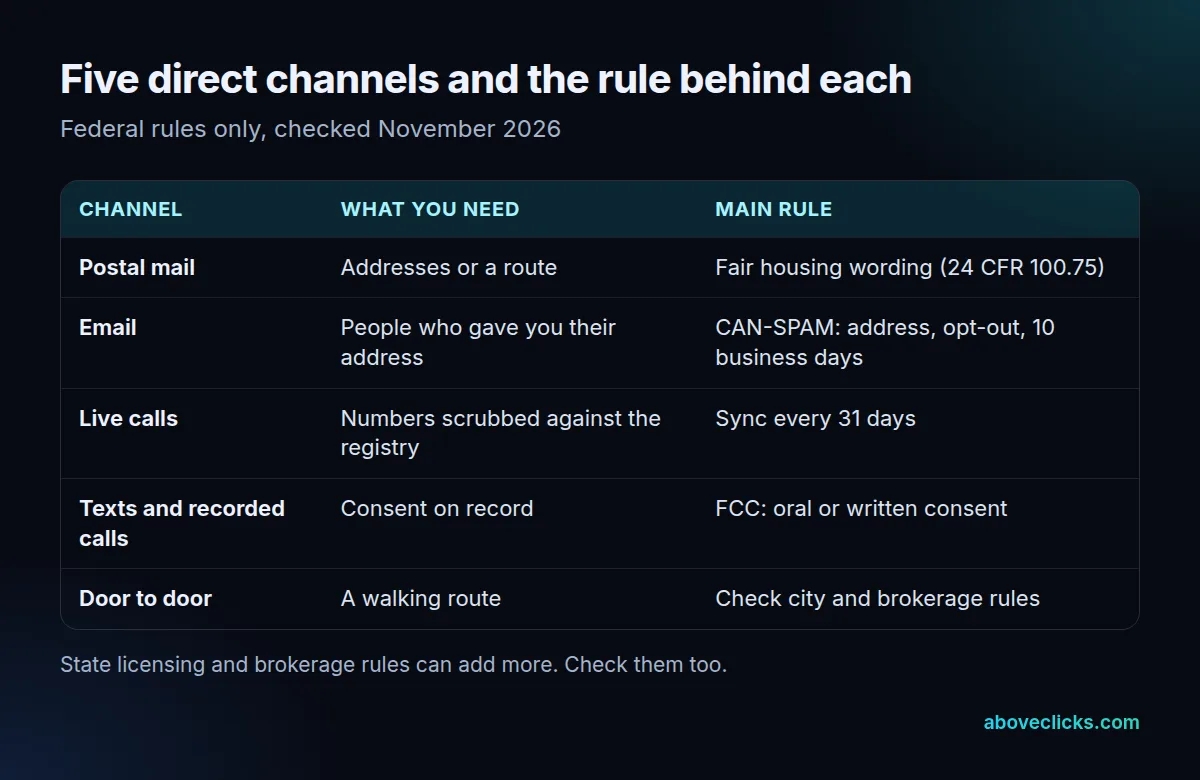
Email. The FTC’s CAN-SPAM guide requires your valid postal address and a clear way to opt out. You must honor an opt-out within 10 business days, and the opt-out has to keep working for at least 30 days after you send. Each separate non-compliant email can bring a penalty of up to $53,088.
Live calls. Under the FTC’s Telemarketing Sales Rule, you can’t call numbers on the National Do Not Call Registry, and you must sync your list with it every 31 days. An existing business relationship allows live calls for 18 months after a purchase or 3 months after an inquiry. Civil penalties run up to $53,088 per violation.
Texts and recorded calls. The FCC’s robocall and robotext page says a caller needs oral or written consent before an autodialed or prerecorded call or text to a wireless number. It adds that a prerecorded telemarketing call needs prior written consent. A bought list does not give you either.
Mail and doors. In direct marketing for real estate on paper, no federal consent rule applies, but the fair housing advertising rule does, and state, brokerage and city rules may add more. These were not checked for this guide.
How do you build the list and the offer?
For real estate direct marketing, start from people you can already name: past clients, inquiries, open house guests and one farm. Then give each group one offer and one wording that passes the fair housing rule.
For a mail farm in direct marketing for real estate, choose a single neighborhood, because a small repeated list beats a large one-off. A list of 400 homes mailed 3 times gives 3 touches inside 2 months. For past clients, use the contact details they gave you, and keep a note of when and how they asked to be contacted.
The offer should be specific and free to take up: a home value report, a market note for the street or an invitation to an open house. Avoid vague lines such as “thinking of selling?”.
Wording needs care. 24 CFR 100.75 makes it unlawful to publish any notice, statement or advertisement for the sale or rental of a dwelling that shows a preference or limit based on race, color, religion, sex, handicap, familial status or national origin. That is 7 listed grounds, and it covers headlines, images and targeting words in a mailer. If a line describes the people you want rather than the property, cut it.
A mailer needs very little on it. Use this order:
- Headline: the offer, in plain words, such as “What is your home worth this spring?”.
- One proof line: a sourced local fact, such as the number of homes sold on the street in the last 12 months, taken from your MLS.
- One response route: a phone line or QR code that belongs to this piece only.
- Sender block: your name, brokerage and address.
Keep the list clean, because real estate direct marketing depends on it. Remove names that asked to stop, merge duplicates and drop returned mail after each send, so the second mailing does not repeat a mistake from the first. If one household appears twice in a 400 home farm, you pay for 401 pieces and your cost per lead is slightly off.
Our real estate marketing service builds these lists and offers into tracked lead routes, and the industry page shows the wider picture.
How do you measure what a mailing earned?
Real estate direct marketing is only worth repeating if you can count it, so divide the full cost by the leads and by the appointments. A mailing that looks good but returns no counted leads has cost money and taught nothing.
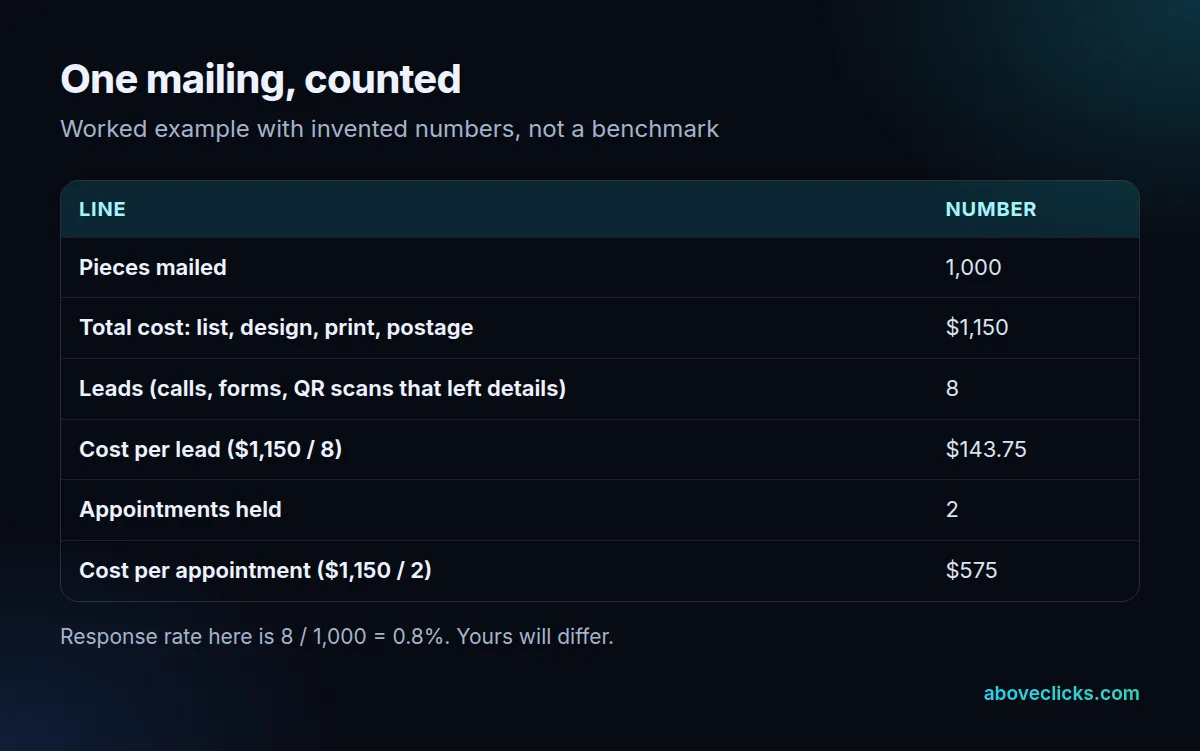
The figures above are invented for one 1,000-piece mailing. Count every cost: list, design, print and postage. Then count only leads that left details, not impressions.
Two traps skew the count. First, a response that arrives by an unmarked route, such as someone calling your main office line, gets lost. Give each mailing its own phone line, short web address or QR code. Second, a listing signed months later still belongs to the mailing that started it, so keep a log of lead source for each name.
Speed matters as much as the count. On our real estate marketing service, every lead goes to the CRM within seconds from any source, with an alert to the salesperson. A mailing that brings in 8 leads is wasted if the first call happens three days later.
This count also tells you when to stop spending on direct marketing in real estate that does not pay back. If three mailings in a row cost more per appointment than your email or ad leads, change the offer or move the money. Our free audit checks how your lead sources are tracked.
How do you run a 90 day test?
Real estate direct marketing improves by testing: split one list in two, change one thing, mail three times and compare. Changing the offer and the design together tells you nothing about either.
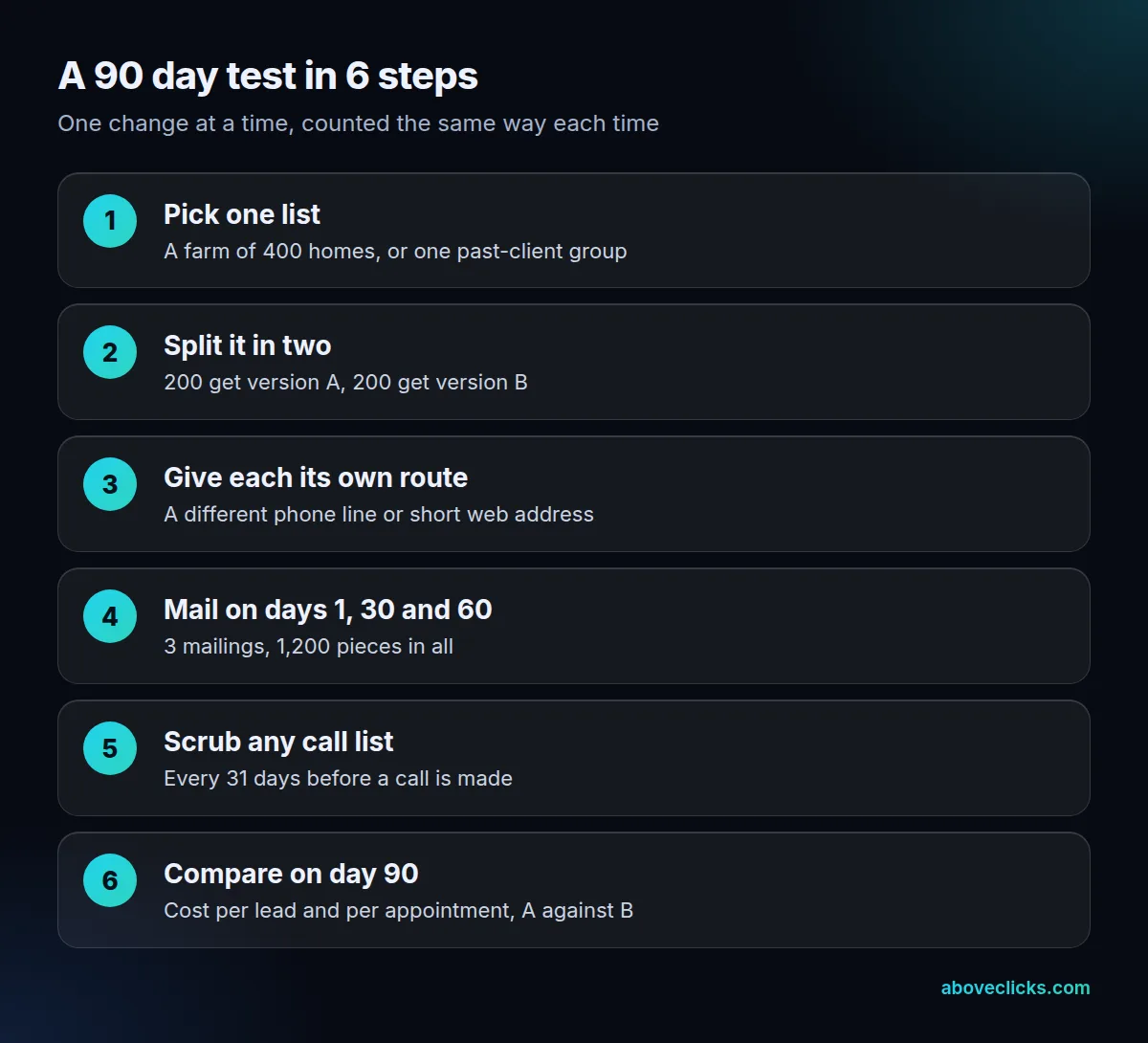
In practice, 400 homes become two groups of 200. Version A carries the home value offer and version B carries the market note. Each has its own route, so every lead can be traced to a version. With three mailings on days 1, 30 and 60, you send 1,200 pieces in all.
If you also call leads, add a registry check before each calling session, and never let it go past 31 days. Day 90 is the decision: keep the version with the lower cost per appointment, and test a new headline next.
Keep the rest of the process fixed. Mail on the same weekday, use the same paper and send from the same address, so the only difference between A and B is the thing you chose to test. For direct marketing for real estate, write the test down before day 1: the list, the two versions, the dates and the number you will compare.
Small groups give noisy results. With 200 homes per version, a difference of one or two leads can be chance, so repeat the test before you drop an idea.
What should you check before every send?
The rule checks and the tracking checks for real estate direct marketing, in one list. Run it on every mailing, email or call session.
- Wording: no preference or limit tied to a protected group, in text or images.
- Sender details: your name, brokerage and a real postal address on every piece.
- Opt-out: an easy opt-out on email, honored within 10 business days.
- Consent: on file before any text or recorded call.
- Call list: scrubbed within the last 31 days.
- Tracking: a separate phone line, web address or QR code per version.
- State and brokerage: advertising rules checked with your brokerage and state.
When the first test finishes, repeat it on a second list, and read more in our industries guides. For help setting up the tracking, request a free audit.