Real estate marketing techniques are the repeatable ways an agent gets found and followed up: a Business Profile, area pages, listing presentation, email and paid ads. Pick 2 to test for 30 days rather than running all 6 at once.
This guide sorts real estate marketing strategies into 6 techniques, shows which 2 fit a new agent or an established one, covers the housing rules each technique runs into, and ends with a test sheet. It judges real estate marketing techniques by hours and counted conversations, not budgets.
What are real estate marketing techniques?
They are the specific tactics inside a marketing plan, such as claiming a map listing or sending a monthly email. A plan says how much time and money you have; a technique is one thing you actually do with it.
Buyers and sellers still choose an agent. The National Association of REALTORS’ 2026 profile, covering transactions from July 2025 to June 2026, found that 92% of sellers used an agent and that 22% of buyers were first-time buyers (as of November 2026). So the job of a technique is to make you the agent a person picks, not to find people who need an agent at all.
If you want the plan around the techniques, our real estate marketing plan guide covers goals, budget and a 90-day calendar. Here we only choose techniques.
Which real estate marketing techniques work for agents?
Six cover most of what one agent can run: a Business Profile, neighborhood pages, listing presentation, email follow-up, paid search and paid social. Each one of these real estate marketing techniques suits a different stage and has a rule to know first.
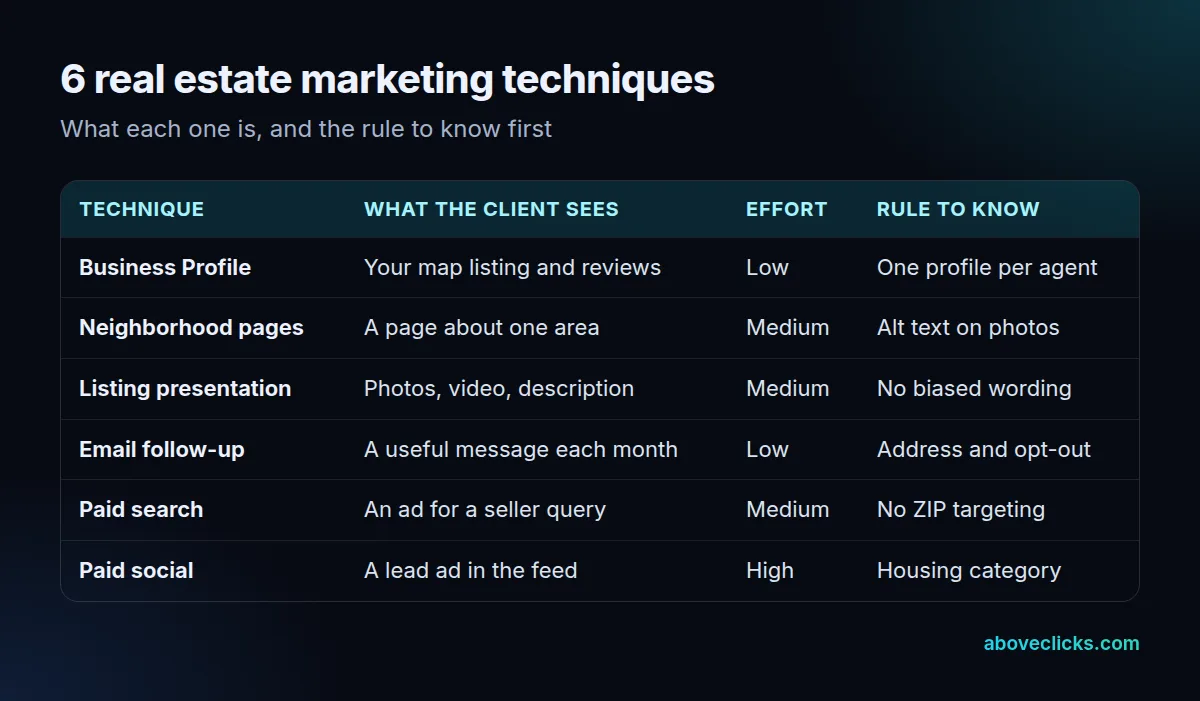
- Business Profile: your Google listing for map searches. Google says local results are mainly based on relevance, distance and popularity, so complete details and real reviews matter more than posting often. With 92% of sellers hiring an agent, your reviews are often what a seller reads before calling. Google’s rules let a public-facing agent have their own profile, but not several profiles for different specialties, and sales associates or lead generation agents for a company aren’t eligible.
- Neighborhood pages: one page per area you work, with local facts, photos and a clear next step. Google uses alt text together with the page content to understand a photo, so describe what the photo shows.
- Listing presentation: how each home is shown, with photos, a short video and a description that sticks to facts. Our video marketing for real estate agents guide goes deeper on that one technique.
- Email follow-up: one useful message a month to past clients and leads, such as a local market note.
- Paid search: ads that appear when someone searches for a seller or buyer query in your area. See Google Ads for realtors for setup.
- Paid social: a lead ad in the feed. It takes the most effort, because the audience tools are limited for housing.
Most real estate marketing ideas you see online are one of these six in a different costume. A “video tour series” is listing presentation, and a “market update newsletter” is email follow-up. Naming the technique lets you check its rule and give it a count, which a loose idea never gets.
Which techniques fit a new agent or an established one?
The first real estate marketing techniques for a new agent are the Business Profile and email follow-up, because both cost hours rather than ad spend. An established agent adds the technique that matches how the business already comes in.
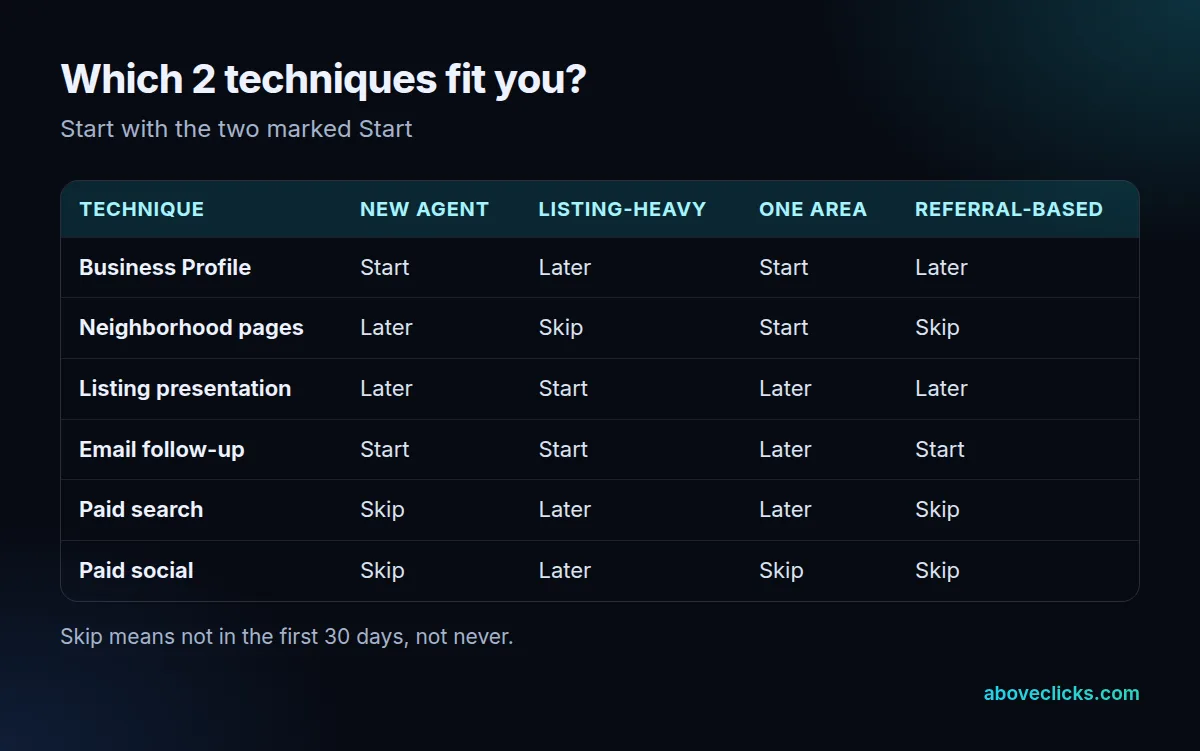
Read the column that matches your situation and start with the two marked Start. These real estate marketing strategies are ordered by what a one-person business can finish, not by how impressive they sound. A listing-heavy agent gets the most from presentation and follow-up on every enquiry. An agent who works one neighborhood gets the most from the profile and an area page, because both speak to people searching that place. A referral-based agent needs, of all the real estate marketing techniques here, mostly a regular, useful message to past clients; a new technique can wait.
Worked example, with an invented agent: a new agent has a 10-hour marketing week. She spends 4 hours on the Business Profile (details, photos, review requests to 5 past contacts), 4 hours on a monthly email and a reply routine, and keeps 2 hours for follow-up calls. She adds nothing else for 30 days. If she’d started with 6 techniques, each would have had under 2 hours a week, which is too little to show a result.
Our guide to marketing for new real estate agents adds the first-year view. This guide stays on which of the real estate marketing techniques to pick.
How do you run each technique as a 30-day test?
Give each of the real estate marketing techniques one count, one start date and one stop rule written before it begins. At day 30, keep it, change it or stop it, based on the sheet and not on how it felt.
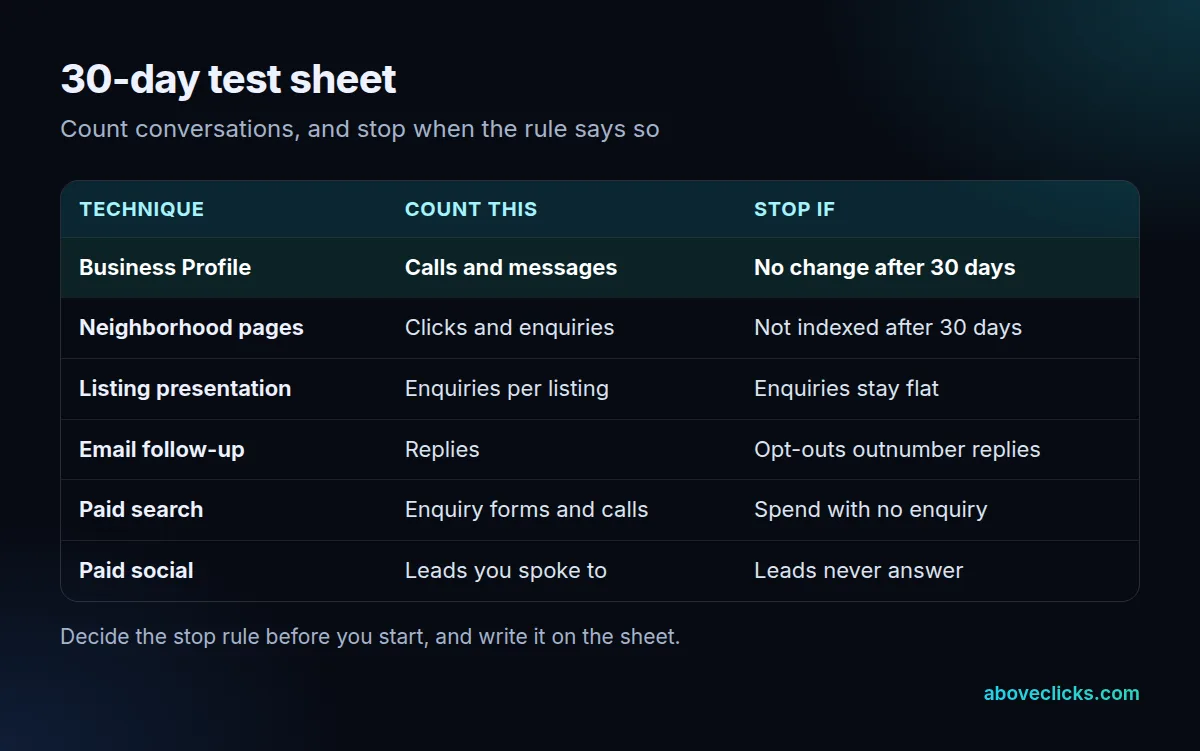
We use the same habit when we review a client’s marketing: one number per channel, taken from conversations held rather than from views. The steps are short:
- Write the start date and the one count for each technique on the sheet.
- Add a “how did you find me?” line to every enquiry reply and write the answer down.
- Check the sheet weekly for 5 minutes, not daily.
- At day 30, mark each technique keep, change or stop.
- Replace a stopped technique with the next one on your scorecard.
Views and likes are easy to count but tell you little. The best real estate marketing tips are the ones you can check against a number. A technique that brings 12 views and 1 conversation beats one that brings 300 views and none.
Which rules apply to real estate marketing techniques?
Real estate marketing techniques that use ads face targeting limits, advertising wording is regulated, and email needs an address and an opt-out. Check each before you spend or send.
Targeting. On Meta, ads for housing use a Special Ad Category. For advertisers in the US, age, gender, ZIP code, exclusion targeting, lookalike audiences and saved audiences are limited or unavailable, and city or pin-drop locations get an expanded radius. On Google, age, gender, marital status and parental status can’t be used to target housing ads in the US and Canada, and neither can ZIP code location.
Wording. US federal rules make it unlawful to publish an advertisement for a dwelling that shows a preference or limit because of race, color, religion, sex, handicap, familial status or national origin. The rule, 24 CFR 100.75, also covers choosing media that keep part of the market from hearing about a home. Describe the property, not the person you imagine buying it. Applied to real estate marketing techniques, that means checking the words in a listing description, a video script and an ad headline before they go out. Read each one aloud and ask whether it describes the home or the buyer.
Email. The FTC’s CAN-SPAM guide requires a valid physical postal address and a clear opt-out in each marketing email. You must honor an opt-out within 10 business days, and each email in breach can carry a penalty of up to $53,088 (as of the FTC’s January 2024 update).
None of this is legal advice. Ask your broker or a lawyer about anything specific.
How much do real estate marketing techniques cost?
Mostly hours first, then ad spend. We don’t quote figures here, because a number without your area and listings attached is a guess.
Count the hours before you count the money. In the worked example above, 4 hours a week for 4 weeks is 16 hours on 2 techniques, and about as much again on follow-up; that is a real cost even with no ad spend. Paid search and paid social add a budget on top, and our real estate marketing service page shows what a managed version covers.
Two things move the cost of real estate marketing techniques most: how many areas you work and how many listings you show. A new agent with 1 area and 2 listings can run a technique on far fewer hours than a team covering 5 areas. The real estate marketing plan guide shows how to turn an income goal into a spending limit.
How do you tell which technique is working?
Compare the counts on your test sheet with what each platform reports. If the two disagree, trust the conversations you actually had.
For anything that sends people to a website, Search Console’s Performance report shows clicks and impressions for the past three months by default, so use the same range each month. Pair it with the call and message counts from your Business Profile and the replies to your email.
The same applies to marketing techniques for real estate agents who work in a team: give each person one technique and one count, so results don’t blur together. Write down one line each month: what you kept, what you changed and why. After 3 months you have 3 lines and a clear idea of which of your real estate marketing tips actually pay. Our industry guides cover more of the same ground. If you would like a second pair of eyes on your site’s setup, the free audit is a PDF report, and our real estate digital marketing page explains how we work with agents and brokerages.