Video marketing for real estate agents works best as a routine, not a string of one-off clips: one 90-minute shoot per listing, cut into a few videos shaped for the places buyers and sellers look. This guide covers the production side, for an agent who films, edits and posts alone.
For which kinds of video to make, and the drone and fair housing rules, read our guide to real estate video marketing. Here we skip the ideas and plan the shoot, the cuts, the captions and the hours.
What is video marketing for real estate agents?
It is planning, filming and publishing short videos of your listings, your area and your own advice so that buyers and sellers find you and contact you. Real estate agent video marketing is a production habit as much as a creative one.
The habit is what most agents lack, and it is why video marketing for real estate agents so often stalls after the first few posts. They film when they feel inspired, then go quiet for a month. A routine fixes that: one 90-minute shoot per listing gives you 4 cuts: a long video, a vertical teaser and 2 room clips, all from one visit.
Real estate agent video marketing is one channel inside a wider plan, not a replacement for it. Our real estate agent marketing plan shows where video sits next to email and referrals, and the real estate marketing service page lists what we set up for agents.
How do you plan one shoot that gives a month of videos?
Time-box it. In video marketing for real estate agents, a listing shoot of 90 minutes, split into five parts, gives you enough footage for a long video, a teaser and several short clips without a second visit.
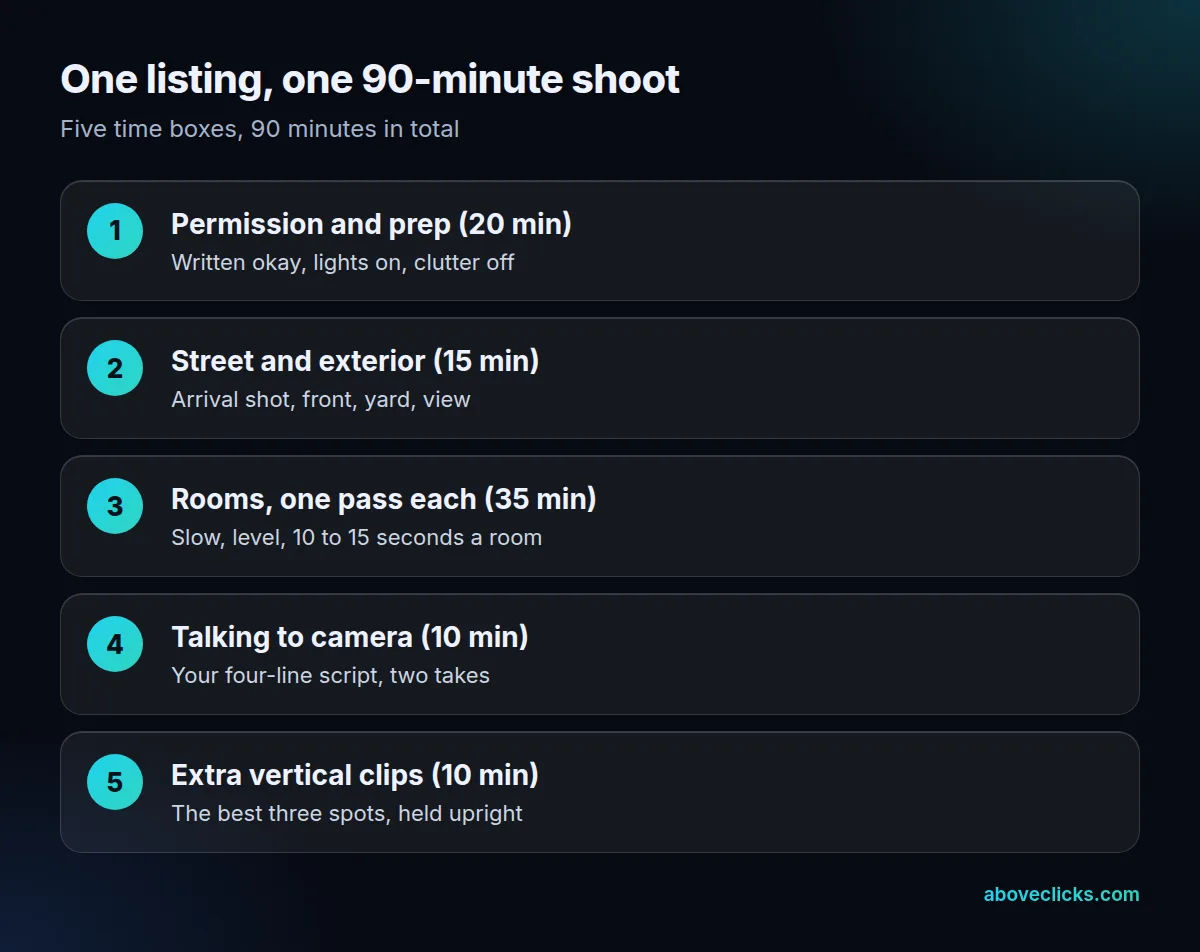
Real estate agent video marketing rewards the agent who repeats a small plan, and the five boxes in the figure are 20, 15, 35, 10 and 10 minutes. They are our own planning method, not a platform rule, so stretch the room pass for a big home and shrink it for a small flat.
Three habits make the boxes work:
- Walk the home first. Ten minutes without the camera tells you which three spots are worth the vertical clips.
- Shoot every room once, slowly, level. A steady 10 to 15 seconds a room is easier to edit than a long wander.
- Film the talking lines last. By then you know the home and the lines come out in two takes.
Light matters more than gear. Open every curtain, turn on every lamp and shoot rooms in daylight where you can; a dim room looks smaller on a phone. Record 10 seconds of room tone, the quiet sound of the empty home, to lay under cuts that have no voice.
Get written permission from the seller before you film, and ask anyone who might appear whether they are happy to.
What shape should each video be for YouTube and Instagram?
For video marketing for real estate agents, shoot two shapes on the day: wide 16:9 for the main video and upright 9:16 for the teaser. Those two cover YouTube, Shorts and Reels, which all document different limits.
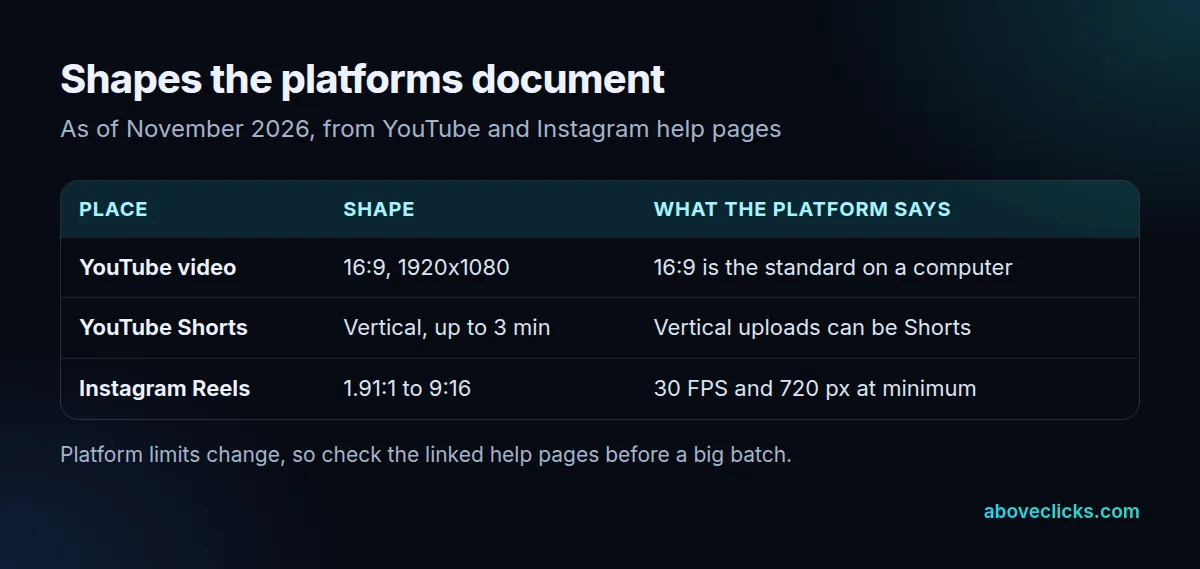
The details behind the table, as of November 2026:
- YouTube video: the standard aspect ratio on a computer is 16:9, and 1080p means 1920×1080, according to YouTube’s resolution guide. The same page says 9:16 videos may get padding on a computer, so don’t add your own bars.
- YouTube Shorts: Shorts can be up to 3 minutes long, and you can upload vertical videos saved on your phone or computer, per YouTube’s Shorts help.
- Instagram Reels: Instagram’s Reels size page accepts ratios between 1.91:1 and 9:16, with at least 30 frames per second and 720 pixels.
A phone shot at 1080p (1920×1080) in both shapes meets every number above. Frame the vertical clips with the subject in the middle third, away from the app buttons that cover the screen edges. Hold the phone upright for them instead of cropping a wide shot later, because a crop throws away the sides of the room.
How do you script a real estate agent video?
Write four lines of about 12 words each for every real estate agent video: where it is, one fact, one detail you noticed, and what to do next. That is 48 words, short enough to learn by heart and say to camera in two takes.
An example for a listing, with invented details: “This is a three-bedroom home on a quiet street. It has a south-facing garden. The kitchen opens straight onto it. Message me to book a viewing.”
Keep these rules for every script in your video marketing for real estate agents routine:
- Say the facts you can show. If you can’t point the camera at it, leave it out.
- Describe the home and the area, not the kind of person who would fit there.
- End with one action, such as a message or a call, never two.
For a market update, the same four lines work: the area, one figure from a named source, what it means for sellers or buyers, and how to ask you more. Name the source on screen and in the caption, so real estate agent video marketing stays honest about its numbers.
How do you add captions and music without trouble?
Add captions to every cut of your video marketing for real estate agents and read them before you publish. Pick music from a licensed library and note any credit it requires. Both take minutes and avoid the two problems that most often sink a good video.
YouTube can create automatic captions, but its own guidance says they may misrepresent speech because of mispronunciations, accents, dialects or background noise, and it asks you to review and edit them. A street name or a price is exactly where a wrong word hurts.
Captions also serve people who can’t hear the audio. The W3C’s explanation of the captions criterion places captions for prerecorded video at Level A, the lowest and most basic conformance level in WCAG 2.2.
Captions and music are the two edits agents skip, and real estate agent video marketing suffers most when they are wrong. For music, YouTube says tracks in its Audio Library are copyright-safe, and that a track under a Creative Commons licence needs credit in the video description. Keep a note of the track name beside each video so you can paste the credit.
How much time does real estate agent video marketing take?
Real estate agent video marketing takes about 12 hours a month in this example: two listings at 5 hours each and one market update at 2 hours. Your numbers will differ, so time your first video and replace ours.
Example (invented, for illustration only): an agent has 2 listings in a month. Each takes a 90-minute shoot, 2.5 hours of editing, 30 minutes to check captions and music, and 30 minutes to publish and share. That is 5 hours a listing, 10 hours for two. One 2-hour market update brings the month to 12 hours.
Track the result with a link of its own. Put a separate link in each video’s description, such as a different form or phone number page, and note the enquiries from each in a simple sheet at the end of the month. After 3 months of video marketing for real estate agents, that sheet shows which cut earns its 5 hours and which does not.
Three ways to cut the total:
- Edit to a template. Reuse the same title card, caption style and music slot.
- Batch the checks. Read captions for all of a day’s cuts in one sitting.
- Drop the weakest cut. A teaser and a walkthrough beat five thin clips.
Video marketing for real estate agents only lasts if the hours are honest. If 12 hours is more than you can spare, shoot one listing a month and keep the market update. Then look at the enquiries that came from each video’s own link, not the view counts, before you add more.
What should you check before you publish?
For video marketing for real estate agents, check six things: permission, captions, music, testimonials, fair housing wording and any drone footage. Run through them on every video, because one slip costs more than the hours saved by skipping the check.
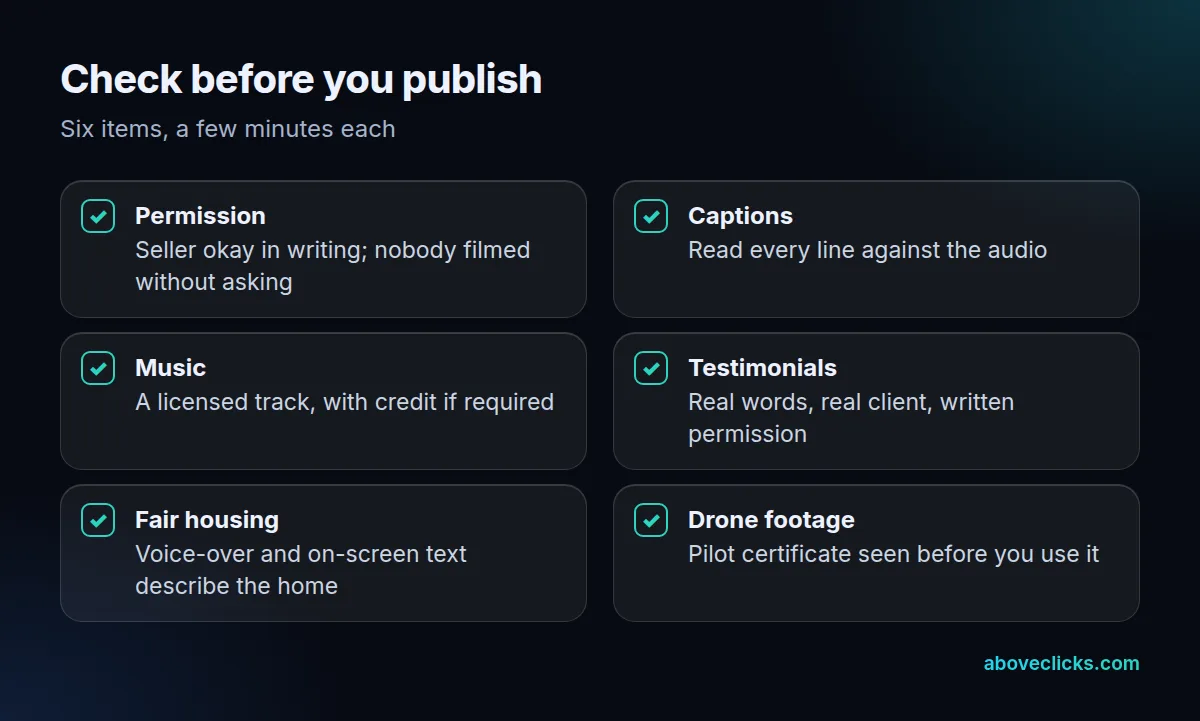
On testimonials, the FTC’s rule on consumer reviews and testimonials has been in effect since October 21, 2024. It covers fake or false testimonials, and the FTC notes that using actors to portray testimonialists could be deceptive under the FTC Act. Use a past client’s own words, with their written permission, and nothing you wrote for them.
Fair housing and drone checks are in our guide to real estate video marketing, which covers the FAA and HUD rules in detail. This is general information, not legal advice; your broker or local board can confirm what applies in your state.
If you want a second pair of eyes on your set-up, our free audit is a place to start, and the real estate digital marketing page lists how we work with agents. More guides are in industries.