Real estate marketing materials are the printed and digital pieces an agent uses to win listings and buyers, from a presentation to a postcard. Give each piece one job, the same required lines and a tracked link.
This guide on real estate marketing materials lists the 8 pieces, the lines each must carry, how to tag them so you can count what each one brings in, and a 30-day test for deciding what to reorder.
What are real estate marketing materials?
Real estate marketing materials are every piece you make to put a property or yourself in front of a buyer or seller. People also call them real estate marketing collateral or advertising materials; Google’s autocomplete returns 10 suggestions for the search, and those terms are among them.
A useful way to sort real estate marketing materials is by where they are read:
- In the hand: a flyer, a brochure or a business card, read for 30 seconds or less.
- From a car: a yard sign, which gets a glance and one phone number or code.
- On a phone: a social post or an email, which needs a clear next tap.
Each place needs a different length and a different next step, so one design does not fit all.
Most agents treat each real estate marketing material as a one-off design job. That is why the second print run looks like the first: nothing was counted. Treat each as a small test with one job and one number instead.
Which real estate marketing materials does an agent need?
Eight cover almost every job: a listing presentation, a property flyer, a just-listed postcard, a brochure, a yard sign, a business card, a social post and an email update. Start with three and add the rest one at a time over the first 30 days.
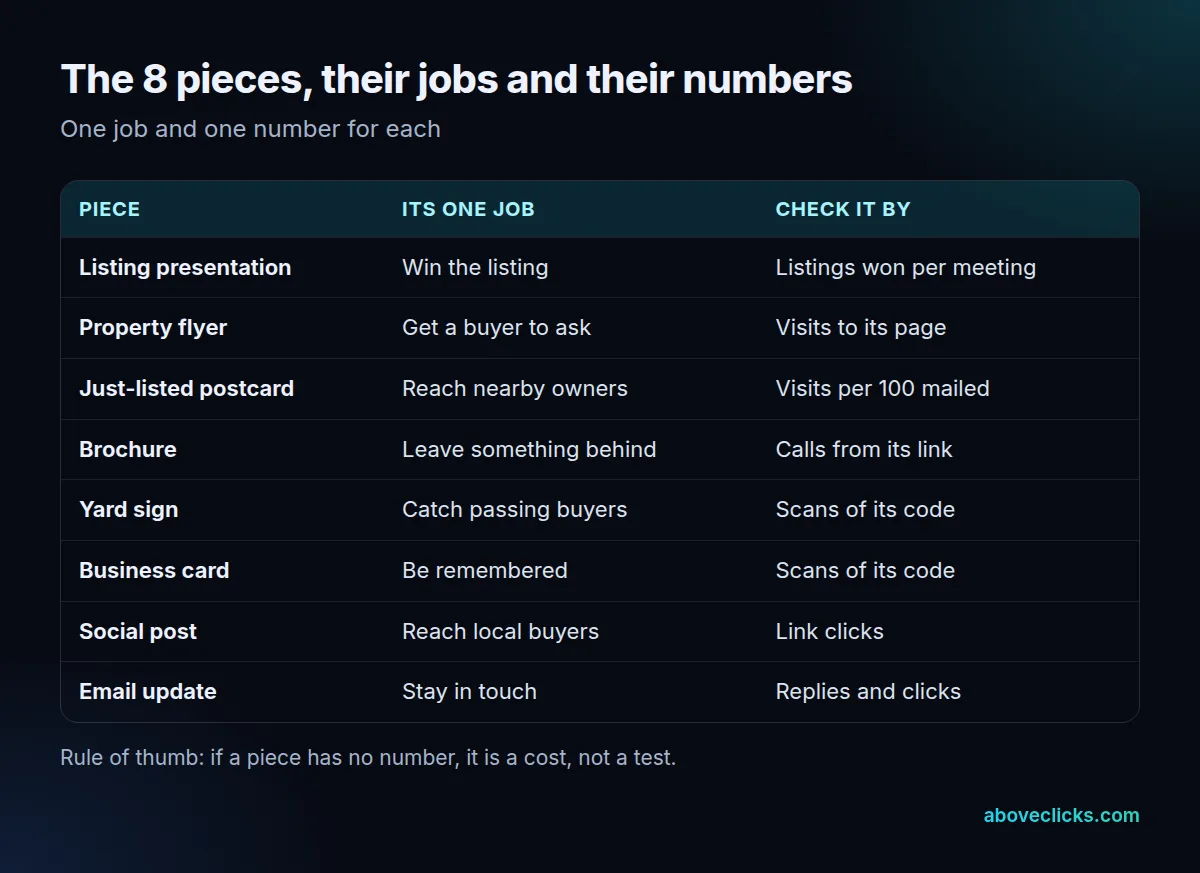
The table gives each piece one job and one number. The first three to make are usually the listing presentation, the flyer and the postcard, because they sit closest to a signed listing or a booked viewing. A business card matters less than its place on the table suggests: it only works if it leads somewhere you can count.
The jobs also tell you what to leave off your real estate marketing materials. A flyer that tries to win a listing and sell a house at once does neither. Put the price story and the neighborhood on the flyer, and keep your track record for the presentation.
If you work with a larger plan, our real estate marketing plan shows how a budget splits across channels. The kit above sits inside that plan as the things you hand over or post, and the agent marketing plan guide covers the weekly hours to make and send them.
What do real estate marketing materials need to carry?
Words and pictures that treat every buyer the same, plus the contact lines the channel requires. The federal text on housing advertising covers printed pieces by name, so a flyer gets the same check as an ad.
The Fair Housing rule at 24 CFR 100.75 makes it unlawful to make, print or publish an advertisement for the sale or rental of a dwelling that shows a preference or limit because of race, color, religion, sex, handicap, familial status or national origin. That is 7 protected groups. The rule lists flyers, brochures, signs, banners, posters and billboards as written notices.
It also covers words, phrases, photographs, illustrations and symbols that suggest a home is or is not available to a group, and the choice of media or locations that keep some people from hearing about it. So the check is about pictures and distribution as well as text.
Three more rules apply once a piece of real estate marketing material goes digital:
- Housing ads on Meta: in the US, Meta’s special ad category page says age, gender, ZIP code, exclusion targeting, lookalike audiences and saved audiences are limited or unavailable for housing ads. That is 6 options, so a social post you boost has a broad audience by design. Google Ads says the same for housing ads in the US and Canada: age, gender, marital status and parental status cannot be used, and neither can ZIP code location targeting.
- Email: the FTC’s CAN-SPAM guide requires a valid postal address and a clear way to opt out. As of November 2026 the guide says to honor an opt-out within 10 business days, keep the opt-out working for 30 days after sending and warns of penalties up to $53,088 per email.
- Your own rules: your state’s real estate commission and your brokerage add rules for what an ad must show. We do not cover them here, so ask your broker before a print run.
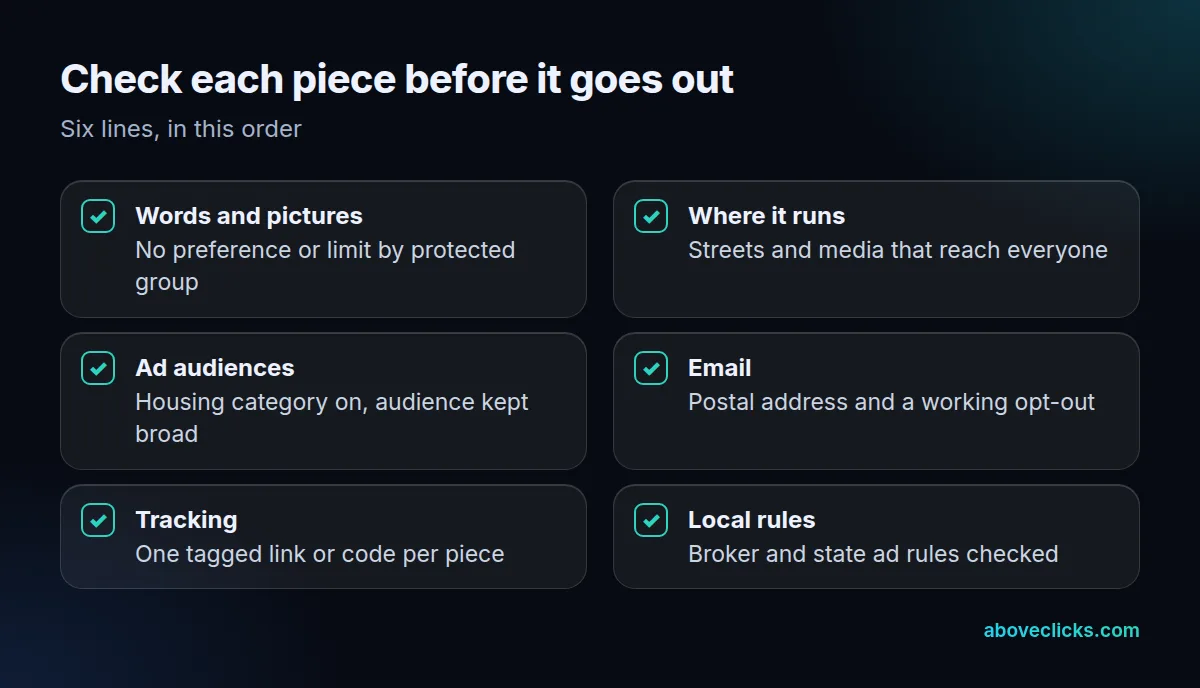
Run the six lines in the order shown for every one of your real estate marketing materials. It takes about 2 minutes per piece, and it is far cheaper than recalling 500 postcards.
How do you track each piece with a link or QR code?
Give each piece its own tagged link or QR code that opens a page made for it. Then your analytics shows which piece of your real estate marketing materials sent each visit, instead of lumping print and digital together as “direct”.
Google Analytics Help says to always use three parameters in a campaign link: utm_source, utm_medium and utm_campaign. It adds that utm_content tells similar links apart and that names are case-sensitive, so you should keep everything in lowercase. Its own example of a source is “billboard”, so offline pieces are a normal use.
A naming sheet for your real estate marketing materials could look like this:
- Source: the piece, such as
postcard,flyeroryardsign. - Medium:
printorqrfor pieces read on paper,emailorsocialfor the others. - Campaign: the listing or the month, such as
elm-street-listing, in lowercase with hyphens. - Content: only when two versions of one piece run at once, such as
blueandredpostcards.
Keep the sheet in one place and copy from it every time. Postcard and postcard count as two sources in reports, which splits the numbers and hides the winner.
Point each link to a page that matches the piece. A flyer for a house should open that house’s page, not your home page. If the page is slow or hard to use on a phone, the scan is wasted; our real estate marketing service page describes how we check landing pages and lead quality and send a PDF report within 2 workdays.
Are free real estate marketing materials worth using?
Yes, as a starting point, if you check three things before you print: the words and pictures, the contact lines and whether the link can be tagged. Free real estate marketing materials from template sites, a brokerage or a lender rarely do any of the three for you, and no free template knows your listing.
- Read it as the publisher. The rule in 24 CFR 100.75 applies to the person who makes or publishes the piece, so a template’s wording is your wording once you hand it out.
- Replace the placeholder lines. Swap in your own contact details, your own link and your broker’s required lines.
- Tag the link. A template with a generic QR code from the maker’s site sends the visit to someone else’s page, or to none you can count.
Free marketing materials for real estate also look like everyone else’s. Keep the layout if it works and change the photos, the headline and the first line to match your listing.
How do you test marketing materials for real estate?
Run each of your real estate marketing materials for 30 days with its own tagged link, then compare visits per 100 pieces handed out, not total visits. A small mailing with a high rate beats a big one with a low rate.
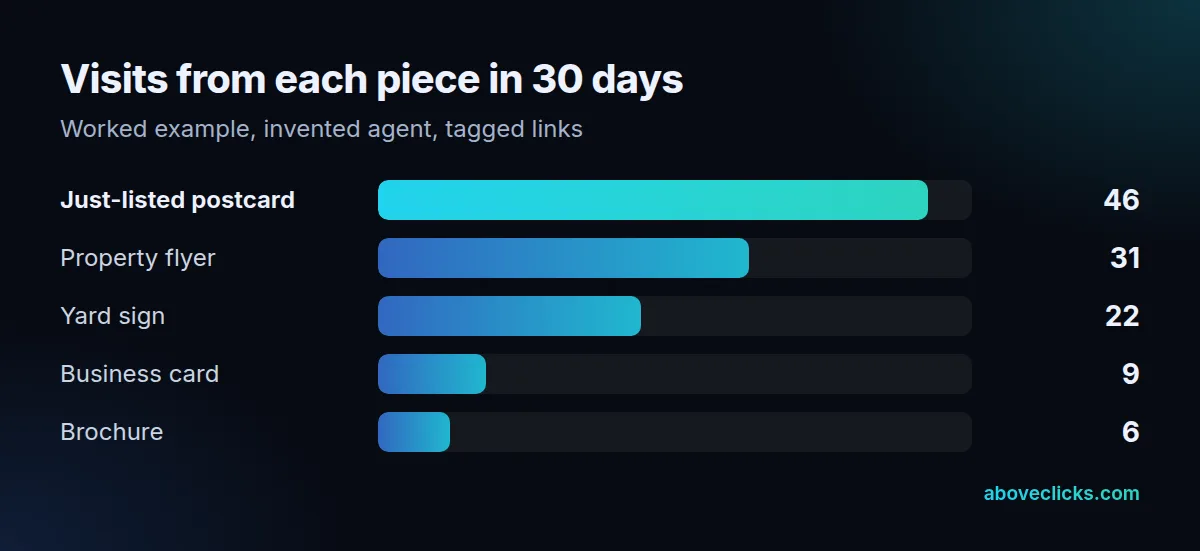
Example: an invented agent mails 400 just-listed postcards, hands out 300 flyers, plants 6 yard signs, gives out 150 business cards and leaves 100 brochures. After 30 days the tagged pages show 46, 31, 22, 9 and 6 visits.
That works out to 11.5 visits per 100 postcards and about 10.3 per 100 flyers. Business cards come to 6.0 per 100 and brochures to 6.0 per 100. The yard signs cannot be compared per 100, so they are judged by scans per sign: 22 across 6 signs is about 3.7 each.
The decision is simple. Reorder the postcard and the flyer, change the card so its code is bigger, and rewrite the brochure’s link. Your numbers will differ; the method for testing real estate marketing materials will not. Repeat it for the next listing, and add the email flows from our email guide once the printed pieces are counted.
Which marketing materials for real estate suit a team or a developer?
A team needs the same eight pieces with one shared naming sheet, and a developer adds a project brochure and a sales-gallery pack. The rules do not change with size: each real estate marketing material still needs the checks and a tag.
A team’s main risk is drift. With 3 to 10 people, each agent makes their own flyer and nobody can compare results. Fix it with one naming sheet, one folder of approved pieces and one person who reads the report each month.
A developer sells many units from one set of pieces, so the page behind each code matters more than the print. Our real estate digital marketing page covers the channels around the printed set. If you want a second opinion on the pages your codes lead to, our free audit is a place to start, and more guides are in industries.