Real estate marketing products are the tools and items an agent or team buys to find, win and keep clients. Choose them by the one job each must do and the number that proves it did it.
This guide sorts real estate marketing products into 6 types, shows the rules that apply to housing ads and email, and gives a worksheet for comparing any product by cost per booked appointment.
What are real estate marketing products?
The tools, services and printed items used to get a property or an agent in front of buyers and sellers. They range from a CRM to listing photos, ads, a website and branded items such as pens or calendars.
Searches show two meanings. Some people want real estate marketing tools, meaning software and services. Others mean real estate promotional products, meaning branded items handed to clients. Both are covered here, because both should be judged the same way: what job does it do, and how will you know?
A product that has no job is just a cost. A product with a job but no number is a guess. The next section gives each type both.
Three questions sort any offer in under 2 minutes:
- What job does it do? Finding leads, answering them, showing a listing or staying visible.
- What number proves it? Appointments booked, replies, views or calls.
- How soon will you know? Every product in this guide gets a 30-day test, described in the last section.
Which types of real estate marketing products are there?
There are 6: lead sources, CRM and follow-up, listing media, website and profile, email and text, and print and promo items. Most agents need about 3 of them in their first year.
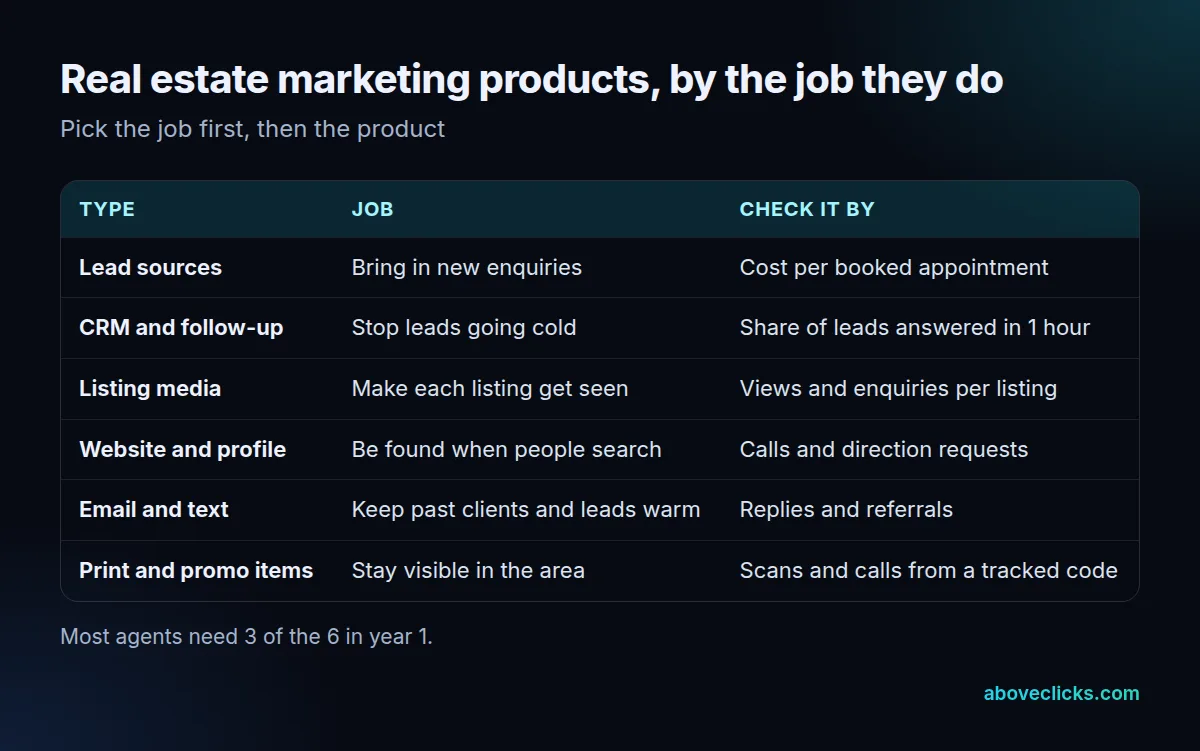
Read the table from the left, one of the 6 real estate marketing products at a time. If your problem is that enquiries arrive and nobody answers within an hour, a new lead source adds cost, while a CRM fixes the actual job. If your problem is that listings get few views, ads will not help until the listing media is good.
Two details about real estate marketing tools in the website and profile type are worth knowing before you hire a developer or an agency to set them up:
- Listing pages: Schema.org has a RealEstateListing type with properties such as the date a listing was posted, so a developer can mark up each listing page in a standard way.
- Business Profile: Google treats real estate agents as individual practitioners, and its Business Profile guidelines say a practitioner shouldn’t have multiple profiles to cover all of their specializations.
Our real estate marketing plan shows how these types fit a 90-day schedule, and the agent marketing plan covers the same for a single agent.
Which rules apply to real estate marketing tools?
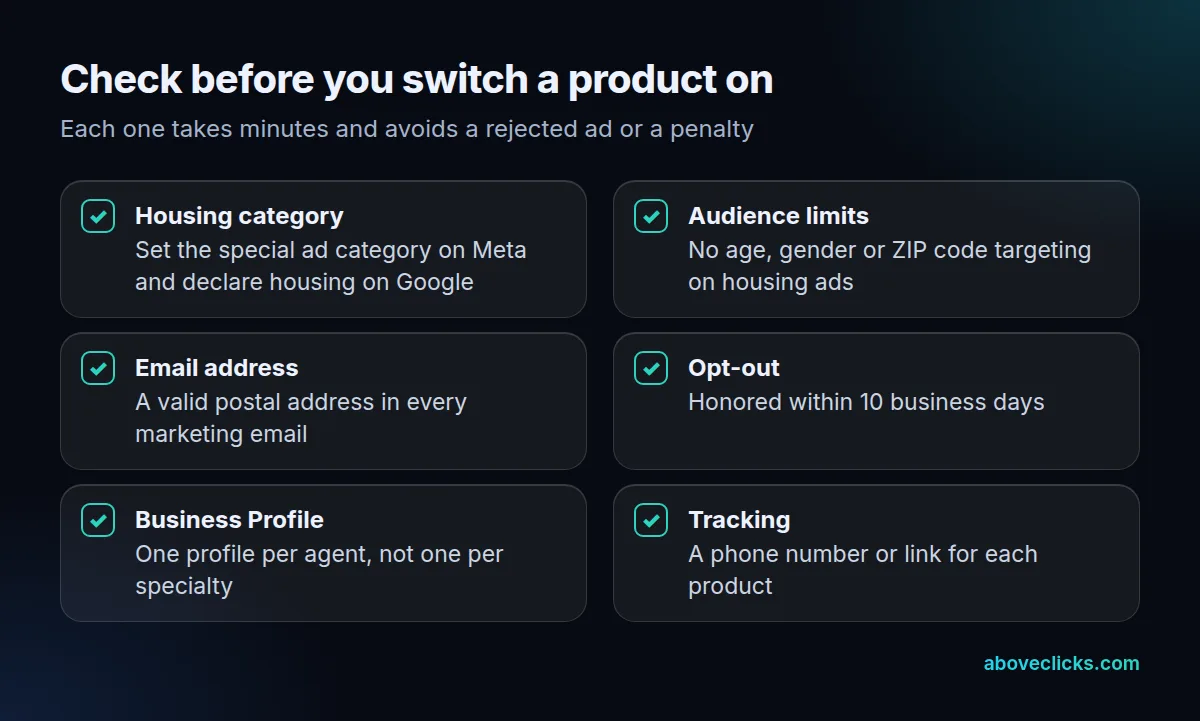
Three sets: Meta’s and Google’s housing-ad limits, the FTC’s email rules and Google’s Business Profile rules. Check them before you turn any ad or email product on.
For ads, Meta asks you to pick a Special Ad Category when a campaign is about housing. Its help page says that for advertisers based in or reaching the US, age, gender, ZIP code, exclusion targeting, lookalike audiences and saved audiences are limited or unavailable, and that city or pin-drop locations get an expanded radius.
Google has a similar rule. Its personalized advertising policy says age, gender, marital status and parental status can’t be used to target housing ads in the United States and Canada, and ZIP code location targeting can’t be used either.
So a vendor of real estate marketing tools that promises “ZIP code lookalike audiences for buyers aged 35 to 55” is describing something housing ads can’t use. Ask any vendor how its ad product handles the housing category.
For email, the FTC’s CAN-SPAM guide says each message must include a valid physical postal address and a clear way to opt out. Opt-out requests must be honored within 10 business days, and the opt-out method must keep working for at least 30 days after you send. As of November 2026, the guide lists penalties of up to $53,088 for each separate email in violation. Our real estate email marketing guide covers the flows themselves.
How do you compare real estate marketing products?
Divide what the product cost in a month by the appointments it booked. Cost per lead looks cheaper, but a lead that never answers the phone is not an appointment.
Here is a worked example for an invented agent who tried three products in the same month with the same hours of follow-up. The numbers are made up to show the method.
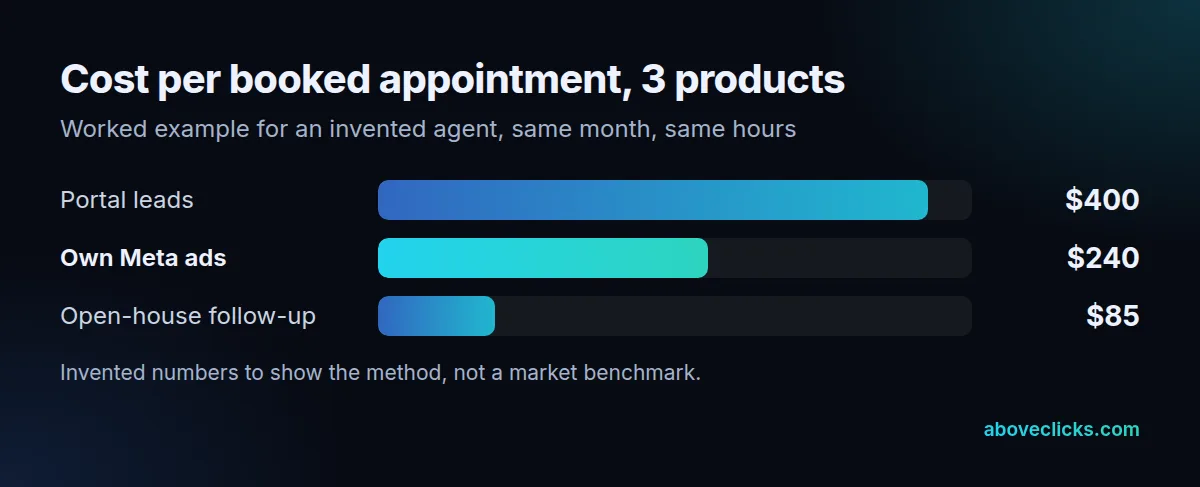
In the example, portal leads cost $400 per booked appointment, own Meta ads $240 and open-house follow-up $85. The open-house line looks best, but it has the smallest volume: 4 appointments in the month. Own ads booked 10. A cheap source that cannot grow is a good supplement and a poor base. When you review real estate marketing products each quarter, ask which ones are still earning their place on the sheet.
Use the same sheet for every one of your real estate marketing products, with 4 columns:
- Spend: the product’s cost for the month, plus the hours you spent on it.
- Leads: every enquiry it produced.
- Replies: leads who answered a call or message.
- Appointments: meetings or viewings that were actually booked.
Divide spend by appointments. If a product books none, you have your answer after one month, not after a year of auto-renewal.
Add one more column if you can: the number of those appointments that turned into a signed listing or an offer. It takes months to fill in, but it is the figure that shows whether a cheap source brings serious clients or only curious ones.
Which products suit an agent, a team or a developer?
A solo agent needs the fewest, a team needs shared follow-up, and a developer needs volume and a project site. The right set of real estate marketing products grows with the number of people who touch a lead.
| Who you are | Start with | Add later |
|---|---|---|
| Solo agent, about 20 sales a year | CRM, Business Profile, one lead source | Email to past clients |
| Team of 3 to 10 | Shared CRM with lead routing, listing media | Own ads with a landing page |
| Developer or project seller | Project website, lead ads with a booking step | Email nurture, print for site visits |
The pattern is that every row begins with the follow-up product, not with the flashiest of the real estate marketing products on offer. Leads that reach a person within the hour are worth more than extra leads that wait a day, so the first purchase is usually the one that fixes response time, not the one that adds volume.
If you market a single large project, the lead source matters most, and so does what happens after the click. Our real estate digital marketing page explains how we judge lead quality for projects and listings. For more tools and ideas by channel, browse the industry guides.
What do real estate marketing products cost?
It depends on the type, the market and how much you buy, so we don’t quote market ranges here. Vendor lists change often, and the only fair comparison is your own cost per appointment.
What can be said is how the cost behaves:
- Per lead or per month: portals and lead services usually charge one of these. A per-lead charge rises with volume; a flat monthly charge rewards a product that works.
- Per listing: photo, video and tour services charge for each property, so the cost follows your listing count.
- Per item: real estate promotional products cost less per piece as the order grows, but a box of 500 you cannot track is a larger risk than 50 with a QR code.
Our own starting prices for campaigns that use these real estate marketing products are on the real estate marketing service page, and the industry page shows how we judge lead quality. For the budget as a share of income, see the marketing plan guide.
How do you test a product before you commit?
Run it for 30 days with a tracking number or link of its own, then keep, change or drop it. A product that cannot be tracked cannot be judged.
Use this test for every new product, including printed items:
- Day 0: write down the job, the number and the target, such as 5 booked appointments in 30 days.
- Day 1: give the product its own phone number, link or QR code.
- Day 15: check leads and replies. If there are none, fix the setup before spending more.
- Day 30: work out cost per appointment from the 4-column sheet.
- Day 31: keep it, change one thing and test for 30 more days, or drop it.
Write the result down even when it is bad, for real estate promotional products as much as for software. A year later, a list of 6 tests with their cost per appointment is the best guide you have to what your market responds to, and it makes the next vendor conversation short.
The same method works for an agency or a freelancer. If you want a second opinion on which products your current setup is missing, our free audit reviews your ads, profile and lead handling and sends a PDF report.