PPC for real estate means paying Google when someone clicks your ad on a property search, such as a home valuation or a buyer’s agent in your city. Judge it by cost per closing, not cost per click.
This guide to PPC for real estate covers Google search ads for agents, investors and small developers. It shows which campaigns to start with, which keywords to buy and block, the targeting limits on housing ads, how to count leads and calls, and a budget worked back from your commission. It ends with a 30-day launch plan.
What is PPC for real estate?
Pay-per-click advertising where you bid on property searches and pay only when someone clicks. It is the paid half of search engine marketing for real estate; the free half is ranking in the normal results.
Google keeps the two apart. Its Help Center says ads appear under an “Ads” label, and ordinary search results aren’t part of its advertising programs (as of November 2026). So paying for ads does not change your organic position, and the two need separate plans.
People search for this in at least 2 ways. Google Autocomplete (November 2026) suggests “ppc for real estate agents” and “ppc for real estate investors”, and those two buy very different searches. Agents bid on sellers and buyers in a city. Investors bid on owners who want a fast sale.
Throughout this guide to real estate PPC marketing we use one invented example: an agent with a $9,000 average commission. The rates are made up to show the arithmetic, so replace them with your own.
Which PPC campaigns should a real estate business start with?
Two or three separate Search campaigns, one per kind of customer, each with its own budget and landing page. Real estate PPC marketing goes wrong quickly when buyers, sellers and investors share one budget.
- Sellers: valuation and listing searches. These usually have the highest value per lead.
- Buyers: searches for a buyer’s agent or an area. Expect more clicks and less commission per lead.
- Investors: cash-offer and fast-sale searches, kept apart because the page, the offer and the rules differ.
Add a small brand campaign only after these pay back. Real estate search engine marketing rewards patience here: three focused campaigns beat ten thin ones, because each one needs enough clicks to show a pattern. A lead form asset can also capture people without a page visit. Google says you can add lead forms to Search and Performance Max campaigns, stores leads for 60 days and lets you download only the last 30 days as a CSV (as of November 2026). Export weekly or connect the form to your CRM, or leads quietly disappear.
For PPC for real estate, send each campaign to its own page that matches the search: a valuation page for valuation searches, not your home page. Our Google Ads service page shows how we structure accounts, and the same rule holds for any real estate PPC marketing: one intent, one page, one budget line.
Which keywords should real estate PPC campaigns target?
Start with high-intent searches that name a service and a place, buy them in exact and phrase match, and block the rest with negative keywords. Add broader searches only when the first tier pays back.
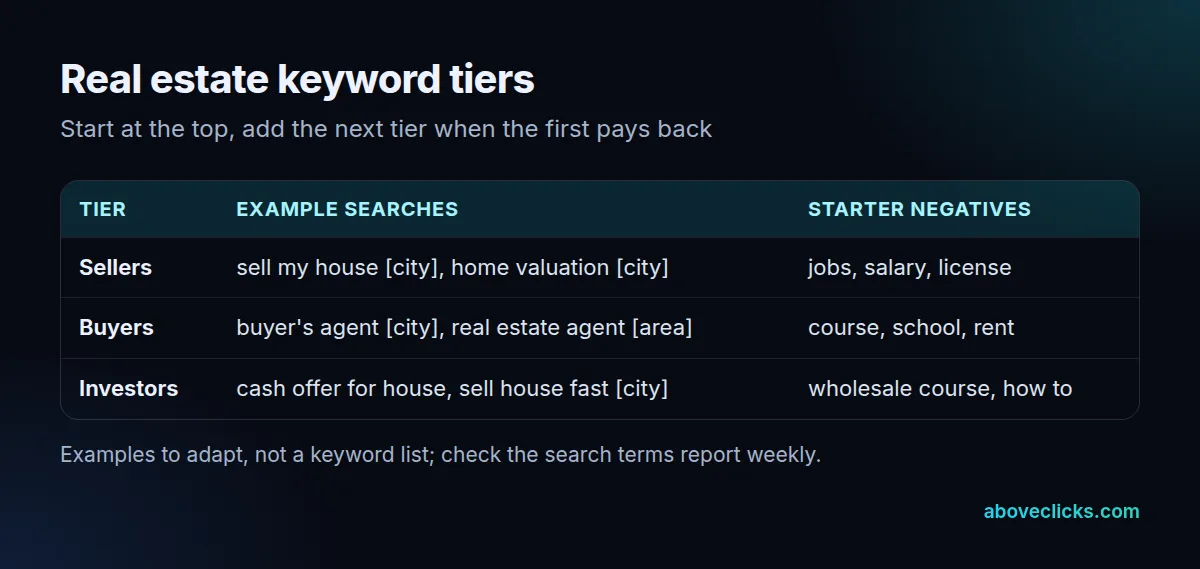
Google’s match types guide says exact match gives you the most steering over who sees your ad but reaches fewer searches than phrase or broad match. It also says to use Smart Bidding with broad match. With a small budget, exact and phrase match keep the spend on the searches you chose.
Negative keywords do the other half of the job. Google notes they don’t match close variants, so you need to add singular and plural forms yourself. Read the search terms report every week and add the irrelevant ones, such as job, salary and course searches.
Keep an eye on Quality Score too. It runs from 1 to 10 at keyword level and is a diagnostic, not an input to the ad auction, based on expected clickthrough rate, ad relevance and landing page experience. Use the three component ratings to decide whether to fix the ad or the page, rather than chasing a 10. For example, a keyword with a below-average landing page rating usually needs a clearer page, not a higher bid.
Which targeting rules apply to real estate ads?
In the US and Canada, Google restricts personalization for Housing ads: you can’t target by age, gender, parental status, marital status or ZIP code. Check Google’s policy against your own ad before you build audiences.
As of November 2026, Google’s personalized advertising policy lists Housing among its “access to opportunities” categories for the United States and Canada. It says the 4 demographics above and ZIP codes can’t be used there, while city targeting and radius targeting are allowed. A radius must be at least 1 km around the location.
We haven’t verified how Google classifies a particular agent or listing ad, so read the policy text for your ads and ask Google Ads support if you’re unsure. In practice, target the city or a radius around the neighborhood you serve, and don’t build lists by age or family status.
Example: an agent with a $1,500 test budget serves 2 neighborhoods. She creates 2 radius areas of a few kilometers each, one per neighborhood, instead of 6 ZIP codes. She can then compare the cost per lead of each area and move the budget to the cheaper one. This keeps PPC for real estate inside the policy and still gives you local control.
Our real estate agent marketing plan covers the wider ad, email and profile rules for agents.
How do you track leads and calls from PPC for real estate?
Count form submissions and qualifying phone calls as conversions, then import what happens offline, such as booked appointments and signed listing agreements. Clicks alone say nothing about lead quality.
Property buyers and sellers often call. Google lists 5 ways to track phone call conversions, and for calls from ads you set a minimum call length, so only calls that last that long count. A 60-second minimum, for example, filters out wrong numbers and hang-ups.
Most real estate deals close offline, so real estate search engine marketing needs results fed back. Google recommends enhanced conversions for leads for sales that happen offline, and says that from 15 June 2026 offline conversion imports move to the Data Manager API (as of November 2026). If someone else sets up your tracking, ask which method they use.
Set the order of value, from a form fill, to a booked appointment, to a signed agreement. Smart Bidding strategies such as Target CPA and Maximize conversions optimize for the conversions you give them, so they need the right ones. Our tracking and analytics service covers this setup.
How much should you budget for PPC for real estate?
Work backwards from the commission: pick the share you would spend to win one closing, divide by the clicks it takes, and the result is the highest click cost you can afford. Don’t start from a round monthly number.
Example, with invented rates: the agent earns $9,000 per closing. One closing needs 5 appointments (a 20% close rate). Five appointments need 25 leads (20% of leads book). Twenty-five leads need 500 clicks (5% of visitors enquire). So one closing takes 500 clicks.
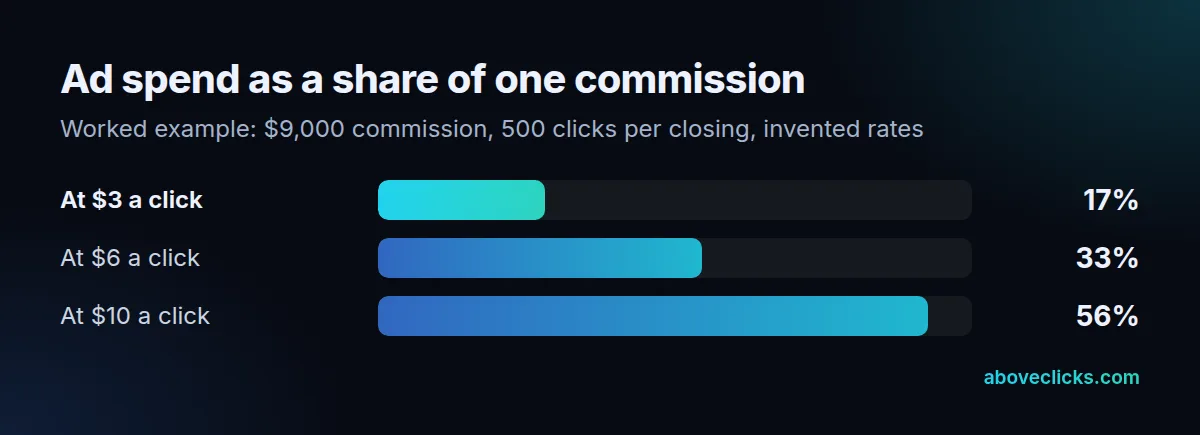
If the agent will spend 20% of the commission, that is $1,800 per closing. Divide by 500 clicks and the highest affordable click cost is $3.60. At $6 a click the same funnel spends 33% of the commission; at $10 it spends 56%.
If your account shows clicks costing more than your limit, the PPC for real estate plan does not work yet, so fix the funnel or the keywords, not just the bid. A better landing page that lifts enquiries from 5% to 7.5% cuts the clicks needed from 500 to about 333. Our PPC pricing guide covers click costs and management fees, and the real estate marketing plan shows how to split a total budget across channels.
What does the first 30 days of real estate PPC look like?
Tracking first, a small launch, then weekly search-term cleaning, ad and page fixes, and a review on day 30. The aim is a real cost per appointment, not a quick win. A month is short, so treat the review as the first data point of PPC for real estate in your market, and plan a second 30-day round with what you learned.
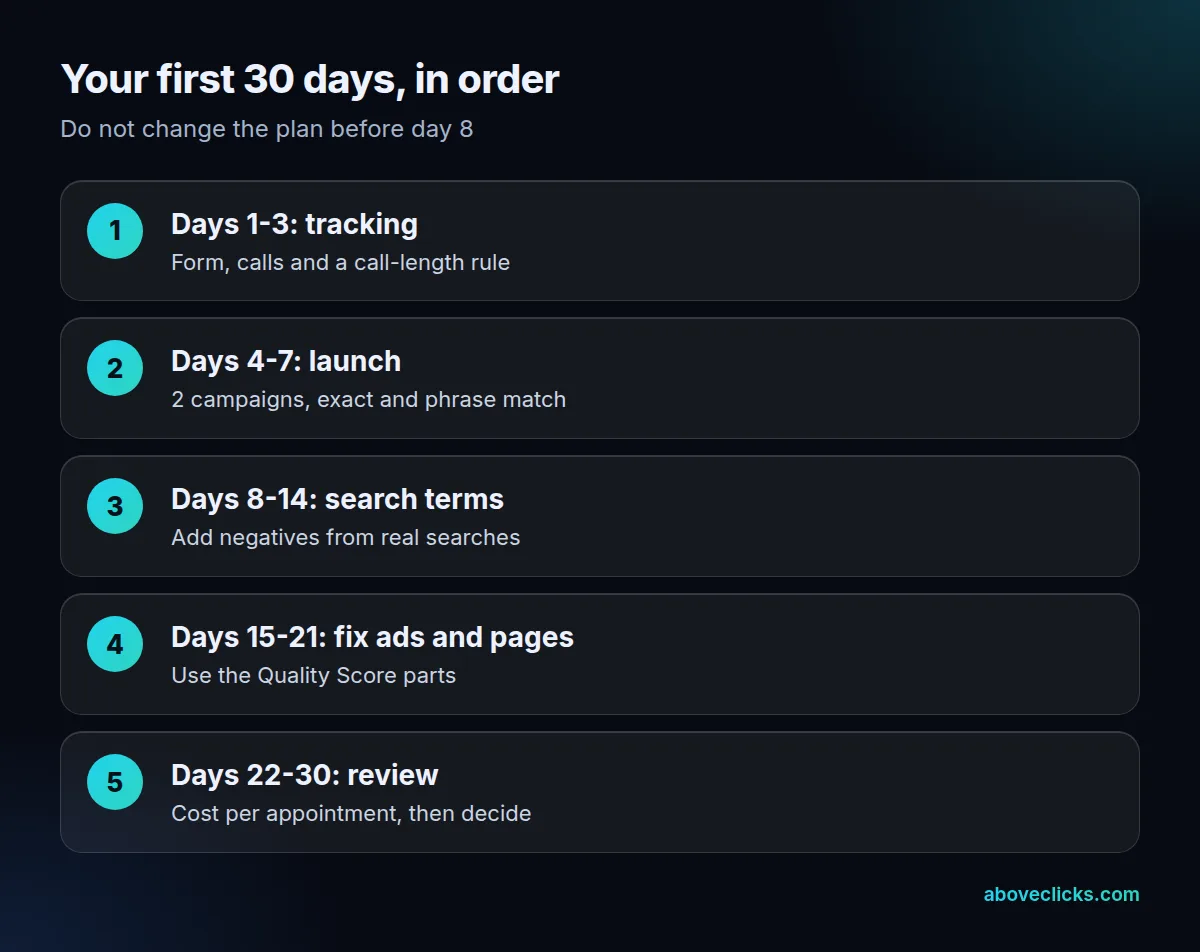
- Days 1-3: create the conversion actions for your form and calls, and set the minimum call length.
- Days 4-7: launch 2 campaigns in exact and phrase match, each with its own page.
- Days 8-14: read the search terms report and add negatives. Don’t change bids much yet; the data is too thin.
- Days 15-21: use the Quality Score component ratings to rewrite weak ads and fix slow or vague pages.
- Days 22-30: compare cost per lead and cost per appointment with your limit from the budget section, then keep, cut or expand.
Search engine marketing for real estate punishes impatience in both directions, so don’t scale on day 10 and don’t quit on day 20. The costly mistakes are the ones this plan avoids: one campaign for everyone, no negatives, ZIP targeting on housing ads, and judging success by form fills alone.
If you’d rather have it built and run for you, see our real estate marketing service and the real estate digital marketing page. For a read-only check of an account you already run, our free audit covers the same points. More guides are in Google Ads.