ActiveCampaign vs Klaviyo comes down to what your marketing runs on. ActiveCampaign is marketing automation with a CRM and sales pipeline, built for many kinds of business; Klaviyo is built around store data such as orders, browsing and checkouts.
This guide compares the 5 differences that decide it, works through what each plan lets you send, and covers how to move from one to the other without emailing anyone twice.
What is the difference between ActiveCampaign and Klaviyo?
The data each one is built around. ActiveCampaign centres on contacts, deals and automations for any business; Klaviyo centres on what shoppers do in your store.
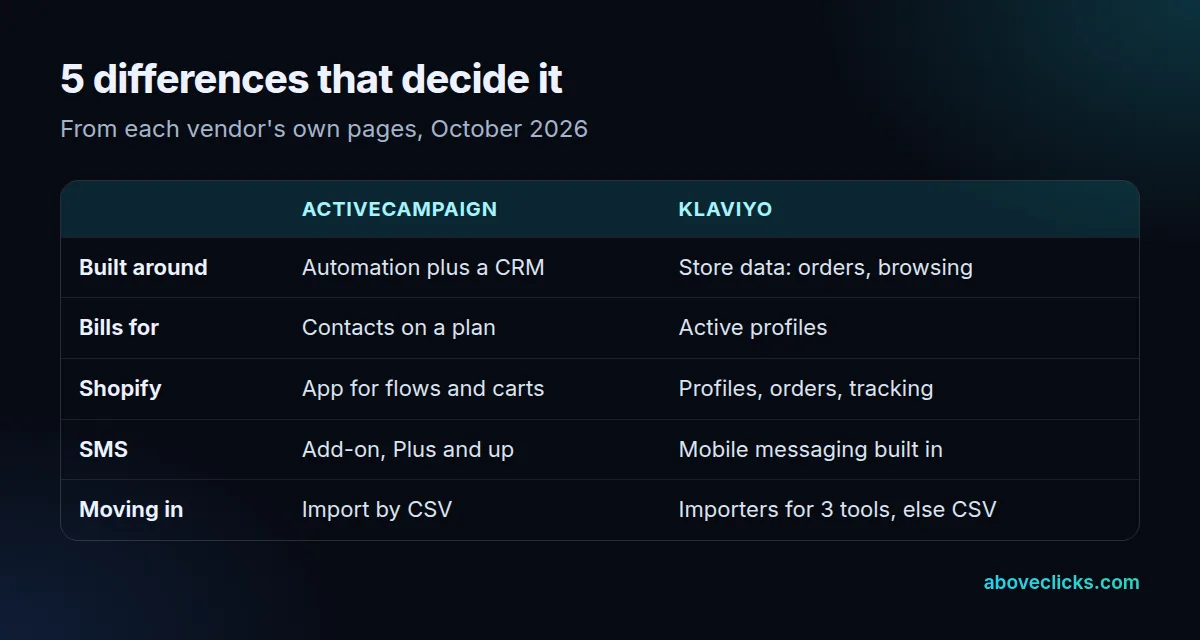
That difference shows up everywhere else. In ActiveCampaign, a contact moves through automations and, with the CRM add-on, through a sales pipeline. In Klaviyo, a profile fills up with orders, product views and checkouts from the store, and flows fire on those events. Read the ActiveCampaign vs Klaviyo choice as a question about your business: does a person close the sale, or does the checkout?
Automation depth differs too. On ActiveCampaign’s plans, as of October 2026, Starter allows 5 actions per automation, while Plus and above allow unlimited actions. A cart sequence with a wait, a condition and 3 emails already uses most of that, so a store comparing ActiveCampaign vs Klaviyo on the cheapest plan should check whether its flows fit.
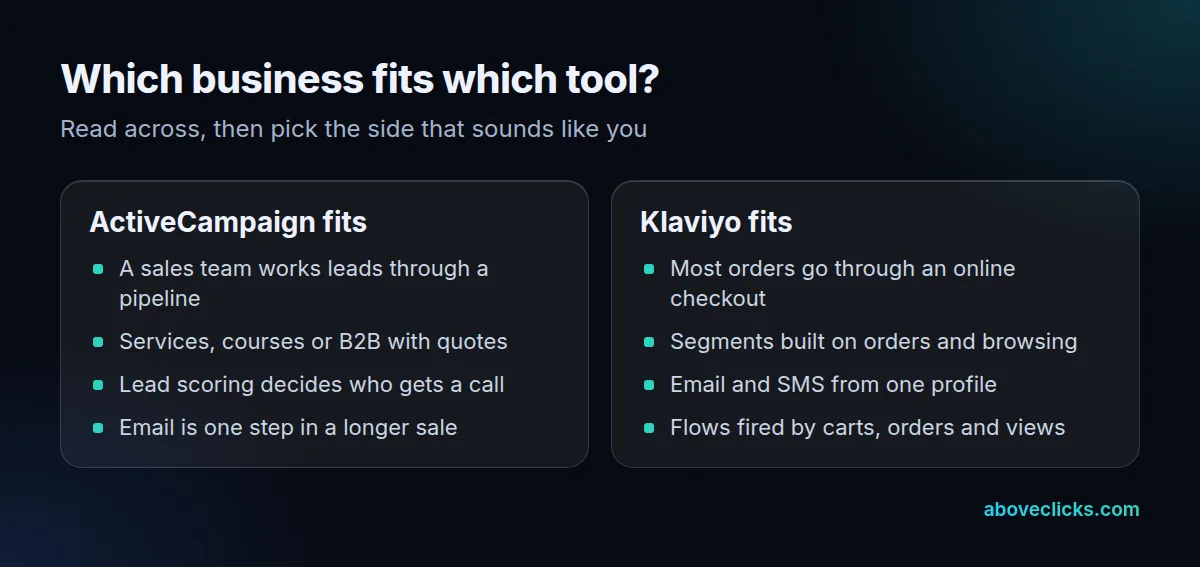
Neither is the “better” tool in general. A course creator with a sales call in the middle of the funnel and a fashion store with 3,000 orders a month need different things. The 5 rows in the table are the ones that change the decision; the sections below take them one at a time.
Is ActiveCampaign a CRM?
Partly. It’s marketing automation first, with a CRM add-on that adds sales pipelines, lead scoring and sales engagement on the Plus plan and above.
On the ActiveCampaign pricing page, as of October 2026, the Enhanced CRM is an add-on available on Plus, Pro and Enterprise, not on Starter. Lead scoring comes with its Pipelines add-on and win probability with the Sales Engagement add-on. Starter and Plus include 1 user, Pro 3 users and Enterprise 5 users, which matters once sales and marketing both work in the account.
Klaviyo isn’t a sales CRM. It keeps one profile per customer with their orders, browsing and messages, which is what a store needs, but it has no deal stages or sales pipeline. In the Klaviyo vs ActiveCampaign question, that’s the clearest split: if your team needs to track deals, ActiveCampaign does it in one place; if no one sells by phone or email, the CRM is cost you won’t use.
How does ActiveCampaign pricing compare with Klaviyo pricing?
They count different things. ActiveCampaign prices plans by contacts and caps sends at a multiple of them; Klaviyo prices by active profiles, which can include people who never opted in to marketing.
On its pricing page, as of October 2026, ActiveCampaign quotes each plan for 1,000 contacts billed yearly: Starter at $15, Plus at $49, Pro at $79 and Enterprise at $145 a month, with the price rising as the list grows. Email sends are capped at 10 times the contact limit on Starter and Plus, 12 times on Pro and 15 times on Enterprise.
Klaviyo pricing works by active profile. Its help article on active profiles says, as of October 2026, that any profile you can email counts, including people who gave an email at checkout without consenting to marketing, and that the Shopify integration can add both kinds. Suppressed profiles don’t count. The free plan covers 250 active profiles and 500 email sends a month, and a plan that doesn’t cover your active profiles can be upgraded automatically.
ActiveCampaign vs Klaviyo: a worked send example
Send limits matter as much as the plan price. Take an invented store with 1,000 contacts that emails 3 times a week: 1,000 × 3 × 52 ÷ 12 is about 13,000 sends a month.
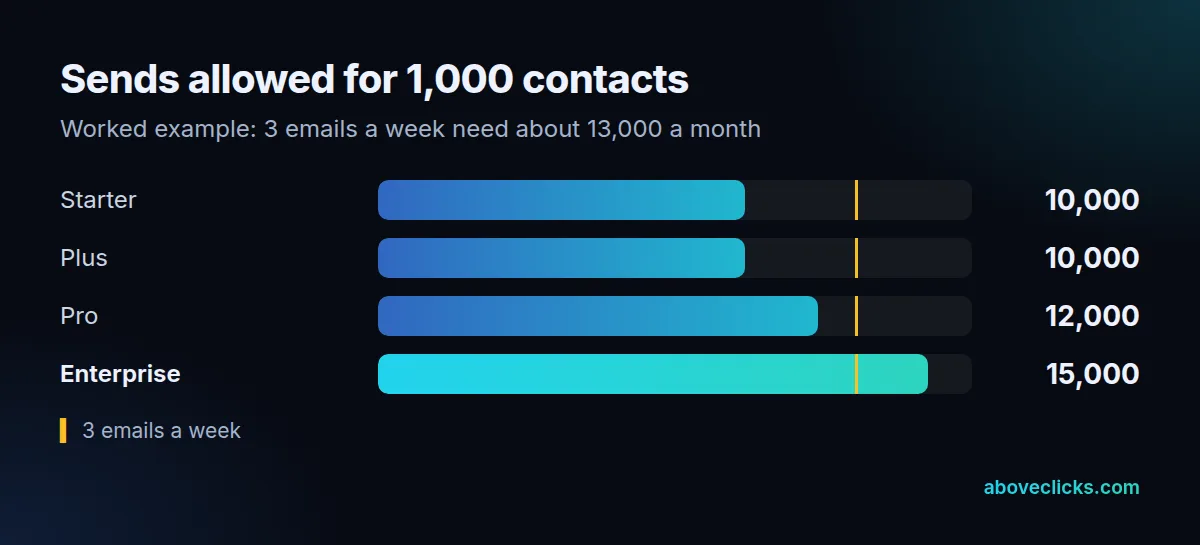
On ActiveCampaign, that store outgrows the 10,000-send cap of Starter and Plus, and Pro’s 12,000 is still short, as of October 2026 on its plan cards. Only Enterprise covers it without adding contacts. On Klaviyo, the same question becomes how many of those 1,000 count as active profiles, and whether inactive ones can be suppressed first. That’s the trap in ActiveCampaign vs Klaviyo comparisons that stop at the plan price: the cheapest plan may not send what your calendar needs. Run both numbers on your own list before comparing plan prices; our guide to email marketing cost covers the rest of the bill.
How does each one connect to Shopify?
Both have a Shopify integration, but Klaviyo’s brings in more store data. ActiveCampaign’s app powers welcome, post-purchase, review and abandoned cart automations; Klaviyo syncs profiles, orders, onsite browsing and sign-up forms.
The ActiveCampaign Shopify app is built by ActiveCampaign and covers welcome emails, upsells and cross-sells after a purchase, review requests and abandoned cart alerts, as of October 2026. For a store whose email is mostly those flows, an ActiveCampaign Shopify setup is enough, and it keeps marketing and any sales pipeline in one account.
Klaviyo’s Shopify integration brings customer profiles and order data into Klaviyo, adds onsite tracking and sign-up forms, and can sync email and SMS consent from Shopify checkout. Onsite tracking for visitors in the EU, EEA, UK and Switzerland depends on their consent under your Shopify privacy settings. In Klaviyo vs ActiveCampaign terms, that depth is what lets a Klaviyo segment say “bought twice, viewed this collection in the last 30 days, never used a discount”.
Which one is better for SMS?
Klaviyo, for most stores, because email and SMS share one profile and one set of flows. In ActiveCampaign, SMS is a paid add-on that isn’t available on Starter.
Klaviyo’s free plan includes $5 of mobile messages a month, as of October 2026, according to Klaviyo’s pricing page, and paid mobile messaging is billed alongside the email plan. A cart flow can send an email, wait, then send a text, with consent kept per channel on the same profile.
ActiveCampaign sells SMS as an add-on on Plus and above, as of October 2026 on its pricing page, with two-way messaging and automated SMS in the add-on. If text messages are a small part of your plan, that’s fine; if SMS is half your revenue from flows, compare the add-on’s cost with Klaviyo’s mobile messaging on your real volume. SMS is where ActiveCampaign vs Klaviyo differs most for stores that text as often as they email.
Is Klaviyo better than ActiveCampaign for ecommerce?
For most online stores, yes, because its segments and flows run on order and browsing data. ActiveCampaign is the better fit when a sales team, not the checkout, closes most deals.
Store data also helps with list hygiene. Klaviyo’s active profile guide suggests excluding profiles that received at least 5 emails without an open or click in 90 days from regular campaigns, and suppressing long-inactive ones so they stop counting toward the plan (as of October 2026). Our Klaviyo email marketing work starts from those segments. If neither tool fits, our guides to Klaviyo alternatives and Omnisend vs Klaviyo compare other options.
How do you move from ActiveCampaign to Klaviyo?
By CSV, in a set order: suppressions first, then subscribers, then flows rebuilt, then the old tool disconnected from Shopify. Klaviyo has no built-in importer for ActiveCampaign.
Klaviyo’s migration article lists built-in importers for 3 tools, Mailchimp, Campaign Monitor and Salesforce Marketing Cloud, as of October 2026; everything else comes in by CSV. Keep unsubscribes and bounces out of the subscriber file and import them as suppressions before the first send. Klaviyo’s Shopify guide adds one more trap: disconnect the previous email tool from Shopify before connecting Klaviyo, or double opt-in emails can go to your existing list.
In practice, the move runs in 7 steps:
- Export contacts from ActiveCampaign as a CSV, with the consent fields.
- Export unsubscribes and bounces in a separate file.
- Import that file into Klaviyo as suppressions before anything else.
- Import subscribers, mapping each consent column, and only mark consent people actually gave.
- Rebuild the welcome, cart and post-purchase flows in Klaviyo, switched off.
- Disconnect the ActiveCampaign Shopify app, then connect Klaviyo to the store.
- Switch Klaviyo’s flows on and ActiveCampaign’s off on the same day, then mail the most engaged first.
The order matters more than the speed. Suppressions first means no one who opted out hears from you again; flows off until cut-over means no one gets two cart emails. Your Klaviyo pricing follows from the import too: whoever you bring in as a subscriber becomes an active profile on the first day.
Your sending reputation moves with you, not with the platform. Google’s sender guidelines require senders of more than 5,000 messages a day to Gmail to authenticate with SPF, DKIM and DMARC, keep the spam rate below 0.3% and support one-click unsubscribe, as of October 2026.
Our Klaviyo migration starts with a free audit: a PDF plan within 2 workdays of what moves, what gets rebuilt and what to leave behind, then the move and a cut-over with nothing sent twice. Whichever side of ActiveCampaign vs Klaviyo you choose, more comparisons are in buying guides.