SEO audit cost is set by how much work the audit takes, not by a market rate. The size of the site, its filters, its JavaScript, the number of page templates, the scope and whether fixes are included decide most of the price.
This guide explains each of those factors, what an audit should hand you, how long it takes, when a free audit is enough, and how to judge a quote before you pay for one.
What is an SEO audit?
A structured review of how search engines crawl, index and show your site, ending in a ranked list of fixes. Google describes its purpose plainly: an estimate of improvement, and of the work involved.
In its guide to hiring an SEO, Google says an SEO audit should give you realistic estimates of improvement and an estimate of the work involved, and that you should grant only read access to Search Console at that stage, not write access (as of October 2026). The same page warns that no one can promise a #1 ranking.
That definition is useful when you look at SEO audit cost, because it tells you what you’re paying for: a diagnosis and a work estimate. An audit that only lists problems, without saying which matter or how long they take to fix, is half the job.
Here’s a worked example. Say the audit of a store with 2,500 products comes back with 400 crawler warnings in no order. You now know what’s wrong in 400 places, but not which 10 to fix first, or whether a developer needs 2 days or 2 weeks for them. The SEO audit cost was spent, and the decision is still yours to make. Ask for the ranking and the effort before you pay.
What does an SEO audit include?
Indexing, crawling, speed, structured data and site health, checked against your own pages and turned into a fix list. Content and links are often a separate, larger part.
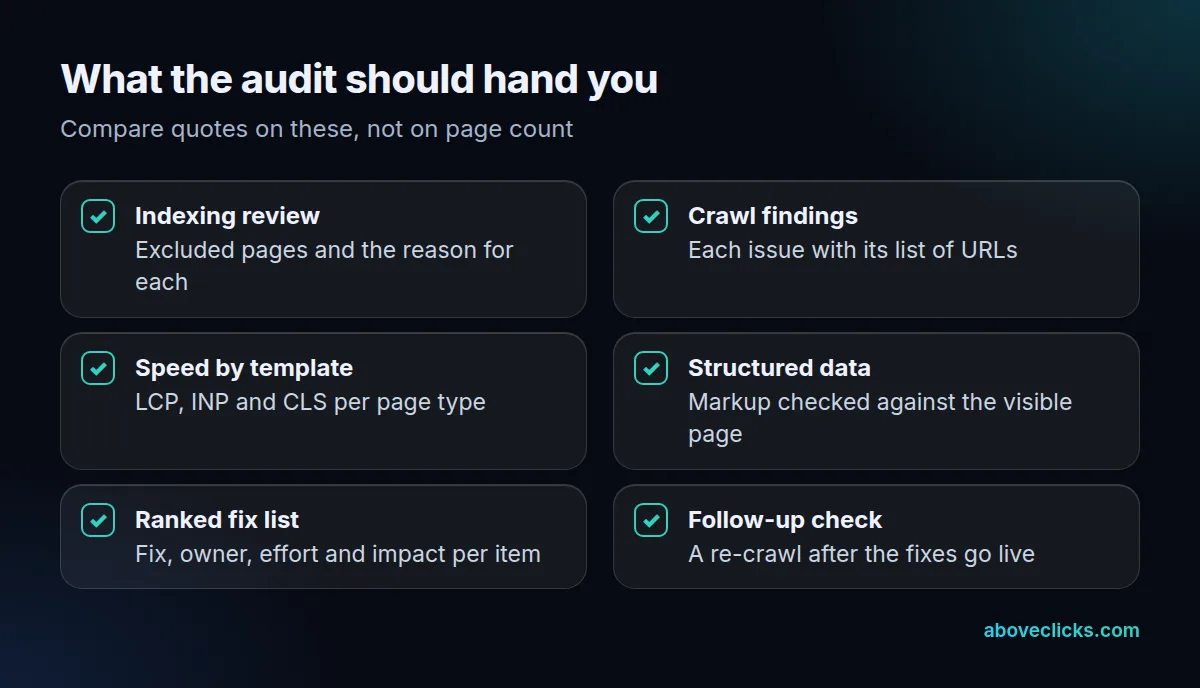
Our own technical SEO audit runs 25 checks in 5 groups of 5: crawling, indexing, speed, structured data and site health. For stores, our ecommerce SEO audit starts with the Page indexing report in Search Console, then crawls the store and reads server logs where the host allows it. Every finding ends up in one list with the fix, who should do it, the effort and the impact.
Speed should be reported per template, not as one score. Google’s Core Web Vitals treat a page as good when Largest Contentful Paint is within 2.5 seconds, Interaction to Next Paint is 200 milliseconds or less and Cumulative Layout Shift is 0.1 or less, as of October 2026. A product template and a blog template often fail for different reasons, so the audit should say which.
What drives SEO audit cost?
Six things: site size, filters and parameters, JavaScript, the number of templates, the scope and whether fixes are included. Each adds hours, and hours are what an auditor prices.
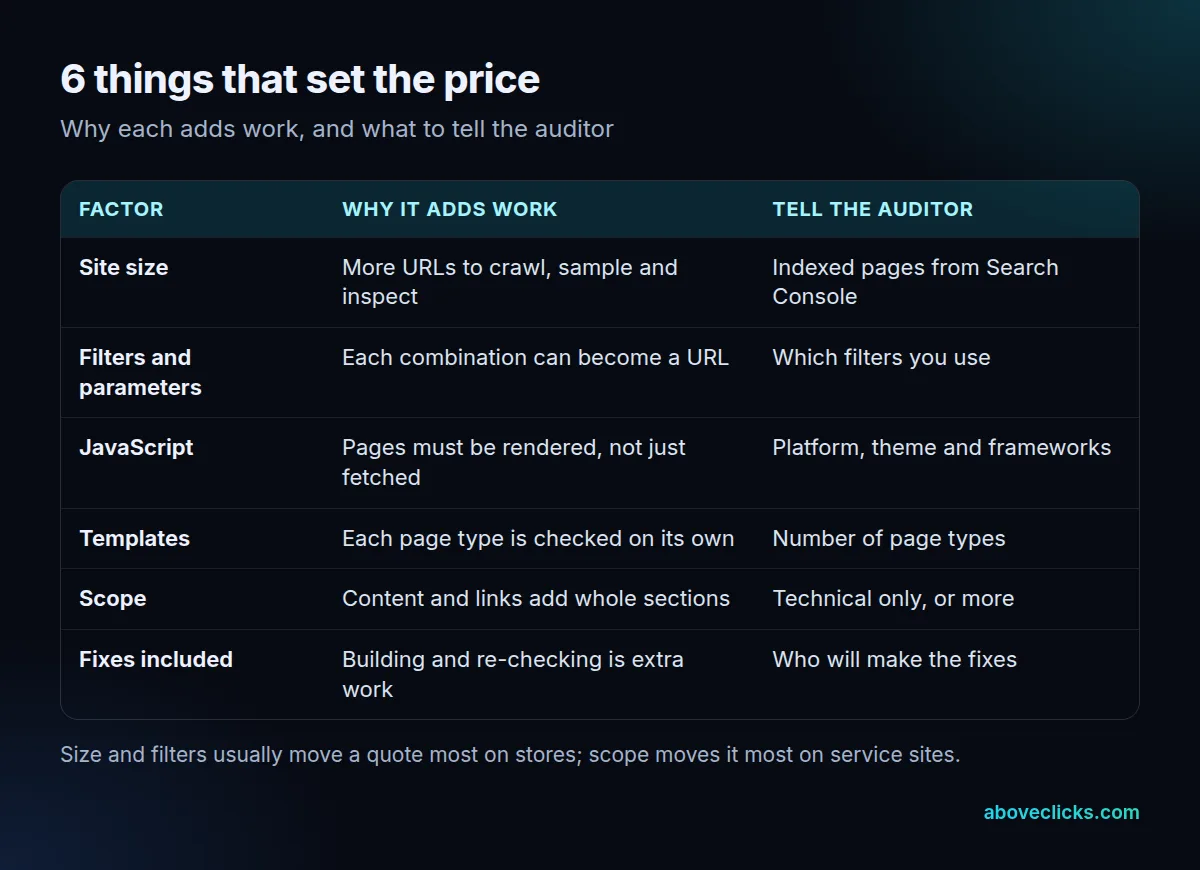
Site size. Size changes the method, not just the hours. Google’s crawl budget guide says crawl budget mainly matters for sites with 1 million or more unique pages that change about weekly, or 10,000 or more pages that change daily, as of October 2026. Large sites also need split sitemaps, because one sitemap is limited to 50,000 URLs or 50MB. Checking each file adds to the technical SEO audit cost, and so does reading server logs, which only makes sense once a site has thousands of URLs.
Filters and parameters. Google’s page on faceted navigation warns that filter URLs built on parameters can create infinite URL spaces, which leads to overcrawling and slower discovery of new pages (as of October 2026). Here’s a worked example with an invented store: 3 filters with 8 colours, 6 sizes and 5 price bands give 9 × 7 × 6 = 378 possible URLs per collection, counting “not set”. Across 40 collections, that’s 15,120 URLs to map before the audit can say which should rank.
JavaScript. Google processes JavaScript apps in 3 phases: crawling, rendering and indexing. When content or links only appear after rendering, the auditor has to crawl twice and compare, which raises the website SEO audit cost on headless and app-heavy builds.
Templates, scope and fixes. Each page type is checked on its own, so 12 templates take longer than 4. Adding content review and a backlink review can double the scope. A technical SEO audit cost covers how pages are crawled and shown; content review reads every key page for intent and gaps, and a link review checks who links to you and why. Ask which of the 3 a quote includes, because SEO audit pricing often bundles them under one name. Fixes, a re-crawl and a check in Search Console afterwards are a project of their own.
How much does a website SEO audit cost?
As much as the hours the 6 factors add up to. We don’t print market ranges in this guide, because the same label covers a 10-minute tool export and a month of manual work.
Ranges hide the scope. A low SEO audit price can buy a crawler report with a logo on it; a high one can include fixes and a re-check. Compare what each quote hands you, not the number on top. Two quotes with the same SEO audit price can differ several times over in hours, and the hours are what you’re buying. For what agencies, freelancers and consultants charge overall, with survey figures, see our SEO price guide.
SEO audit cost for 3 kinds of site
A worked example with 3 invented sites shows how the same factors change the work:
| Site | What takes the time | What you can skip |
|---|---|---|
| 40-page service site | Content, local signals, contact pages | Crawl budget and log files |
| 2,500-product store | Filters, duplicate product URLs, product markup | A full content audit of every product |
| 60,000-URL catalogue | Logs, sitemap split, template sampling | Inspecting every URL by hand |
The service site’s SEO audit cost goes mostly into content and local pages, while the catalogue’s goes into data handling: logs, sitemaps and samples per template. The store sits in between, with filters taking the biggest share. If a quote spends its hours on the column you can skip, ask why. A website SEO audit cost that looks high for a 40-page site usually means the scope includes content rewrites, which is worth knowing before you compare it with a technical-only quote.
Our own SEO audit pricing is set out as starting price cards on the technical SEO audit and ecommerce SEO audit pages. The first audit is free, and the exact price of the fixes is fixed in writing after you’ve read it.
How long does an SEO audit take?
Days for a small or mid-sized site, weeks for a large one. We send ours as a PDF within 2 workdays of getting access; very large sites need more time, mostly because of data limits.
The limits are real. Search Console’s API usage limits allow 2,000 URL inspections per site per day and 600 per minute, as of October 2026. Inspecting every URL one by one, at that rate, takes this long:
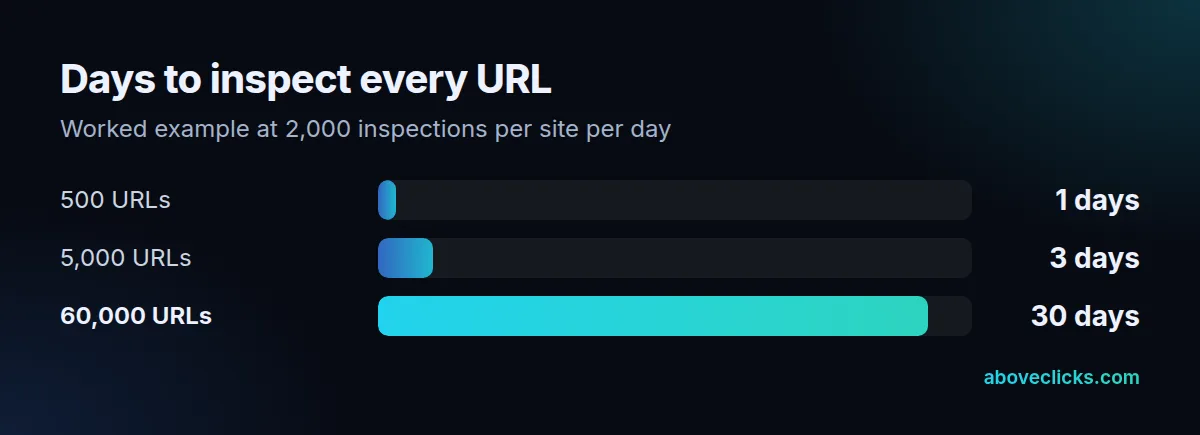
That’s why audits of big sites sample each template instead of inspecting every URL, and why a quote that promises a URL-by-URL check of a 60,000-page site in 2 days deserves a question. Sampling isn’t a shortcut; done per template, it finds the same pattern problems faster. Ask the auditor how they’ll cover your size, and you’ll understand most of the SEO audit cost before the quote arrives.
After our report, the steps on our store audit and technical audit pages run to a timetable, as of October 2026: a video meeting if you want one, a written plan within 2 workdays of it, fixes made on a copy of the theme, and a check in Search Console 28 days after the fixes go live. The plan carries a fixed price, and none of the work is billed until you’ve seen it.
Is a free SEO audit worth it?
Yes, if a person checks the findings against your own pages. A free tool export lists warnings; it can’t rank them by the traffic they cost or say how to fix them on your platform.
Google’s advice on hiring an SEO says to check any third-party tool’s audit against official Google guidance before you make large changes. Tool data also has gaps. The Page indexing report shows at most 1,000 example URLs for each issue, so on a large site the auditor needs a crawl as well to see the full list.
A good free audit is a sample of the paid work: real findings on your pages, in order. Ours covers the 25 checks and is free with no obligation; you can ask for it through the free audit form. If a free audit is only a sales call, you’ve lost an hour, not money, but you haven’t learned what the paid SEO audit cost would buy either.
How do you judge an SEO audit price?
By what it hands you and how it was built: a ranked fix list with owners and effort, checked by a person, using read-only access. A cheap list of 400 warnings is worth less than a higher SEO audit price for that.
Ask each auditor these questions before you compare the SEO audit cost of 2 quotes:
- What exactly will I get: a ranked fix list, URL lists, effort per item?
- Will a person check every finding, or is it a tool export?
- How will you cover my site’s size, filters and templates?
- Do you need only read access to Search Console? Google says read access is enough at this stage.
- Are fixes included, and if not, who can make them?
- How will we know the fixes worked, and when?
Treat 2 answers as warning signs. A promise of a #1 ranking, which Google’s own guide says no one can give. And a request for full write access before the work is agreed.
The next step after an audit is usually a fix project or monthly work. Our monthly SEO package guide shows what a year of that looks like, and how to choose an SEO company covers the wider hiring decision. More guides are in buying guides. To see what your own site needs before you pay anything, start with our free technical SEO audit: 25 checks and a PDF report within 2 workdays.