Amazon PPC management cost is two bills: the clicks you pay Amazon for, and the fee you pay whoever runs the account. The fee is worth paying only when the profit the ads leave, after their own cost, is bigger than it.
This guide covers what Amazon charges, the 4 ways agencies price the work, how to find your break-even ACOS, how to work out the most a fee can be worth, and what to ask before you sign.
What is Amazon PPC management?
The weekly work of running Amazon’s pay-per-click ads: choosing keywords and products to target, setting bids and budgets, cutting wasted searches and reporting what the ads earned.
On Amazon, the main format is Sponsored Products: cost-per-click ads for single listings, targeted by keywords you pick or by Amazon’s automatic targeting, as of October 2026. The ads only show when the item is in stock. Someone has to decide which searches deserve money, which should be blocked and how much each click is worth. That someone is what the management part of the Amazon PPC management cost pays for.
Our own Amazon PPC management starts with the numbers before any bid changes: break-even ACOS worked out product by product, branded and generic searches split apart, then search terms harvested every week. The report puts ad sales next to total sales (TACoS), so you can see whether the ads grow the business or only buy orders you’d have had anyway. The audit comes within 2 workdays and the first monthly report after 30 days.
How much does Amazon PPC cost?
Whatever the clicks cost at auction, up to the budget you set. Amazon charges no monthly fee for Sponsored Products, so the Amazon PPC cost on Amazon’s side is your click spend and nothing else.
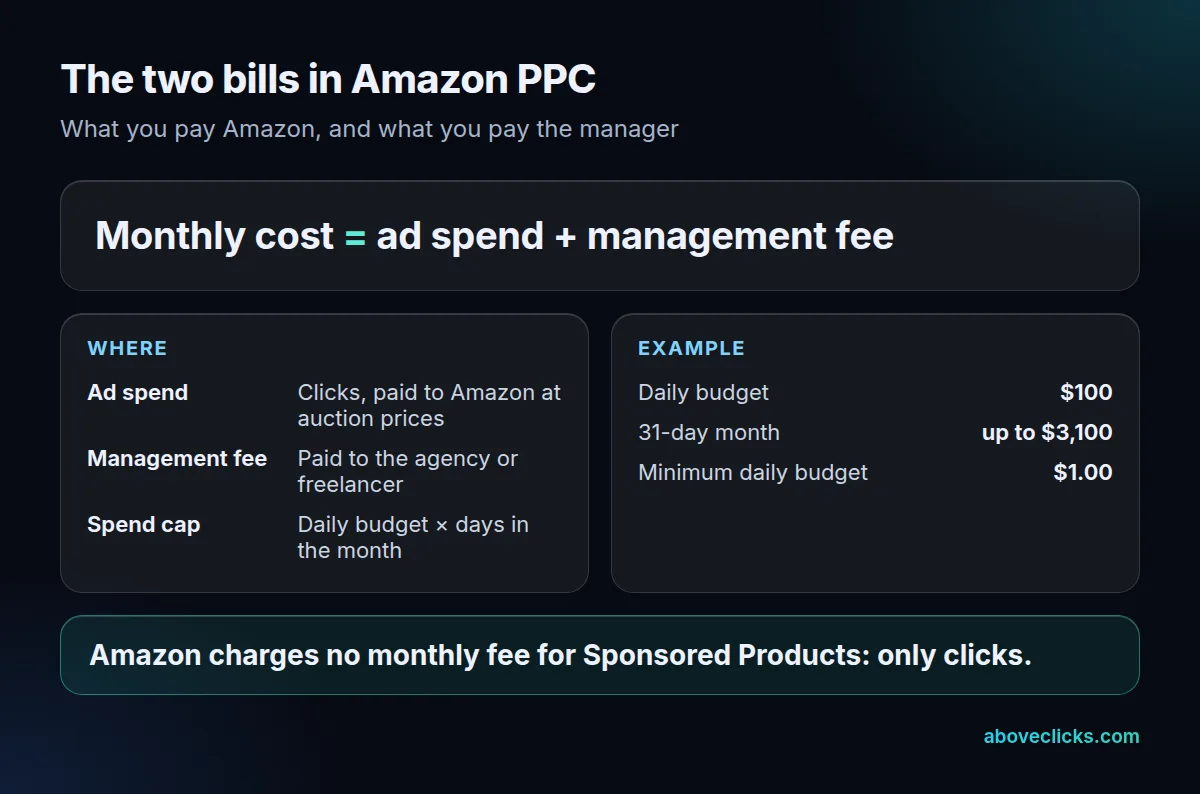
Amazon’s advertising FAQ explains the rules, as of October 2026. You set a bid, the most you’ll pay for a click, and an auction decides when your ad shows. The daily budget is an amount you’re willing to spend over a calendar month: a $100 daily budget can buy up to $3,100 of clicks in a 31-day month. Budgets aren’t paced through the day, so a small one can run out in minutes. The minimum daily budget for Sponsored Products is $1.00, so an Amazon PPC cost can start very small.
The click itself has no fixed rate. Amazon’s cost-per-click guide says the final CPC comes from an auction based on your adjusted bid plus other factors, and that busier keywords and more visible placements cost more (as of October 2026). That’s why any Amazon pay per click cost figure you read in a round-up is a starting point, not your number: it depends on your category, your listings and the searches you bid on.
How is Amazon PPC agency pricing set?
In 1 of 4 ways: a flat monthly fee, a share of ad spend, a share of ad-attributed sales, or a hybrid of a base fee plus a share. Each one rewards something different, and each changes the Amazon PPC management cost as your spend grows.
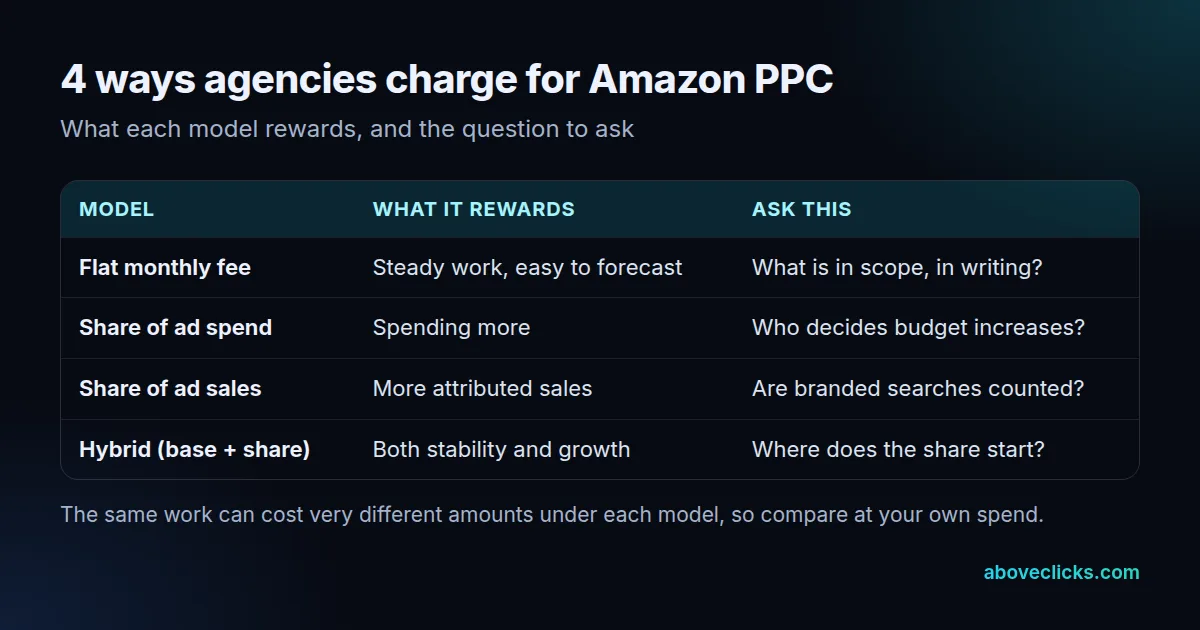
Flat monthly fee. Easy to forecast, and it doesn’t rise when you spend more. The risk is scope: ask what’s included in writing, and what is billed on top (new campaigns, Sponsored Brands creative, listing work).
Share of ad spend. The commonest model in PPC generally, and the simplest to calculate. Its weak point is the incentive: the manager earns more when you spend more, so agree who decides budget increases and on what evidence.
Share of ad sales. Ties the fee to results, which sounds fair. Ask which sales count. Ads on your own brand name report strong sales that you’d often have had anyway, so a fee on those is a fee on orders the agency didn’t win.
Here’s a worked example of how the models drift apart. On $3,000 of monthly spend, each 1% share of spend is $30 each month; at $6,000 of spend it’s $60, while a flat retainer stays where it was. That’s why Amazon PPC agency pricing should be compared at your planned spend, not today’s.
Hybrid. A base fee for the steady work plus a share above an agreed level of spend or sales. It protects the manager’s time on small accounts and shares the upside when the account grows. Ask where the share starts.
Amazon PPC agency pricing rarely differs as much in the work as in the model. For how these models work across all marketing services, see our guide to marketing agency pricing models; for Google and Microsoft search ads, our PPC pricing guide covers click costs and fee bands.
What is a good ACOS?
Any ACOS below your break-even point, which is your profit margin before ad costs. Amazon says there is no single good number; it depends on your margin, your category and your goals.
Amazon’s ACOS guide defines ACOS as ad spend divided by ad revenue, as a percentage: $50 of spend that brings $100 of sales is a 50% ACOS (as of October 2026). ROAS is the same thing turned around: $100 ÷ $50 = 2. The guide’s rule for profit is plain: ACOS has to stay below your profit margin, or you spend more on ads than you earn. It also warns that new campaigns tend to start with a high ACOS.
So your margin has to include what Amazon charges to sell, and your break-even ACOS is the anchor for every Amazon PPC management cost decision. On Sell on Amazon, as of October 2026, a Professional plan is $39.99 a month, and referral fees depend on the category: 15% for backpacks, handbags and luggage, 12% for automotive, with a $0.30 minimum per item. Those come off every sale before advertising.
Here’s a worked example with an invented product. It sells for $40. Product cost is $12, the 15% referral charge takes $6 and shipping and other costs take $8. That leaves $14, a 35% margin before ads, so the break-even ACOS is 35%. Any campaign above 35% loses money on the sales it reports.
How much should I spend on Amazon PPC?
Start from what each product can afford per sale, not from a round budget. Your margin, your ACOS and your goals set the spend; the management fee then has to fit inside what the ads leave.
A budget picked first and justified later is how accounts end up paying for clicks that never pay back. Work it the other way: list your top products, their margins and break-even ACOS, then set daily budgets for the ones that can carry it. Products with thin margins may only earn a small exact-match campaign until the listing improves.
Amazon PPC management cost: a worked example
Take the invented product above and $3,000 of monthly ad spend. Ad sales are spend divided by ACOS. Profit before ads is 35% of those sales. Subtract the $3,000 of spend, and what’s left is the most a manager can cost before the ads lose money on the sales they report:
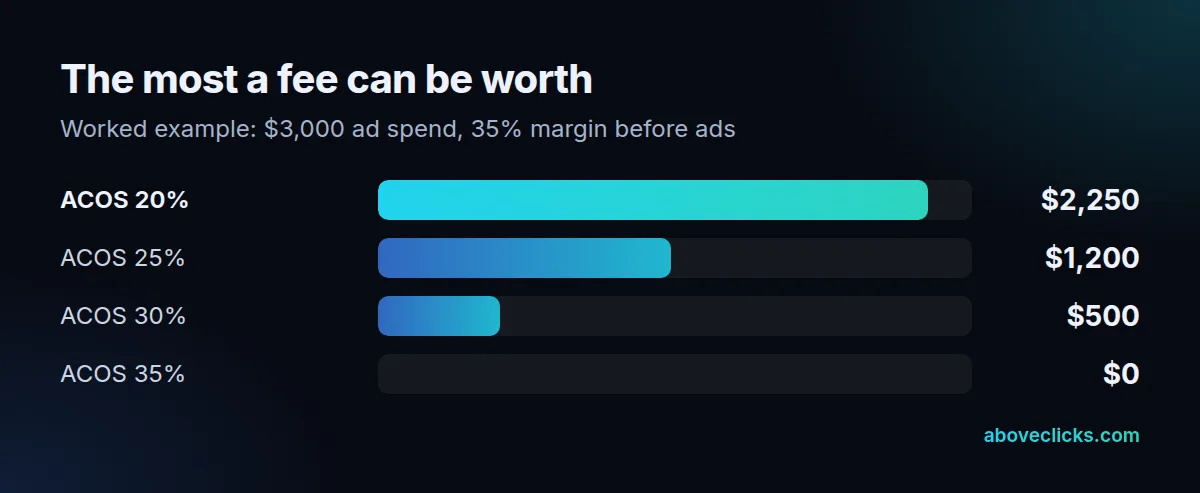
At a 25% ACOS, $3,000 of spend brings $12,000 of ad sales and $4,200 of profit before ads, so $1,200 is left. A $1,500 management fee would turn that month into a loss on ad sales alone. At a 20% ACOS, $2,250 is left; at 35%, nothing is. This is the simplest way to judge any Amazon PPC management cost: work out your own ceiling before you read the quote, then compare the Amazon PPC management cost on it with that ceiling. It ignores organic sales the ads help create, which is why the TACoS trend over a few months matters too.
Is Amazon PPC management worth it?
Yes, when the fee sits well below the profit the ads leave and someone will do the weekly work. Amazon PPC management pays for that work, not for access to Amazon. For a small catalogue with time to learn, Amazon’s own free help may be enough to start.
Amazon’s FAQ lists two options of its own, as of October 2026. Free one-on-one support from an Amazon Ads specialist, for eligible advertisers, covers setup and recommendations on keywords, bids and budgets. Amazon’s managed service, with an account executive, typically requires a minimum spend of $50,000. Between those sits the in-house route: the Amazon Ads console is free to use, and your time is the cost.
The work is steady rather than one-off. Amazon’s CPC guide suggests about two weeks of data before you make keyword decisions, then refining match types, adding keywords and adding negatives (as of October 2026). Someone has to do that every week. If no one in-house will, the Amazon PPC cost of unpruned automatic campaigns usually exceeds a reasonable fee within a few months.
Ads also can’t fix a listing that doesn’t convert. If titles, images or reviews are weak, the click is paid for and the sale doesn’t happen; Amazon SEO work on the listing may come before more ad spend.
How do you compare Amazon PPC management quotes?
By what the fee covers, how it’s tied to your results and who owns the account. Two quotes at the same headline number can buy very different amounts of work.
Ask each agency or freelancer these questions:
- Which fee model is it, and what does it come to at my current spend?
- What’s in scope: Sponsored Products only, or Sponsored Brands, display and listing work too?
- Do campaigns run in my own Amazon Ads account, with you added as a user?
- How do you treat branded searches in reports and in any share-of-sales fee?
- How often are search terms harvested and negatives added: every week, or only every 30 days?
- Will the report show TACoS and total sales, not only ACOS?
Amazon’s Partner Network lets agencies earn advanced or verified partner status and product certifications, as of October 2026; it’s a useful check, though not a promise of results. Our wider list of questions to ask a marketing agency covers contracts and reporting.
Our own starting prices are on the price cards of our Amazon PPC service, in US dollars, and the exact cost is fixed in writing before any work begins. More guides are in buying guides. To see what your account needs first, ask for our free audit: campaigns, search terms and wasted spend reviewed within 2 workdays, with a fix list in order, so you know your own ceiling before you weigh any Amazon PPC management cost.