A luxury real estate marketing plan is a written plan for reaching a few qualified buyers for high-value homes, and for what you may spend doing it. Build it as two documents: a yearly plan for you and a one-page plan for each listing.
This guide to the luxury real estate marketing plan shows how the two documents differ, how to cap a listing’s budget, what a seller should sign, which advertising rules to check and when to change the plan. It goes deeper on the plan itself than our guide to luxury real estate marketing, which covers tiers and channels.
What is a luxury real estate marketing plan?
A luxury real estate marketing plan is the document that turns a luxury sales goal into funded, dated work. It names the buyers you want, the channels that reach them, the budget and the dates when you will review the results.
Keep it short: 1 page for the seller and no more than 2 pages for your own year. Most plans fail in 1 of 5 places: there is no plan for the individual listing, no spend cap, no agreement on who pays, no seller sign-off and no rule for changing course. Those are the five costly gaps in the title, and the rest of this guide closes them one by one.
A general real estate marketing plan starts from an income goal and works down to leads. A luxury plan needs the same chain, but the numbers are small: one sale can be worth more than the rest of a year’s income for a smaller agent. So a luxury real estate marketing strategy has to work at the level of one home as well as the year, and the luxury real estate marketing plan is where that strategy is written down.
How is a luxury listing marketing plan different from the yearly plan?
The yearly luxury real estate marketing plan builds your pipeline of sellers and buyers. A luxury listing marketing plan is a one-page agreement about one home. Keep the two apart, because they have different readers, budgets and review dates.
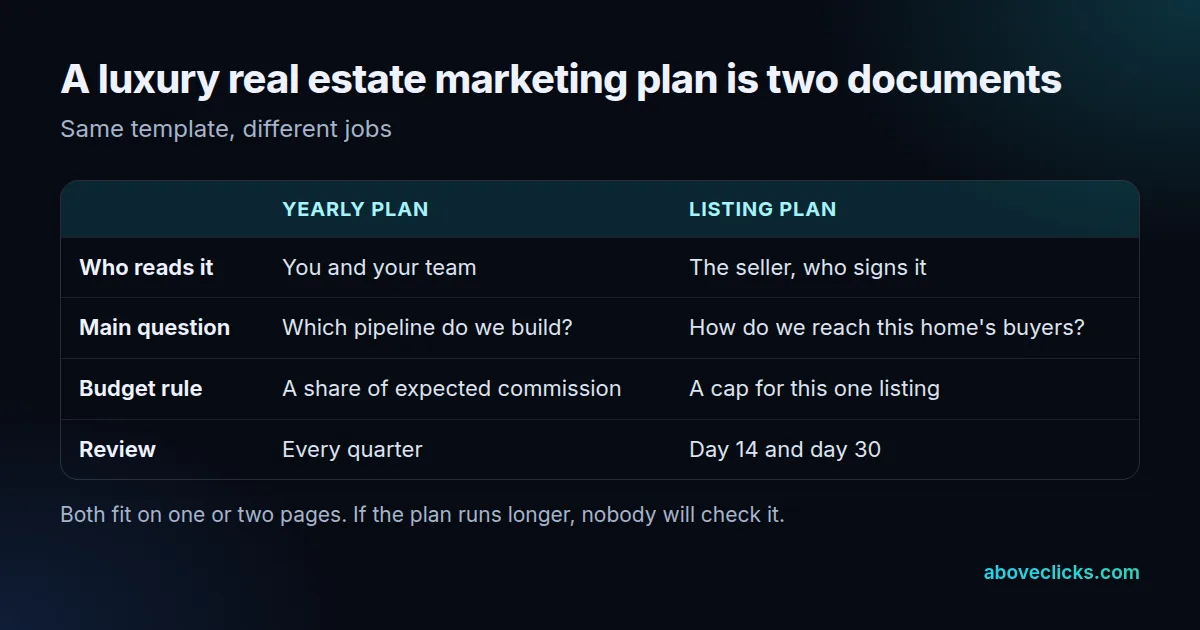
The yearly plan is for you. It sets the pipeline goal, the budget rule and the channels you will always run, such as your private buyer list and your agent network. Our real estate agent marketing plan guide covers the agent-level version, including a 12-week calendar.
The luxury listing marketing plan is for the seller. It says what will be done for this home, in what order, and what it may cost. A seller who reads one page and signs it is far less likely to ask on day 40 where the money went. It also gives you a record: when the seller asks why the third tranche was held back, the listing plan already says that it depends on the day-14 enquiry log.
Both documents of the luxury real estate marketing plan share one template. Only the contents change: each home has its own privacy limits, buyer pool and timeline.
How do you budget a luxury real estate marketing plan?
Cap the budget in your luxury real estate marketing plan for each listing as a share of its expected commission, then release it in stages. The cap protects you if the home does not sell; the stages let you stop spending when the results do not justify it.
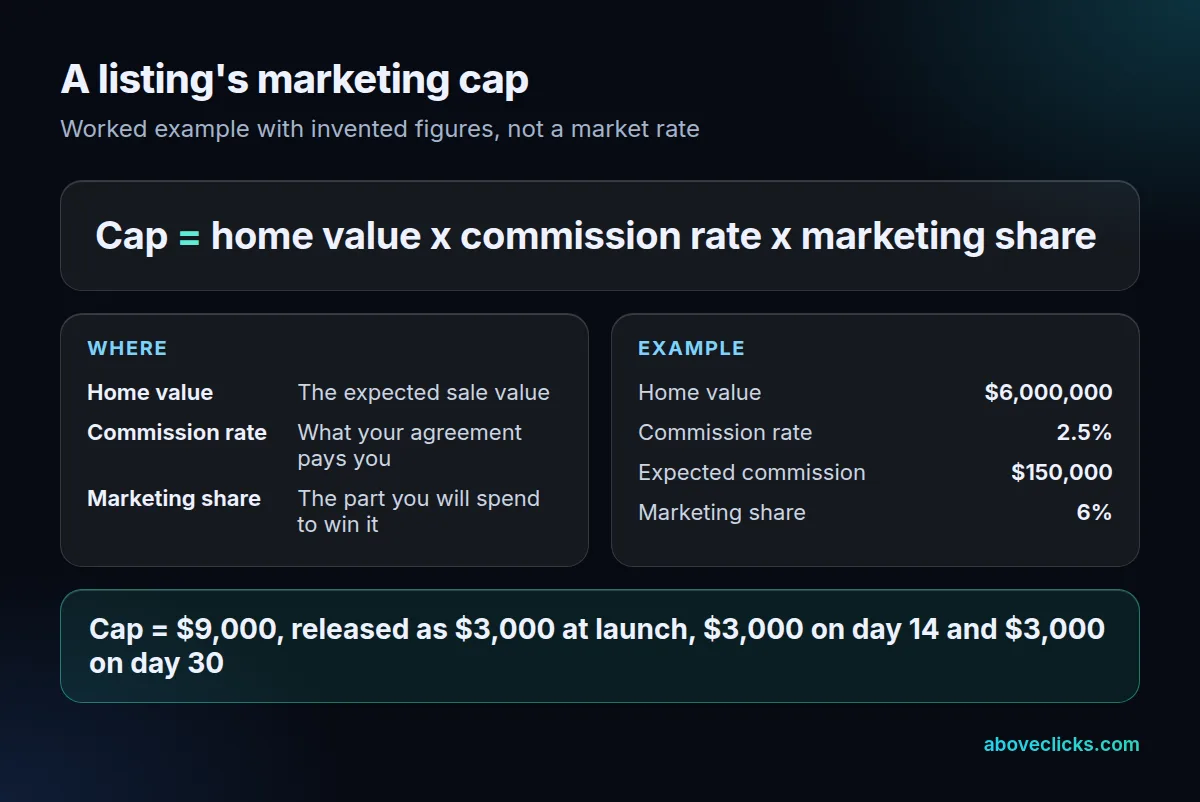
The worked example uses invented figures. A $6,000,000 home with a 2.5% commission rate gives an expected commission of $150,000. At a 6% marketing share, the cap is $9,000. Commission rates are negotiable and differ by market, so use the rate in your own agreement and a share you can defend to the seller.
Release the cap in three parts. Spend $3,000 at launch on the page, photography and the private-list message. Release the second $3,000 on day 14 only if the enquiry log shows serious enquiries. Keep the last $3,000 for day 30, when you know which channel is working.
In a yearly plan, apply the same rule across all expected listings, then keep a reserve for the home that arrives mid-year. If the listings you expect in a year are 8 and the average cap is $9,000, the year’s listing budget is $72,000 before any spend on your own brand. That is a figure to test against your cash flow, not a target.
Who pays for the plan, the seller or the agent?
Settle it in writing before any spend on the luxury listing marketing plan. In practice that is a per-line decision: some lines the seller funds, some you fund, and the plan should say which is which and who keeps the assets.
Use this short list of questions to settle it:
- Which lines does the seller pay for, such as photography, video or printed brochures?
- Which lines do you pay for, such as ads on your own accounts?
- What happens to unspent money at day 30?
- Who owns the photos, the video and the listing page after the sale?
- If the listing ends without a sale, are any costs shared?
Rules about who may pay for what, and what you must disclose, differ by brokerage, state and listing service. Check yours before you put numbers in the plan. Our real estate digital marketing page shows how we scope this kind of work, and our real estate marketing service page has the starting price cards.
What should the seller sign off in the listing plan?
Six things: who pays, the spend cap, the privacy limits, the channels, the reporting dates and the rule for changing the plan. Each line is one sentence, and the seller initials it.
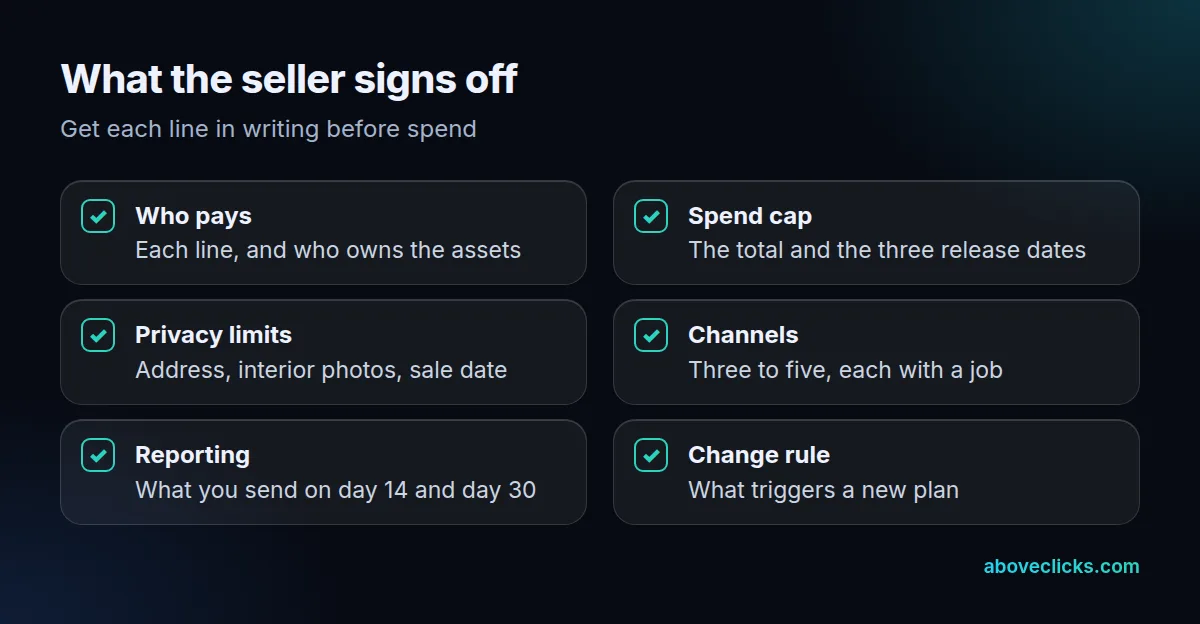
Privacy limits matter most for a luxury real estate marketing plan, because owners often do not want the address, interior photos or sale date public. Record the limits as a list, such as “no street address before a qualified viewing” or “no interior photos”. The same list tells your photographer and your designer what to leave out.
The channel list is where a luxury listing marketing plan most often goes vague, so keep it short. Name three to five channels and give each a job, for example “private list: first look” or “search ads: people already searching for the area”. A channel with no job is the first to cut on day 30.
Which advertising rules does the plan need to respect?
Housing ads carry restrictions. In the US, HUD’s rules cover every notice, flyer, brochure, sign and billboard, and Google and Meta both limit audience options for housing ads. Put the checks in the luxury real estate marketing plan so the creative and the targeting follow them.
The Fair Housing Act protects people from discrimination in renting or buying a home on 7 grounds: race, color, national origin, religion, sex, familial status and disability, according to HUD as of November 2026. HUD’s advertising rule makes it unlawful to publish an advertisement for a dwelling that shows a preference or limitation on those grounds, and it applies to flyers, brochures, signs, banners, posters and billboards, as of November 2026.
On the platforms, as of November 2026:
- Google does not allow age, gender, parental status, marital status or ZIP code targeting for housing ads in the US and Canada, and radius targeting needs at least 1 km (about 0.6 miles) around a location, according to Google’s personalized advertising policy.
- Meta limits age, gender, ZIP or postal code, exclusion targeting, lookalike audiences and saved audiences for housing ads, according to Meta’s Help Center.
Our guide to luxury real estate marketing has the longer version of these ad rules. Your luxury listing marketing plan only needs a line that says the creative and the audience were checked against them before launch.
When should you change the luxury real estate marketing plan?
Change it when the enquiry log says so, not on a feeling. Agree four triggers with the seller on day 1, each tied to something you can count on day 14 or day 30.
To count anything, tag every channel link. Google’s URL builder guide explains how utm parameters in a link let Analytics show which campaign sent a visit, in its Traffic acquisition report. Add a “how did you hear about this home?” question to the enquiry form, and ask the same thing on the first phone call, so that private-list and word-of-mouth buyers are counted too. Without that log, the table below has nothing to read.
Use these triggers, with illustrative numbers:
| Day 30 signal | What it suggests | Change |
|---|---|---|
| 25 enquiries, 0 viewings | The wrong people, or a weak page | Narrow the audience, rewrite the page |
| 8 viewings, 0 offers | The home or its asking figure | Review feedback with the seller |
| Viewings only from the private list | Paid channels add little | Move the day-30 tranche to the list |
| 0 enquiries from a channel | The channel has no buyers | Cut it and keep the money |
Write the change rule into the luxury listing marketing plan so that the seller expects it. A luxury real estate marketing plan that can change on day 30 is one the seller trusts on day 1.
If you want a second opinion on the luxury real estate marketing plan you have, ask for our free audit. More guides for this sector are in our industries section.