Marketing automation for real estate agents is software that sends follow-up messages and creates tasks on rules you set, so each contact hears from you at the right stage. The rules should differ for each kind of contact, which is where most agents go wrong.
This guide to marketing automation for real estate sorts a database into 4 contact types, shows a message budget for each, and covers the email, text and fair housing limits. It names 4 traps: one cadence for everyone, marketing sent as relationship mail, texts without consent, and biased audiences or copy. For the cross-channel build, see our real estate marketing automation guide.
What is marketing automation for real estate agents?
Rules that send a message or create a task when something happens, such as a new enquiry, a booked viewing or a closing date. A person still decides what is said and what is promised.
Marketing automation for real estate agents is sold as a long feature list, but an individual agent needs very little of it, and the rules are not optional: the FTC says each email that breaks CAN-SPAM can cost up to $53,088, as of November 2026. A form that stores each contact with its source, a few saved messages and a rule for when each one stops will cover most of it. The tool matters less than whether you know which contact gets which message. Good marketing automation for real estate starts from that list, not from a feature comparison.
The same idea runs through real estate agent automation of every kind, from a free CRM to a paid platform, and through real estate crm automation in particular. Each rule needs a trigger, a message and a stop. If you cannot say what ends a message, it will keep going after the contact has booked, replied or left. For the task-by-task view of what to hand over, see automated real estate marketing.
Which contacts need different automation?
At least 4 groups: new enquiries, active clients, past clients and a wider network. In the worked example below, past clients are 30% of the database and the wider network is 62.5%. Each has a different reason to hear from you, so a single cadence for everyone is the first trap.
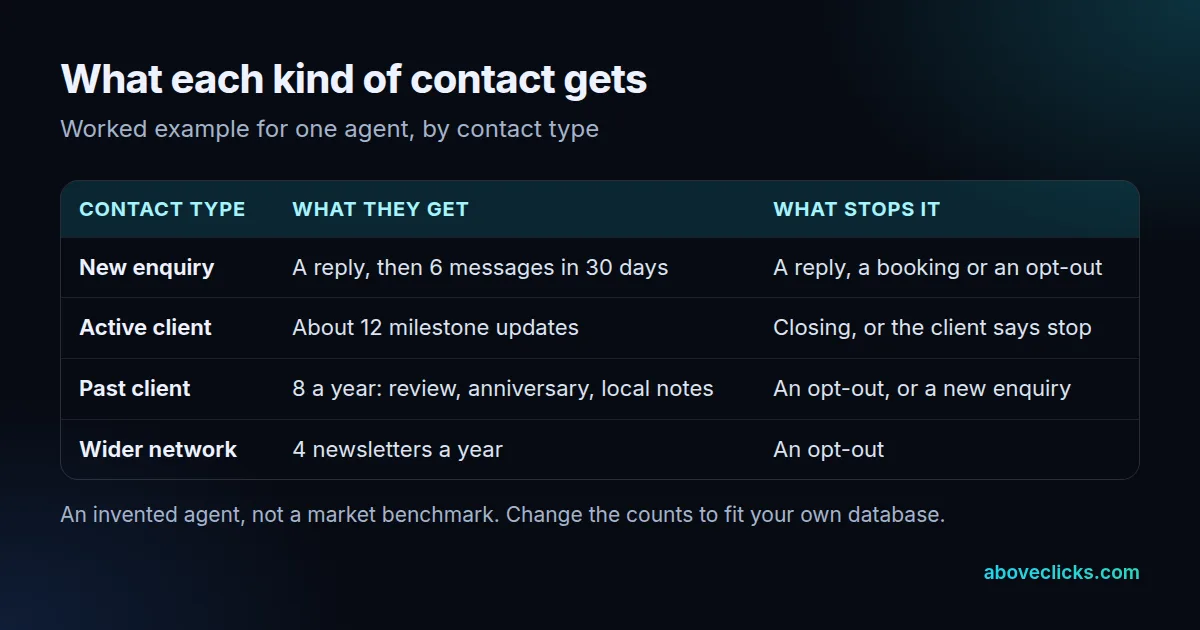
Think about what each person expects from marketing automation for real estate agents. Someone who enquired yesterday expects a quick answer and some follow-up for a few weeks. A client halfway through a purchase expects milestone updates, not a newsletter. A past client expects to hear from you rarely and only when it is useful. A neighbor or friend on your list expects the least.
On our own real estate work, every lead reaches the CRM within seconds, whatever the source, and is assigned by project or area. The contact type is then one more field on that record. That field is what real estate crm automation should key off in every flow: it decides which flow the contact enters and which flows they can never enter.
A simple setup for marketing automation for real estate agents with no team:
- Add a “type” field to every contact, with the 4 values above.
- Write one stop rule per type before you write any message.
- Let a contact move up a type automatically when they reply or book, and pause the old flow at the same moment.
The third step matters most. A past client who replies to an anniversary note is now an active conversation, and a marketing message arriving the next morning looks careless.
How many automated messages should one contact get?
Set a budget per contact type, then multiply by your database. The budget keeps total volume in check, because each flow looks reasonable alone and the sum is what contacts feel.
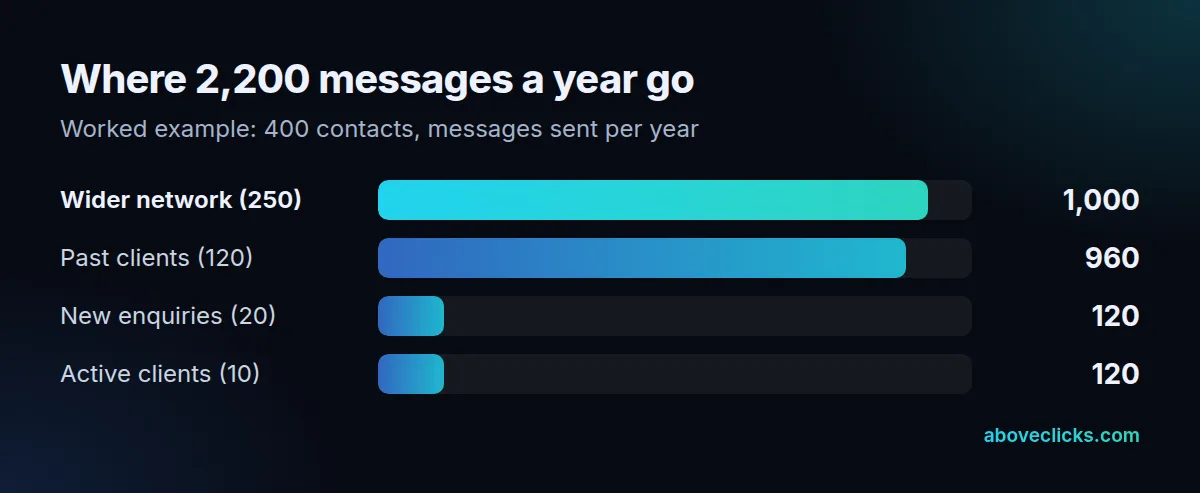
Here is a worked example with an invented agent. The database holds 400 contacts: 20 new enquiries, 10 active clients, 120 past clients and 250 people in the wider network. The agent sets 6 messages for each new enquiry in their first 30 days, 12 for an active client, 8 a year for a past client and 4 for the network.
That adds up to 120 + 120 + 960 + 1,000 = 2,200 messages a year, or about 183 a month. The chart shows the surprise: the two largest groups, past clients and the wider network, take almost 90% of the volume, while the people closest to a deal take the least. That is the right balance for those groups, because the people who are not in a transaction should hear from you rarely.
The numbers are an example, not a benchmark. Change them to match your market and your database. The point of a budget in marketing automation for real estate agents is to make the sum visible before you switch anything on. Real estate agent automation that nobody has added up tends to grow one flow at a time. If one person on your list is in 3 flows at once, add them up for that person too.
Which automated emails count as marketing?
Most of them. The FTC’s CAN-SPAM guide treats an email as transactional or relationship mail only if it consists only of a short list of content types, and a market update, a just-listed note or an anniversary email is not on it.
The guide lists 5 categories, such as content that confirms a transaction the recipient has already agreed to. It says the law reads these categories narrowly. A message that mixes both kinds is judged by its subject line and by whether the transactional part comes first. A note confirming an inspection time is likely relationship mail. A note about three new listings in the same email is not.
Everything else in your marketing automation for real estate is commercial email, and the FTC guide sets out what it needs:
- Accurate “From”, “To” and reply information, and a subject line that matches the content.
- A clear disclosure that the message is an ad.
- Your valid postal address.
- A clear way to opt out, which must keep working for at least 30 days after you send the message.
You have to honor an opt-out within 10 business days, and each email in violation can bring penalties of up to $53,088, as of November 2026. Your marketing automation for real estate can send the message, but you remain responsible for the list it sends to. For what to say in the emails themselves, read our email marketing for real estate agents guide.
Trap number two is labeling a marketing message as a client update to avoid the unsubscribe link. Treat an opt-out from a past client as covering every flow, not just the last one they received.
When do automated texts need written consent?
For commercial texts sent with an autodialer, always. The FCC says commercial texts require written consent, and that a recipient can opt out of any robotext at any time in any reasonable manner.
The FCC guide says autodialed or prerecorded texts to a wireless number need the owner’s prior consent. Written consent can be a website form or a keypress. A phone number from an open house sign-in sheet or a portal enquiry is not automatically consent to automated marketing texts, so record where and when each person agreed.
Three practical rules follow for marketing automation for real estate agents:
- Store the consent source and date on the contact, next to its type.
- Send texts only to contacts who agreed to texts, not to everyone with a phone number.
- Treat “stop” in any reasonable form as an opt-out from every flow.
In the 400-contact example, if 90 contacts gave written consent to texts, that is 22.5% of the database, and the other 310 get email only. Calling is separate again: organizations covered by the FTC’s Telemarketing Sales Rule or the FCC’s TCPA rules screen numbers against the National Do Not Call Registry.
Texts are the third trap, and the one that surprises agents most, because a sign-in sheet feels like permission. If you are not sure whether a particular message counts, ask a qualified lawyer; this guide covers the regulators’ general rules, not your situation.
How do you keep automated messages fair-housing safe?
Apply the Fair Housing Act to templates and audiences, not just to what you say in person. HUD says the Act protects 7 classes: race, color, national origin, religion, sex, familial status and disability.
Marketing automation for real estate agents spreads wording to hundreds of people at once, so one careless template repeats at scale. Read each saved message for phrases that describe the kind of buyer a home or area is “perfect for”, and describe the property and its features instead. HUD’s overview lists the protected classes, and your local board or state regulator may add its own rules.
Ads are the other half of marketing automation for real estate. Meta requires you to choose a special ad category for housing ads, and in the US that limits or removes 6 audience options: age, gender, ZIP code, exclusion targeting, lookalike audiences and saved audiences. Meta encourages advertisers to broaden, not restrict, the audience. Do not try to recreate a removed targeting option through an audience list or a proxy.
The fourth trap is therefore the audience, not the copy: a list built to leave certain people out, or a template that describes who a home is for. For the paid side of housing ads, our real estate marketing service page covers the paid and search work we do for agents.
What should an agent review each month?
The same 6 things on the same day: opt-outs, stuck contacts, replies, template wording, the message budget and lead sources. Thirty minutes is enough for a database of a few hundred contacts, and the same review works for any marketing automation for real estate you run.
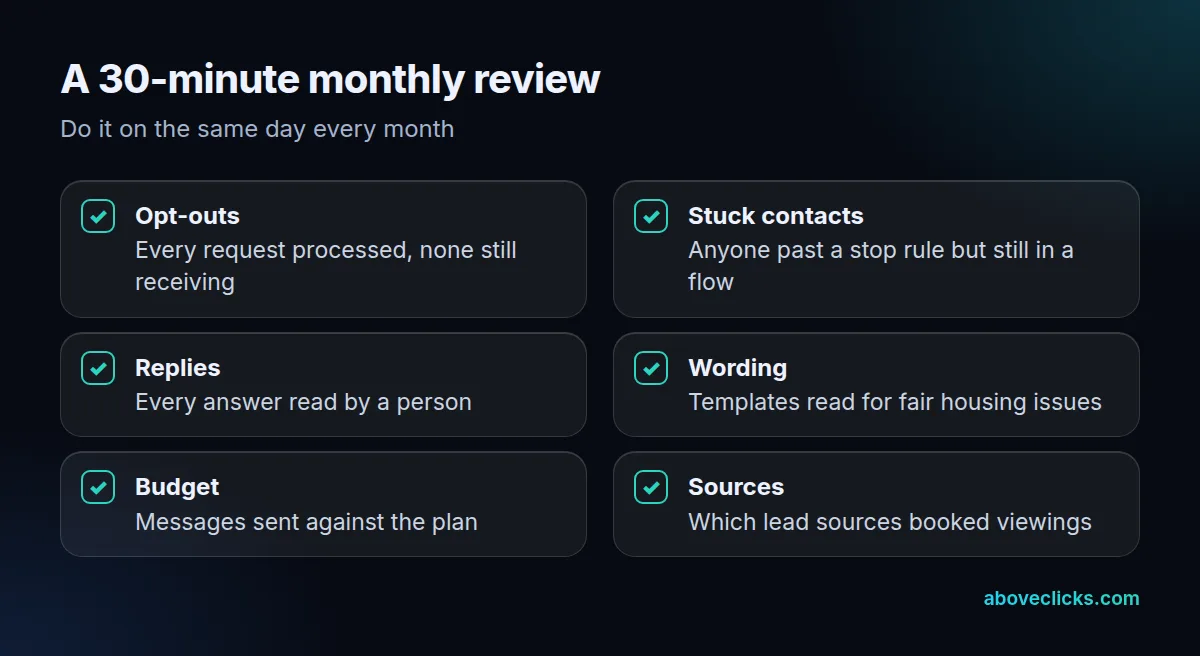
Start with opt-outs, because they carry a deadline in any real estate crm automation. Then look for contacts that should have left a flow but did not: someone who booked a viewing and still got a “have you thought about buying?” message is a stop-rule bug. Read the replies, since an automation that nobody reads is only a broadcast.
Compare the messages sent with your budget; real estate agent automation drifts upward if nobody checks. If you planned 183 a month and sent 260, find the flow that grew. Finally, look at which lead sources turned into booked viewings, not just enquiries, and cut the ones that did not. If you want a second pair of eyes on your setup, our free audit gives you a written look at your ads, tracking and SEO.
Marketing automation for real estate agents should lower the work between a lead appearing and a person speaking to them. When it adds work, or when contacts complain, go back to the contact types: usually one of them is getting the wrong message. More industry guides are in the industries topic.