Is real estate market slowing down? On sales volume, yes, as of November 2026. Your own market may differ, and five numbers show whether it does.
When people ask is the real estate market slowing down, the national data points one way, with a caveat. NAR’s existing-home sales page says sales fell year over year in all four regions in September 2026. This guide covers what the data says, five signs to check in your area, why rates matter, and which marketing moves to change.
Is real estate market slowing down right now?
On sales volume, yes. Is the real estate market slowing down on prices and new homes too? Those signals are less clear, and none of the sources describe a collapse. Here is what the three main releases say as of November 2026:
- Existing homes: NAR reports 3.99 million sales in September 2026, up 1.5% on August after seasonal adjustment. NAR’s chief economist says August and September were the two slowest months for sales this year. Inventory rose to 1.60 million homes.
- New homes: the Census Bureau and HUD put September 2026 new-home sales at a seasonally adjusted annual rate of 676,000, with 8.4 months of supply at that sales pace.
- Mortgage rates: Freddie Mac’s weekly survey shows the 30-year fixed rate at 7.18% on November 5, 2026, against 6.22% a year earlier.
Read the Census numbers with care. Its release says new-home sales were 5.3% below September 2025, with a margin of ±12.5%, and marks that change with an asterisk. The Census release tables explain the asterisk: the 90 percent confidence interval includes zero, so there is insufficient statistical evidence that the actual change is different from zero.
In plain words, the new-home dip could be noise. The existing-home signal is stronger because the year-over-year fall appears in every region. So the honest answer to is real estate market slowing down is “yes on volume, unproven on the rest”. A national figure still cannot tell you what is happening on your own streets, and is the real estate market slowing down in your ZIP code is a different question from the national one.
Is the real estate market slowing down where you work?
Is the real estate market slowing down in your town, or only in the headlines? Check five numbers in your MLS and compare each with the same month last year. Together they show whether buyers are pulling back or sellers are simply listing more.
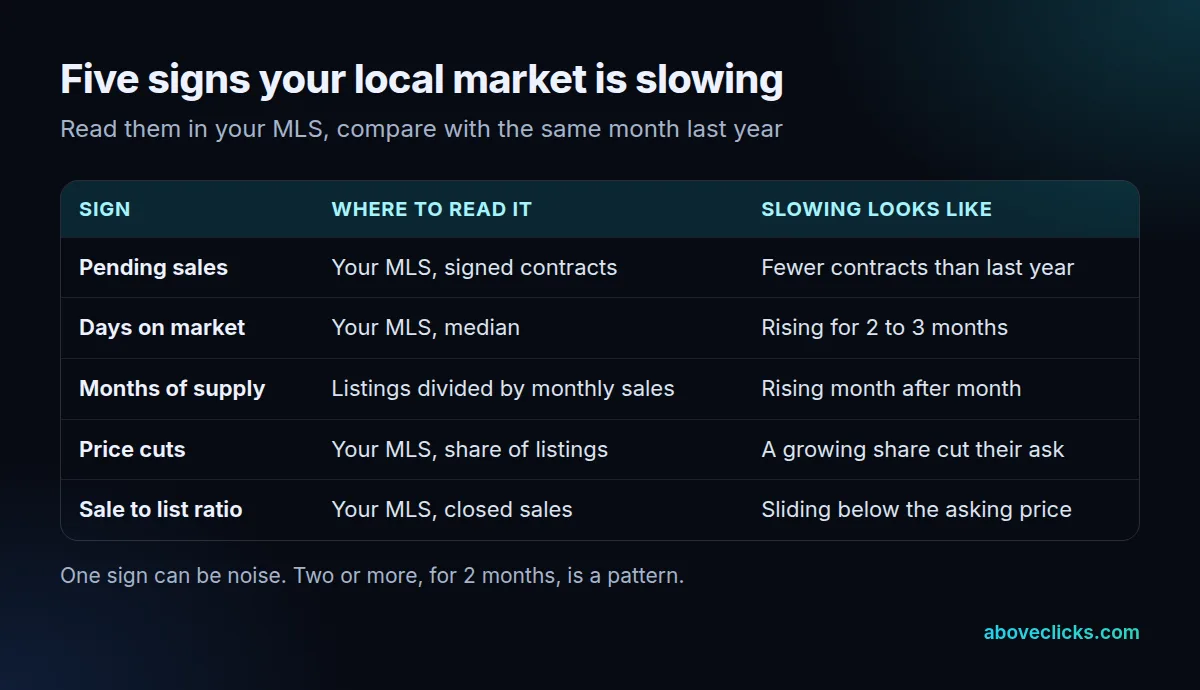
Months of supply is the one agents misread most. The Census release describes it as the number of months the current stock would last at the current sales rate, so you divide active listings by sales per month. Census’s 8.4 months covers new houses only, so do not compare it with your MLS figure.
Example, with an invented market: in the spring a town has 300 active listings and 60 sales a month, which is 5.0 months of supply. By autumn it has 340 listings and 45 sales a month, which is 7.6 months. Listings rose 13%, but sales fell 25%, so buyers, not sellers, caused most of the shift.
Whether the real estate market is slowing down in the sense of falling values needs a longer view. As of November 2026, the Federal Housing Finance Agency’s HPI covers all 50 states and over 400 cities, down to the ZIP code, and is built on repeat sales of the same properties. It is quarterly, so use it to confirm a trend, not to spot one early.
Two traps cost agents money here. One is reacting to a single sign, because days on market can lengthen simply when a few overpriced listings sit unsold. The other is comparing this month with last month, since sales follow a yearly pattern. A third check helps: ask two other local agents what they see. If their numbers and yours agree, you are looking at the market and not at your own listings.
Why is the real estate market slowing down?
Mostly because borrowing costs more. NAR’s chief economist says further rises in mortgage rates mean fewer buyers can qualify to buy a home, and the Freddie Mac survey shows the rate close to a percentage point higher than a year ago.
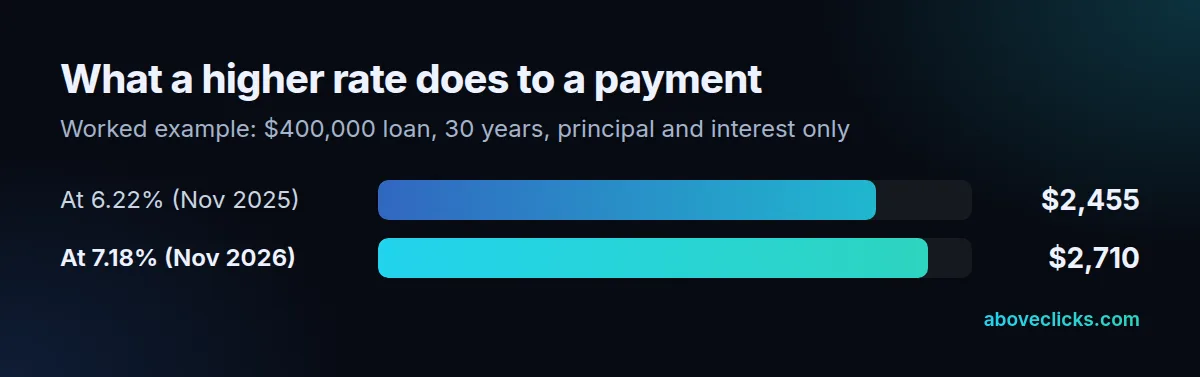
The worked example above uses an invented $400,000 loan over 30 years and the two Freddie Mac rates. The payment of principal and interest rises from about $2,455 to about $2,710, which is $255 more a month, or 10.4%. Taxes and insurance come on top. That gap is what moves a buyer from comfortable to stretched.
The Federal Reserve is not offering relief yet. Its October 28, 2026 statement kept the target range at 3-3/4 to 4 percent, and two members preferred a quarter-point rise. Mortgage rates do not follow that range one for one, so treat it as context, not a forecast. So is the real estate market slowing down because of rates alone? The sources do not say so.
Rates are not the only cause, and the sources do not rank the causes. Inventory, household budgets and local jobs all play a part, which is another reason to test your own market before you act on a national story.
Does the real estate market slow down in the summer?
It can, but it depends on your area, which is why agencies publish adjusted figures. NAR’s September gain was reported “on a seasonally adjusted basis”, and the Census figure is a seasonally adjusted annual rate. Both aim to remove the normal calendar pattern.
For your own market, the rule is simple. Compare each month with the same month last year, not with the month before. A drop from June to July means little if every July in your MLS history looks the same. If you are asking is the real estate market slowing down in summer or just in its usual season, the year-on-year comparison answers it.
The same logic applies to your ads. Google Ads Help describes seasonality adjustments as a tool for events of 1 to 7 days and says they may not work as well beyond 14 days, because Smart Bidding already manages seasonal events. A cooling market lasts months, so it is not a case for that setting. Measure it, then change the plan.
What happens when the housing market slows down?
Buyers get more time and more choice, and sellers have to compete harder. Is the real estate market slowing down more for sellers than for buyers? The NAR comments suggest sellers feel it first. NAR’s chief economist says higher inventory and lengthening days on market give buyers improved negotiating power, and that sellers need to be realistic about local conditions, which could mean price discounts and other incentives.
With 1.60 million existing homes for sale and 8.4 months of new-home supply, as of September 2026, buyers have more to compare. For an agent, that has three effects, and this is our reading of those statements rather than a measured figure:
- Fewer buyer enquiries. If fewer buyers qualify, there are fewer people to enquire, so the cost of each enquiry tends to matter more.
- Longer decisions. Buyers shop more and decide later, so follow-up that stops after two calls loses them.
- Harder listing conversations. Sellers need evidence for a realistic asking figure, such as local days on market and price cuts from your MLS.
Is the real estate market slowing down enough to stop spending? Rarely. A slower market does not mean there is no business. It means the same effort converts less often, and sloppy follow-up becomes costly.
How should agents change their marketing in a slow market?
Change the measure first, then the follow-up, and hold budget until two signs agree. Many agents do the reverse and cut ads after one weak release.
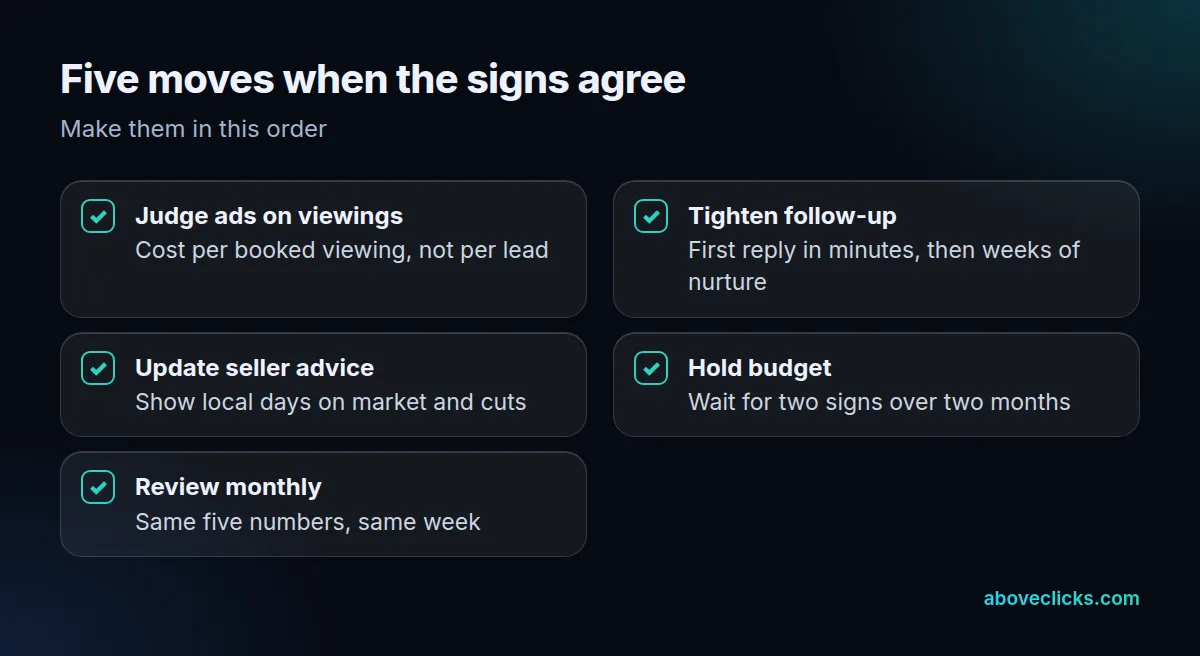
We run real estate marketing on one rule that holds in any market: judge campaigns on site visits and booked viewings, not form fills, because cheap leads that never answer inflate the lead count without adding a viewing. Our real estate marketing page explains that approach. The first reply speed and WhatsApp and email follow-up matter more when buyers decide over weeks or months.
Use the five signs as triggers, each time you ask is real estate market slowing down in my area:
- One sign moves: watch it for another month and change nothing.
- Two signs move for 2 months: move budget toward past-client and seller content, and update your listing presentation with local days on market.
- Three or more move: review every campaign on cost per booked viewing, and pause the ones that rose for several weeks.
The costly traps are easy to name. Do not cut follow-up to save time, do not judge ads on lead count, and do not copy a national headline into your seller advice. Each time a new release arrives, ask again, is the real estate market slowing down here, and answer it with your five numbers.
What if the answer to is the real estate market slowing down is no?
Then keep the plan and use the quiet to improve it. If your five numbers are flat or improving, the headline does not apply to you. Spend the time on seller content, review requests and a faster first reply, so you are ready if the real estate market is slowing down next quarter instead.
If you need a plan for the whole year, the real estate marketing plan guide covers channels, and marketing for real estate leads covers lead sources. For paid search, see Google Ads for realtors. Our real estate industry page shows how we plan each segment.
Whenever the next release lands, ask again: is real estate market slowing down here, or only in the news? If you want a second opinion on how your campaigns would cope with a slower market, our free audit checks your lead ads, landing pages and lead quality. More in industry guides.