Automated real estate marketing is software that does repeat marketing jobs, such as logging leads, sending the first reply and scheduling posts, on rules you set. People keep the calls, prices and judgment.
This guide sorts 9 common jobs into automate, check and keep human, shows how many minutes a small team can save, and lists the email, text and housing-ad rules that apply. For how to build the rules themselves, see our real estate marketing automation guide.
What is automated real estate marketing?
Software that reacts to events, like a new enquiry or a booked viewing, and does the repeat step without anyone typing it. The agent still decides what to say, what to charge and who to call.
Automated real estate marketing covers more than email. It includes lead capture, replies, reminders, social scheduling, newsletters and reports. Real estate automated marketing works job by job: each can be automated on its own, so you don’t need a full platform on day one. Our real estate marketing platform guide covers the tool side.
The useful question is not “what can software do?” but “which of my jobs are identical every time?”. Those are the ones to hand over. The rest need a person, and the table below shows where each job lands.
Speed is the clearest case. Buyers often enquire about several homes at once, so a reply inside 5 minutes during working hours tends to win the viewing. No one can type that reply 40 times a month on time, which is why automated real estate marketing starts with the first reply, not with fancy sequences.
Which tasks should automated real estate marketing cover?
Jobs that repeat in the same way, where speed matters more than polish: logging leads, the first reply, viewing reminders, social scheduling and reports. Keep pricing advice and negotiation with a person, even in automated real estate marketing.
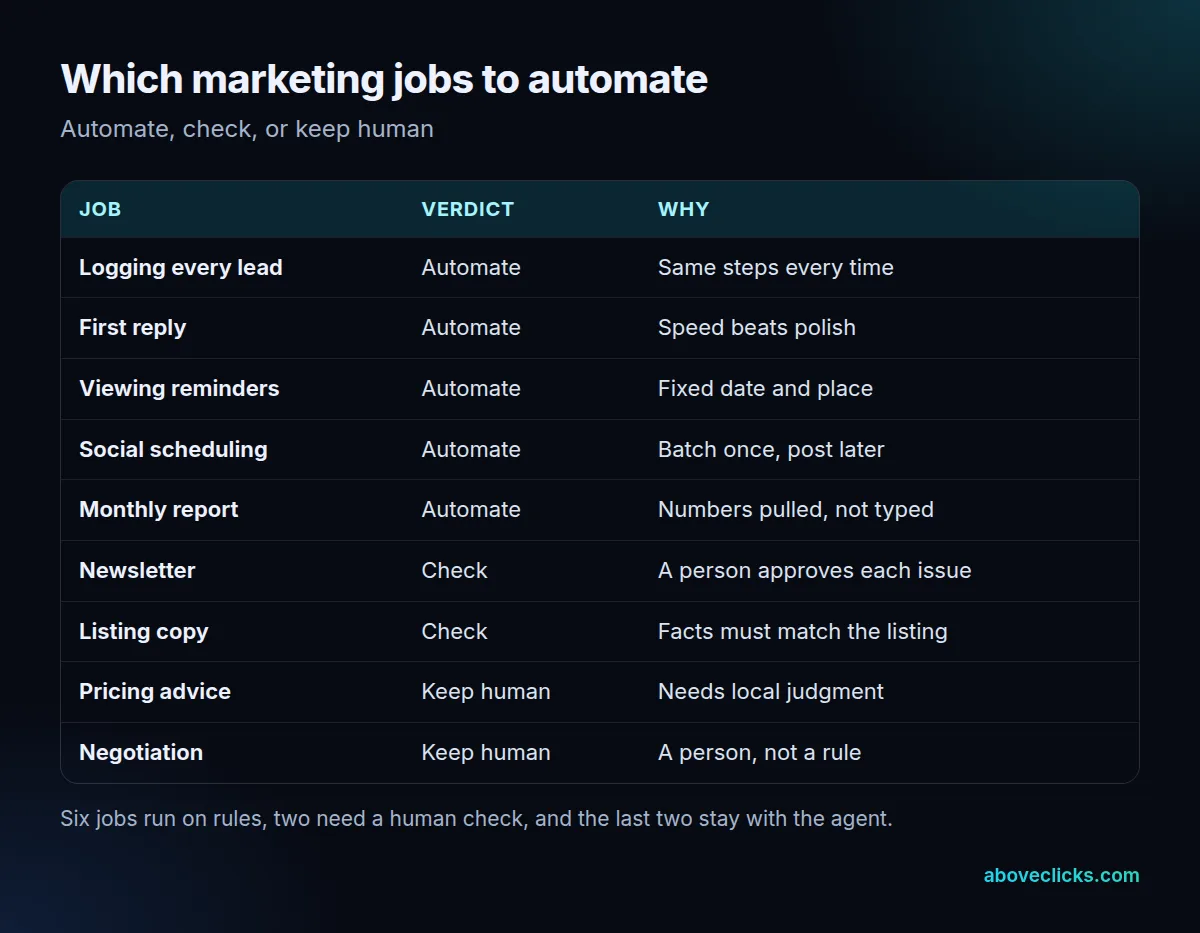
On our own real estate work, every lead reaches the CRM within seconds, whatever the source, and is assigned by project or area. For leads who opted in, a WhatsApp welcome goes out within 5 minutes, as set out on our real estate digital marketing page. A person then makes the call.
Two jobs sit in the middle. A newsletter can be drafted and scheduled by software, but someone should read each issue before it goes. Listing text can be drafted from the listing’s fields, but the facts, such as room counts and fees, must match the listing. Those 2 jobs get a check, not a handover.
The last two rows are different in kind. A price opinion depends on recent local sales, the condition of the home and the seller’s timeline. A negotiation depends on tone and trust. Automated real estate marketing can set up the conversation, by getting the right lead to the right agent fast, but it should not hold the conversation. If a message could change what someone offers or accepts, a person writes it.
Can social media posts and newsletters be automated safely?
Yes, if a person approves the content and the sending follows the law. Scheduling is low risk in automated real estate marketing; generating hundreds of near-identical pages or emails is where it goes wrong.
For email, the FTC’s CAN-SPAM guide sets out the basics. Each message needs accurate sender details, a subject line that matches the content, a clear ad disclosure, your postal address and a working opt-out. Opt-out requests must be honored within 10 business days, and each violating email can cost up to $53,088. Our email marketing for real estate agents post covers the content side.
For web pages, Google’s spam policies define scaled content abuse as generating many pages mainly to manipulate rankings, including with generative AI, without adding value. One neighborhood page with real local detail is fine. 200 pages with only the street name changed is not.
Listing text deserves its own rule. Draft it from the listing’s fields, such as bedrooms, lot size and fees, then have the listing agent read it against the source before it goes out. An automated description that invents a feature is a worse problem than a slow one, because it may break advertising rules and the buyer will notice on the first visit.
Social scheduling is simple: write 8 posts in one sitting and queue them. Keep one person responsible for replying to comments, because a scheduler cannot answer a buyer’s question.
How much time can you save by automating real estate marketing?
In the example below, six jobs in automated real estate marketing save 600 minutes a month, or 540 after an hour of checking. Your numbers will differ, so redo the arithmetic with your own enquiries and task times.
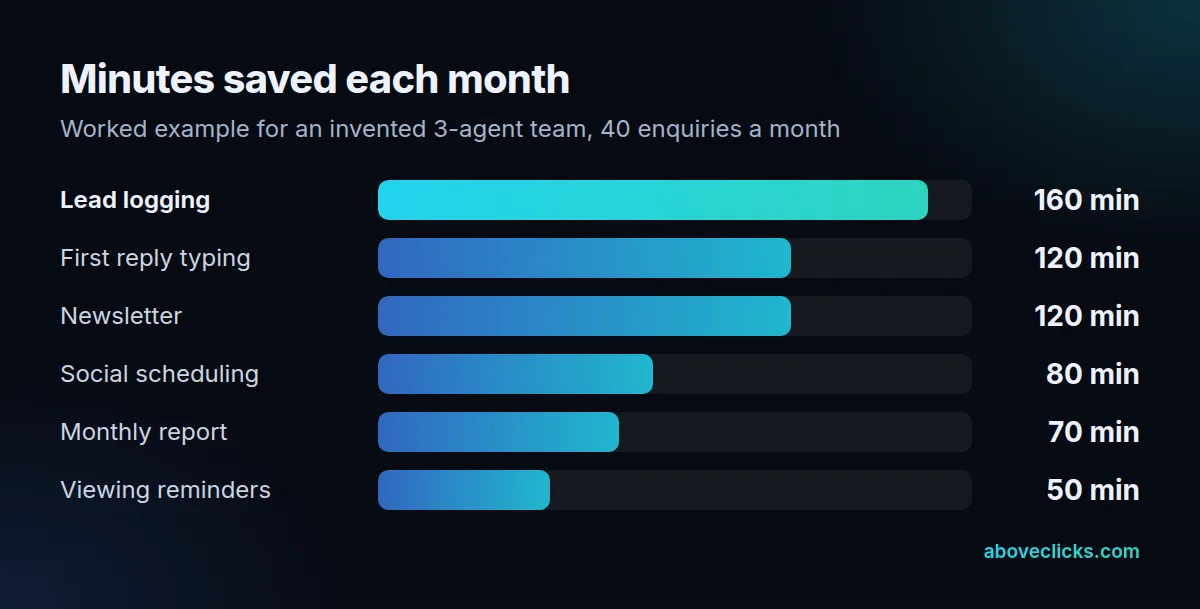
Worked example: a 3-agent team with 40 enquiries a month and 25 viewings. The minutes are the example’s own assumptions, not a benchmark or a client result.
- Lead logging: 40 leads at 4 minutes each is 160 minutes by hand, 0 once the form feeds the CRM.
- First reply typing: 40 at 3 minutes is 120 minutes, 0 with a saved template. The call stays manual.
- Viewing reminders: 25 at 2 minutes is 50 minutes, 0 when sent automatically.
- Newsletter: 180 minutes by hand, 60 with a template and scheduler, a saving of 120.
- Social scheduling: 8 posts at 15 minutes is 120 minutes, 40 when batched, a saving of 80.
- Monthly report: 90 minutes by hand, 20 when pulled automatically, a saving of 70.
That is 720 minutes by hand against 120 automated, a saving of 600 minutes, or 10 hours. Add 60 minutes a month to check the rules and the net is 540 minutes, or 9 hours. Set-up time comes on top, once.
Which rules limit automated real estate marketing?
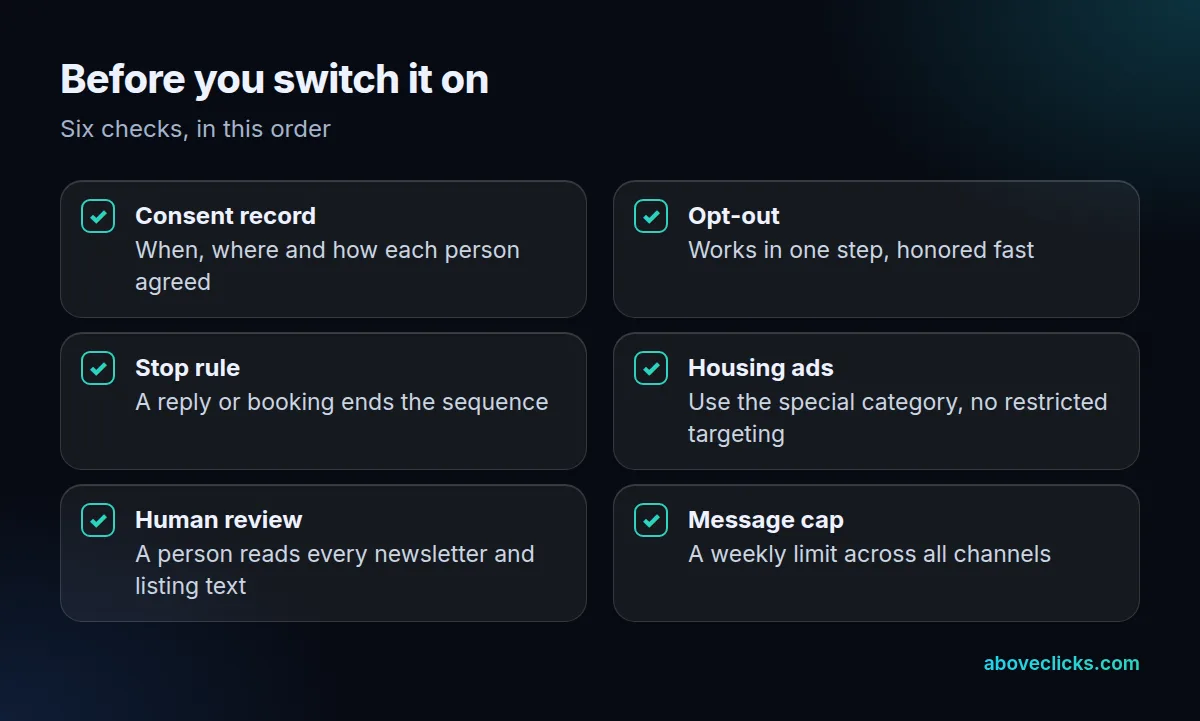
Three limits shape automated real estate marketing: CAN-SPAM for email, written consent for commercial texts, and Meta’s restricted targeting for housing ads. This is general information, not legal advice, so check your state’s rules too.
Texts: the FCC’s guide to robocalls and texts says autodialed texts to a mobile phone need the owner’s prior consent, and commercial texts need written consent. People can opt out at any time in any reasonable manner, so a “reply STOP” rule must end the sequence at once.
Ads: Meta’s housing ads page says age, gender, ZIP code, exclusion targeting, lookalike audiences and saved audiences are limited or unavailable for ads about housing in the US. That is 5 audience options removed or narrowed. Meta encourages broad audiences instead. Check whether your listing ads fall into this category before you automate their audiences.
The checklist below turns the three rules into six checks to pass before you switch anything on.
What is the smallest automated real estate marketing setup?
The smallest automated real estate marketing setup has three pieces: ad leads sent straight to one CRM, an automatic first reply, and a monthly newsletter a person approves. That setup covers the largest savings in the example above.
Start with capture. For Meta lead ads, Meta’s lead retrieval docs show that a webhook fires when a lead is created, and the lead’s ID is used to fetch its data. For Google Ads lead forms, Google’s help page lists a webhook to your CRM, and an API export of up to 60 days of lead data.
Then add one reply template: confirm the enquiry, say who will call and when, and add a booking link, in under 40 words. Last, set a monthly newsletter with a stop-sending link. Leave nurture sequences and AI listing pages until these three work.
Test the whole chain with 5 fake leads before real ones arrive: one from each source, including a lead with no phone number and one with a typo in the email. Check that each lands in the CRM with its source, that the reply arrives, and that the opt-out stops the next message. A broken chain that loses 3 leads in 40 is easy to miss and expensive.
If you want help wiring this up, our real estate marketing service sets it up and tests it with fake leads first.
How do you check that the automation is helping?
Review your automated real estate marketing every 30 days: read 10 real conversations from start to finish and compare three numbers, minutes to first reply, share of leads contacted, and viewings booked per 10 leads.
Use the same 30 days to retire anything that does not earn its place. If a nurture email gets no replies in 60 days, cut it or rewrite it. Fewer rules that work beat a long list that nobody reads, and each extra rule is one more thing that can fire at the wrong time. Real estate automated marketing should shrink the workload, not add a new one.
Look for rules that fire at the wrong time. A reminder sent after a viewing was moved, or a nurture email to someone who already booked, costs more goodwill than the minutes it saved. Fix the rule or switch it off.
Also check the opt-outs. Every opt-out should stop all messages across email and text within the limits above. If the same person is still getting messages, the rules disagree and need one shared list.
If you want a second opinion on your setup, our free audit covers your ads, tracking and lead flow. More guides are in industries.