Real estate marketing trends 2026 come down to seven shifts, from older repeat buyers and AI search answers to limited housing ad targeting. Each has a source and one move you can make this quarter.
This guide ties every one of these real estate marketing trends to a primary source: NAR’s 2026 survey of home buyers and sellers, Google’s documentation, Meta’s and Google’s housing ad rules, and the FTC. It also says what to skip, and it ends with a 90 day plan.
Which real estate marketing trends 2026 matter most?
Seven, ordered here by how strong the evidence is. The first 3 come from who is buying and selling, the next 2 from how people find you, and the last 2 from how you can advertise. Four of the 7 rest on written rules or documentation from Google, Meta or the FTC, and the other 3 on NAR’s survey of 12 months of transactions.
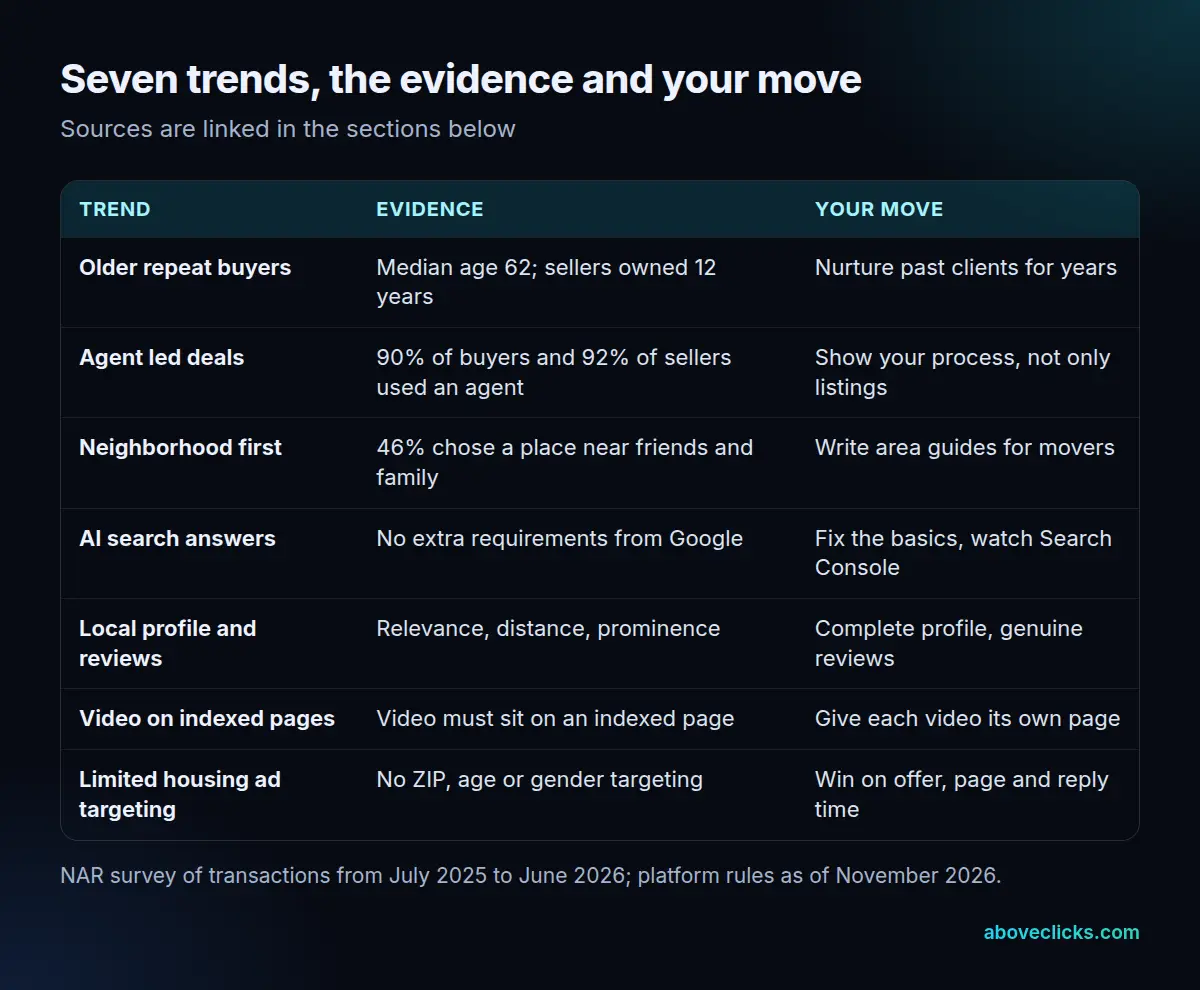
Treat the table as a checklist, not a ranking of budgets. Real estate marketing trends only deserve money when they connect to a booked viewing, a listing appointment or a referral you can count. The sections below give the source for each row and the numbers behind it.
Are real estate marketing trends the same as market trends?
No. Real estate marketing trends describe how people find and choose an agent; market trends describe prices, inventory and mortgage rates. Searches for one often return pages about the other.
This guide covers the first kind: real estate marketing trends, not price charts. For sales volume and inventory in your area, use your MLS and NAR’s housing statistics. For how to budget and sequence the marketing itself, our real estate marketing plan guide covers channels, budgets and the first 90 days.
The two connect in one place: market conditions change who is in the market, and that changes which real estate marketing trends will pay off. The next section uses NAR’s survey to show how.
Who is buying and selling, and what does that change?
Older, more settled people, who use agents more than at any point in decades. NAR’s 2026 Profile of Home Buyers and Sellers covers transactions from July 2025 to June 2026 and gives the clearest evidence behind the first 3 real estate marketing trends 2026 will reward.
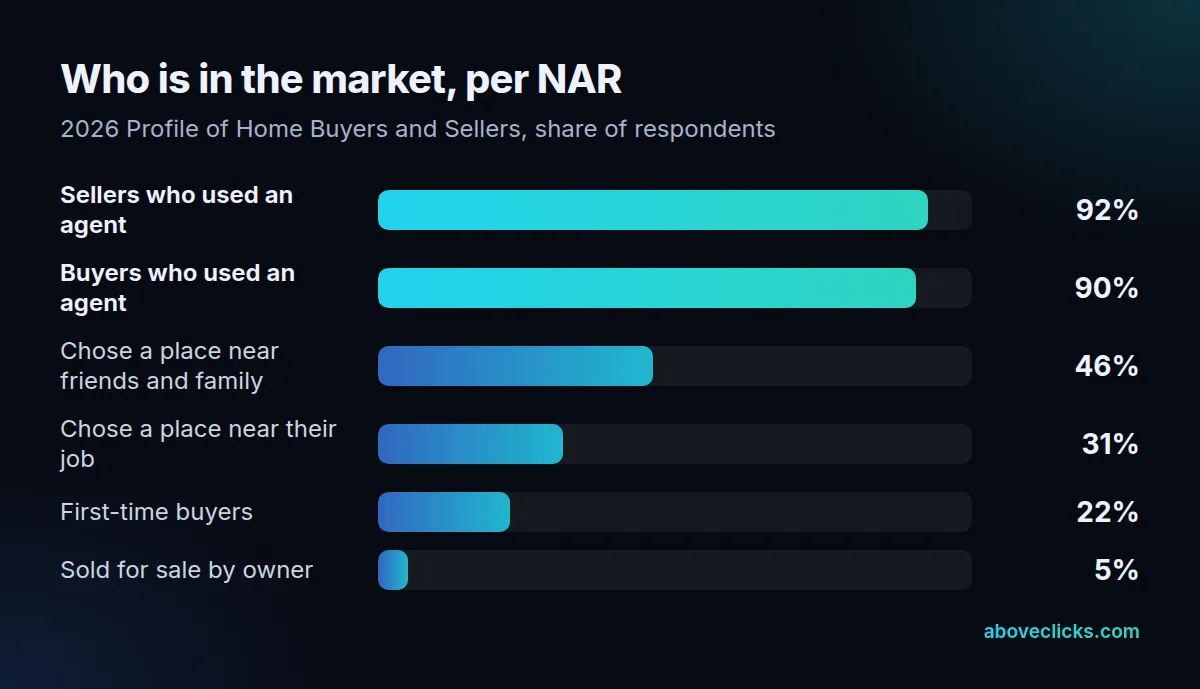
Three findings shape these real estate marketing trends, all from NAR’s 2026 takeaways:
- Older repeat buyers and long ownership. The median repeat buyer is 62, and sellers had owned their home a median of 12 years, an all-time high. Your next sellers may already be in your contacts. Move: keep past clients and neighbors on a slow, useful schedule for years, not weeks.
- Agent led deals. 90% of buyers and 92% of sellers used an agent or broker, and for-sale-by-owner sales were 5% of sellers. Move: explain how you work, with a clear process, named steps and real reviews, because buyers and sellers are choosing an agent, not deciding whether to use one.
- Neighborhood first. 46% of buyers chose a neighborhood close to friends and family, up from 35% in 2015, while 31% chose one convenient to their job, down from 52% in 2014. Move: write area guides for people moving toward family, not only commuter guides. That is the most local of the real estate marketing trends in this list.
NAR also reports that 22% of buyers were first-time buyers, with a median age of 40. Marketing aimed only at young first-time buyers misses most of the market, so the older audience is the first of the real estate marketing trends to plan around.
How is AI changing real estate marketing?
Mostly in how people ask questions, not in what earns visibility. Google says AI Overviews and AI Mode have no additional requirements and need no special optimization beyond the basics of Search. Of all real estate marketing trends, this one has the most hype and the least new work.
Google’s AI features guide says a page must be indexed and eligible to show a snippet to be a supporting link. It lists 7 points, the same fundamentals as before: crawlable pages, internal links, good page experience, text that matches your structured data, and an up to date Business Profile. It also says you don’t need new AI text files or special markup.
Google adds that AI Mode may use “query fan-out”, running several related searches at once. For an agent, that favors a site that answers the sub-questions around a move, such as neighborhoods, process and timing, on separate pages that link to each other.
Two practical moves follow:
- Verify the site in Search Console. AI feature traffic is counted in the Performance report under the Web search type, so no separate tool is needed to see it.
- Treat “AI SEO” packages with care. If a vendor sells markup or files that Google says are unnecessary, ask what it changes in your Search Console report. Real estate marketing trends that need new files or tools should show a result there.
If you want a deeper look at fan-out and AI answers for search, our AI search optimization page explains how we approach it.
Do real estate agents need Google reviews and a Business Profile?
They help you show up in local results, which Google bases mainly on relevance, distance and prominence. A complete profile and genuine reviews are the parts you control, which makes local search the least glamorous of the real estate marketing trends and one of the cheapest.
Google’s local ranking guide names 3 points. Relevance is how well your profile matches the search, distance is how far you are from the searcher, and prominence is how well known you are. It also says there is no way to request or pay for a better local ranking. What you can do is verify the profile, keep hours, category and details complete, add photos and reply to reviews.
Reviews carry a legal point in 2026. The FTC’s final rule on fake reviews bans buying or selling fake reviews, including AI-generated ones, and paying for reviews that express a set sentiment. It also covers undisclosed insider reviews and review suppression, and it allows civil penalties against knowing violators.
The safe routine is simple: ask every happy client at closing, send the same link to everyone, never pay for a positive review, and reply to each one in your own words.
Video, paid ads and email: what changes in 2026
Video must live on a page Google can index, housing ads lose most targeting options, and email needs a working opt-out. These last 2 real estate marketing trends carry the most direct cost.
Video on indexed pages. Google’s video guide says a video must be embedded on a watch page, and that page must be indexed before the video can be. Give each listing or area video its own page with text around it, which keeps video among the real estate marketing trends that are cheap to act on. Our real estate video marketing guide covers which video types are worth making.
Housing ads. Google’s personalized advertising policy says age, gender, parental status, marital status and ZIP code can’t be used to target housing ads in the US and Canada, and radius targeting needs at least 1 km. Meta’s special ad category rules remove age, gender, ZIP code, exclusion, lookalike and saved audiences, and expand the radius of city and pin-drop locations. With fewer levers, the offer, the landing page and the first reply carry the result.
Email you own. The FTC’s CAN-SPAM guide says you must honor an opt-out within 10 business days, and lists penalties of up to $53,088 per email as of November 2026. A list of past clients is also how you reach those 12 year sellers.
Worked example: cost per lead or cost per viewing?
Example (an invented brokerage, illustrative figures): two campaigns each spend $1,000 in a month.
- Campaign A brings 100 leads at $10 each and 4 booked viewings, or $250 per viewing.
- Campaign B brings 40 leads at $25 each and 10 booked viewings, or $100 per viewing.
Campaign A looks cheaper per lead, yet Campaign B costs 60% less per viewing. We publish lead costs on our real estate industry page, for example 486 Meta leads at $10.03 each across six campaigns in September 2026 (accounts anonymized, shown with permission), and we treat that as the starting number: the next one to ask for is the cost per site visit. Speed matters too, which our real estate leads guide covers.
How do you turn the trends into a 90 day plan?
Count first, fix the basics second, publish two assets third, then review. Don’t add a channel for any of the real estate marketing trends 2026 lists until you can say what a booked viewing costs in the one you have.
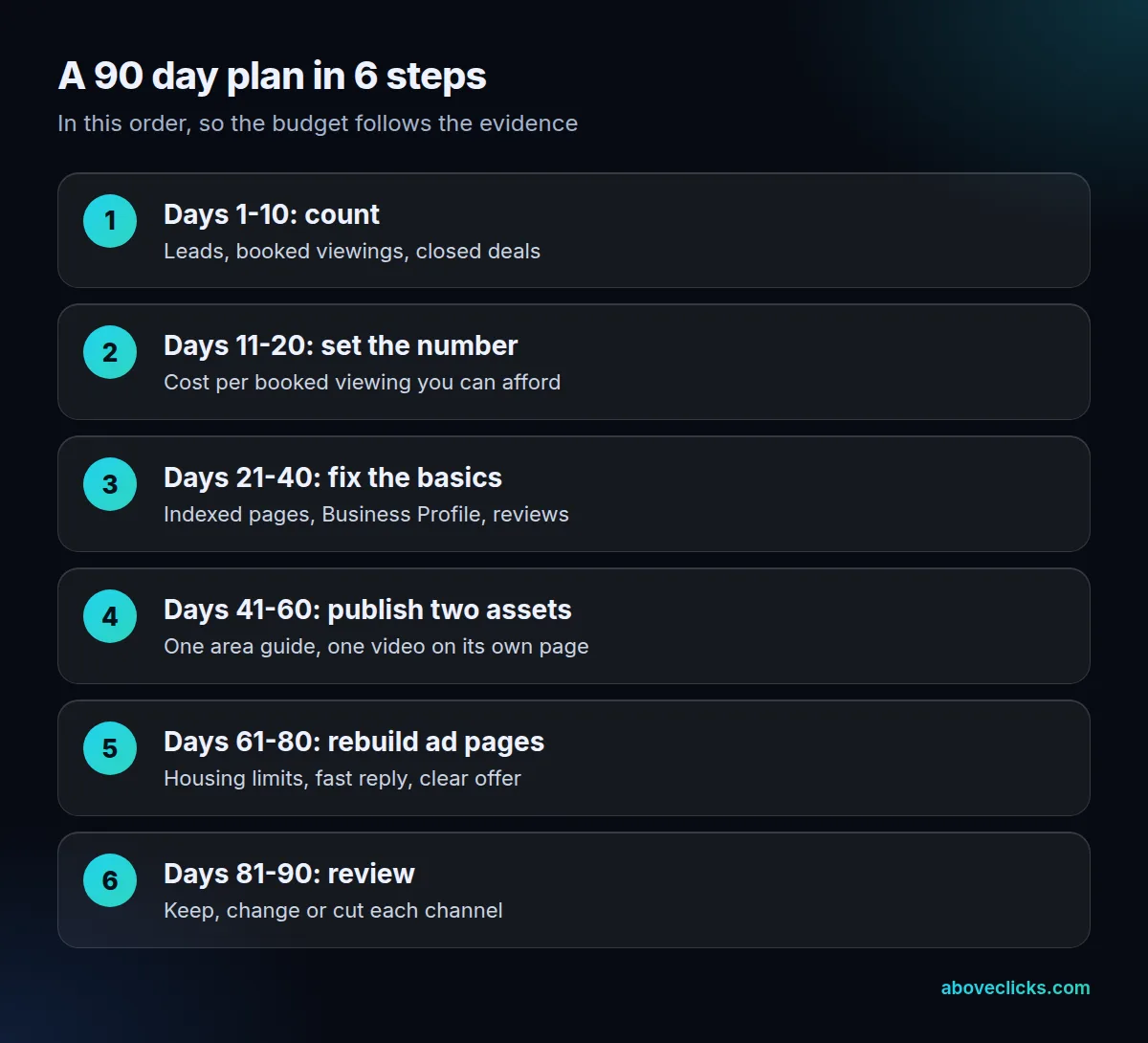
Each step of the plan has one test, so the real estate marketing trends you follow stay measurable. At day 10 you can state your leads, viewings and closed deals for the last quarter. At day 20 you have a cost per viewing you can afford. At day 90 you can say which channel to keep, change or cut. If you want a second pair of eyes on the numbers, our real estate marketing service starts with a free audit.
Three costly traps to avoid along the way:
- Judging on cost per lead. It rewards instant forms that bring names but few viewings, as the example shows.
- Buying or faking reviews. The FTC rule makes it a legal risk, not only a reputation risk.
- Targeting housing ads by ZIP code or age. Google and Meta don’t allow it, so campaigns built that way are rejected or reset.
What to skip: any of the real estate marketing trends you read about that has no source and no way to count a viewing from it. More industry guides are in industries.